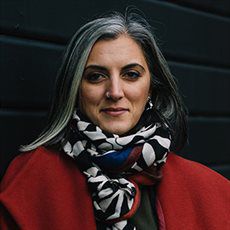
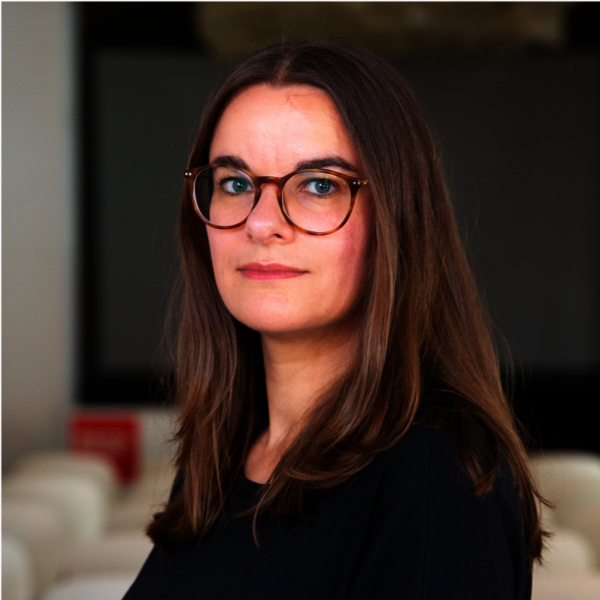
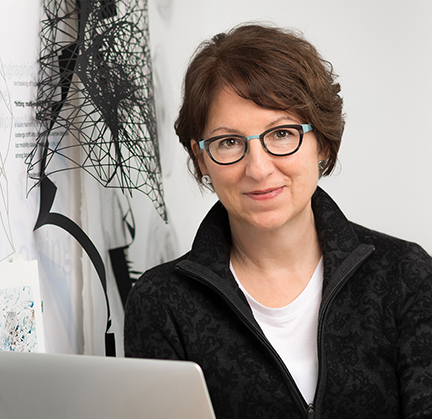
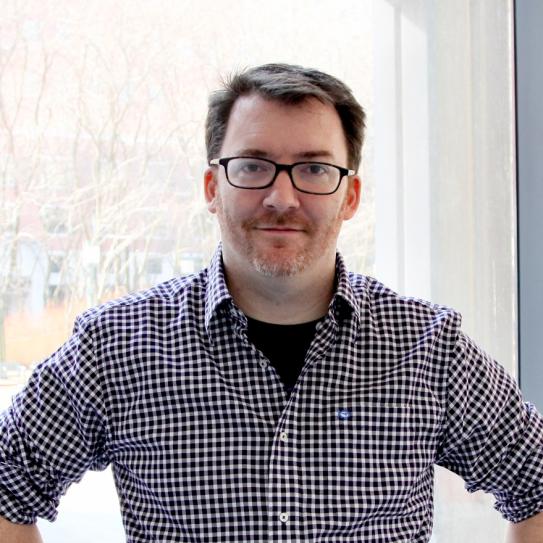
Adrian Martinez Chavez is a Mexican American artist, educator, and DJ currently serving as a Lecturer in Photography at Trinity College, Hartford, CT. He holds a BFA from the Hartford Art School and an MFA from the Yale School of Art. His practice spans photography, audio, video, and filmmaking, often exploring immigrant experiences through familial perspectives. Connecticut Office of the Arts Grant Greater Hartford Arts Council Grant New York Foundation for the Arts Fellowship Houston Center for Photography Grant His research interests focus on cultural preservation, Latin American diaspora narratives, and socially engaged art. Key projects include the Cumbias, Cumbias, y Más Cumbias installation, which merges historical audio archives with contemporary DJ culture to explore migration through sound. Exhibitions of his work have appeared nationally, including at Yale University, AMANITA NY, and the University of Hartford's Goldfarb Memorial Collection. His New York Times publications blend journalistic storytelling with visual documentation of human experiences.
Professor Annie Mahtani is a Professor of Electroacoustic Composition and Practice at the University of Birmingham's Department of Music. She holds a BMus (Hons), MA, MPhil, and PhD from the University of Birmingham and Birmingham City University. Her work focuses on electroacoustic music, acousmatic composition, multichannel audio, spatialisation, and field recordings, with significant contributions to site-specific installations and cross-disciplinary collaborations. She co-directs the SOUNDkitchen collective and serves on key boards such as the British ElectroAcoustic Network (BEAN) and the British Section of ISCM. Her research explores the sonic identity of environmental sounds, large-scale multichannel composition, and ambisonic audio techniques. As a performer with BEAST (Birmingham Electroacoustic Sound Theatre), she develops live acousmatic performances and soundwalks. Recent projects include Becoming Tree (an immersive audio retelling of a literary work) and Minimum Monument , performed at Birmingham Hippodrome. She actively collaborates with dance and theatre companies like Rosie Kay Dance Company. Professor Mahtani teaches undergraduate and postgraduate modules in electroacoustic composition and is involved in admissions and curriculum leadership. Her works have been performed globally in festivals like Klang! Électroacoustique and Sound + Environment, showcasing her innovative contributions to contemporary music and sound art.
Paul D. Miller, known professionally as DJ Spooky, That Subliminal Kid, is a Professor of Music and Mediated Art at The European Graduate School (EGS). Based in New York City, he is an experimental electronic and hip-hop musician, conceptual artist, and writer whose work spans music production, film, multimedia installations, and critical theory. He has released over a dozen albums pioneering 'illbient' and trip hop genres, authored influential books including Rhythm Science and Sound Unbound , and exhibited internationally at venues like the Venice Biennale and Andy Warhol Museum. Education: Bowdoin College: Studied philosophy and French literature; thesis on Richard Wagner's Gesamtkunstwerk as precursor to new media. Research Interests: Miller's work centers on remix culture as a postmodern methodology, exploring intersections of sound, image, and technology. His theoretical framework positions the DJ as a 'post-subjective auteur' who creates meaning through layered connections across time, culture, and media. Key projects include Rebirth of a Nation (reworking D.W. Griffith's film to address racial history) and Terra Nova (Antarctica sound recordings addressing climate change), demonstrating his focus on historical reinterpretation and environmental crisis through digital media. Publications: His 14 scholarly articles (2001-2009) analyze remix as cultural practice across domains from album art history ( The Inner Sleeve ) to Baudrillard's philosophy ( Baudrillard: A Remembrance ). The corpus reveals consistent investigation into how sampling, digital layering, and media archaeology reshape narrative, memory, and cultural identity in the information age. Awards: No scientific awards or fellowships were documented in the source text. Advising and Grants: The source text provides no information regarding students supervised, academic advising, or research grants administered by Miller. Labs and Teams: Miller operates through project-based collaborations rather than fixed labs, forming temporary collectives with institutions like the American Museum of Natural History (for Terra Nova ) and artists including Yoko Ono, Ryuichi Sakamoto, and choreographer Francesca Harper. His 'Unfinished Stories' project with Pulitzer-winning critic Margo Jefferson exemplifies his interdisciplinary approach bridging dance, music, and social commentary.
Berit Greinke is an Assistant Professor of Wearable Computing at the Berlin University of the Arts (UdK) and the Einstein Center Digital Future (ECDF) since 2018, previously serving as a researcher at UdK's Design Research Lab and DFKI (2016-2018). Her academic foundation includes a PhD from Queen Mary University of London (2017), an MA from Central St Martins (2009), and a Diploma from Weissensee Academy of Art Berlin (2007). Her educational trajectory: PhD in Media and Arts Technology, Queen Mary University of London (2017) MA in Design for Textile Futures, Central St Martins College of Art and Design (2009) Diploma in Textile and Surface Design, Berlin Weissensee School of Art (2007) Greinke's research pioneers the convergence of craft, textile design, and digital technology, with core expertise in electronic textiles and smart materials. She investigates metamaterial-based 'metatextiles' for electromagnetic applications and explores transdisciplinary collaboration between designers and scientists, particularly regarding 'negative data' in creative and scientific workflows. Her current UdK work focuses on four interconnected domains: performing materials for expressive textile/fashion design; multi-modal sensing converting visual processes into haptic/audible experiences; micro-to-macro material design spanning nanostructures to final products; and transdisciplinary processes for technology-art-science collaboration. Analysis of her 2020-2025 publications reveals dominant trends in sustainable textile electronics, with emphasis on knitted/folded sensor structures, origami-inspired capacitive shape estimation, and social sustainability in e-textile communities. Her work uniquely bridges fundamental material science (e.g., textile metamaterials) with artistic applications (e.g., interactive orchestra garments) and industrial production challenges. Berit Greinke supervises PhD students including Giorgia Petri. Her junior professorship is co-financed by SAP under a public-private partnership model, supporting projects like WEAR (Wearable technologists engage with artists for responsible innovation) and STELEC (Sustainable Textile Electronics), which emphasize ethical co-design and industry-academia collaboration. She leads research within UdK's Institute for Product and Process Design and collaborates with the Design Research Lab (formerly part of Connected Textiles group), focusing on sustainable industrial production of electronic clothing and transdisciplinary innovation frameworks.
Andrea Wollensak is Professor of Art at Connecticut College, where she has taught since 1993. She is an interdisciplinary artist and designer whose work explores the convergence of place, identity, and history through site-based artworks that combine new media technology with traditional design and fabrication. Her educational background includes a B.F.A. from the University of Michigan and an M.F.A. from Yale University. She has held visiting faculty positions at numerous institutions including the University of Gothenburg, Nova Scotia College of Art and Design, Concordia University, Rhode Island School of Design, and the Estonian Academy of Arts. Wollensak's research focuses on social design and place-based storytelling, employing collaboration with community partners, computer scientists, musicians, poets, and scientists. Her work addresses themes of place-based narratives, environment, and memory through forms including audio/video, interactive installations, data visualization, artist books, and digitally fabricated works. She examines how design can be used as a tool for social impact and civic participation. Her most recent projects include Mapping Your Journey to School (2023), which engages Estonian and Ukrainian refugee students in creative writing workshops; Water Stories: Visual Poetics and Collective Voices (2022), a year-long artist residency at the Anchorage Museum; and Open Waters (2019-2020), an interactive installation examining Arctic environmental change. U.S. Fulbright Scholar in Estonia (2023) Artistic Excellence Award in Digital Art from Connecticut Office of the Arts Artist residency at Hafnarborg Contemporary Art Museum in Iceland (2011) Connecticut Commission on Culture and Tourism Grants in New Media (2010, 2006) IASPIS International Artist Studio Program in Sweden (2007) Rockefeller Study and Conference Center residency (2000) Wollensak has advised numerous students in design and new media projects, often collaborating with community partners. She served as Director of the Ammerman Center for Arts and Technology at Connecticut College from 2014-2020 and currently serves on the Advisory Council of the Winterhouse Institute and the Advisory Board for Digital Media Connecticut. Her teaching emphasizes design as an interdisciplinary practice that prepares students to be creative problem solvers who can use design to create positive social impact. Her work has been exhibited internationally at venues including the Göteborg International Contemporary Art Biennial, Nova Scotia Art Gallery, Brno Design Biennial Moravian Gallery, Center for Visual Art in Denver, Brown University's Granoff Center Gallery, and the Burchfield Penney Arts Center in Buffalo.
Dr. Sam Ferguson is a Senior Lecturer at the School of Computer Science, University of Technology Sydney (UTS), with a multidisciplinary background in music performance, cognitive science, and psycho-acoustics. His research explores the intersection of sound, music, and human experience through creative coding, machine learning, and interactive systems. Key Research Areas: Sound and Music Computing, Human-Computer Interaction, Creative Coding, Cognitive Science, Installation Art, and Acoustics. Current Projects: ARC Linkage project on creative coding and multiplicitous media; industry collaborations on IoT-based audiovisual systems. Recent Publications: Focus on spatial audio complexity, gestural interaction with networked sound, music emotion recognition frameworks, and robotic performance through genre-based cultural platforms. Leadership Roles: Director of Teaching & Learning Engagement; former Deputy Head of School (Teaching and Learning); active in ACM Creativity and Cognition Steering Committee. Teaching: Courses like Digital Media Studio , Prototyping Physical Interaction , and Data Processing using R within UTS's interdisciplinary Software Development Studio.
Bart J. Hengeveld is an Assistant Professor at Eindhoven University of Technology (TU/e), affiliated with the Industrial Design department within the Faculty of Industrial Design. He leads the Future Everyday research cluster, focusing on the intersection of sound design and IoT systems. His work explores how embedded technologies can communicate through sound and tangible interaction in ways that enhance human experience. Education: BSc/MSc in Industrial Design Engineering, Delft University of Technology (2003) PhD in Industrial Design, TU/e (2011), with concurrent training in double bass at Codarts Conservatory Research Interests: Acoustic communication in IoT systems Tangible interaction design Social implications of ubiquitous computing Sound as a medium for human-technology interaction Recent Research Trends: Focus on multimodal interfaces combining sound/light/haptics Studies on sound design for healthcare and smart living environments Investigations into ethical and inclusive IoT soundscapes Awards: Two Teacher of the Year awards at TU/e, reflecting his commitment to pedagogical excellence. Advising & Projects: Supervised 113 student projects including interactive installations like 'Naktis' and 'Sonostapp' Leading the €1.5M 'Role of Sound in Hybrid Work Environments' project (2023–2026) Organized TEI 2016 conference and serves on its steering committee Teams/Labs: Core member of TU/e's Future Everyday cluster, collaborating with multidisciplinary teams on embodied interaction research.
Keith Obadike is a Professor in the Department of Art at Cornell University's College of Architecture, Art, and Planning (AAP), where he also serves as Director of Undergraduate Studies. He is an acclaimed interdisciplinary artist and composer, known for his collaborative work with Mendi Obadike, which spans sound art, digital media, public installations, performance, and internet-based projects. His artistic and academic work critically engages with technology, race, history, and identity. Obadike earned a B.A. in Visual Art from North Carolina Central University and an M.F.A. in Sound Design from Yale University. Prior to joining Cornell, he taught at William Paterson University and held visiting positions at Princeton University, Columbia University, Northwestern University, and the Art Institute of Chicago. His research and creative practice focus on sound art, digital media, public art, performance, and collaborative practice , with strong interdisciplinary connections to Afrofuturism, data sonification, and social justice. He explores how sound and technology mediate racial identity, memory, and liberation, notably through the concept of acousmatic blackness , which he and Mendi developed to describe the racial perception of sound when its source is unseen. Obadike’s selected works include large-scale public sound installations such as Blues Speaker (for James Baldwin) , Free/Phase , Compass Song (Times Square Arts), and GuideStar (Space Needle, Seattle). His projects often use data sonification, archival research, and mythic storytelling, blending historical inquiry with futuristic vision. Notable series include the Opera-Masquerades , Americana Suites , and Numbers Station works, which transform databases of violence into sonic experiences. His honors include: Rockefeller New Media Arts Fellowship (2004) Louis Comfort Tiffany Biennial Award (2015) New York Foundation for the Arts Fellowship in Fiction New Music USA Creator Development Fund (2022) Obadike has received commissions and support from institutions such as the Vera List Center, Harlem Stage, Times Square Arts, the American Composers Orchestra, and the Cornell Mui Ho Center for Cities. He has exhibited and performed at The New Museum, The Whitney Museum of American Art, MoMA, and The Studio Museum in Harlem. His writings and publications include contributions to Studies into Darkness (2022), and artist books such as Four Electric Ghosts and Big House / Disclosure (both 2014). He has also released albums like Crosstalk (2008) and created internet artworks such as Blackness for Sale (2001) and The Interaction of Coloreds (2002), which are foundational in new media and critical race art. While specific advisees are not listed, his role as Director of Undergraduate Studies and Professor indicates active mentorship. His work is deeply collaborative, often co-created with Mendi Obadike, and supported by interdisciplinary teams and institutions.
R. Luke DuBois is an Associate Professor and Co-Chair of the Technology, Culture and Society Department at the NYU Tandon School of Engineering, where he also directs the Integrated Design & Media program and the Brooklyn Experimental Media Center. He holds a DMA in music composition from Columbia University and is a renowned artist, composer, and performer whose work explores intersections between technology, sound, and visual media. His research focuses on digital media, human-computer interaction, and emerging technologies applied to artistic expression and accessibility. Key roles include directing the SONYC initiative (addressing urban noise pollution via AI) and leading the NYU Ability Project (advancing disability studies through technology). He has collaborated with institutions like the Smithsonian and artists such as Maya Lin, and his work has been exhibited globally, including at the Sundance Film Festival and the Aspen Institute. DuBois co-developed the Jitter software suite for real-time data manipulation and performs in avant-garde groups like Bioluminescence and Fair Use. His artistic practice combines time-lapse phonography, interactive installations, and interdisciplinary projects that critique cultural ephemera while advancing accessibility in STEM and the arts. Recent contributions include browser-based tools for accessible music notation (SoundCells) and sonification techniques for calculus education. He serves on the Board of the ISSUE Project Room and has been featured in major publications like the New York Times and TED Conference talks.
Koray Tahiroglu is a University Lecturer at Aalto University's School of Arts, Design and Architecture, specializing in Sound and Music Computing. His work bridges artificial intelligence, digital musical instruments, and embodied interaction, with a focus on deep learning applications in audio synthesis and human-AI creative collaboration. His research explores New Interfaces for Musical Expression (NIME), sonic interaction, and physical computing. He collaborates with SOPI Research Group and Google Brain Team (Magenta) on AI-driven artistic innovation. Recent Publications : 2024 studies on dance-sound cross-correlation and intra-action frameworks; 2023 work on AI-terity and deep learning syllabi; 2022 explorations of GAN synthesis, musical expectations, and lifeworld sonification. Scientific Awards : Co-Creative Artificial Intelligence of Music (2022) 2010 grant for scientific publications and artistic activities 2017 Honorable Mention for mobile cultural heritage research Tahiroglu contributes to digital art education and leads projects at Media Lab Helsinki, advancing sonic interaction and generative audio systems.
Sophie Seita is a London-based artist, researcher, and Lecturer in Fine Art & History of Art at Goldsmiths, University of London, where she also serves as Director of Critical Studies for the BA Fine Art Extension Degree and Deputy Director of Research for the Department of Art. Her interdisciplinary practice spans performance, video, sound, textiles, books, and installations, with language as a central material. Previously, she was a tenure-track Assistant Professor at Boston University (2019-2022) and a Junior Research Fellow at Queens' College, University of Cambridge (2016-2019). Seita's research interests encompass lecture-performances, poetic essays, video essays, practice-based research, queer studies, trans studies, affect theory, disability studies, deaf studies, creative access, experimental captions and audio descriptions, speculative approaches to archives, fictional collectives, concepts of play, difficulty, opacity, absurdity, ornamentation, deep listening, histories of avant-garde group formation, translation studies, multilingualism, queer ecology, decolonial ecology, and experimental pedagogy. Her creative curiosities include opacity, playfulness, difficulty, artifice, queer abstraction, minor genres, ornamentation, materiality beyond objects, the materiality of language, listening beyond hearing, ambiguity, non-linear narratives, and provisional ideas. Her recent publications demonstrate strong trends in examining the intersections of performance, language, and experimental publishing, particularly focusing on lecture-performances as critical knowledge production, the materiality of language, and speculative approaches to archives. Her work consistently engages with queer and feminist perspectives on avant-garde practices while exploring experimental forms of documentation and presentation. Werner Düttmann Fellowship at Akademie der Künste Berlin (2024) Vice-Chancellor's Public Engagement Award (University of Cambridge) Eccles Centre Fellowship (British Library) PEN/Heim Translation Award Wonder Book Prize Dorothea Schlegel Artist in Residence Seita supervises and examines PhD projects at Goldsmiths and has secured numerous research grants, including funding from the British Academy, Arts Council England, Canada Council for the Arts, and the Early Career Research Fund Award from Goldsmiths. She is co-founder of The Hildegard von Bingen Society for Gardening Companions, an ongoing queer collaborative project with musician Naomi Woo that explores speculative archives and queer ecology through sound, performance, and publications. Her artistic practice often involves collaborative work across disciplines, particularly with The Hildegard von Bingen Society for Gardening Companions, which creates experimental pedagogical frameworks and community-based environmental projects.
Rachel Devorah Wood Rome is an Assistant Professor in the Electronic Production and Design (EPD) department at Berklee College of Music, where she teaches creative coding, live coding, and music technology. Her work bridges electronic music, improvisation, and critical theory, with a focus on sonic cyberfeminism, archival practices, and the social meanings of sound and space. Ph.D. in Music Composition and Computer Technologies, University of Virginia (2018) M.L.I.S., San José State University (2017) M.A. in Music Composition, Mills College (2013) B.Mus. in Horn Performance, CUNY Queens College (2007) Her research explores superhuman prolongation, opaque complexity, and the re-signification of archaic tools in sonic media. She values machines for their patience and memory, and her creative practice emphasizes critical agency in technology design and use. She performs under the name 'mehetabel' when using archival materials in improvised electronic music. The most recent publications and performances reflect a deep engagement with AI and music, live coding, feminist media theory, and spatialized sound. Her works often involve real-time data processing, generative systems, and collaborative improvisation, situating sound within broader social, political, and technological contexts. Ruth Anderson Installation Prize (IAWM) New Music USA Grant Fellowships from MIT OpenDocLab, Adrian Piper Foundation, Ina GRM, New Museum, and Jefferson Scholars Foundation Residencies at EMS Stockholm, STEIM Amsterdam, MassMoCA, and Cove Park Rome advises emerging artists in electronic music and creative coding, many of whom have gone on to establish their own practices. She is also active in academic service, including curriculum development, faculty governance, and labor organizing as a Councilor for the Berklee Faculty Union. She leads initiatives in DEI, sound design, and coding pedagogy within the EPD department. She has been involved in interdisciplinary collaborations with artists, technologists, and institutions worldwide, presenting work in galleries, festivals, and academic conferences across North America, Europe, and Asia. Her leadership extends to nonprofit arts organizations, where she has served as Executive Director and grantwriter.
Paula Schneider serves as Teacher for Special Tasks at the University of Art and Design Offenbach am Main , heading their book and paper workshop since 2020. She studied Book Art at Burg Giebichenstein Halle (2013-2019) and previously taught at Bezalel Academy (2017-2020). Her work bridges bookbinding , literary experimentation , and archival research through installations, artist books, and public interventions. Education : 2019: Diploma in Book Art, Burg Giebichenstein University of Halle Teaching : 2020–present: Lecturer for special tasks at HfG Offenbach 2017–2020: Annual courses at Bezalel Academy for Arts and Design, Jerusalem Screen printing tutor during studies Her artistic research explores narrative structures , time perception , and memory systems through works like Inner Monologue (2018) and Mio Mnemotop (2021). Recent projects include Night Frost (2024) examining textual accumulation and Cloudburst Working on the Textberg (2024) using mining metaphors for textual analysis. She examines book formats (e.g., leporello, monotypes, screen printing) to interrogate knowledge preservation (Rabaraababaraba, 2015) and urban observation (Praise of the Gate, 2023). Notable exhibitions include Because We Are Young (2021) analyzing GDR industrial history and Between (2019) at Halle/Leipzig Airport, which required mobile audience engagement with audio pieces about airport soundscapes. Her works have been featured in Text3 and Spin n errei tours. Contact: schneider@hfg-offenbach.de | Workshop: +49 69.80059-245 | Office: +49 69.80059-106
Verónica Perales Blanco is a Professor in the Department of Fine Arts at the University of Murcia's Faculty of Fine Arts, specializing in Drawing. Her artistic research explores intersections of Art/Technology/Ecology , with a focus on ecofeminism , environmental activism , and corporeal perception . PhD in Fine Arts from Universidad de Castilla-La Mancha (2005) Co-founder of Transnational Temps art collective (2001) Coordinates Drawing While Moving educational innovation project Her work addresses planetary embodiment through outdoor learning, participatory installations, and multisensory mapping. Recent publications examine AI integration in artistic practices , interspecies empathy , and ecological awareness amplification . Current affiliations include: OPEN ART research group (GID-Grupo de Innovación Docente) Active Artistic Practices and Citizenship research group Key collaborations span: Stephanie Whitelaw (walking arts) Elise Ashby (ecological mapping) Fred Adam (cosmosis workshops)
Tivon Rice is an Assistant Professor in DXARTS (Digital Arts and Experimental Media) at the University of Washington. His work critically examines digital culture's impact on representation, communication, and environmental systems. Rice holds a PhD from UW (2016) and an MFA in Sculpture (2006), with a BFA in Sculpture & Electronic Media (2000). He is a Fulbright Scholar (Korea, 2012) and collaborated with Google's Artists + Machine Intelligence program. Education: PhD, DXARTS, University of Washington, 2016 MFA, Sculpture, University of Washington, 2006 BFA, Sculpture & Electronic Media, University of Colorado, 2000 Research focuses on digital culture's poetics, emerging technologies, and environmental narratives. Projects use AI, 3D scanning, and experimental film to explore how new technologies shape visual communication and social systems. Recent exhibitions include venues in New York, Seoul, Berlin, and São Paulo. Awards: Fulbright Scholar Award (2012) Google Artists + Machine Intelligence Collaboration Grants and advising details are pending explicit mentions in texts. Affiliated with UW eScience Institute, exploring computational methods in artistic research.