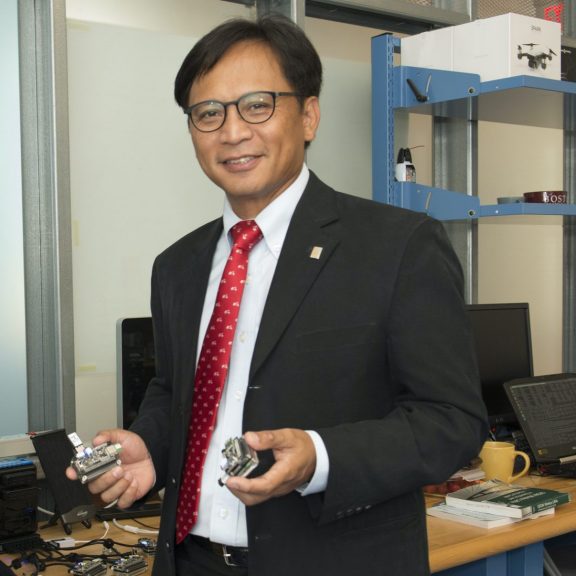
Professor Hongdong Li is a Tenured Professor at the School of Computing, Australian National University (ANU), within the College of Engineering and Computer Science. His research focuses on 3D Computer Vision, Machine Learning, and their applications in dynamic environments. He has held visiting roles at Carnegie Mellon University and has contributed to significant projects like the Australia Bionic Eyes initiative. Education: PhD (Electrical Engineering). Research Interests : 3D Computer Vision fundamentals and applied AI systems Learning-based 3D perception for plant sciences Robot navigation in unfamiliar environments Awards : Marr Prize Honourable Mention CVPR Best Paper Award Advising & Grants : Supervised 40+ PhD students, with funding from ARC, CSIRO, Microsoft, and firms like OPPO/Tencent. Active in projects such as bushfire detection via video analytics and sign language translation systems. Labs/Teams : Co-founder of the Australian Centre for Robotic Vision (ACRV). Collaborates globally on cross-view localization and autonomous systems.
Jiatao Gu is an Assistant Professor in the Department of Computer and Information Science (CIS) at the University of Pennsylvania, with a part-time role as Staff Research Scientist at Apple (MLR). He holds a Ph.D. in Electrical and Electronic Engineering from the University of Hong Kong (2018) and a B.Eng. in Electronic Engineering from Tsinghua University (2014). His research focuses on generative machine learning and AI agent interaction with the physical world, emphasizing multi-modal systems spanning language, images, videos, and 3D. Key themes include efficient modeling , flexible architecture design , and scalable decision-making frameworks . 2025: ICLR paper on DART framework 2024: TMLR work on GFlowNet alignment 2023: NeurIPS research on diffusion stability 2022: ACL papers on speech translation Recent publications explore diffusion models for text-to-image synthesis, 3D reconstruction, and efficient sampling techniques. His work addresses fundamental challenges in attention mechanisms, entropy collapse, and multi-stage distillation while advancing non-autoregressive translation and vision-language reasoning . Prospective students can apply through his recruitment process at UPenn. Prior affiliations include Meta AI (FAIR Labs) and academic collaborations with institutions like New York University's CILVR Lab.
Olga Russakovsky is an Associate Professor of Computer Science at Princeton University and Associate Director of the Princeton Laboratory for Artificial Intelligence. Her research focuses on computer vision , machine learning , human-computer interaction , and fairness, accountability, and transparency in AI systems. Princeton University faculty member since 2025 Affiliated with Princeton's Center for Statistics and Machine Learning and Center for Information Technology Policy Scientific Recognition: Presidential Early Career Award for Scientists and Engineers (2025) PAMI Young Researcher Award (2022) AnitaB.org Emerging Leader Abie Award (2020) CRA-WP Anita Borg Early Career Award (2020) MIT Technology Review 35-under-35 Innovator (2017) PAMI Everingham Prize (2016) As a co-founder and current Board Chair of AI4ALL , she drives initiatives to expand diversity in AI. Her recent publications demonstrate expertise in vision-language models , deepfake detection , and ethical AI systems .
Minseok Ryu is an Assistant Professor at the School of Computing and Augmented Intelligence, Arizona State University (ASU). He holds a Ph.D. in Industrial & Operations Engineering from the University of Michigan (2020). Prior to ASU, he was a postdoctoral appointee at Argonne National Laboratory’s Mathematics and Computer Science Division. His research focuses on optimization methodologies for decentralized and stochastic decision-making distributed algorithms for machine learning and operations research applications in healthcare systems and energy grids Teaching responsibilities include courses on applied deterministic operations research (IEE 574), optimization (IEE 622), and research practicums (IEE 792). His work emphasizes computational challenges in decision-making under uncertainty, with recent projects addressing nurse staffing optimization, federated learning frameworks (e.g., APPFL/APPFLX), and resilient power grid systems. He has no recorded academic awards but actively contributes to open-source software and cross-disciplinary research collaborations. Research interests bridge theory and practice, targeting social goods through optimization techniques like distributionally robust optimization, federated learning, and heuristic algorithms for energy and healthcare systems.
Michael A Osborne is Professor of Machine Learning at the University of Oxford and leads the Bayesian Exploration Lab . He serves as Director of the EPSRC Centre for Doctoral Training in Autonomous Intelligent Machines and Systems and co-directs the Oxford Martin AI Governance Initiative. His research focuses on Bayesian optimization, Gaussian processes, and probabilistic numerics with applications in quantum devices, battery modeling, and AI governance. Key Positions: Professor of Machine Learning, University of Oxford Official Fellow, Exeter College Co-founder of Mind Foundry Lead Researcher, Oxford Martin Programme on Technology and Employment Research Themes: Probabilistic modeling for quantum systems Uncertainty quantification in energy storage AI safety and societal impact analysis Automated experimental design Quantum device calibration Probabilistic numerical methods Technical Contributions: Bridging reality gap in quantum devices Efficient Bayesian quadrature techniques Personalized neurostimulation algorithms Automated measurement protocols Quantum-classical hybrid ML
Clifford Stein is a Professor of Industrial Engineering and Operations Research (IEOR) and Computer Science at Columbia University, and Associate Director for Research at the Data Science Institute. He holds a Ph.D. (1992), M.S. (1989), and B.S.E. (1987) from MIT and Princeton University, respectively. His research focuses on algorithms, combinatorial optimization, operations research, scheduling, and computational biology. A co-author of the best-selling textbook Introduction to Algorithms , Stein has published widely in top venues and holds prestigious awards like ACM Fellow and NSF Career Award. His work includes foundational contributions to minimum cut algorithms, scheduling theory, and network optimization, supported by NSF and Sloan Foundation grants. Stein has advised over 40 graduate and undergraduate students, many now in academia and industry.
Raul Vicente Zafra is a Professor of Data Science at the University of Tartu, Faculty of Science and Technology, Institute of Computer Science, where he has been working since 2013. His research spans computational neuroscience, artificial intelligence, and data science, with a particular focus on bridging biological and artificial models of intelligence. Education: PhD in Physics (2001-2006), University of the Balearic Islands BSc in Physics (1997-2001) Professor Zafra's research interests center on computational neuroscience and artificial intelligence, with specific expertise in brain-computer interfaces, reinforcement learning, neural modeling, and explainable AI. His work bridges the gap between biological and artificial intelligence systems, exploring how neural principles can inform machine learning algorithms and vice versa. He has made significant contributions to understanding neural coherence, time interval learning in neural systems, and the application of information theory to brain-computer interfaces. His research often involves interdisciplinary collaboration between computer science, neuroscience, and medicine. Analysis of Zafra's recent publications reveals a strong focus on the intersection of artificial intelligence and neuroscience. His work spans explainable AI methods, brain-computer interfaces, reinforcement learning models that mimic cognitive processes, and neurophysiological studies of brain activity. A notable trend is his exploration of how biological principles of neural computation can inform and improve artificial intelligence systems, particularly in areas like time-based learning, consciousness modeling, and neural coherence. Scientific Awards: 2012: Attendee at the 62nd Lindau Nobel Laureate Meeting 2007: Quantum Electronics and Optics Division Prize of the European Physical Society for the best PhD Thesis in Applied Optics in Europe 2006: PhD Extraordinary Award of the Physics Department of the University of the Balearic Islands 2001: Physics Degree Extraordinary Award (First Class Honors, best GPA) 1997: Bronze Medal in the "8th Spanish Physics Olympiad" Professor Zafra has been principal investigator on numerous significant research projects including the Estonian Centre of Excellence in Artificial Intelligence, Cardiovascular Stress Impacts On Neuronal Function, and Bridging biological and artificial models of vision. His grant portfolio demonstrates strong funding support from the Estonian Research Council, European Commission, and other major funding bodies. He has supervised multiple PhD students and mentored early-career researchers in computational neuroscience and AI. His laboratory work focuses on developing computational models of neural systems and applying these insights to artificial intelligence. Current research directions include explainable AI methods, brain-computer interfaces, modeling of consciousness and cognitive processes, and the application of AI to healthcare challenges.
Hadi Meidani is a Clinical Associate Professor at the Carle Illinois College of Medicine , specifically within the Department of Biomedical and Translational Sciences at the University of Illinois at Urbana-Champaign . He teaches courses in Civil and Environmental Engineering, including topics like Systems Engineering & Economics , Machine Learning in CEE , and Uncertainty Quantification . Ph.D., Civil Engineering, University of Southern California (2012) M.S., Electrical Engineering, University of Southern California (2012) M.S., Structural Engineering, Sharif University of Technology (2005) B.S., Civil Engineering, K.N. Toosi University of Technology (2002) Dr. Meidani's research focuses on uncertainty quantification , scientific machine learning , and optimization under uncertainty for engineering systems. His work spans stochastic multiscale analysis , physics-informed machine learning , and model reduction techniques. His recent publications emphasize machine learning for infrastructure systems , graph neural networks , physics-informed models , and traffic assignment . Key trends include deep learning , multi-fidelity modeling , and neural operator transformers applied to metamaterial design , seismic reliability , and autonomous freight delivery .
Osman Yağan is a Research Professor in the Department of Electrical and Computer Engineering at Carnegie Mellon University (CMU), with affiliate faculty status in the School of Computer Science. He is also a core member of CyLab Security and Privacy Institute. Prior to joining CMU in 2013, he was a Postdoctoral Research Fellow at CyLab. He holds a Ph.D. in Electrical and Computer Engineering from the University of Maryland (2011) and a B.S. from Middle East Technical University (2007). His research focuses on modeling, analysis, and optimization of computing systems, leveraging applied probability, network science, data science, and machine learning. Key areas include multi-armed bandits, resilient machine learning, contagion processes in networks, and cybersecurity. Research Interests include Machine Learning, Data Science, Network Science, Cybersecurity, and Robustness in Cyber-Physical Systems. He has advised numerous students, including current PhD candidates Yurun Tian, Orkun İrsoy, and Ishank Juneja, as well as notable alumni such as Mansi Sood (now at MIT) and Jun Zhao (Assistant Professor at Nanyang Technological University). Key Awards include the CIT Dean's Early Career Fellowship, IBM Academic Award, and Best Paper Awards at ICC 2021, IPSN 2022, and ASONAM 2023. His work spans theoretical contributions (e.g., contagion models in multi-layer networks) and applied research (e.g., mitigating cascading failures in power systems). He leads or co-leads grants from ONR, NSF, and ARO, focusing on resilient machine learning, network robustness, and pandemic modeling.
Evrim Acar Ataman is a Research Professor and Chief Research Scientist at Simula Metropolitan, where she serves as Head of the Department of Data Science and Knowledge Discovery. Her research focuses on advanced data mining techniques for complex, multi-modal datasets across biomedical and network domains. Her primary research interests include Data Mining , Matrix and Tensor Factorizations , and Data Fusion for multi-modal data analysis. She develops constrained and coupled factorization methods to extract interpretable patterns in applications spanning neuroimaging, metabolomics, and mobile network analysis, with emphasis on dynamic and longitudinal data structures. Her work integrates mechanistic models with data-driven approaches to enhance biological and system understanding. Analysis of her recent publications (2024-2025) reveals a dominant trend applying tensor and coupled matrix-tensor factorizations to biomedical data for biomarker discovery, particularly in metabolomics and neuroimaging. Key innovations include tracking evolving patterns in temporal data (tPARAFAC2), constrained fusion methods (dCMF), and integration of mechanistic models with tensor decompositions for longitudinal analysis. As Head of the Department of Data Science and Knowledge Discovery, she leads research in developing novel data mining methodologies and their real-world applications at Simula Metropolitan, with significant contributions to interpretable AI for complex systems.
Bei Wang Phillips is an Associate Professor in the School of Computing and a faculty member at the Scientific Computing and Imaging (SCI) Institute at the University of Utah. She holds a Ph.D. in Computer Science from Duke University and an undergraduate degree from the University of Bridgeport. Her research focuses on Topological Data Analysis (TDA), data visualization, computational topology, and machine learning, with applications in scientific data exploration and analysis. She has received prestigious awards including the NSF CAREER Award (2022) and the PECASE Award (2025). Her work spans projects funded by NSF, NIH, and DOE, including multiparameter TDA and topology-aware data compression. She advises numerous students and collaborates on interdisciplinary initiatives in astrophysics, climate science, and AI fairness. Education: Ph.D. in Computer Science, Duke University (2010) B.S. in Computer Science and Mathematics, University of Bridgeport (2003) Research Interests: Topological techniques for large-scale data analysis Integration of topological, geometric, and machine learning methods Applications in visualization, bioinformatics, and network analysis Key Projects: NSF-funded TDA research (DMS-2301361, OAC-2313124) DOE project on topology-preserving data compression Collaborations with NASA, Argonne National Lab, and Carnegie Institution of Washington Awards: Presidential Early Career Award for Scientists and Engineers (2025) NSF CAREER Award (2022) DOE Early Career Research Program (2020) Advising and Grants: Mentored over 30 students and postdocs Recipient of multiple NSF and DOE grants totaling millions
Moe Z. Win is the Robert R. Taylor Professor at the Massachusetts Institute of Technology (MIT), specializing in wireless communications, optical communications, and space communications systems. His research bridges theoretical and applied domains, including quantum sensing, network localization, and signal processing. B.S.E.E., Texas A&M (1987) M.S.E.E. & Ph.D., University of Southern California (1989, 1998) Recent work focuses on quantum-enhanced positioning, machine learning for localization, and next-generation (xG) non-terrestrial networks. He leads research at the Quantum neXus Laboratory (QX Lab), Wireless Information & Network Sciences Lab, and Laboratory for Information and Decision Systems. His career spans the Jet Propulsion Laboratory (1987-1995) and AT&T Research Laboratories (1998-2002). Key methodologies include soft information fusion, variational quantum sensing, and robust beam tracking for terahertz communications.
Suhas Diggavi is a Professor in the Department of Electrical and Computer Engineering at the University of California, Los Angeles, within the Henry Samueli School of Engineering and Applied Science. His primary research area is Signals and Systems, with a strong focus on information theory and its interdisciplinary applications. His research interests span Information Theory , Machine Learning , Differential Privacy , Federated Learning , Cyber-Physical Systems , and Bio-informatics . He investigates fundamental limits and practical algorithms for secure, efficient, and robust data processing in distributed and networked environments. The recent publications highlight a strong trend in privacy-preserving machine learning, particularly in the shuffled model of differential privacy , communication-efficient distributed SGD , and robust optimization . His work bridges theoretical information-theoretic foundations with real-world applications in federated learning, wireless networks, and genomic data analysis. Notable scientific awards include: Guggenheim Foundation Fellow (2021) ACM CCS Best Paper Award (2021) IEEE Fellow (2013) IEEE Donald G. Fink Prize Paper Award (2006) Multiple Google, Amazon, and Facebook Research Awards Suhas Diggavi actively advises graduate students and leads a research group focused on learning, information, and optimization. His work is supported by major industry grants and collaborations, particularly in privacy and distributed learning. He has made significant contributions to information-theoretic models in bio-sequencing and wireless security. He leads the LIOS (Learning, Information, Optimization, and Stochastic Systems) research group at UCLA, where his team develops theoretical frameworks and practical algorithms for next-generation data-driven systems.
Professor Anders C. Hansen is a mathematician at the University of Cambridge and University of Oslo, leading the Applied Functional and Harmonic Analysis group. His work bridges functional analysis, artificial intelligence, and computational mathematics, focusing on the Solvability Complexity Index (SCI) hierarchy and stability issues in deep learning. He has held prestigious fellowships, including a Royal Society University Research Fellowship and Peterhouse Bye-Fellowship. Educated at the University of Cambridge, UC Berkeley, and the Norwegian University of Science and Technology Developed groundbreaking theories in compressed sensing and deep learning, revealing algorithmic instability paradoxes Organized workshops on computational mathematics and AI interpretability His research explores the SCI hierarchy , exposing computational barriers in AI, quantum mechanics, and inverse problems. Key projects include Smale’s 18th problem and analyzing neural network stability. His work has transformed understanding of compressed sensing, particularly in medical imaging. Recent scientific awards include the Whitehead Prize (2019), IMA Prize (2018), and Leverhulme Prize (2017). Collaborations span institutions like Caltech, MIT, and the University of Vienna. As an educator, he teaches NST Part IA Mathematical Methods , Part II Numerical Analysis , and a Part III course on Compressed Sensing . His group has mentored 17 PhD and postdoctoral researchers since 2012.
Florentina Bunea is a Professor in the Department of Statistics and Data Science at Cornell University’s Bowers College of Computing and Information Science, and an active member of the Graduate Fields of Statistics, Applied Mathematics, and Computer Science. She also serves on the Diversity and Inclusion Council of her college, championing workforce diversity in data-science disciplines. Education & Institutional Roles Professor, Department of Statistics and Data Science, Cornell University Member, Graduate Fields of Statistics, Applied Mathematics, Computer Science Member, Diversity and Inclusion Council, Bowers College of Computing and Information Science Research Interests Professor Bunea’s research lies at the intersection of statistical machine-learning theory and high-dimensional inference. She develops rigorous methodology supported by sharp theoretical guarantees to tackle core problems in modern data science. Recent themes include: Soft-max mixtures for understanding large-language-model/AI algorithms Optimal transport for high-dimensional mixture distributions Wasserstein-distance inference for sparse mixing measures in topic models Latent-space clustering and cluster-based inference in high dimensions Network modeling and hidden-structure inference Applications spanning genetics, systems immunology, neuroscience, sociology, and economics Research Funding & Awards Her work is supported by grants from the National Science Foundation (NSF-DMS). She is a Fellow of the Institute of Mathematical Statistics and a recipient of the IMS Medallion Award. Editorial & Service Contributions Associate Editor: Annals of Statistics, Bernoulli, JASA, JRSS-B, EJS, Annals of Applied Statistics Co-Editor: Chapman & Hall/CRC Statistics and Applied Probability Monograph Series Advising & Collaboration Professor Bunea has mentored numerous doctoral and post-doctoral researchers, including Xin Bing, Shuyu Liu, Seth Strimas-Mackey, and Yang Ning, among others. Collaborative projects extend across Cornell and external institutions, producing widely-used software packages and high-impact publications. Contact Office: 1184 Comstock Hall, Cornell University Email: fb238@cornell.edu Phone: (607) 255-8449