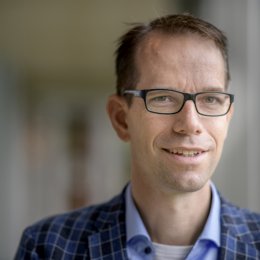
Prof. Jan Dirk Jansen (Delft University of Technology) specializes in systems and control theory applied to subsurface flow and geomechanics. His research spans induced seismicity , geothermal energy , reservoir simulation , and data assimilation . Current projects include co-leading the NWO-funded NEPTUNUS initiative on transient induced seismicity and previously researching seismicity mitigation in Dutch gas fields through the Science4Steer program. Expertise in numerical reservoir simulation History matching & model-order reduction Optimization of fluid injection/production He authored the textbook Nodal Analysis of Oil and Gas Production Systems , with significant contributions to closed-form geomechanical solutions and scalable numerical schemes . Contact: J.D.Jansen@tudelft.nl
Dr. Jeroen Dudink is an Associate Professor at University Medical Center Utrecht (UMC Utrecht) and a practicing neonatologist at Wilhelmina Children's Hospital. His research bridges neonatal neurology, advanced neuroimaging (MRI/ultrasound), and sleep physiology, with a focus on protecting brain development in preterm infants. He chairs multiple university research initiatives including '1001 Critical Days' (Dynamics of Youth), 'Developmental Disorders' (BRAIN theme), and 'Perinatal Damage' (Child Health theme). His work centers on: Neuroprotective strategies via sleep cycle analysis and the Sleep Well Baby Project , developing algorithms to optimize NICU care timing Cerebellar development and injury patterns in hypoxic-ischemic encephalopathy Advanced monitoring using EEG, near-infrared spectroscopy (NIRS), and ultrafast ultrasound Recent publications demonstrate strong emphasis on: Neuroimaging biomarkers for outcome prediction (DTI, synthetic MRI) Clinical interventions for perinatal brain injury (stem cells, allopurinol trials) Sleep architecture quantification and its developmental impact Non-invasive monitoring innovations (UWB radar, actigraphy) He collaborates extensively with data science teams and international consortia, including the PASSIoN trial for perinatal stroke and Dolphin CONTINUE nutritional study.
Dr. Andrei V. Petukhov is an Associate Professor at the Van 't Hoff Laboratory for Physical and Colloid Chemistry within Utrecht University's Debye Institute for Nanomaterials Science . He holds a part-time associate professor position at Eindhoven University of Technology since 2016. As a leading expert in synchrotron-based X-ray techniques , he serves as Editor-in-Chief of MDPI journal Materials ' Advanced Nanomaterials section and chairs the beamtime allocation panel at ESRF. Founded and chairs International Advisory Council at Immanuel Kant Baltic Federal University (until 2022 resignation) Developed XFEL pump-probe methodology for studying extreme irradiation conditions Created microradian SAXS setups for nanoscale structural analysis His research focuses on colloidal self-organization across multiple length scales, using both nonspherical colloids and external field manipulations . Key themes include: Entropic patchiness in crowded suspensions Magnetic field control of anisotropic colloids Confinement effects in droplet-based assembly Phase transitions in colloidal crystals His group performs in situ X-ray scattering experiments at prestigious facilities like ID10 beamline and BM-26 DUBBLE , with notable methodological contributions to: X-ray cross-correlation analysis Coherent diffraction imaging Advanced colloidal crystallography
Ömür Arslan is an assistant professor in the Department of Mechanical Engineering at the Eindhoven University of Technology (TU/e) , affiliated with the Robotics Group and the EAISI Mobility and EAISI High Tech Systems institutes. His research focuses on the algorithmic foundations of robotics, particularly safe adaptive motion planning algorithms for robots operating around humans. Education: PhD in Electrical and Systems Engineering (2016), University of Pennsylvania MSc in Electrical Engineering (2012), University of Pennsylvania MSc in Electrical & Electronics Engineering (2009), Bilkent University BSc in Electrical & Electronics Engineering (2007), Middle East Technical University His research interests span robotics, motion planning, control theory, sensor networks, dynamical systems, optimization, machine learning , and machine perception . Recent work includes safe unicycle control, probabilistically safe corridors, and statistical coverage control of mobile sensor networks. He has received nominations for best paper awards at ICRA 2018 and WAFR 2016 . Ömür has supervised student projects such as Hancheng Min's MSc thesis on statistical coverage control and Vincent Pacelli's work on local geometry in motion planning .
Prof. Frits C.R. Spieksma is a full professor in the Department of Mathematics and Computer Science at Eindhoven University of Technology (TU/e) , where he leads research within the Combinatorial Optimization Group. He has held academic positions at Maastricht University, KU Leuven, and the University of British Columbia, and has been at TU/e since 2018. Education: M.Sc. in Econometrics, University of Groningen (1987) Ph.D. in Operations Research, Maastricht University (1992) Research Focus: His work lies at the intersection of combinatorial optimization and real-world applications . Key themes include: Scheduling and clustering problems, especially in sports tournaments Organ allocation optimization for Eurotransplant Assignment and transportation problems Approximation algorithms and graph-theoretic optimization Scientific Service & Leadership: Founder and ex-Chair, EURO Working Group OR in Sports Member, Steering Committees of MAPSP and MathSports International President, EURO (Association of European Operational Research Societies) Former Vice-President, IFORS Former President, Belgian Society of Operations Research (ORBEL) Editorial Boards: Associate Editor, 4OR (2015–present) Associate Editor, Journal of Quantitative Analysis in Sports (2014–present) Associate Editor, Operations Research Letters (2008–2024) Former Associate Editor, INFORMS Transactions on Education , OMEGA , Computers & Operations Research , IIE Transactions , Naval Research Logistics PhD Supervision & Mentoring: He has supervised more than 25 PhD theses at KU Leuven and TU/e, many of whom now hold academic positions worldwide. Conference & Workshop Organisation: Recent leadership roles include General Chair of IPCO 2022 (Eindhoven), organiser of Benders Day 2024 , and co-organiser of the Dagstuhl Seminar on Fairness in Scheduling and Resource Allocation (March 2025).
Gerwin Hoogsteen is an Assistant Professor at the University of Twente, affiliated with the Computer Architecture for Embedded Systems chair. He focuses on smart grids, cyber-physical systems, and applying theoretical research in field-tests. PhD in Decentralized Energy Management (2017, University of Twente) His research integrates machine learning , distributed coordination , and cybersecurity into smart grid optimization. Recent work emphasizes multi-objective optimization for EV charging hubs, energy community resilience, and congestion management. Key article trends include EV charging algorithms , decentralized control , and hybrid storage systems . He contributes to UN SDGs like Climate Action and Affordable Energy . Founder of DEMKit and ALPG open-source software Collaborator in EU projects (SUSTENANCE, SERENE, LocalRES)
Prof. Dr. Ir. Herman van der Kooij is a leading academic in Biomechatronics and Rehabilitation Technology , affiliated with the University of Twente (0.8 FTE) and Delft University of Technology (0.2 FTE). He chairs the Biomechatronics group at UT and has made groundbreaking contributions to wearable robotics for medical and industrial applications. His research focuses on human balance control , neuromechanical modeling , and exoskeleton-assisted mobility . He develops technologies like the LOPES gait rehabilitation robot and the Mindwalker exoskeleton , combining experimental and computational approaches to advance wearable robotics. His work spans soft robotics , real-time EMG-driven control , and low-cost sensor integration . Van der Kooij has published over 170 peer-reviewed works and received prestigious Dutch VIDI and VICI grants . He leads national programs in Wearable Robotics and 4TU Soft Robotics , and serves as associate editor for IEEE journals. He founded two specialized labs: the Rehabilitation Robotics Laboratory (with Roessingh Research and Development) and the Virtual Reality Human Performance Lab , which integrates robotics, motion capture, and VR for testing. He emphasizes active learning in courses like Biorobotics and Biomechatronics , encouraging students to learn through hands-on projects and mistakes. His work also explores non-medical applications of exoskeletons, including industrial ergonomics and entertainment technology .
Prof. Dr. Ir. Dannis Brouwer is a professor at the Faculty of Engineering Technology, University of Twente, leading the Precision Engineering group. His work focuses on flexure mechanisms with applications in ultra-precision machinery, robotics, orthoses, and flexible implants. He lectures Design Principles for Precision Mechanisms in Mechanical Engineering programs and has pioneered advancements in large-motion flexure joints. Education: MSc in Mechanical Engineering and Mechatronic Design (Eindhoven University of Technology, 1998-2001); PhD (University of Twente, 2007) Past Roles: Mechatronics System Designer at Philips (2001-2004); Senior Applied Research Engineer at Demcon (2007-2009) Brouwer’s research addresses the limitations of traditional bearings by optimizing flexure joints for high load capacity, large motion, and stiffness. His group developed topology synthesis methods and leverages additive manufacturing to enable geometric complexity at low cost. Applications span space mechanisms, cryogenic systems, and medical devices. His 15 most recent publications focus on flexure modeling, optimization, and applications in robotics and precision engineering. Key subfields include torsion reinforcement, underactuated grippers, and superelement formulations. Scientific Leadership: Associate Editor of Precision Engineering; Director-at-Large, American Society for Precision Engineering (2015-2017) Grants: 14 projects (total 5.5M€), supervising 11 PhD students, 7 PostDocs, and 2 EngD candidates Brouwer integrates education with industry through intensive Master’s courses and lectures at industrial academies. His work bridges theoretical advancements with practical implementations in mechatronic systems.
Ahmed Elazab serves as an Associate Researcher at Shenzhen University's School of Biomedical Engineering since January 2021, following a Postdoctoral Research Fellowship at the same institution from January 2018 to April 2020. He holds a Ph.D. in Pattern Recognition and Intelligent Systems from the Shenzhen Institutes of Advanced Technology, University of Chinese Academy of Sciences (2017). Education Ph.D. in Pattern Recognition and Intelligent Systems, Shenzhen Institutes of Advanced Technology, University of Chinese Academy of Sciences, China (2017) Research Focus Dr. Elazab's work centers on machine learning and deep learning applications in biomedical contexts, with specialized expertise in medical image analysis , brain anatomy analysis , and computer-aided diagnosis . His research integrates computer vision, bioinformatics, and data science to develop AI-driven solutions for complex medical challenges including neurodegenerative diseases and infectious outbreaks. Publication Trends Analysis of his recent publications (2020-2023) reveals a concentrated focus on deep learning for medical diagnostics, particularly in Alzheimer's disease staging from MRI data and COVID-19 detection from X-ray images. His work consistently incorporates domain-specific knowledge into neural architectures, with growing emphasis on generative models for medical image segmentation and vaccine development. Cross-cutting themes include handling multi-modal biomedical data and addressing real-world clinical constraints. Scientific Recognition Active Academic Editor for PeerJ Computer Science with 1,600 contribution points Reviewer for prestigious international journals across computer science and biomedical domains Author/co-author of over 80 peer-reviewed publications Academic Engagement Dr. Elazab maintains significant scholarly involvement through editorial work at PeerJ Computer Science, where he has handled manuscripts on deep learning applications in medical imaging since 2020. His extensive publication record demonstrates consistent research productivity, though specific grant funding or student supervision details are not documented in available sources. He contributes to multiple subject areas including Artificial Intelligence, Bioinformatics, and Computational Biology. Research Environment As part of Shenzhen University's School of Biomedical Engineering, Dr. Elazab operates within a multidisciplinary research ecosystem focused on AI-driven medical solutions. His work intersects with ongoing initiatives in medical image computing and computational diagnostics, leveraging institutional resources for biomedical data analysis without specified laboratory affiliations.
Dr. Herbert Koelman serves as a Lecturer in the Maritime research group at NHL Stenden, while simultaneously directing software company SARC (developer of PIAS & LOCOPIAS) and advising SWZ Maritime trade journal. He graduated from Haarlem University of Applied Sciences Naval Architecture and advanced his studies at Delft University of Technology, where early BASIC programming for ship stability analysis catalyzed SARC's founding. His research prioritizes: Algorithmic Optimization for Ship Design/Operations Stability, Strength, Resistance and Propulsion Systems User Interaction in Engineering Software Clean Ship Development Initiatives Dr. Koelman actively leads over ten international innovation projects strengthening Dutch maritime manufacturing, integrates research into education through minors like Advanced Engineering Tools for ShipX, and oversees SARC's 15-member development team.