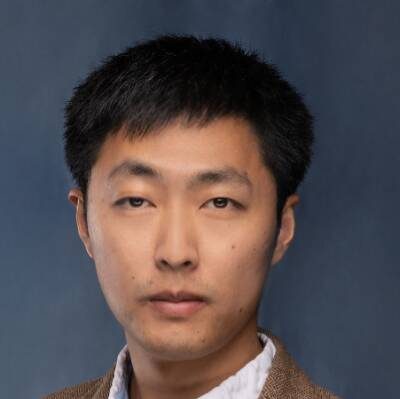
Chinthaka Pathum Dinesh Herath Gedara is an Assistant Teaching Professor in the Multidisciplinary Graduate Engineering Programs at Northeastern University. He holds a PhD in Signal and Image Processing from Simon Fraser University (2021). His research focuses on graph signal processing, machine learning, computer vision, and smart grids. He has published extensively in top journals like IEEE Transactions on Image Processing and Pattern Analysis and Machine Intelligence. His recent work addresses challenges in 3D point cloud processing, image super-resolution, and power system forecasting. Education: PhD, Signal and Image Processing, Simon Fraser University, 2021 Research interests include developing novel algorithms for graph-based data analytics, generative AI applications, and optimization techniques. His work bridges theoretical foundations and practical applications in computer vision and smart energy systems. While no grants or awards are explicitly listed, his publications reflect active engagement in high-impact interdisciplinary research. No student advisees or lab affiliations are documented in the provided materials.
Dr. Armin Mustafa is an Associate Professor in Computer Vision and AI at the University of Surrey, where he holds a prestigious Royal Academy of Engineering Research Fellow position. He is affiliated with the Centre for Vision, Speech and Signal Processing (CVSSP), the School of Computer Science and Electronic Engineering, and the Surrey Institute for People-Centred Artificial Intelligence (PAI). His research focuses on developing AI systems for visual understanding of complex dynamic scenes, with applications in entertainment, autonomous systems, and augmented/virtual reality. Dr. Mustafa completed his PhD in general dynamic scene reconstruction from multi-view videos in 2016 from the University of Surrey under the supervision of Prof. Adrian Hilton. Prior to his doctoral studies, he worked for three years (2010-2013) at Samsung Research Institute in Bangalore, India, in the field of Computer Vision. His research expertise spans Computer Vision, Scene Understanding, 3D/4D Vision, Virtual Reality, Light Fields, Machine Learning, Video Captioning, Augmented Reality, Artificial Intelligence, and Audio-visual Video Understanding. Dr. Mustafa has pioneered advances in 4D vision, NLP, and Scene Understanding over the past decade, with a particular focus on enabling machines to model and interpret real-world environments for socially beneficial applications. His work bridges theoretical advances in computer vision with practical applications in media production, virtual reality, and autonomous systems. Analysis of Dr. Mustafa's recent publications reveals a strong focus on multimodal learning, particularly the integration of audio and visual information for scene understanding. His work spans diverse areas including shadow detection and removal, audio event classification, video captioning, person image generation, and dynamic scene reconstruction. A notable trend is his exploration of transformer architectures for both vision and audio tasks, as well as the application of self-supervised learning techniques to reduce dependency on labeled data. Dr. Mustafa has received numerous prestigious awards: 2018 - Research Fellowship, The Royal Academy of Engineering, UK 2017 - Young Researcher award, CVPR 2016 - Doctoral Consortium grant, CVPR 2015 - BMVA travel grant for ICCV 2014 - Set-Squared Research to Innovator grant 2013 - Overseas Research Scholarship, FEPS, The University of Surrey 2010 - Cadence Silver Medal, Indian Institute of Technology, Kanpur As a dedicated mentor, Dr. Mustafa supervises several PhD students working on cutting-edge topics including multi-person reconstruction, audio-visual scene understanding, and automatic storyboard generation. His research is supported by significant grants including a £15 million UKRI Prosperity Partnership with the BBC (AI4ME), a 5-year Royal Academy of Engineering fellowship (4D Vision for Perceptive Machines), and multiple projects with industry partners such as Figment Productions and Foundry. Dr. Mustafa is an active member of the Centre for Vision, Speech and Signal Processing (CVSSP), one of the world's leading research centers in vision, speech, and signal processing. He also contributes to the Surrey Institute for People-Centred Artificial Intelligence (PAI), where he serves as a Surrey AI Fellow. His work often involves collaboration with industry partners and other academic institutions across Europe.
Dr. Wei Shao is an Assistant Professor in the College of Medicine at the University of Florida, specializing in artificial intelligence applications in medical imaging. His work focuses on developing machine learning algorithms for medical image registration, segmentation, and diagnosis, with a particular emphasis on integrating these tools into clinical workflows. Dr. Shao holds a Ph.D. in Electrical and Computer Engineering from Stanford University (2022), preceded by M.S. degrees in Mathematics and Electrical and Computer Engineering from the University of Iowa (2019-2018). His postdoctoral training focused on deep learning and medical imaging. His research projects include: Machine learning algorithms for multimodal image registration and segmentation AI-driven disease diagnosis on medical images Integrating image processing into clinical practices Notable contributions include advancements in 3D medical image segmentation, text-guided models for radiology, and AI-enhanced micro-ultrasound for prostate cancer screening. His work bridges computational methods with clinical needs, aiming to improve diagnostic accuracy and patient care. Recent publications highlight innovations in diffusion models, vision-language integration for medical imaging, and robust artifact detection in 4DCT scans. These studies underscore his commitment to advancing AI-driven solutions in healthcare.
Professor Stepan Lucyszyn FREng, FIEEE is Professor of Millimetre-wave Systems at Imperial College London. A pioneer in terahertz technologies, he co-founded Imperial's Centre for Terahertz Science and Engineering and has developed innovative 'THz Torch' wireless communication systems. Research focus areas: Millimeter-wave and terahertz systems engineering Additive manufacturing of RF components RF MEMS technology and applications Low-cost security and defense technologies Honors include Fellow of the Royal Academy of Engineering (2023), IEEE Fellow (2014), and recipient of Junkosha's Technology Innovator Award (2022) for 3D printing innovations. He has authored over 200 papers and 12 book chapters in applied physics and engineering.
Dr. Rafeef Garbi is a Professor at the Department of Electrical and Computer Engineering, University of British Columbia, and the Founder/Director of the Biomedical Signal and Image Computing Laboratory (BiSICL). Her multidisciplinary research integrates artificial intelligence, computer vision, and medical imaging for clinical applications in pediatric orthopedics, oncology, and neurology. PhD (Chalmers University, Sweden), MSc (with distinction), Technical Licentiate Research Focus: Specializing in Medical Image Computing and Visual Computing , her lab develops AI-driven solutions for: Automated segmentation and analysis of multi-dimensional biomedical data Clinically-translatable biomarkers for disease assessment Computer-aided intervention systems in surgical contexts Scientific Leadership: UBC Killam Faculty Research Fellow Peter Wall Institute for Advanced Studies Early Career Scholar Senior IEEE Member & Founding IEEE EMBS Vancouver Section Member Key Collaborations: Active in the Medical Image Computing and Computer Assisted Intervention (MICCAI) Society and CAIDA: UBC ICICS Centre for Artificial Intelligence Decision-making and Action. Her team bridges engineering, medicine, and computational biology through translational research.
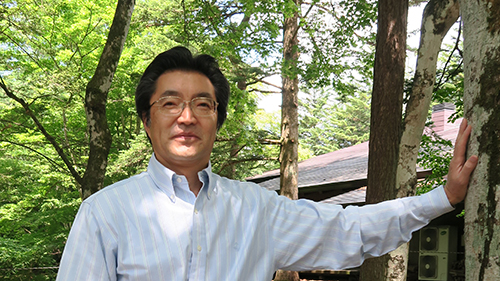
Professor Masatoshi Okutomi is affiliated with the Department of Systems and Control Engineering at the School of Engineering, Institute of Science Tokyo. His research focuses on advanced medical imaging techniques, particularly in endoscopy and 3D reconstruction, leveraging deep learning and neural networks. Key interests include virtual chromoendoscopy for cancer detection, image restoration, and stereo matching under challenging conditions. His work bridges computer vision and healthcare, addressing real-world applications such as MRI reconstruction and foggy stereo matching. Notable contributions include developing lightweight medical segmentation networks for edge devices and advancing neural radiance fields (NeRF) for novel view synthesis. His research spans diverse domains: from improving video quality assessment to enhancing object detection in high-dynamic-range images. Collaborative projects emphasize practical solutions for medical diagnostics and robust image processing in adverse environments. Recent articles highlight advancements in temporally-consistent video restoration, few-shot view synthesis, and degraded image classification using knowledge distillation. These innovations underscore his commitment to pushing boundaries in both theoretical computer vision and applied medical technology.
Dr. Alexander Plopski is an Assistant Professor at the Institute of Visual Computing, Technische Universität Graz. His research focuses on advancing augmented reality (AR) technologies, human-computer interaction (HCI), and optical display systems. He holds a PhD, M.Sc., and BSc in relevant fields. His work emphasizes perceptual optimization in AR displays, eye tracking integration, and accessibility solutions for color vision deficiencies. Key research areas include gaze-contingent AR interfaces, light field manipulation for extended reality, and multimodal interaction techniques. Notable contributions include the development of the 'guitARhero' interactive AR guitar tutorial system and studies on focal distance effects in optical see-through displays. His publications span topics from AR display calibration to gesture recognition using radar sensing. He has explored applications in industrial training, medical AR, and robotic telemanipulation. His work often bridges theoretical perceptual studies with practical system implementations, aiming to enhance user experience and accessibility in AR/VR environments.
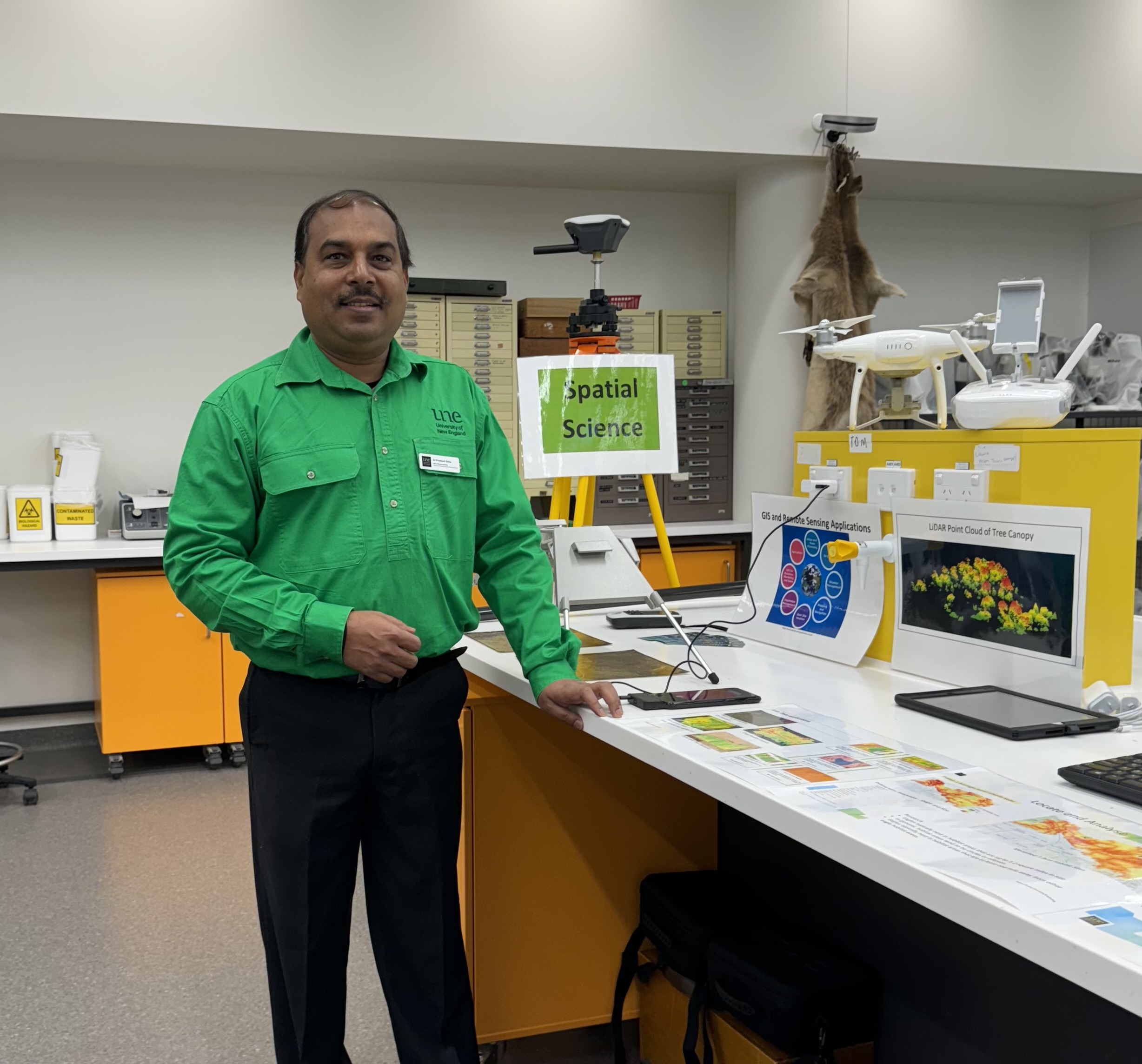
Dr. Priyakant Sinha is a Senior Lecturer in Spatial Science at the University of New England's School of Environmental and Rural Science, with over 20 years of research experience in remote sensing and geospatial science. He specializes in applying remote sensing technologies to agriculture, environmental monitoring, and natural resource management. His research focuses on: Advanced agricultural remote sensing and precision agriculture Time-series crop monitoring and yield prediction UAV/Drone-based 3D imaging for farm management Vegetation species mapping and change detection Hyperspectral and LiDAR data analysis Dr. Sinha teaches courses in GIS, spatial analysis, precision agriculture, and remote sensing applications. He has successfully supervised multiple PhD students in areas ranging from flood hazard mapping to drought monitoring using earth observation data. Technical expertise includes advanced digital image processing, GIS analysis and modeling, and specialized software including ENVI, ArcGIS, QGIS, and Pix4D. He develops innovative methods for temporal change analysis using machine learning and Google Earth Engine.
Christophe Charrier is a Full Professor in Forensics and AI at Université de Caen Normandie, affiliated with GREYC UMR CNRS 6072 and IUT Grand Ouest Normandie's Multimedia and Internet Department (Dept. MMI). He obtained his PhD in Computer Science from Université Jean Monnet (Saint-Etienne) in 1998, followed by an HDR (Habilitation à Diriger des Recherches) in 2011 from Université de Caen Normandie. His academic journey includes roles as a Postdoctoral Researcher at Université Laval (1998-2001), Associate Professor at IUT Saint-Lô (2001), and Visiting Scholar/Professor positions at University of Texas at Austin (2008) and University of Sherbrooke (2009-2011). His research focuses on Digital Image and Video Forensics (e.g., deepfake detection), Image/Video Quality Assessment , Computational Vision , and Biometrics (fingerprint quality, template update, presentation attack detection). He leads the SAFE research group since 2016 and collaborates with the E-payment & Biometrics team at GREYC. His work integrates machine learning for quality metrics, biometric system evaluation, and forensic analysis. Recent publications highlight advancements in deepfake detection , 3D mesh quality assessment , and biometric security . Articles span journals like Intelligent Service Robotics (2024), IEEE Access (2024), and conferences such as CORESA (2024) and Cyberworlds (2023-2024). His studies on fingerprint systems, behavioral biometrics, and environmental impacts on data quality underscore his interdisciplinary approach. Scientific Awards : Best PhD Paper Award (ASONAM 2022) Best Full Paper Award (CW2022) He has mentored 14 PhD students since 2003, including notable alumni like Xinwei Liu (Zhejiang Wanli University) and Antoine Cabana (ALTEN, Toulouse). His projects span biometric certification, latent space manipulation, and 3D mesh evaluation, often in collaboration with institutions in Canada, Norway, and Morocco.
Shimeng Yu is a full professor at the Georgia Institute of Technology's School of Electrical and Computer Engineering, holding the Dean’s Professorship. He earned his B.S. from Peking University (2009) and M.S./Ph.D. from Stanford University (2011/2013). His research focuses on semiconductor devices, non-volatile memories, 3D integration, and AI hardware accelerators. Yu leads SRC/DARPA JUMP 2.0 centers on memory/storage and 3D integration, with over 400 publications and 30,000+ citations (H-index 82). He serves on flagship conference committees (e.g., IEDM, VLSI) and editorial boards (IEEE EDL, JETCAS). Education: B.S., Microelectronics, Peking University (2009) M.S./Ph.D., Electrical Engineering, Stanford University (2011/2013) Research Themes: Emerging non-volatile memories for AI Monolithic 3D integration Energy-efficient computing systems His work spans device fabrication, circuit design, and system-level co-optimization. Recent projects are funded by NSF, DARPA, DOE, and industry partners (TSMC, Intel, Samsung), totaling >$17M. His lab, located at the Pettit Microelectronics Research Center, develops prototypes with cleanroom access. Awards: IEEE Fellow (2024) ACM/IEEE DAC Under-40 Innovators Award (2020) NSF CAREER Award (2016) Multiple editorship roles and distinguished lecturer appointments (IEEE EDS/CASS) Grants & Funding: Lead of two SRC/DARPA JUMP 2.0 centers Total research funding exceeds $17M
Tivon Rice is an Assistant Professor in DXARTS (Digital Arts and Experimental Media) at the University of Washington. His work critically examines digital culture's impact on representation, communication, and environmental systems. Rice holds a PhD from UW (2016) and an MFA in Sculpture (2006), with a BFA in Sculpture & Electronic Media (2000). He is a Fulbright Scholar (Korea, 2012) and collaborated with Google's Artists + Machine Intelligence program. Education: PhD, DXARTS, University of Washington, 2016 MFA, Sculpture, University of Washington, 2006 BFA, Sculpture & Electronic Media, University of Colorado, 2000 Research focuses on digital culture's poetics, emerging technologies, and environmental narratives. Projects use AI, 3D scanning, and experimental film to explore how new technologies shape visual communication and social systems. Recent exhibitions include venues in New York, Seoul, Berlin, and São Paulo. Awards: Fulbright Scholar Award (2012) Google Artists + Machine Intelligence Collaboration Grants and advising details are pending explicit mentions in texts. Affiliated with UW eScience Institute, exploring computational methods in artistic research.
Dr. Jose Manuel Sánchez Peña is a Full Professor at Universidad Carlos III de Madrid (UC3M), affiliated with the Grupo Universitario de Tecnologías de Identificación (GUTI). His research focuses on precision agriculture technologies, optoelectronics, and neuroscientific interfaces. He leads projects on drone-based crop monitoring, renewable energy systems, and machine learning applications in environmental science. Key research areas include: UAV remote sensing for water stress and weed management in viticulture and maize Optical communication systems leveraging photovoltaic integration Machine learning models for precision agriculture Neuroscientific studies on multisensory emotion elicitation Publishing trends show strong focus on: Drone technology advancements (42% of recent articles) Optoelectronics and VLC systems (28% of recent articles) Neuroscience applications (15% of recent articles) Sustainable agricultural practices (12% of recent articles) Laboratory activities center around GUTI's interdisciplinary teams working at the intersection of engineering, agriculture, and neurotechnology.
Dr. Minglun Gong is a Professor and Director of the School of Computer Science at the University of Guelph (since 2019). Previously, he served as Professor and Head of the Department of Computer Science at Memorial University of Newfoundland. He holds a Ph.D. from the University of Alberta (2003), M.Sc. from Tsinghua University (1997), and B.Engr. from Harbin Engineering University (1994). His research focuses on visual computing, including computer graphics, computer vision, visualization, image processing, and pattern recognition. He has authored over 150 referred papers and holds patents in the field. He is an Associate Editor for Pattern Recognition and IEEE Signal Processing Letters , and has received awards such as the Izaak Walton Killam Memorial Award and multiple best paper awards. Dr. Gong has advised numerous students, including Ph.D./M.Sc. candidates and visiting scholars. His lab's recent work includes UAV path planning for urban reconstruction, image stylization techniques, and 3D human pose estimation. He actively participates in academic service, including editorial roles, conference program committees, and administrative roles at multiple institutions. His teaching spans courses in image processing, computational photography, and technical communication. He is also involved in administrative committees, such as Graduate Studies and Promotion at Memorial University. Key research contributions include advancements in transparent object modeling, underwater 3D reconstruction, and image-to-image translation. His work emphasizes practical applications in fields like medical imaging, autonomous systems, and environmental modeling.
David E. Breen is a Professor in the Department of Computer Science within the College of Computing & Informatics (CCI) at Drexel University. He leads the Geometric Biomedical Computing Group and is affiliated with the Metadata Research Center and the Center for Biological Discovery from Big Data. His research spans interdisciplinary domains including biomedical image informatics, geometric modeling, textile modeling, and bio-inspired self-organization algorithms. Education: PhD, Computer and Systems Engineering, Rensselaer Polytechnic Institute MS, Computer and Systems Engineering, Rensselaer Polytechnic Institute BA, Physics, Colgate University His research interests focus on computational methods for biomedical applications, including shape and image analysis for cancer diagnosis, 3D reconstruction of biological tissues, and video analysis of animal behavior. He also investigates geometric modeling techniques for textiles and self-organizing systems. His work integrates computer science with biology, medicine, and engineering to solve complex problems in biomedical computing. The recent publications highlight a strong trend in computational modeling of textiles, biomedical image informatics, and AI-driven data analysis. Key themes include geometric modeling of knitted fabrics, deep learning for medical image classification, agent-based modeling of cancer metastasis, and metadata generation for biological image collections. His work bridges fundamental geometric algorithms with practical applications in healthcare and digital archives. Scientific Awards: No specific awards mentioned in the provided text. Breen has advised numerous students and collaborators across multiple domains, particularly in biomedical computing and textile modeling. His research has been supported through affiliations with major centers and collaborations with institutions such as Johns Hopkins University and the Max Planck Institute. He has been involved in projects related to NSF Center for Visual & Decision Informatics and has contributed to over 100 technical publications. He leads the Geometric Biomedical Computing Group , which conducts research at the intersection of biology, medicine, engineering, and computer science. The group develops algorithms and software for geometry-related computing problems in biomedical applications. Collaborations include the Drexel Integrated Laboratory for Cellular Tissue Engineering, Dr. Dan Marenda's Lab, and Dr. Aleister Saunder's Lab in Drexel's Biology Department.
Keith D. Paulsen is the MacLean Professor of Engineering at Dartmouth College’s Thayer School of Engineering and holds the title of Professor of Radiology & Surgery at the Geisel School of Medicine. He serves as Scientific Director of the Center for Surgical Innovation at Dartmouth-Hitchcock Medical Center and Co-Director of the Translational Engineering in Cancer Research Program at the Norris Cotton Cancer Center. His roles emphasize interdisciplinary collaboration between engineering, medicine, and oncology. Paulsen earned a BSc in Biomedical Engineering from Duke University (1981), followed by MS (1984) and PhD (1986) degrees in Engineering Sciences from Dartmouth College. His research focuses on biomedical imaging, cancer therapeutics, and image-guided surgery, with particular expertise in optical and electromagnetic methodologies. He has pioneered technologies such as fluorescence-guided surgery, quantitative scatter imaging, and non-linear image reconstruction techniques, aiming to enhance surgical precision and cancer diagnosis. His awards include fellowships from OSA, SPIE, AIMBE, IEEE, and the National Academy of Inventors. Paulsen’s work has led to startups like CairnSurgical (where he serves as CTO) and InSight Surgical Technologies, translating research into clinical tools. Key projects include intraoperative imaging systems for brain and spine surgery, microwave imaging for breast cancer, and optical molecular imaging for real-time surgical guidance. Paulsen teaches advanced computational methods (ENGS 205, 105) and courses on medical device innovation (ENGM 189.1/2). His lab, part of Dartmouth’s Optics in Medicine cluster, collaborates with radiology, surgery, and oncology departments to develop clinical technologies funded by NIH, NCI, and DoD grants.