
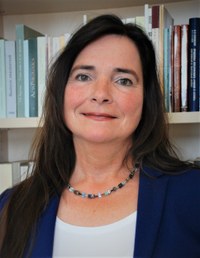
About
Monika Wingender is a Professor of Slavic Linguistics and Cultural Studies at Justus Liebig University of Giessen, where she has been a faculty member since 2001. She serves as Principal Investigator at the Research Center 'Transformations of Political Violence' and has directed the Giessen Center for Eastern Europe (GiZo) since 2007. Her academic career spans over three decades, with significant contributions to Slavic linguistics, language policy, and sociolinguistics.
Wingender earned her Master's degree in Slavic and Romance Studies from Ruhr University Bochum in 1990, followed by her doctorate from the same institution in 1994. She completed her habilitation at Georg-August University of Göttingen in 2000, after which she joined Justus Liebig University of Giessen as a full professor.
Professor Wingender's research focuses on sociolinguistics, contact linguistics, linguistic conflict research, and language policy in Slavic countries, with particular emphasis on Russian, Polish, Croatian, and Serbian languages. Her work examines theoretical frameworks of standard language varieties, language conflicts, and the relationship between language policy and political dynamics in post-Soviet states. She has developed innovative approaches to understanding how language ideologies shape national identity and political discourse, especially in multilingual contexts like Tatarstan and Ukraine. Her recent publications reflect a growing emphasis on the impact of geopolitical conflicts on language policy and linguistic diversity, particularly in relation to Russia's war against Ukraine. Wingender's scholarship bridges theoretical linguistics with practical policy implications, addressing how language legislation interacts with social realities in Eastern Europe.
Wingender has secured substantial research funding from prestigious organizations including the German Research Foundation (DFG), Volkswagen Foundation, and the BMBF. Current projects include 'Comparison of language ideologies in the Soviet Union and today's Russian Federation' (2022-2025) and previous significant work on 'Contested language diversity in post-Soviet Ukraine and Russia' (2020-2023).
She has mentored numerous postdoctoral researchers including Dr. Liudmyla Pidkuimukha, Dr. Nadiya Kiss, and Daniel Müller, who have collaborated with her on multiple interdisciplinary projects examining language policy across Eastern Europe. Her research teams often include international scholars from Ukraine, Russia, Kazakhstan, and other post-Soviet states, creating a robust network for comparative linguistic research. She has served as Partnership Officer for university partnerships with Łódź, Kazan, and Kyiv, fostering international academic collaboration despite geopolitical challenges.
Find Monika Wingender elsewhere
Related Searches
You Might Also Like
 Andrea GawrichJustus-Liebig-University Giessen · Professor
 Martin PaulsenUniversity of Bergen · Professor
 Korine AmacherUniversity of Geneva · Professor
 Ingunn LundeUniversity of Bergen · Professor
 Andreas LangenohlJustus-Liebig-University Giessen · Professor
- TTetyana DzyadevychGrinnell College · Assistant Professor