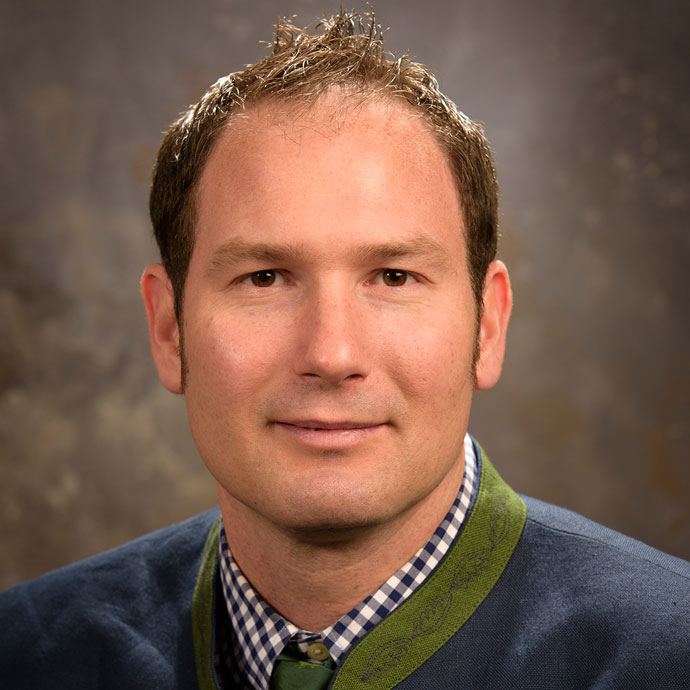
Michael Stoellinger
Associate Professor · Modeling and Simulation of Turbulent Flows
University of WyomingAbout
Michael Stoellinger is an Associate Professor in the Department of Mechanical Engineering at the University of Wyoming, within the College of Engineering and Physical Sciences. His research focuses on advanced computational modeling of turbulent and reactive flows, with applications in combustion and wind energy systems.
Research Interests: His work spans modeling and simulation of turbulent and reactive flows, particularly using probability density function (PDF) models integrated with Reynolds-Averaged Navier-Stokes (RANS) and Large Eddy Simulation (LES) methods. He investigates radiative heat transfer coupling, premixed and flameless combustion, oxy-fuel combustion of alternative fuels, coal combustion and gasification, and soot formation. A significant focus is on hybrid LES/RANS methods applied to wind turbine blade performance prediction. These models are implemented in both in-house codes and the open-source CFD platform OpenFOAM.
The trend in his publications from 2008 to 2013 shows a consistent development of unified and hybrid turbulence models, advancing from fundamental PDF modeling of premixed flames to complex applications in coal combustion and atmospheric boundary layers. His work bridges theoretical model development with practical implementation in aerospace and energy systems.
Education:
- Ph.D. in Mathematics, University of Wyoming, 2010
- M.S. in Mechanical Engineering, Technical University of Munich, 2005
Professional Experience:
- Assistant Professor, Mechanical Engineering, University of Wyoming, 2012–present
- Postdoctoral Researcher, Applied Science, Delft University of Technology, 2010–2012
- Graduate Research Assistant, Mathematics, University of Wyoming, 2005–2010
- Graduate Research Assistant, Technical University of Munich, 2001–2004
Dr. Stoellinger has not been mentioned as receiving any scientific awards in the provided text. He advises graduate students in mechanical engineering and combustion research, though specific names are not listed. His work is supported through academic research grants typical of computational mechanics and energy research, though specific grants are not detailed. He leads or contributes to a research group focused on computational fluid dynamics and combustion modeling, utilizing high-performance computing and simulation tools.
Research fields