About
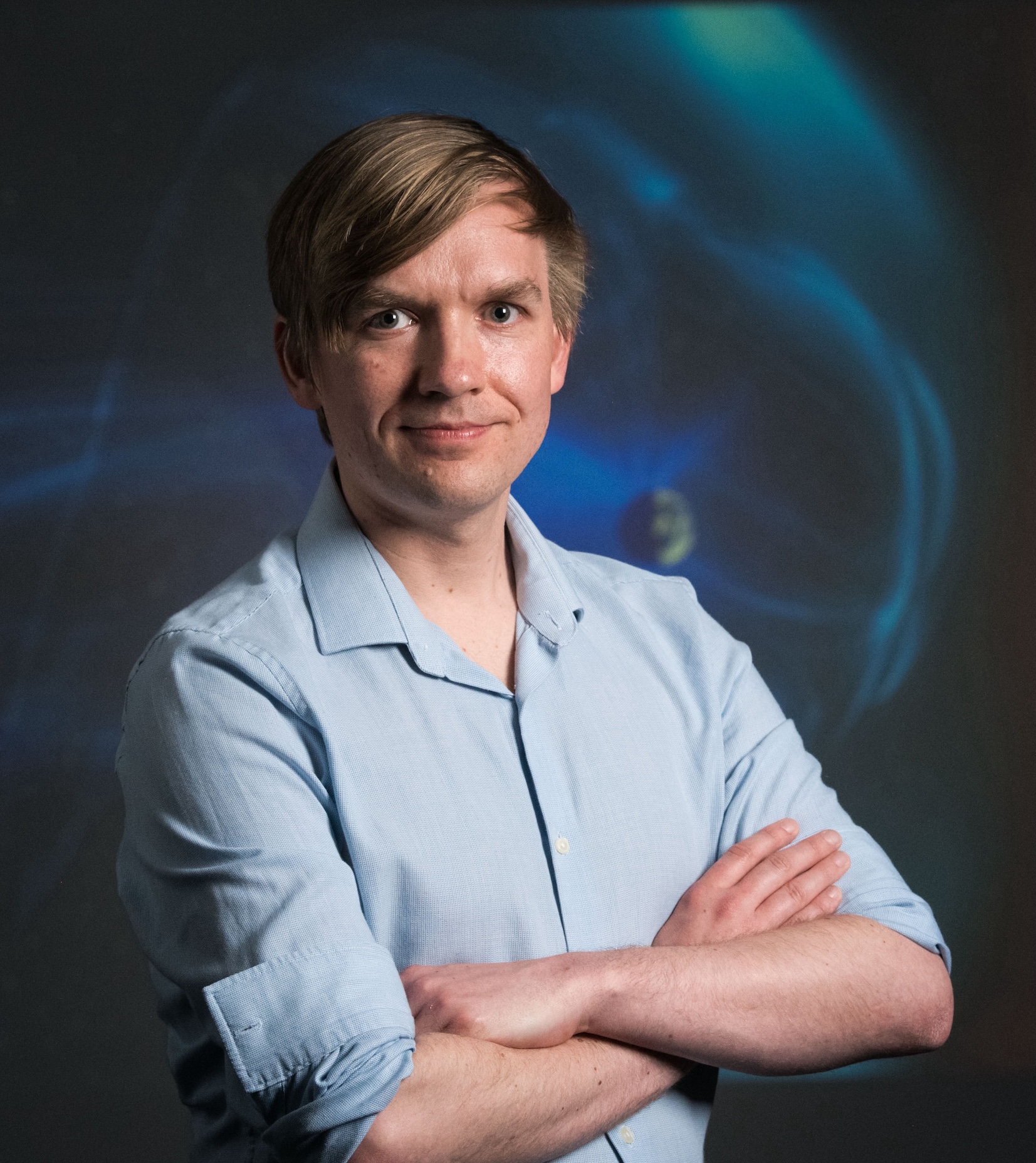
Dr. Daniel Ratliff is an applied mathematician at Northumbria University since 2020, specializing in nonlinear waves across physics. He holds a PhD in Mathematical Physics from the University of Surrey (2017), focusing on conservation laws and universal nonlinear equations. His research explores fluid dynamics, magnetospheric plasmas, and soft matter physics, with notable work on water wave instabilities and Whistler-mode chorus waves. Key contributions include deriving reduced nonlinear models for wave evolution and investigating wave-particle interactions in space plasmas. He actively advocates for LGBTQ+ inclusion in mathematics through initiatives like the QED Network and organized events such as the 2025 Queer Experience in Mathematics workshop. His work bridges theoretical analysis, numerical simulations, and interdisciplinary applications, including data sonification of space phenomena. Supervising PhD student Adam Toulson, Ratliff's research also involves collaborations on quasicrystal formation and space weather dynamics.
Education:
- PhD in Mathematical Physics, University of Surrey, 2017
- Postdoctoral Research, Loughborough University (2017–2020)
Research Interests:
- Nonlinear waves and modulation theory
- Fluid dynamics and water wave instabilities
- Magnetospheric plasma dynamics and Whistler-mode chorus
- Data sonification for scientific communication
- Soft matter physics and quasicrystal self-organization
Recent Research Trends: Recent articles highlight advancements in understanding wave-mean flow interactions, frequency downshifting in water waves, and modulation instability in space plasmas. His work links fluid dynamics principles to space weather phenomena, emphasizing universal nonlinear behaviors across disciplines.
Grants & Advising: Advises on PhD research and collaborates on projects involving radial diffusion models and particle transport in radiation belts. Active in organizing conferences like the 2025 International Couette-Taylor Workshop and the British Applied Mathematics Colloquium 2024.
Labs/Teams: Engages in interdisciplinary teams focusing on space weather, plasma physics, and soft matter systems, leveraging computational and theoretical tools to explore complex wave phenomena.