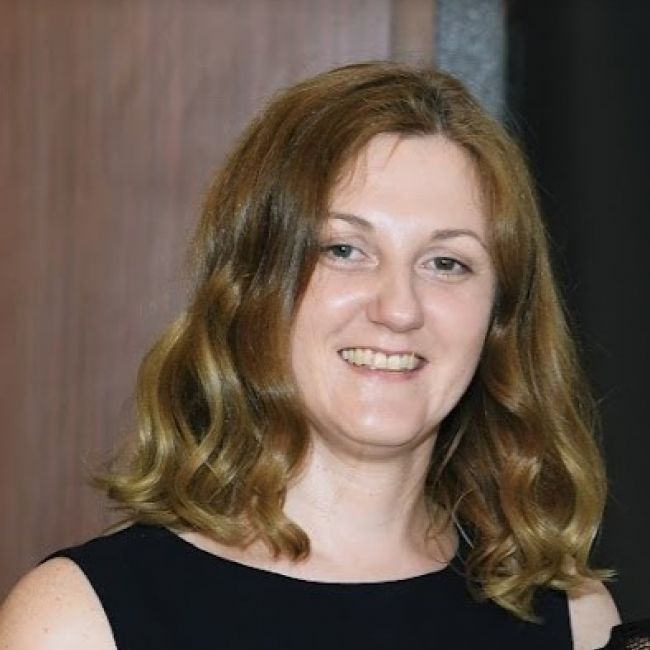
Vass Verkhodanova is a Lecturer at the University of Groningen's Campus Fryslân, affiliated with the Language Technology and Culture (LTC) department. Her research focuses on phonetics, speech prosody, and Parkinson's disease speech analysis. She completed her PhD in 2021 with the thesis titled More than words: Recognizing speech of people with Parkinson's disease . Her work spans cross-linguistic studies of speech healthiness, dysarthric speech recognition, and perceptual effects of expertise. Recent publications (2024-2017) emphasize Dutch dysarthric speech recognition strategies, prosodic changes in Parkinson's patients, and vowel articulation in multilingual contexts. Key contributions include developing machine learning approaches for speaker-specific speech recognition and analyzing acoustic correlates of Parkinson's-related speech disorders. Media engagements highlight her work on speech technology for Parkinson's detection.
Kristine M. Jensen de López is a Professor at Aalborg University's Department of Communication and Psychology within the Faculty of Social Sciences and Humanities. She co-founded the university's Child Language Clinic and leads graduate programs in developmental psychology. Her work focuses on child language development, developmental language disorders (DLD), multilingualism, and inclusive education strategies for vulnerable children. Education: BA, MA (Cand.Psych.), and PhD in Psychology. Key roles include Co-PI of the Center for Human Animal Psychology (CHAP) and Danish representative in international networks like JustLang and IALP. Research Interests: DLD assessment, narrative analysis, multilingualism effects on cognition, and evidence-based interventions. Her clinical tools include the Mary Foundation's LæseLeg program for literacy promotion and grief therapy frameworks for youth. Grants & Projects: Active in 17 ongoing projects including MeRID (cross-linguistic sentence processing) and MultiplEYE (multilingual eye-tracking research). Has secured funding from Swiss National Science Foundation and EU COST actions. Awards: Multiple prizes including 2022 best abstract award, travel grants, and leadership roles in international initiatives. Lab/Teams: Leads the Children's Language Clinic and collaborates with the Center for Developmental & Applied Psychological Science. Supervises master's students in rehabilitation clinic placements.
Patrick Plummer is an Assistant Professor in the Department of Psychology at Howard University, part of the College of Arts & Sciences. His research focuses on cognitive processes underlying word recognition and language processing, using methods like eye tracking, electrophysiological measures, and computational modeling. He investigates semantic representation retrieval and contextual effects during tasks such as sentence comprehension and numerical processing. Key research areas include bilingualism's impact on executive control, rational number processing, and contextual diversity in reading. His work has been published in journals and spans behavioral, computational, and electrophysiological approaches. Collaborations include studies on bilingual comprehension and numerical reasoning strategies. No scientific awards are explicitly listed in the provided text. Current roles include advising and contributing to research grants, though specific details are not detailed. His work is centered in the Department of Psychology at Howard University, with no mention of labs or teams beyond co-authorship networks listed.
Mandy Maguire is the Robinson Family Professor and Assistant Professor in the Department of Speech, Language, and Hearing at the University of Texas at Dallas (UTD), affiliated with the School of Behavioral and Brain Sciences. She directs the Center for Children and Families and leads the Developmental Neurolinguistics Laboratory. Her research focuses on how socioeconomic status (SES) and home environments influence brain and language development in children. She holds a B.A. in Psychology from Pennsylvania State University (1998), a Ph.D. in Developmental Psychology from Temple University (2003), and completed postdoctoral work at the University of Louisville (2005). Her key research areas include the neural mechanisms of word learning, the impact of poverty on language acquisition, and the role of neural oscillations (e.g., theta, beta, gamma frequencies) in cognitive processes. She has secured significant grants, including NSF awards totaling over $1.3 million, to study SES disparities in language development and to support culturally responsive research training. Dr. Maguire has received notable awards, including the UTD Distinguished Teacher in Diversity (2018) and the Møller Undergraduate Teaching Award (2022). Her work is published in journals like Developmental Cognitive Neuroscience and Brain and Language . She mentors students, such as Julie Schneider (now at LSU), and collaborates with institutions like Children’s Hospital of Philadelphia and the Sandbox Learning Company. Labs/Teams: Developmental Neurolinguistics Laboratory, Center for Children and Families Grants: NSF REU Site (2023–2023), NSF SES-Vocabulary Grant (2023), NIH Brain-Tracking Grant (2010–2012)
Troy Riddell is an Associate Professor and Chair of the Department of Political Science at the University of Guelph. He is affiliated with the College of Social & Applied Human Sciences and holds a PhD in Political Science from McGill University. His research focuses on judicial politics, judicial decision-making, criminal justice policy, and the implementation of Charter of Rights decisions. Education: PhD in Political Science (McGill University). His work examines topics such as judicial independence, judicial appointments, sentencing policies, and minority-language education rights. Recent publications include co-authored books like Canadian Courts: Law, Politics and Process and influential articles in journals like Canadian Journal of Political Science and Law and Society Review . Riddell’s research bridges empirical legal studies and political theory, emphasizing the intersection of law, governance, and societal outcomes. His studies often explore how judicial decisions shape public policy and institutional accountability.
Don Foss is a Professor in the Department of Psychology at the University of Houston, affiliated with the College of Liberal Arts & Social Sciences. He has held significant administrative roles, including Senior Vice President and Provost from 2005 to 2008, and previously served as Chair of Psychology at the University of Texas-Austin and Dean of the College of Arts & Sciences at Florida State University. His research expertise lies in cognitive psychology, particularly psycholinguistics and applied cognitive psychology. Key areas include language comprehension, reading processes, and cognitive mechanisms underlying learning. More recently, his work has focused on factors that contribute to college student success and how to implement evidence-based, scalable teaching techniques in undergraduate education. The 15 most recent publications reflect a consistent trajectory from foundational cognitive and psycholinguistic research toward applied educational psychology. Early works explore syntactic parsing, discourse processing, and individual differences in comprehension, while recent articles emphasize pedagogical innovation, student success strategies, and the integration of cognitive science into classroom practice. Broad keywords include Cognitive Psychology, Education, and Psycholinguistics, with subfields spanning from syntactic ambiguity resolution to metacognitive learning strategies. Scientific Awards and Honors: Fellow of the American Association for the Advancement of Science Fellow of the American Psychological Association (various divisions) Fellow of the Association for Psychological Science Fellow of the Psychonomic Society All-University Outstanding Teaching Award, University of Texas at Austin Outstanding Achievement Award, University of Minnesota Advising and Grants: While specific students and grant funding are not listed in the text, Dr. Foss has co-authored seven books and over 50 refereed publications, indicating extensive mentorship and research leadership. His editorial roles as Editor of Contemporary Psychology and Associate Editor of the Annual Review of Psychology further underscore his influence in the field. His work on scalable teaching methods suggests involvement in educational grants and curriculum development initiatives. Labs and Research Teams: Although no specific lab or research team is mentioned, his focus on evidence-based learning and classroom implementation implies collaboration with educational researchers and teaching innovation groups at the University of Houston.
Erica Cosentino is a Research Fellow at the Department of Philosophy, Ruhr University of Bochum. Her work bridges the Philosophy of Language, Philosophy of Mind, and Cognitive Science, focusing on episodic memory, mental time travel, and the neuro-psychological basis of language processing. Her research explores how sensory-motor information shapes semantic processing, the evolution of language, memory’s role in self-identity, and consciousness in communication. Recent publications highlight interdisciplinary approaches to affordances, Bayesian pragmatics, and pain-related lexical cognition. Scientific projects include The Interaction of Bayesian Pragmatics and Lexical Semantics in Linguistic Interpretation under the DFG’s XPrag framework. Collaborations span comparative psychology (humans, chimpanzees, chicks) and experimental pragmatics.
Marina Rauker Koch is a Professor of Professional Studies at the College of Rijeka. She specializes in the integration of technology in education, particularly focusing on multimedia systems, information systems in transport, and natural language processing. Her academic work emphasizes the application of the Node of Knowledge (NOK) method in various domains, including sentence modeling, query formalization, and educational technology. She is actively involved in teaching courses such as Electronic Business, Multimedia Systems, and Digital Design Basics, reflecting her expertise in both theoretical and applied aspects of computer science and information systems. Her research interests span a broad range of areas, including multimedia systems development, the transformation of natural language into database records using the NOK framework, and the integration of ESG standards with educational practices through digital tools. She also explores the use of Web 2.0 technologies in pedagogy, ensuring that educational content remains accessible and engaging. Her work in transportation logistics focuses on cost-benefit analyses and safety protocols for hazardous materials, demonstrating her interdisciplinary approach to solving real-world problems. Professor Rauker Koch has contributed to numerous courses at the College of Rijeka, including foundational subjects like Basics of Computer Science and advanced electives such as Modeling and Simulations. While her teaching and research activities are extensive, specific grants or student advisees are not detailed in the provided information.
Tomasz Kanty is a legal scholar and practitioner affiliated with the Institute of Law and Administration (IPiA) at the University of Gdańsk. He serves as a Researcher with expertise in Criminal Law, Criminal Proceedings, and Disciplinary Law. From 2013 to 2020, he held a judicial role as a member of the Disciplinary Court at the Pomeranian Bar Association. His work bridges academic research and practical legal application, particularly in evidence law, judicial procedures, and professional ethics. His research focuses on cognitive processes in criminal proceedings, judicial punishment mechanisms, and disciplinary regulations for legal professionals. Notable contributions include analyses of Supreme Court rulings, European legal directives, and procedural fairness in criminal cases. He has co-authored landmark publications on evidence admissibility, victim rights, and sustainable development principles in criminal law. Kanty is actively involved in academic publishing and editing. He co-edited the handbook Criminal Law: A Handbook for Legal Trainees (2019, 2020), and contributed to interdisciplinary research teams at IPiA, including the Criminal Law Research Team. His recent work explores procedural limitations, tax-related evidence challenges, and interpreter rights under EU directives. His professional network spans legal academia, judicial practice, and the legal profession’s regulatory bodies. He remains a practicing attorney, further integrating theoretical insights with real-world legal practice.
Dr. Joseph A. Melusky is a Professor of Political Science at Saint Francis University since 1980. He concurrently serves as Director of the Center for the Study of Government and Law, Coordinator of Public Administration/Government Service, and Director of the Pre-Law program. His roles have included Interim Vice President for Academic Affairs, Department Chair positions, and Dean of General Education. He has held leadership roles in professional associations such as the Pennsylvania Political Science Association and Northeastern Political Science Association. Education: B.A. from West Chester University, M.A. and Ph.D. from University of Delaware, with post-doctoral work at University of Michigan, University of Delaware, and Carnegie Mellon University. Research focuses on constitutional law, civil liberties, public administration, and death penalty policy. His publications include authoritative texts like The Death Penalty: A Reference Handbook (2017) and Cruel and Unusual Punishments (2004). His work combines legal analysis with ethical and sociopolitical dimensions of governance. Teaching spans courses ranging from constitutional law to public administration ethics. Awards include the Alumni Association's Distinguished Faculty Award and Dr. John F. Coleman Award for Teaching and Research. Professional service includes Election Judge in Blair County and directorial roles in academic employment services. Active in curriculum development and interdisciplinary collaboration across Saint Francis University's academic divisions.
Mark A. Drumbl serves as the Class of 1975 Alumni Professor of Law at Washington and Lee University School of Law, where he also directs the Transnational Law Institute. An internationally recognized scholar, he has held visiting appointments at numerous prestigious institutions worldwide including Oxford University, Université de Paris II, Free University of Amsterdam, and University of Sydney. His academic journey includes degrees from McGill University (BA), Institut d'études politiques de Paris (MA), University of Toronto (JD), and Columbia University (LLM, SJD). Professor Drumbl's research spans international law, transnational legal processes, mass violence and human rights, with particular expertise in child soldiers, post-conflict justice, and international criminal law. His work challenges conventional wisdom in these fields, most notably through his groundbreaking book Reimagining Child Soldiers in International Law and Policy (Oxford University Press, 2012). His scholarly output demonstrates remarkable breadth, addressing topics from the aesthetics of atrocity prosecutions to the moral responsibility of scientists who develop weapons. His recent publications reveal evolving research trajectories, with 2024-2025 seeing multiple significant releases including Informers Up Close: Stories from Communist Prague (Oxford University Press, 2024), Sights, Sounds, and Sensibilities of Atrocity Prosecutions (Brill Publishers, 2024), and the forthcoming Children and Violence (Routledge, 2025). These works collectively examine agency, representation, and justice mechanisms across diverse contexts of violence. 2007 Book of the Year Award by International Association of Criminal Law Certificate of Merit for Outstanding Contribution to Creative Scholarship (2009) Association of American Law Schools Outstanding Scholarly Papers Prize Professor Drumbl's practical engagement with international justice is substantial, having served as defense counsel in Rwandan genocide trials, co-authored amicus briefs for the International Criminal Court, and provided expert testimony to the United Nations. He has organized major international conferences, including one at Washington and Lee on children implicated in violent situations that led to the 2025 Children and Violence publication. His current research projects explore child soldiers in the Korean War, the moral responsibility of scientists through the case of Fritz Haber, and the future of international criminal law.
Randle DeFalco is an Assistant Professor of Law at Delaware Law School, Widener University . He holds a J.D. from Rutgers Law School, an LL.M. from the University of Toronto, and an S.J.D. from the University of Toronto, where he was a Vanier Scholar and recipient of the Alan Marks Outstanding Thesis Medal. Education : J.D. (Rutgers Law School), LL.M. (University of Toronto), S.J.D. (University of Toronto) Professor DeFalco specializes in atrocity law, international criminal law, transitional justice , and slow mass violence , including famine and starvation. His research explores the intersection of aesthetics, legal accountability, and public health in international criminal justice. His scholarship has appeared in journals such as the University of Pennsylvania Journal of International Law and London Review of International Law , as well as in edited volumes. His first book, Invisible Atrocities (Cambridge UP, 2022), received an honorable mention for the Law and Society Association’s Herbert Jacob Book Prize. Scientific Awards : Vanier Scholar Alan Marks Outstanding Thesis Medal Law and Society Association Herbert Jacob Book Prize Honorable Mention (2023) He has also contributed to blogs like Just Security and Justice in Conflict , analyzing topics such as U.S. travel bans, Sudanese accountability, and Cambodian post-conflict justice. His teaching includes courses on criminal law, international criminal law, and evidence.
F. Andrew Hessick is a Professor at the University of North Carolina School of Law , with a research focus spanning Criminal Law , Federal Courts , and Constitutional Law . His work critically examines plea bargaining dynamics, judicial constraints on prosecutorial power, and federalism implications in legal adjudication. Education: J.D. from University of Virginia School of Law, Ph.D. in Law from University of North Carolina. Research Interests include: Criminal Procedure : Analyzing plea bargaining, sentencing guidelines, and prosecutorial accountability. Administrative Law : Investigating nondelegation doctrine and agency influence in criminal law. Jurisdictional Theory : Exploring standing doctrines, Article III limits, and federal-state court interactions. Recent publications highlight trends in: Procedural Fairness : With 15+ papers on sentencing reforms, injunction interpretation, and discovery practices. Constitutional Litigation : 10+ works addressing standing, federalism, and judicial review. Prosecutorial Accountability : 8+ collaborations with scholars like Carissa Byrne Hessick and Ronald F. Wright. Collaborative Networks span institutions including: Vanderbilt Law School Wake Forest University - School of Law Emory University School of Law
Cristina España-Bonet is a researcher at the Department of Computer Science (CS) in the Polytechnic University of Catalonia (UPC), where she works in the Natural Language Processing (GPLN) group. Previously, she was affiliated with the University of Barcelona (UB) in the Department of Astronomy and Meteorology (DAM), where she completed her PhD in Cosmology. Her research spans both Natural Language Processing and Cosmology , with a strong focus on Machine Translation and Multilingual Systems . Her work in NLP includes: Statistical and Hybrid Machine Translation Document-level Translation Multilingual Information Retrieval Sign Language Translation Low-resource Language Processing She has contributed to major projects such as: OPENMT MOLTO TACARDI Wikiparable Her research has produced significant resources including: Wikipedia-based comparable corpora Hybrid translation systems for patents Stopword lists for Occitan Sign language translation systems
Prof. Dr. Vera Demberg is a full Professor of Computer Science and Computational Linguistics at Saarland University, affiliated with the Faculty of Mathematics and Computer Science. She holds a chair in her field and is co-opted into the Department of Language Science and Technology. Since 2024, she has also been a Max Planck Fellow at the Max Planck Institute for Informatics, where she leads a research group on Multimodal Language Processing. She currently serves as Dean of Study Affairs for her faculty (2024–2026). Her research focuses on cognitive models of human language understanding, natural language generation, experimental psycholinguistics, and computational discourse and pragmatics. She integrates computational modeling with empirical methods such as eye-tracking and reading time experiments to study how humans process language in real time. Key themes include individual differences in comprehension, information-theoretic models, and multimodal language processing (language and vision/body language). The recent publications and talks reflect a strong trend in modeling incremental and predictive language processing, discourse coherence, and individualized interaction in dialogue. Her work bridges computational linguistics, cognitive science, and artificial intelligence, often applying rational agent models and information theory to human language processing. Elected Member of the Academy of Sciences and Literature Mainz (2024) ELLIS Fellow (2023) ERC Starting Grant 'Individualized Interaction in Discourse' (2020–2025) Cognitive Science Society Glushko Dissertation Prize (2011) Falling Walls Lab 2014, Berlin Multiple Google Anita Borg Scholarship Finalist recognitions Prof. Demberg advises several PhD students and postdoctoral researchers, including Marian Marchal, Anupama Chingacham, Iza Škrjanec, Alexandra Mayn, and Jiaxin Li. She leads multiple funded research projects, including an ERC Starting Grant and several SFB projects funded by the DFG. Her lab hosts guest researchers and organizes international workshops such as IndiREAD and IndiPRAG. She is actively involved in the academic community, serving on the Executive Committee of ACL, as Program Chair for SigDIAL 2024, and as Associate Editor for IEEE TPAMI and other journals. Her research group is involved in several major projects, including 'Individualized Interaction in Discourse' (ERC), 'Cognitive Modelling of Information Density for Discourse Relations' (SFB 1102), and the DFG Research Training Group on Neuroexplicit Models of Language, Vision, and Action. These projects explore the intersection of human cognition and machine language processing, often using eye-tracking and computational modeling.