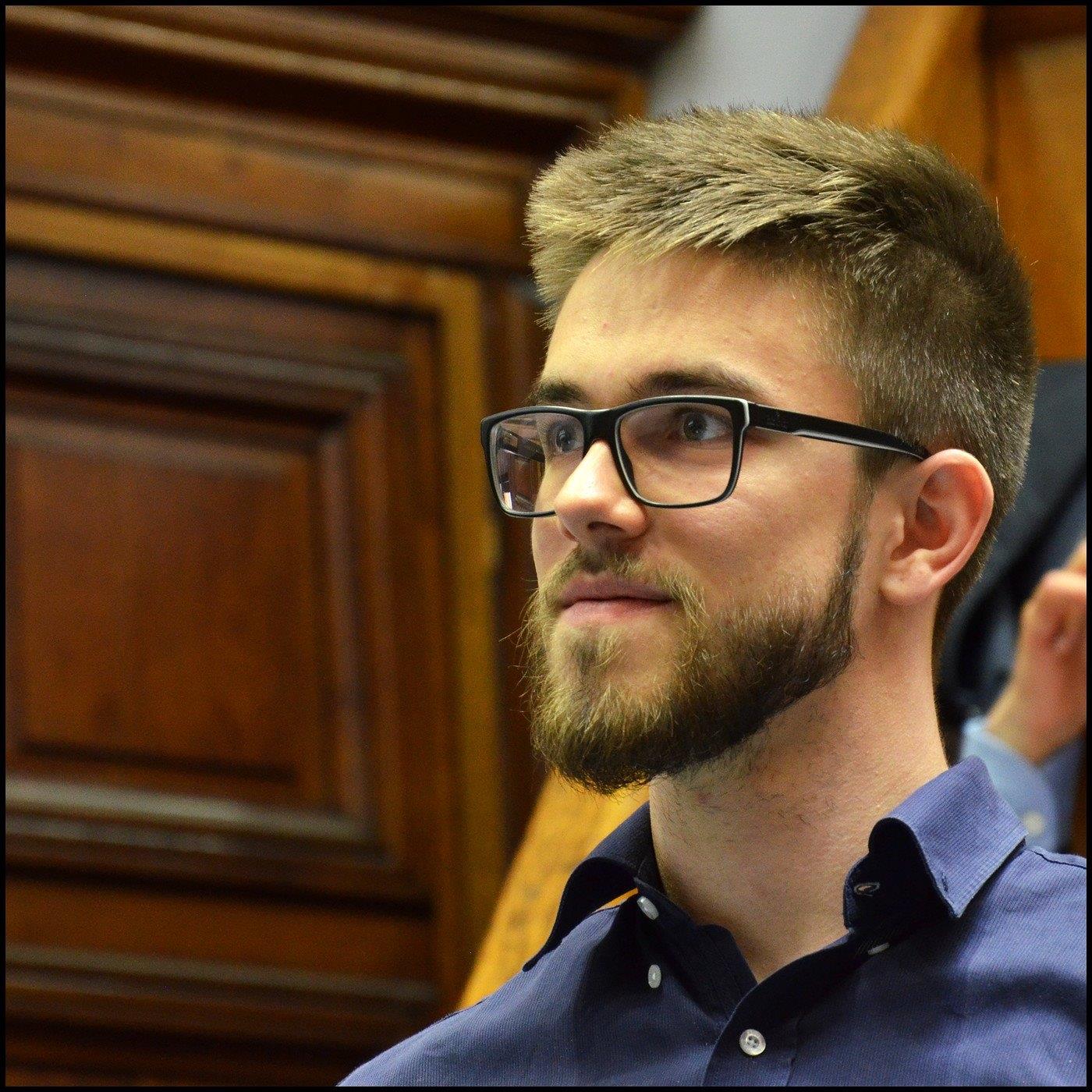
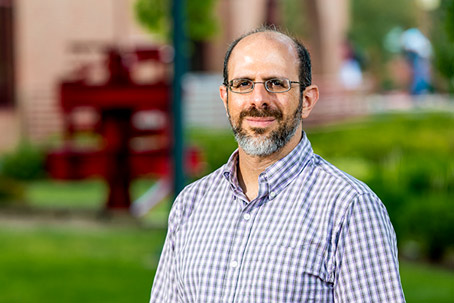
Alfonso Di Bartolo is a Researcher at the Department of Mathematics and Computer Science , University of Palermo. His work focuses on algebraic structures, particularly Lie and Leibniz algebras, algebraic groups, and number theory. He holds regular office hours on Thursdays from 3:00 PM to 5:00 PM in Studio 107, Via Archirafi 34, Palermo. Role: Researcher Department: Mathematics and Computer Science Contact: alfonso.dibartolo@unipa.it Office Hours: Thursdays 3:00 PM–5:00 PM His research spans topics like solvable/nilpotent algebras, biderivations, affine mappings, and p-adic integers. Publications highlight classifications of Lie algebras, transformations groups, and applications to number theory. No scientific awards or student advisement details are provided in the text.
Gregorio Baldi is a Research Fellow (Chargé de Recherche) at the French National Center for Scientific Research (CNRS), affiliated with the Institut de Mathématiques de Jussieu - Paris Rive gauche. His research centers on Arithmetic Geometry , with expertise in Shimura varieties, variational Hodge theory, and the Zilber-Pink conjecture. He also investigates connections between homogeneous dynamics, Teichmüller dynamics, and geometric Diophantine problems. Baldi has authored significant publications in premier mathematical journals, including: Annals of Mathematics (2023, 2025) Inventiones mathematicae (2024) Ergodic Theory and Dynamical Systems (2025) His recent work (2023–2025) focuses on Hodge loci distribution, non-arithmetic ball quotients, and o-minimality in Hodge theory, demonstrating consistent contributions to foundational problems in geometry and number theory.
Sharon M. Frechette is an Associate Professor in the Department of Mathematics & Computer Science at the College of the Holy Cross, where she teaches across the undergraduate curriculum and develops innovative interdisciplinary seminars. Her educational background includes: Ph.D. in Mathematics from Dartmouth College (1997), thesis: "Decomposition of Spaces of Half-Integral Weight Cusp Forms" under Thomas Shemanske A.M. from Dartmouth College (1994) B.A. from Boston University (1988) with senior thesis advised by Paul Blanchard Frechette's research bridges number theory and combinatorics, with deep investigations into modular forms, L-functions, multiple Dirichlet series, and hypergeometric functions over finite fields. She explores connections between algebraic combinatorics and representation theory, and examines the relationship between elliptic curves and modular forms. Her work often reveals combinatorial structures within analytic number theory problems, particularly through the lens of Hecke operators and their traces. Analysis of her publication timeline (2000-2018) shows evolution from foundational work on half-integral weight modular forms to sophisticated studies of multiple Dirichlet series and finite-field hypergeometric functions, with consistent emphasis on combinatorial interpretations of number-theoretic objects. As an educator, Frechette has created the distinctive Montserrat cryptology sequence combining historical narrative with mathematical rigor, and regularly teaches advanced courses like Modern Algebra and Number Theory. Her commitment to undergraduate research is evident through supervision of senior theses and development of course-based research opportunities.
Jérémy Le Borgne is an Assistant Professor in the Department of Mathematics at ENS Rennes, where he has held faculty positions since 2012. He is a core member of IRMAR's Geometry and Effective Algebra Team, contributing to France's national mathematics research infrastructure through this CNRS-affiliated institute. His dual role encompasses advanced teaching from undergraduate to Agrégation levels and active research at the intersection of algebra, geometry, and computation. His educational foundation includes: ENS Cachan - Antenne de Bretagne (2005-2009) PhD in Mathematics, University of Rennes 1 (2009-2012), supervised by Xavier Caruso and David Lubicz Le Borgne's research pioneers computational approaches to arithmetic geometry, with seminal work on Ore polynomials enabling breakthroughs in Gabidulin code construction for error correction. His investigations into p-adic Galois representations bridge number theory and algorithm design, while recent studies of Hall bases for free Lie algebras reveal deep combinatorial structures applicable to differential equations. This tripartite focus creates synergies between theoretical mathematics and practical computation. Analysis of his 2010-2023 publications reveals consistent progression from foundational number theory (Ax-Sen-Tate theorem optimization) toward increasingly computational work, with 2022-2023 papers emphasizing algorithmic Lie algebra structures and nonlinear system expansions. His research demonstrates strong continuity in non-commutative algebra applications while expanding into new combinatorial territories. No formal awards are documented in public materials, though his publication record in high-impact journals like Journal of Algebra and Comptes Rendus Mathématique indicates peer recognition. His teaching portfolio spans advanced algebra courses and Agrégation preparation, with documented outreach including Lebesgue lectures and Olympiad training. As a research supervisor, Le Borgne integrates students through IRMAR's collaborative environment, though specific advisee counts aren't public. His Geometry and Effective Algebra Team provides infrastructure for computational mathematics projects, with recent work suggesting active funding for skew polynomial and Lie algebra research. The lab maintains close ties with University of Rennes 1's mathematics department, facilitating resource sharing across Rennes' academic ecosystem.
Joshua Brandon Holden is a Professor of Mathematics at Rose-Hulman Institute of Technology, where he has established himself as an expert in number theory and cryptography. His work bridges theoretical mathematics with practical cryptographic applications, and he has contributed significantly to both academic research and educational initiatives at the institution. Education: PhD in Mathematics from Brown University (1998) AM in Mathematics from Brown University (1994) AB in Mathematics from Harvard University (1992) Dr. Holden's research focuses on computational number theory, discrete logarithms, algebraic number theory, and applications of number theory to cryptography. His work explores the mathematical foundations of cryptographic systems, with particular attention to the discrete exponential function and its properties. He has also pioneered interdisciplinary connections between mathematics, computer science, and art through his investigations of braids, cables, and weaves using mathematical models. His research demonstrates how pure mathematical concepts can have practical applications in information security and artistic patterns. Dr. Holden's publication record reveals a consistent focus on the intersection of mathematics and cryptography, with a special emphasis on educational applications. His work spans theoretical investigations of number-theoretic concepts, practical cryptographic implementations, and innovative approaches to teaching complex mathematical ideas. A notable trend in his research is the connection between abstract mathematical structures and tangible real-world applications, including secure communication systems and artistic patterns. Scientific Awards: Honorary Member of Upsilon Pi Epsilon (2008) Best Paper in Mechanical Engineering Division at ASEE Annual Conference (2005) Dr. Holden has led National Science Foundation-funded research projects exploring discrete logarithms and has served as a cryptography consultant for Vadium Technology, Inc. since 2003. He has advised numerous student projects and theses in mathematics and cryptography. Additionally, he has played a leadership role on campus by chairing the committee on integrating classroom technology, demonstrating his commitment to innovative teaching methods and educational technology. His book 'The Mathematics of Secrets: Cryptography from Caesar Ciphers to Digital Encryption' has made complex cryptographic concepts accessible to a broader audience. While specific laboratory information isn't provided in the text, Dr. Holden's work with wireless tablet PCs and mathematical software suggests he has been involved in developing technology-enhanced learning environments. His research on braids and cellular automata also indicates interdisciplinary collaborations that bridge mathematics with computer science and artistic applications.
Matt Stokes serves as a Visiting Assistant Professor of Mathematics at Randolph College, joining the institution for the 2023-24 academic year. A native of Arizona, he completed all his formal education at Arizona State University, earning his PhD in Mathematics in 2023. His research focuses on Number Theory , particularly Iwasawa Theory and p-adic Numbers , inspired by coursework under advisor Nancy Childress. Stokes emphasizes an interactive teaching philosophy where he "likes to ask a lot of questions" and ensures students feel comfortable with confusion as part of the learning process. He was drawn to Randolph by its close-knit academic community and opportunities for meaningful student-professor interaction. Outside academia, Stokes maintains active hobbies including hiking, camping, walking, and drumming, while identifying research as his primary passion.