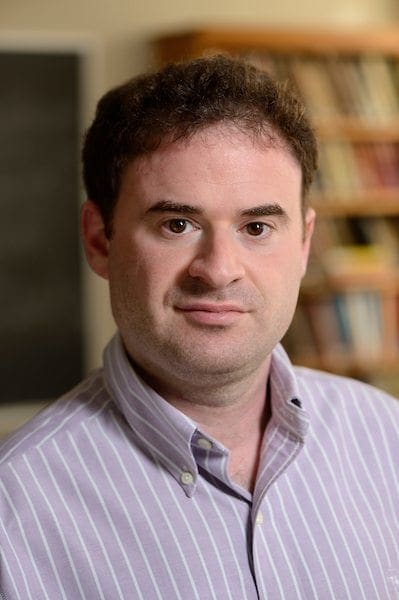
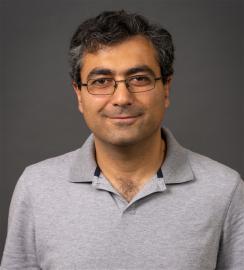
Henri Darmon is a Distinguished James McGill Professor in the Department of Mathematics and Statistics at McGill University, affiliated with the Centre Interuniversitaire en Calcul Mathématique Algébrique (CICMA) and the Centre de Recherches Mathématiques (CRM). He holds citizenships of Canada, France, and Switzerland. His research focuses on algebraic number theory, particularly elliptic curves, modular forms, and L-functions, with contributions to the Birch and Swinnerton-Dyer conjecture and Stark conjectures. Education: B.Sc. Mathematics & Computer Science, McGill University (1987) Ph.D. Mathematics, Harvard University (1991) Key Positions: Director of CICMA (1998–2024) Editorial roles at journals like Commentarii Mathematici Helvetici and Transactions of the AMS Organizer of major conferences including CNTA, ICM satellite events, and thematic programs at MSRI and CRM Research Interests: Stark-Heegner points and Euler systems p-adic L-functions and Iwasawa theory Arithmetic of modular curves and Shimura varieties His work bridges analytic and algebraic approaches to number theory, emphasizing computational and geometric methods.
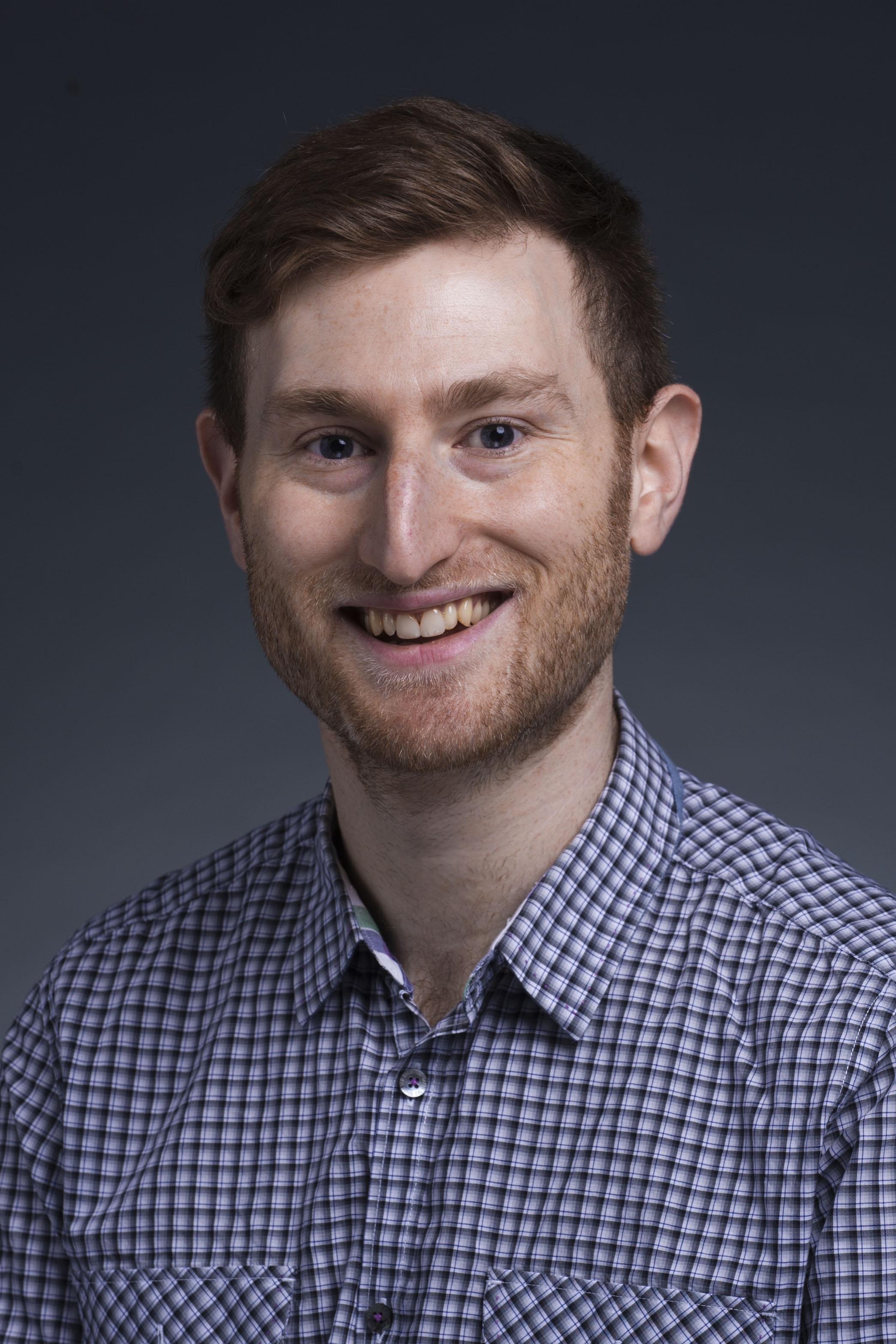
Sean Howe is an Assistant Professor in the Department of Mathematics at the University of Utah, where he has been employed since July 2019. His research is supported by NSF grants DMS-2201112 and DMS-2501816. In the academic year 2023-2024, he was a Friends of the Institute for Advanced Study Member at the special year on p-adic arithmetic geometry at the Institute for Advanced Study. Dr. Howe received his PhD from the University of Chicago in 2017 under the supervision of Matt Emerton. Prior to his position at Utah, he was an NSF Postdoctoral Scholar at Stanford University from September 2017 to June 2019. He earned a joint master's degree from Leiden University and Universite Paris-Sud 11 through the ALGANT program in 2012 and completed his undergraduate studies at the University of Arizona. Dr. Howe's research spans arithmetic and algebraic geometry, representation theory, and number theory, with a particular focus on p-adic aspects. His work often explores the connections between geometry and number theory through the lens of p-adic methods, including p-adic Hodge theory, perfectoid spaces, and the Langlands program. He has made significant contributions to understanding cohomological structures in mixed characteristic settings, the geometry of moduli spaces, and the statistical properties of L-functions. His extensive publication record demonstrates a strong trajectory in advancing p-adic geometry and its applications. Recent work shows increasing focus on cohomological smoothness in mixed characteristic, p-adic periods, and the interplay between random matrix theory and arithmetic statistics. His research often bridges abstract theoretical frameworks with concrete computational approaches. NSF Postdoctoral Scholar NSF grants DMS-2201112 and DMS-2501816 Dr. Howe is an active mentor, currently advising five PhD students: Minhua Cheng, Madison Delmoe, Shea Engle, Abhay Goel, and Suo Jun Tan. He has successfully graduated two PhD students: Matthew Bertucci (2025) and Hanlin Cai (2024). He also regularly mentors undergraduate researchers, with notable projects including Emil Geisler's work on stable multiplicities in configuration space cohomology and Daniel Koizumi's software for computing braid monodromy of cubic surfaces. His teaching portfolio includes advanced courses in algebraic topology, number theory, and algebra, reflecting his broad expertise across pure mathematics. He has taught courses such as Math 6950 (Topics in Algebraic Topology), Math 4400 (Introduction to Number Theory), and Math 6320 (Modern Algebra II).
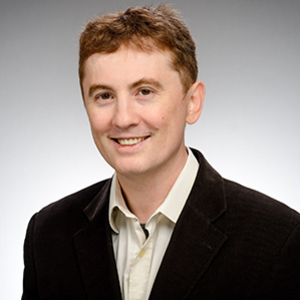
David Savitt is a Professor and Chair of the Department of Mathematics at Johns Hopkins University, affiliated with the Krieger School of Arts & Sciences. His research focuses on algebraic number theory, with emphasis on Galois representations, modular forms, and p-adic Hodge theory. He holds a PhD from Harvard University and has served on the board of directors for Canada/USA Mathcamp, a summer program for high school students. His work spans theoretical contributions to arithmetic geometry, including studies on moduli stacks of Galois representations and geometric aspects of the p-adic Langlands program. Education: PhD in Mathematics from Harvard University. Research interests include the interplay between Galois representations and modular forms, p-adic Hodge theory, and moduli spaces. His recent work explores geometric structures in the Emerton-Gee stack and the Breuil-Mézard conjecture. Over 20 years of research has produced influential papers on topics like Serre weight conjectures and crystalline lifts of Galois representations. Professional contributions include editorial roles for journals and books, such as co-editing p-adic Geometry: Lectures from the 2007 Arizona Winter School . His involvement with Mathcamp highlights his dedication to nurturing young talent in mathematics.
Patrick Allen is an Associate Professor in the Department of Mathematics and Statistics at McGill University, where he contributes to research in number theory and related fields. He is affiliated with the Montreal Number Theory Group and the Centre Interuniversitaire en Calcul Mathématique Algébrique (CICMA), focusing on areas such as Galois representations, automorphic forms, and algebraic number theory. His work bridges algebraic geometry and arithmetic, with a particular emphasis on modularity lifting theorems and deformation theory. Allen's research interests include the study of CM fields, modular forms, and elliptic curves, alongside investigations into the Langlands program and p-adic methods. He has published extensively on topics such as potential automorphy, monodromy, and adjoint Selmer groups. His contributions address questions in arithmetic algebraic geometry and cohomological automorphic forms, often intersecting with representation theory. While his articles span over 20 years, recent work (2020–2023) emphasizes the modularity of Galois representations over CM fields and the application of automorphic techniques to solve problems in number theory. Allen’s research often involves collaboration with international experts in algebraic number theory and arithmetic geometry. Scientific Awards: None explicitly listed in the provided materials. Advising & Grants: No formal advisees or grant details are listed in the text. His affiliations with CICMA suggest participation in collaborative research initiatives, though specific grants are not mentioned. Labs/Teams: Active member of the Montreal Number Theory Group and CICMA, contributing to inter-university collaborative projects in algebraic number theory.
Raphaël Beuzart-Plessis is a CNRS Research Fellow affiliated with Aix-Marseille University and the Institute of Mathematics of Marseille (I2M) at Luminy Campus. He specializes in advanced areas of mathematics, including harmonic analysis, automorphic forms, representation theory, and number theory, with a focus on unitary groups and conjectures like Gan-Gross-Prasad. His work bridges algebraic geometry, differential geometry, and operator theory. Arithmetic, Geometry, Logic and Representations Group (AGLR) 2022-2027 ERC RELANTRA grant recipient Research interests span automorphic representations, L-functions, periods of automorphic forms, and harmonic analysis on real spherical spaces. He works extensively on the local and global Gan-Gross-Prasad conjectures, endoscopy, and supercuspidal representations. His recent publications analyze Plancher1el formulas, spherical characters, and congruences of automorphic forms. His 15 most recent publications (2014-2022) address topics such as the Gan-Gross-Prasad conjecture, Jacquet-Rallis's fundamental lemma, and the Asai Rankin-Selberg integrals. These works reflect his expertise in automorphic forms, representation theory, and number theory, often involving collaborations with leading mathematicians. 2016-2017 Peccot Prize for young mathematicians under 30 2022-2027 ERC RELANTRA grant for research in automorphic forms and representation theory Beuzart-Plessis has no listed students or laboratory teams but participates in the AGLR-RGR (Reduction Group Representations) team and has been an invited speaker at the 2022 International Congress of Mathematicians. His career includes guest lectures at Collège de France, including four sessions on Period factorizations and Plancherel formulas in 2017.
Elena Mantovan is the Taussky-Todd-Lonergan Professor of Mathematics at the California Institute of Technology (Caltech), within the Department of Mathematics under the Division of Physics, Mathematics and Astronomy. She holds a Laurea from the University of Padova (1995), an M.A. from Harvard University (1998), and a Ph.D. from Harvard (2002). Her research focuses on Arithmetic Geometry and Number Theory, particularly the study of moduli spaces of abelian varieties, Barsotti-Tate groups, and the arithmetic theory of Shimura varieties. Her work contributes to the Langlands program, exploring connections between automorphic forms and Galois representations. Elena joined Caltech as an Assistant Professor in 2005, advancing to Associate Professor (2010), full Professor (2010-2023), and her current title (2023-). She served as Executive Officer for the Department of Mathematics from 2016 to 2019. Her research interests emphasize Shimura varieties, Newton stratifications, and cohomological studies, reflecting her expertise in algebraic geometry and number theory. Despite no listed awards, her scholarly contributions include foundational work on Rapoport-Zink spaces and Igusa varieties. Elena’s advising and grants are not explicitly detailed in the provided texts, though her role as an academic leader suggests involvement in mentorship and institutional projects. She maintains an office in Sloan Hall and collaborates on initiatives like the Southern California Number Theory Day Conference and the Number Theory seminar.
Frank Calegari is a Professor of Mathematics at the University of Chicago. His primary research interests include algebraic number theory, the Langlands program, Galois representations, and arithmetic geometry. He has made significant contributions to understanding reciprocity laws linking Galois representations to automorphic forms. His work often intersects with cohomology of arithmetic groups, motives, and the arithmetic of periods. Prof. Calegari has advised numerous PhD students, including Maria Stadnik, Shiva Chidambaram, and Eric Stubley. He serves on editorial boards for prestigious journals such as Algebra & Number Theory, Essential Number Theory, and the Annals of Mathematics. He actively participates in academic conferences and programs, including organizing the 2020 Arithmetic of the Langlands Program in Bonn. His research spans modularity theorems for abelian varieties, cohomology of arithmetic groups, and the study of L-functions. Key recent work includes resolving the unbounded denominators conjecture and advancing potential automorphy results over CM fields. Calegari frequently collaborates with leading mathematicians, including George Boxer, Vincent Pilloni, and Yilin Yang. He teaches advanced courses such as Honors Calculus (Math 16100) at the University of Chicago. His expository work includes lecture notes on motives and L-functions, as well as a blog compiling mathematical insights (Persiflage). Calegari’s contributions to number theory have been recognized through his editorial roles and invited lectures at institutions like the ICM and Clay Mathematics Institute.
Jared Weinstein is a Professor in the Department of Mathematics and Statistics at Boston University, serving as the Departmental Ombud. He specializes in Number Theory and Algebraic Geometry, with a focus on p-adic geometry, shtukas, and moduli spaces. His research explores connections between arithmetic geometry and homotopy theory, including contributions to the Langlands program and local Shimura varieties. Education: AB from Harvard University (undergraduate), PhD from University of California, Berkeley. Postdoctoral work at UCLA and the Institute for Advanced Study before joining BU in 2011. Research interests include arithmetic geometry, p-adic Hodge theory, and the geometry of moduli spaces. His work often intersects with topics like perfectoid spaces, diamonds, and chromatic homotopy theory. Recent articles highlight advancements in modularity of elliptic curves over function fields and the Kottwitz conjecture for local shtuka spaces. No scientific awards are explicitly listed, but his extensive publications reflect significant contributions to his field. Advising and grants details are not provided here. His work is closely tied to the v-topology and related geometric frameworks in algebraic geometry.
Andrei Jorza is an Associate Professor of the Practice in the Department of Mathematics at the University of Notre Dame. His research focuses on the interplay between number theory and algebraic geometry, including topics such as modular forms, Galois representations, p-adic Hodge theory, and arithmetic geometry. He holds an A.B. from Harvard University (2005) and a Ph.D. from Princeton University (2010), advised by Andrew Wiles. Prior to his current position, he was a Taussky-Todd Instructor at Caltech and a member of the Institute for Advanced Study (IAS). Dr. Jorza has taught advanced courses on p-adic Hodge theory, global class field theory applications, algebraic number theory, and graduate algebra. His work includes significant contributions to computational verification of the Birch and Swinnerton-Dyer conjecture and studies on Galois representations for Siegel modular forms. His research also extends to topics like Lagrangian hyperplanes in holomorphic symplectic varieties and eigenvarieties in automorphic forms. He is affiliated with Notre Dame's Department of Mathematics, located in 275 Hurley Hall, and actively participates in seminars on algebraic geometry and commutative algebra. His lecture notes and courses reflect a deep engagement with foundational topics in number theory and algebra, emphasizing adelic methods and applications of class field theory.
Prof. Dr. Peter Schneider is a faculty member at the University of Münster, affiliated with the Faculty of Mathematics and Computer Science and the Department of Mathematics and Computer Science . He is a principal investigator in the CRC 1442 Geometry: Deformations and Rigidity and contributes to the Mathematics Münster cluster. University: University of Münster School: Faculty of Mathematics and Computer Science Department: Department of Mathematics and Computer Science Academic Rank: Professor His research focuses on arithmetic geometry and representation theory , particularly the p-adic Langlands program , cohomology theories in mixed characteristics, and noncommutative algebraic structures. He investigates derived categories of p-adic representations, moduli spaces of Galois representations, and geometric approaches to automorphic forms. He has supervised numerous students, including Torsten Schoeneberg (2009), Marten Bornmann (2009), and Marius Kley (2016, 2019). His collaborative works with Rachel Ollivier, Otmar Venjakob, and Marie-France Vigneras explore modular Hecke algebras, Iwasawa theory, and (phi, Gamma)-modules. Emails: pschnei@wwu.de pschnei@uni-muenster.de Workshops Organized: Noncommutative Algebras (2006) Instructional workshop on noncommutative main conjectures (2011) International workshop on K-types for p-adic groups (2003)
Gyujin Oh is a Ritt Assistant Professor in the Department of Mathematics at Columbia University's Faculty of Arts and Sciences. He received his PhD in mathematics from Princeton University in 2022 under the supervision of Christopher Skinner and Akshay Venkatesh. Prior to joining Columbia, he was a postdoctoral member of the SLMath/MSRI program Algebraic Cycles, L-Values, and Euler Systems in Spring 2023. Dr. Oh's research spans multiple areas of number theory and arithmetic geometry. His primary interests include Algebraic Number Theory, the Langlands Program, Modular Forms, Galois Representations, and Arithmetic Geometry. His work often bridges classical number theory with modern geometric approaches, exploring connections between automorphic forms, cohomology theories, and arithmetic structures. He has made contributions to understanding rigid local systems, the Néron-Ogg-Shafarevich criterion, and various aspects of the Langlands correspondence. His recent publications demonstrate a strong focus on advanced topics in number theory, particularly exploring the intersection of modular forms, Shimura varieties, and Galois representations. His work on generalized Whittaker models, moduli stacks of crystals, and arithmetic quantum local systems reflects his interest in both classical and cutting-edge approaches to number-theoretic problems. The pattern in his research shows a consistent theme of connecting geometric structures with arithmetic phenomena. Dr. Oh is an active educator who has developed comprehensive lecture notes for both undergraduate and graduate courses in Algebraic Number Theory. In Spring 2025, he is teaching Graduate Algebraic Number Theory (MATH GR6657) at Columbia University, covering local and global class field theory, Langlands program connections, and related advanced topics. He has also been involved in organizing and participating in numerous learning seminars including the Moduli of Langlands Parameters seminar, Theta learning seminar, and Deformation theory learning seminar.
Florian Herzig is a Professor in the Department of Mathematics at the University of Toronto. His research focuses on Number Theory and Representation Theory, particularly mod p and p-adic representations of reductive groups. Education: Ph.D., Harvard University Certificate of Advanced Study in Mathematics (Part III), University of Cambridge B.A., University of Cambridge Research Interests: Herzig works on modular and p-adic representations, with applications to the Langlands program. His work explores Serre-type conjectures, local-global compatibility, and cohomology of Shimura varieties. Scientific Awards: He was named a Fellow of the American Mathematical Society in 2025. Publications & Collaborations: Herzig has co-authored major works with Christophe Breuil, Yongquan Hu, and Benjamin Schraen. His research appears in leading journals like Inventiones Mathematicae and Duke Mathematical Journal. Teaching & Seminars: He has taught graduate courses on linear algebraic groups and p-modular representations. He participates in the Arizona Winter School and international workshops on representation theory.
Bence Hevesi is a MathInGreaterParis Postdoctoral Fellow at the Laboratoire de Mathématiques d'Orsay, affiliated with Université Paris-Saclay. Previously, he completed his PhD (2020–2023) at the London School of Geometry and Number Theory (LSGNT), a collaboration between King's College London, Imperial College London, and University College London. His primary supervisor during his PhD was Professor Fred Diamond, with additional supervision by Ana Caraiani. He holds a Master's degree in Mathematics, supervised by David Hansen, focusing on the Geometry of the de Rham affine Grassmannian . Research Interests: Bence specializes in Number Theory, particularly the Langlands program. His work explores global and p-adic aspects, including automorphic forms, Galois representations, and arithmetic geometry. He actively contributes to advancing methodologies in p-adic Hodge theory and representation theory. Publications/Preprints: His recent preprint, Ordinary parts and local-global compatibility at l=p , reflects his engagement with cutting-edge topics in number theory. This work bridges local and global perspectives in the Langlands program, with implications for understanding p-adic structures in arithmetic geometry. Awards & Grants: No specific awards or grants are mentioned, but his postdoctoral fellowship under MathInGreaterParis highlights institutional recognition of his research potential. His PhD at LSGNT was supported by the UK's Engineering and Physical Sciences Research Council (EPSRC). Labs & Collaborations: Based at Laboratoire de Mathématiques d'Orsay, he collaborates with leading researchers in arithmetic geometry and number theory. His work intersects with CNRS and international networks, fostering interdisciplinary advancements in algebraic number theory.
Pierre Colmez is a French mathematician affiliated with the École Polytechnique (1993-2010) and the National Center for Scientific Research (CNRS) at the Institut de Mathématiques de Jussieu since 2010. His academic journey includes postdoctoral positions at the Institut Joseph Fourier (Grenoble) and the Max Planck Institute for Mathematics (Bonn). Ph.D. in 1988 (Grenoble) under Jean-Marc Fontaine and John Coates École Polytechnique: Professor (2006-2010), Teaching Professor (1993-2005) Colmez’s research lies at the intersection of arithmetic geometry , Galois representations , p-adic Hodge theory , and the Langlands program . His work explores connections between automorphic forms, p-adic analysis, and cohomological structures in number theory. His most recent publications focus on p-adic cohomology, Drinfeld towers, and syntomic complexes, reflecting his expertise in advanced topics of nonarchimedean geometry and Galois cohomology . Collaborations with Gabriel Dospinescu and Wiesława Nizioł highlight his contributions to modern arithmetic geometry. Prix Léonid Frank (2016) Aisenstadt Chair (2015) Prix Fermat (2005) Prix Gabrielle Sand et Guido Triossi (1999) Colmez has held editorial roles at Astérisque (1999-2004), directed the SMF Mathematical Documents collection (2001-2016), and served on editorial boards for Annales de l'ENS and Publications de l'IHES . His academic network includes collaborations with Laurent Berger, Christophe Breuil, and Jean-Pierre Serre.
Alireza Salehi Golsefidy is a Professor in the Department of Mathematics at the University of California, San Diego (UCSD). He received his Ph.D. from Yale University under Gregory Margulis, a Fields Medalist. His research focuses on algebraic, arithmetic, and analytic properties of linear groups, homogeneous dynamical systems, and expander graphs. He has held positions at Princeton University and the Institute for Advanced Study as a Veblen Research Instructor before joining UCSD in 2011. Education: Ph.D. in Mathematics, Yale University (2006). Research Interests: His work bridges discrete subgroups of Lie groups, homogeneous dynamics, and number theory. Recent contributions include studies on super-approximation, spectral independence, and geometric group theory. He has organized workshops on thin groups, arithmetic groups, and homogeneous dynamics at MSRI and Oberwolfach. Grants & Awards: Alfred P. Sloan Research Fellowship (2012), Clay Liftoff Award (2006), NSF grants 1602137, 1902090, and 2302519. His research explores applications of expander graphs and random walks in algebraic structures. Teaching: Currently teaching Algebra (Math 200C) in Spring 2025. Past courses include advanced algebraic topology, representation theory, and graduate-level number theory. Labs/Teams: Co-organizes UCSD's Algebra Seminar and contributed to the 2013 Lie Theory Workshop. Active in collaborative projects on group actions and automorphic forms.