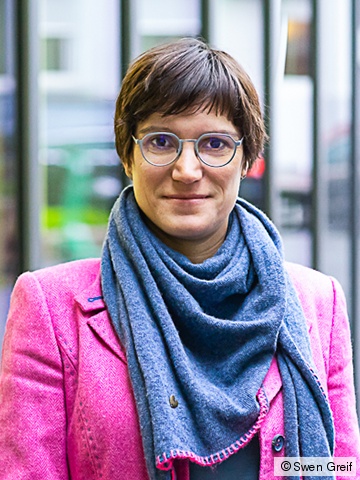
Prof. Dr. Miriam Peters is a Professor for Clinical Nursing at the Frankfurt University of Applied Sciences , Department 4: Social Work & Health. She serves as the Internationalization Officer for Nursing and Health and focuses on digital learning tools in nursing education, research project coordination, and clinical teaching. Education: Master of Science in Nursing (2015, PTHV), Postgraduate doctorate (2021, PTHV), Diploma in Business Administration (2006-2012, Fernuniversität Hagen) Research Interests: Digital learning in nursing, technology integration in geriatric care, educational policy, and competency measurement using mixed-methods designs. Projects: Led federal research programs on nursing education, coordinated GaBaLEARN (game-based learning) and ITAGAP (technology in home care). Currently teaches modules in acute care, digestive/hepatology nursing, and healthcare management. Publications: Authored 15+ works on digital learning analytics, tracking systems for dementia patients, and competency frameworks in nursing education. Key collaborations include studies on ambulatory care innovation and ethical aspects of digital learning.
Stephen J. Lepore is Professor and Chair of the Department of Social and Behavioral Sciences at the College of Public Health, Temple University. He also holds a Member position in the Cancer Prevention and Control program at Fox Chase Cancer Center, reflecting his strong interdisciplinary and translational research profile. His research focuses on behavioral oncology, cancer prevention, survivorship, and health disparities, with a particular emphasis on developing and testing evidence-based interventions for vulnerable populations. He is the originator of the Social Cognitive Processing Model, which examines how interpersonal relationships affect psychological adjustment in cancer patients. His work frequently integrates digital health technologies such as mobile apps, text messaging, and online platforms to enhance intervention accessibility and effectiveness. The trends in his recent publications highlight a sustained focus on tobacco control among low-income families, sexual health communication in breast cancer care, and the use of mHealth tools to support behavior change. His studies often employ rigorous methodologies including randomized controlled trials, mediation analyses, and psychometric validation, and are published in top-tier journals across public health, psychology, and oncology. His scientific honors include being a Fellow of the Society of Behavioral Medicine, receiving awards from the American Psychological Association and the Society of Behavioral Medicine, and earning a Fulbright Award. He has served as a charter member of the NIH Behavioral Medicine Interventions study section, underscoring his national leadership in the field. Fellow of the Society of Behavioral Medicine American Psychological Association Award Society of Behavioral Medicine Award Fulbright Award Dr. Lepore has led multiple federally and privately funded research projects over several decades, particularly in tobacco control, cancer survivorship, and behavioral interventions. While specific PhD or Master’s students are not listed, his extensive collaborative work suggests mentorship of junior researchers and trainees. His grants have supported large-scale trials such as the Kids Safe and Smokefree (KiSS) and Babies Living Safe and Smokefree (BLiSS) interventions. His work is closely tied to clinical and community settings, particularly through partnerships with WIC programs and cancer centers. His research teams are interdisciplinary, involving psychologists, public health scientists, oncologists, and implementation experts. Current and future work continues to expand the use of digital tools to reduce health disparities and improve outcomes in cancer prevention and control.
Vladena Bätge Jahn is a researcher at the Free University of Brussels , affiliated with the Faculty of Psychology and Educational Sciences and the Brussels Research Centre on Innovation in Learning and Diversity . Her work focuses on leveraging technology to enhance learning experiences. Research interests include: Mobile learning and digital literacy Use of audiobooks in higher education Student-centered teaching methodologies Asynchronous collaborative learning tools Negotiation mLearning modules Key publications explore affordances of audiobooks, evaluation frameworks for audio book clubs, and small group discussion games. She has actively participated in international conferences like ECPR General Conference and UNESCO Mobile Learning Week . Her research outputs span 2015–2022, with recent work emphasizing asynchronous learning environments and inclusive educational technologies. She collaborates with researchers such as Kristof Lombaerts and Wouter Jacquet .
Sokratis Nifakos is a Researcher at the Karolinska Institutet's Department of Learning, Informatics, Management and Ethics, with additional affiliation to the Health Informatics Centre. He holds a background in Medical Informatics from Karolinska Institutet (2012–2014). His research spans: Cybersecurity in healthcare : Developing risk management toolkits and cyber hygiene methodologies. Digital health education : Systematic reviews on mLearning efficacy and gamified training solutions. Health data interoperability : Ontology-driven approaches for HL7 FHIR standardization. Recent publications emphasize human factors in cybersecurity, emergency response optimization, and IoT integration in healthcare. No awards or supervised students are mentioned in the source material.