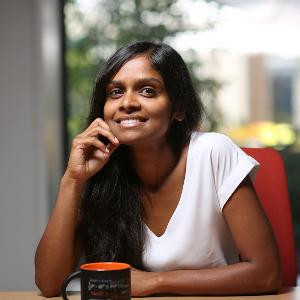
Shivaram Kalyanakrishnan is an Associate Professor at the Department of Computer Science and Engineering , Indian Institute of Technology Bombay , specialising in Artificial Intelligence and Machine Learning . His research spans sequential decision making , multiagent learning , multi-armed bandits , and humanoid robotics , with applications in robot soccer , computer games , and online advertising . He teaches advanced courses like CS 747: Foundations of Intelligent and Learning Agents and CS 748: Advances in Intelligent and Learning Agents , focusing on end-to-end system design and theoretical analysis. His scientific awards include the Best Student Paper Award at RoboCup International Symposium 2006 and nomination for Best Student Paper Award at AAMAS 2007 . His work on reinforcement learning and policy iteration has been published in leading venues such as IJCAI , ICML , and COLT , with recent contributions to railway scheduling and bandit algorithms. While no explicit list of advisees is provided, his research projects and publications suggest mentorship of students in collaborative efforts. Contact : shivaram@cse.iitb.ac.in .
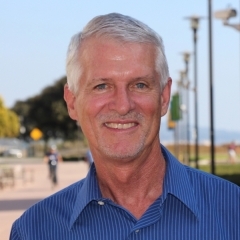
Sham Kakade is the Rampell Family Professor of Computer Science and Professor of Statistics at Harvard University, co-director of the Kempner Institute. His research focuses on advancing artificial general intelligence through foundational work in reinforcement learning, large-scale learning systems, and autonomous agent architectures. He earned his PhD in 2003 from the Gatsby Computational Neuroscience Unit at University College London. His work emphasizes scalable optimization algorithms, distributed systems for foundation models, and understanding emergent capabilities in neural architectures. Research interests include full-stack training pipelines for foundation models, mathematical principles of large-scale learning systems, and bridging language models with embodied intelligence. He advises prospective students with backgrounds in applied deep learning or theoretical computer science, offering access to the Kempner Institute's computational resources. He serves on committees for the ACM Prize in Computing and Sloan Research Fellowships, co-organizes the Simons Symposium on Theoretical Machine Learning, and chaired COLT 2011. His lab works at the intersection of theory and practice, addressing challenges in AI's societal impact and technical scalability. Labs/Teams: Co-directs the Kempner Institute, fostering collaborations between AI researchers and social scientists. Active in Harvard's SEAS community.
Kamalika Chaudhuri is a Professor in the Department of Computer Science and Engineering at the University of California, San Diego (UCSD), and also serves as a Director and Research Scientist with the FAIR team at Meta AI. Her research focuses on the foundations of trustworthy machine learning, including robust machine learning, learning with privacy, and out-of-distribution generalization. Dr. Chaudhuri has earned her PhD from UC Berkeley in 2007 with a dissertation on "Learning Mixtures of Distributions." Her academic journey has led her to become a leading researcher in machine learning theory with a particular emphasis on privacy and robustness. Her research interests span machine learning foundations with a strong focus on trustworthy AI . She investigates problems at the intersection of differential privacy , adversarial robustness , and out-of-distribution generalization . Her work addresses critical challenges in developing machine learning systems that maintain privacy while preserving utility, resist adversarial attacks, and generalize effectively beyond training data distributions. She has pioneered approaches in privacy-preserving machine learning, robust learning theory, and methods for detecting and mitigating data memorization in models. An analysis of her recent publications (2024-2025) reveals a strong focus on the intersection of privacy, security, and machine learning. Her work spans differential privacy mechanisms, membership inference attacks, memorization detection, and fairness certification. She has been particularly active in developing methods for privacy-preserving foundation models, with several papers on differentially private computer vision and language models. Her research demonstrates a consistent thread of addressing fundamental challenges in trustworthy AI while developing practical solutions that balance privacy, accuracy, and utility. Best Award at the ICLR 2024 Workshop on Privacy Regulation and Protection in Machine Learning Distinguished Paper Award at IEEE Conference on Secure and Trustworthy Machine Learning (SaTML), 2024 Dr. Chaudhuri has advised numerous PhD students who have gone on to prominent positions at Google, DeepMind, Microsoft Research, and other leading AI institutions. Her group maintains an active research blog with guest posts from UCSD researchers. She has served in significant leadership roles including General Chair for ICML 2022 and Program Co-Chair for both ICML 2019 and AISTATS 2019, where she pioneered initiatives to improve reproducibility in machine learning research. Her research group at UCSD focuses on trustworthy machine learning, with current projects spanning privacy-preserving AI, robustness against adversarial attacks, and methods for ensuring reliable out-of-distribution generalization. The group collaborates closely with the FAIR team at Meta AI, where Dr. Chaudhuri serves as a Research Scientist.
Henrik Sandberg is a Professor at the Division of Decision and Control Systems , KTH Royal Institute of Technology , Stockholm, Sweden. He holds the title of Deputy Head of Division and is affiliated with the School of Electrical Engineering and Computer Science . Education: MSc in Engineering Physics (1999) PhD in Automatic Control (2004) from Lund University Postdoctoral position at Caltech (pre-2007) Research Interests: Focus on cyber-physical systems security , power systems , model reduction , and fundamental limitations of control systems . Key sub-areas include attack detection , networked control , privacy-preserving estimation , and resilient control architectures . Publications: Over 150 papers across IEEE Transactions and Automatica , covering topics like stealthy attacks , distributed control , LQG optimization , and thermodynamic costs in filtering . Recent work includes LWE-based encrypted control and Bayesian deception mechanisms . Scientific Awards: Best Student Paper Award Finalist at IEEE CASE 2014; Best Student-Paper Award at IEEE CDC 2004. Grants & Projects: Leads the DYNACON project (WASP Cybersec cluster) and collaborates on CERCES (critical infrastructure resilience). Serves as examiner for multiple advanced courses in cybersecurity and control systems. Contact: Email: hsan@kth.se Phone: +46 (0)8 790 7294 Room: A:607, Malvinas Väg 10, Stockholm
Daniel Dominic Kaplan Sleator is a Professor of Computer Science at Carnegie Mellon University's School of Computer Science. He maintains an office in the Gates-Hillman Center (7205 Gates-Hillman) and teaches various courses in algorithms and theoretical computer science. Professor Sleator's research spans several areas of theoretical computer science and algorithms. His primary interests include: Algorithms and Data Structures Amortized Analysis and Competitive Analysis Persistent and Self-Adjusting Data Structures Computational Geometry and Combinatorial Optimization Combinatorial Game Theory and Mathematical Games Music Analysis using Computational Methods His extensive publication record shows a consistent focus on efficient data structures and algorithms. Over the years, his work has evolved from foundational data structures like splay trees and skew heaps to applications in diverse areas such as music analysis and combinatorial games. A notable trend in his work is the development of self-adjusting data structures that achieve excellent amortized performance without maintaining explicit structural constraints. His papers on splay trees, skew heaps, and persistent data structures have become classics in the field. Professor Sleator has made significant contributions across multiple domains of computer science. His work on competitive algorithms for paging and list update problems has been particularly influential, establishing fundamental results in online algorithms. His research extends beyond traditional computer science into interdisciplinary areas like computational music theory, demonstrating the broad applicability of algorithmic thinking. He teaches a variety of courses including Algorithms 15-451/651, Competition Programming 15-295, and specialized topics like mathematical games.
Nina Balcan is a Professor at Carnegie Mellon University and holds the Cadence Design Systems Professorship in Computer Science. She is affiliated with the School of Computer Science, specifically the Machine Learning Department (MLD) and Computer Science Department (CSD). Her research spans foundational aspects of machine learning, artificial intelligence, theoretical computer science, algorithmic game theory, and interdisciplinary connections in learning theory. Machine Learning Artificial Intelligence Theoretical Computer Science Algorithmic Game Theory Multi-Agent Systems Data-Driven Algorithm Design Her recent work focuses on advancing algorithm design through machine learning, robustness in adversarial environments, and economic modeling. Key contributions include Learning to Branch (JACM 2024), Regret Minimization in Stackelberg Games (NeurIPS 2024), and Learning Accurate Decision Trees (UAI 2024, Outstanding Student Paper Award). She has pioneered novel approaches to data-driven optimization, semi-supervised learning, and privacy-preserving clustering. Nina has received prestigious accolades including ACM Fellow AAAI Fellow Simons Investigator 2019 ACM Grace Murray Hopper Award Her teaching at CMU includes graduate courses on machine learning, advanced machine learning, and specialized topics like algorithmic game theory.
Dr. Liang Cheng is the Department Chair and Professor in the Department of Electrical Engineering and Computer Science at the University of Toledo. He leads a department with ~700 students across CS, CSE, and EE programs. His research focuses on Cyber-Physical Systems (CPS), IoT, AI/ML, and intelligent infrastructure, supported by over $30M in funding from NSF, DOE, DOT, and industry. Notable projects include CPS Breakthrough initiatives and underground sensing systems. He co-edited a multidisciplinary book on Underground Sensing and contributed to smart grid cybersecurity. Dr. Cheng has held leadership roles at Lehigh University, shaping faculty governance and equity policies. His 100+ publications span networking, real-time systems, and sensor networks. He advises on funded projects totaling $30M+ and has pioneered pedagogical approaches in computer science education. Research Interests: Cyber-Physical Systems (CPS): Focuses on autonomous drones, energy systems, and real-time infrastructure Networking: Expertise in TSN, DTN, and wireless protocols Cybersecurity: SCADA systems, PLC attack detection, and blockchain energy modeling Underground Sensing: Geo-sensing via wireless signals and subsurface tomography Grants & Projects: Over 20 sponsored projects including NSF CPS Breakthrough (2018-2023), ABB smart grid projects, and DARPA-funded EDIFY systems. Key contributions include reconfigurable wireless architectures and network calculus tools for real-time systems. Teaching: Courses span senior design, compiler design, parallel computing, and wireless sensor networks. Developed pedagogical patterns for non-CS programming education. Awards: Recognized for leadership in academic governance and interdisciplinary research collaboration.
Shipra Agrawal is an Associate Professor at the Department of Industrial Engineering and Operations Research, Columbia University, with affiliations to the Data Science Institute and the Department of Computer Science. Her research bridges optimization and machine learning, focusing on decision-making in uncertain environments. PhD in Computer Science from Stanford University (2011) Researcher at Microsoft Research India (2011–2015) Her work addresses online optimization , reinforcement learning , and game theory , aiming to develop algorithms that balance exploration and exploitation for long-term goals. Applications include internet advertising , revenue management , and resource allocation . Recent publications examine dynamic pricing models, regret bounds in reinforcement learning, and convex knapsack optimization. Her research has been supported by NSF CAREER , Google Faculty Research , and Amazon Research Awards . NSF CAREER Award CMMI-1846792 (2019) Google Faculty Research Award (2017) Amazon Research Award (2017) She has advised PhD students who now hold positions at institutions like Google DeepMind, Amazon, and Facebook. Agrawal serves as an associate editor for Management Science , INFORMS Journal on Optimization , and Journal of Machine Learning Research , and co-chaired major conferences such as COLT 2024 and AISTATS 2025.
Ali Vakilian is a Research Assistant Professor at the Toyota Technological Institute at Chicago (TTIC), with a strong academic background in theoretical computer science and algorithms. He will join the Department of Computer Science at Virginia Tech as an Assistant Professor in Fall 2025. His research bridges algorithmic theory and machine learning, focusing on scalable, fair, and efficient algorithms for massive data. Education: Ph.D. in EECS, Massachusetts Institute of Technology (MIT), advisors: Erik Demaine and Piotr Indyk M.S. in Computer Science, University of Illinois at Urbana-Champaign (UIUC), advisor: Chandra Chekuri B.S. in Computer Engineering, Sharif University of Technology Research Interests: Ali Vakilian's work centers on the algorithmic foundations of machine learning and data science. He develops streaming, sketching, and sublinear-time algorithms for massive datasets, and pioneers learning-augmented algorithms that use machine learning predictions to improve performance while maintaining worst-case guarantees. His research in trustworthy ML includes algorithmic fairness, fair clustering, and learning with strategic agents. He also contributes to combinatorial optimization and approximation algorithms for network design, set cover, and low-rank approximation. His recent publications (2023–2025) show a consistent focus on fair clustering (individual and group fairness), streaming graph algorithms , learning-augmented methods , and frequency estimation . These works appear in top venues such as NeurIPS, ICML, SODA, and ICALP, often with recognitions like oral or spotlight presentations. Scientific Awards: Outstanding Student Paper Highlight Award, AISTATS 2024 Notable-top-25% paper, ICLR 2023 Oral presentation, AISTATS 2024 Spotlight presentation, NeurIPS 2023 Advising and Grants: Ali Vakilian mentors several students and interns, including summer interns at TTIC and Fatima Fellows. His research is supported by the National Science Foundation (TRIPODS program), as noted in the press coverage of his work on LearnedSketch. He actively contributes to the academic community through advising, organizing workshops (e.g., Algorithms with Predictions, Learning-Augmented Algorithms), and serving on program committees (e.g., NeurIPS, ICML, AISTATS). Labs and Teams: He is affiliated with the theory and algorithms group at TTIC and collaborates with researchers at MIT, UIUC, and other institutions. His work on learning-augmented algorithms has led to influential workshops and collaborations with leading figures such as Piotr Indyk and Erik Demaine.
Shai Ben-David is a Professor and University Research Chair at the Department of Computer Science, University of Waterloo. He is affiliated with the Cheriton School of Computer Science and can be reached at shai@uwaterloo.ca . His office is located in DC 2643. Education: Ph.D., Hebrew University, Jerusalem, Israel (1987) M.Sc., Hebrew University Jerusalem, Israel (1979) B.Sc., Hebrew University Jerusalem, Israel (1978) Research interests focus on foundational aspects of machine learning theory, including unsupervised learning (clustering), domain adaptation, fairness, interpretability, and alternative approaches to worst-case computational complexity. He also explores logic applications in computer science theory. His research trends emphasize theoretical challenges in machine learning, particularly clustering, fairness in representations, and the interplay between computational feasibility and learnability. He investigates how unlabeled data and sample compression techniques impact learning robustness and efficiency. No scientific awards are listed. His advising record shows no formal advisees listed here. Grants and funding details are not provided in the text. He has contributed to organizing events like the Dagstuhl Seminar on Foundations of Unsupervised Learning (2017) and co-edited MFCS 2016 proceedings. His work addresses both theoretical questions and practical gaps in ML implementation.
Debmalya Panigrahi is a Professor and Associate Chair in the Department of Computer Science at Duke University. He holds a PhD in Theoretical Computer Science from MIT and has prior affiliations with Microsoft Research, Bell Labs, and the Simons Institute for Theory of Computing. His research focuses on algorithms, particularly graph algorithms, algorithms under uncertainty, and learning-augmented methods. He has received NSF CAREER and other awards, and his work spans peer-reviewed publications in top venues like STOC, FOCS, and SODA. He advises PhD students and mentors postdocs, emphasizing theoretical contributions with practical applications. His teaching includes courses on approximation algorithms, graph algorithms, and discrete mathematics. Education: PhD (MIT, advised by David Karger), MSc (Indian Institute of Science, advised by Ramesh Hariharan), BSc (Jadavpur University). Research highlights include fastest algorithms for graph connectivity, learning-augmented approximation methods, and online algorithms. Funded by NSF, ARO, Google, and others. Current projects explore network reliability, hypergraph algorithms, and algorithmic fairness. His lab collaborates across theory, AI/ML, and databases at Duke. Recent Grants: NSF CCF-2006512, CCF-1618286, CCF-1350537 Labs/Teams: Duke Algorithms Lab, Theory Group, Collaborations with CS-Econ and AI/ML groups Publications span 150+ papers, with 5+ journal articles in SIAM Journal of Computing and ACM Transactions. Recent focus on integrating machine learning into classical algorithms to improve worst-case performance bounds. Advised 10+ PhD students, many now in academia (e.g., UI Chicago, UT Dallas) and industry (Google, Microsoft).
James B. Rawlings is the Mellichamp Process Control Chair in the Department of Chemical Engineering at the University of California, Santa Barbara, and holds the rank of Professor. His research focuses on chemical process control, reaction engineering at the molecular level, and computational modeling with tools like Octave. He has held prominent roles, including the Paul A. Elfers Chair at UW Madison and the Steenbock Professor of Engineering. Education: PhD in Chemical Engineering from the University of Wisconsin-Madison (1985), BS in Chemical Engineering from The University of Texas at Austin. Postdoctoral training at the Institute for System Dynamics and Process Control, University of Stuttgart (1985-1986). Research interests include nonlinear systems, model predictive control (MPC), moving horizon estimation (MHE), and stochastic reaction engineering. His work bridges theory and industrial applications, emphasizing robustness and practical implementation. Awards: Elected Fellow of the National Academy of Engineering (2016), IFAC (2016), and IEEE (2012). Recipient of the Process Automation Hall of Fame (2016), Vilas Distinguished Achievement Professor (2015), and numerous AIChE awards. Honorary doctorate from Technical University of Denmark (2011). Grants & Leadership: Led NSF-funded projects on MPC and control systems. Developed Octave, a widely used computational tool. Active in academic leadership and curriculum development, recognized with teaching awards including the Chancellor’s Distinguished Teaching Award (2013). Labs & Teams: Directs research groups focused on control theory, computational tools, and industrial process optimization. Collaborates with industry on MPC implementation and disturbance modeling.
Nati Srebro is a Professor at the Toyota Technological Institute at Chicago with a cross-appointment as a Part-Time Professor in the Department of Computer Science and Committee on Computational and Applied Mathematics at the University of Chicago. He earned his PhD from MIT in 2004 and has held previous positions including post-doctoral fellow at the University of Toronto, Visiting Scientist at IBM, and Associate Professor at the Technion. Professor Srebro's research focuses on methodological, statistical and computational aspects of Machine Learning and Optimization. His work spans foundational contributions to learning theory, matrix reconstruction, and optimization techniques. He is particularly known for introducing the use of nuclear norm for machine learning, work on wider Markov networks, and advancing our understanding of the relationship between learning and optimization. His current research interests include understanding deep learning through optimization, distributed and federated learning systems, algorithmic fairness, and practical adaptive data analysis. His publication record shows consistent contributions to core machine learning conferences and workshops, with recent work focusing on symmetric and asymmetric hashing techniques, matrix parameter learning, and optimization methods. The publications demonstrate a strong theoretical foundation with practical applications across various machine learning domains. Professor Srebro has been actively involved in several research programs including the Federated and Collaborative Learning program (Spring 2026, as Visiting Scientist and Program Organizer), Modern Paradigms in Generalization (Fall 2024), and multiple summer clusters on Deep Learning Theory and Fairness. His program participation reflects his leadership in emerging areas of machine learning research. Contact: nati@ttic.edu | (773) 834-7493 | Toyota Technological Institute at Chicago, 6045 S. Kenwood Ave., Chicago, IL 60637
Jason Li is an Assistant Professor in the Department of Computer Science at Carnegie Mellon University's School of Computer Science. He teaches advanced algorithms courses including 15-754 Spectral Graph Theory (Spring 2025), 15-451 Design and Analysis of Algorithms (Fall 2024), and 15-850 Advanced Algorithms (Spring 2024). His research focuses on fast graph algorithms , particularly solving longstanding open problems through modern algorithmic techniques. Key research themes include preconditioning and locality , which serve as reductions from worst-case to well-behaved and local instances respectively. His work has produced breakthroughs in deterministic global minimum cut algorithms, all-pairs minimum cut (Gomory-Hu trees), and near-optimal parallel shortest path algorithms. Analysis of his recent publications reveals a consistent trend toward almost-linear time algorithms for fundamental graph problems, with significant contributions to dynamic graph algorithms, minimum cut variants, and parallel computation. His work frequently appears in top venues including STOC, FOCS, and SODA, often with multiple best paper recognitions. EATCS Distinguished Dissertation Award (2021) Best Paper Award at SODA 2024 Invited to HALG 2024 Invited to TALG and JACM for SODA 2024 paper Machtey Best Student Paper at FOCS 2019 Professor Li actively advises graduate students including Henry Fleischmann and George Li. His research is supported by collaborations with leading institutions and frequent invitations to present at major conferences. He maintains an open-door policy for CMU students and collaborators, though notes the high volume of research inquiries he receives weekly.
Björn Brandenburg is a researcher at the Max Planck Institute for Software Systems (MPI-SWS) in Kaiserslautern, Germany. His work focuses on real-time systems, scheduling algorithms, and operating system design, with a particular emphasis on predictable resource allocation and performance guarantees in multiprocessor and cyber-physical environments. His research interests include real-time response-time analysis (e.g., PROSA ), locking protocols for multiprocessor systems, side-channel mitigation in cloud environments, and the verification of real-time scheduling policies. He has contributed to foundational studies on deadline failure probabilities, self-suspending tasks, and predictable real-time Linux implementations. Scientific awards include recognition for outstanding papers on TimerShield (2017) Offline Equivalence (2017) . His work intersects with practical systems like LITMUSRT and ROS 2, aiming to bridge theoretical guarantees with real-world applications in safety-critical and distributed real-time systems.