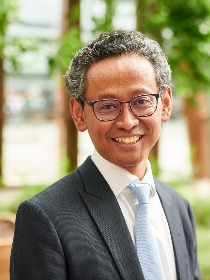
Hailong Jiao is an Assistant Professor in the Department of Electrical Engineering at Eindhoven University of Technology (TU/e) and an Associate Professor at Peking University Shenzhen Graduate School's School of Electronic and Computer Engineering. He is also a Visiting Assistant Professor with TU/e's Electronic Systems group. His research focuses on low-power and variations-resilient VLSI circuit and system design , including error-resilient systems, approximate computing, machine learning in VLSI, ultra-low voltage circuits, and emerging devices like 3D integration and carbon electronics. Education : BSc (highest honor, 2004, Shandong University), MSc (2008, Institute of Microelectronics, Chinese Academy of Sciences), PhD (2012, HKUST). Collaborations : BrainWave project (TU/e and Radboud University Nijmegen) developing wearable brainwave processing for epilepsy/Parkinson's healthcare. Editorial Roles : Associate Editor for Elsevier Microelectronics Journal and World Scientific Journal of Circuits, Systems, and Computers. Committee Memberships : HiPEAC, MemoCiS, ACM/SIGDA, and six IEEE committees. Research Trends : Recent articles emphasize energy-efficient IoT networks , voltage stacking , sensitivity control , and scan flip-flop design , aligning with UN SDGs for energy engineering and healthcare innovation. Scientific awards include highest honor at BSc .
Dusan Milosevic is an Assistant Professor at Eindhoven University of Technology (TU/e) in the Electrical Engineering department. He is affiliated with the Mixed-Signal Microelectronics research group and the RF Sensing & Communication Lab. His research focuses on analog and RF electronics, particularly in power amplifiers, ultra-low-power RF systems, and energy harvesting. He holds an MSc from the University of Niš and a PhD from TU/e. Education: MSc in Electronics and Telecommunications Engineering (University of Niš, 2001) PhD in Electrical Engineering (TU/e, 2009) Research Interests: Design of RF power amplifiers and mm-wave circuits Ultra-low-power communication systems RF energy harvesting technologies High-efficiency analog circuit design His work emphasizes circuit techniques for wireless communication and integrates analog methods with digital control for improved performance. Teaching: Electronic Circuits 1 RF Transceivers 1: Fundamentals Electronics: Selected Topics Collaborations: Active in mm-wave communication, satellite links, and sensor networks. His recent work includes inter-satellite link front-ends and optoelectronic modulation systems. Labs/Teams: Leads the RF Sensing & Communication Lab, focusing on mm-wave systems and energy-efficient RF design.
Prof. Bayu Jayawardhana is a Full Professor in Mechatronics and Control of Nonlinear Systems at the University of Groningen, affiliated with the Faculty of Science and Engineering. He leads the Jayawardhana Group focusing on opto-mechatronics and advanced nonlinear control theories. His roles include Director of Engineering and Scientific Director of the Engineering and Technology Institute Groningen. He holds editorial positions in journals like International Journal of Robust and Nonlinear Control and European Journal of Control . Education: PhD in Control and Power Group from Imperial College London (2006), M.Eng from Nanyang Technological University (2003), and B.Eng from Institut Teknologi Bandung (2000). Research interests span opto-mechatronics for high-tech systems, nonlinear control, and systems biology. Key projects include digital twins for energy optimization, control of ocean energy systems, and modeling of cryogenic actuators for telescopes. His work integrates AI and model-based methods for high-performance systems. Notable awards include the 2016 FSE Faculty Teacher of the Year Award and the Ben Feringa Impact Award (2020). He advises on ventures like Ocean Grazer B.V. and Sencilia B.V. Teaching includes graduate courses on nonlinear control, opto-mechatronics, and fitting dynamical models to data. His research labs include the Groningen Centre for Systems and Control and the Data Science and Systems Complexity Center.
André B.J. Kokkeler is a Full Professor at the Digital Society Institute and affiliated with the Radio Systems department at the University of Twente. His research focuses on wireless communication systems, signal processing, and mmWave technology, particularly in applications like beamforming, cognitive radio, and error-resilient algorithms. Recent research outputs highlight his work on: Hybrid beamforming techniques for full-duplex integrated sensing and communication (ISAC) systems Energy-efficient iterative algorithm implementations Single-bit angle-of-arrival (AoA) localization methods mmWave channel characterization in reverberation chambers Radar-driven human gait modeling His work contributes to advancements in wireless systems for IoT, automotive radar, and energy-constrained environments. Collaborations span multiple institutions and focus on propagation modeling, antenna characterization, and sensing applications.
Marc C.W. Geilen is an Associate Professor at the Electronic Systems group , Eindhoven University of Technology. He leads the Model-Based Design Lab and contributes to the CompSOC Lab and High Tech Systems Center . His work focuses on model-based design methods, design automation, and optimization for real-time and embedded systems. Research Keywords: Cyber-Physical Systems, Real-Time Systems, Embedded Systems, Performance Analysis, Design Automation Key Collaborations: EU ECSEL TRANSACT project, SAM-FMS project, Arrowhead Tools initiative His recent publications address weakly-hard timing constraints in server-based systems, hybrid performance modeling for cyber-physical systems, and neural network optimization for communication. Article trends span Real-Time Scheduling , Trustworthy Modeling , Neural Network Efficiency , and Resource Allocation in distributed environments. Scientific Awards : Partial-Order Reduction for Performance Analysis (2018) Teaching activities include courses in Computational Modeling , Embedded Signal Processing , and Discrete Mathematics . He collaborates across projects like TRANSACT, SAM-FMS, and Arrowhead Tools, focusing on flexible manufacturing and cloud-to-edge transitions.
Peter Baltus is Full Professor of High-Frequency Electronics in the Department of Electrical Engineering at Eindhoven University of Technology. With industry experience at Philips/NXP and academic credentials from TU/e, his research focuses on high-frequency integrated circuit and system design. Research domains include: Ultra-low power transceivers Millimeter-wave wireless power transfer Efficient wideband beamforming Sensor swarm networks RF system architecture His educational contributions feature innovative RF laboratory designs for remote learning environments. Current projects include photonic-electronic integration and satellite communication systems.
Maarten van Steen is a Professor active in the fields of Distributed Systems , Artificial Intelligence , and Cybersecurity . With an h-index of 35 and over 5,400 citations, his work focuses on Edge AI , Privacy Preservation , and WiFi-Based Sensing . His research emphasizes non-intrusive authentication, anonymization techniques, and crowd monitoring without compromising individual privacy. Key research areas: Distributed Systems, Privacy Preservation, WiFi Security Recent projects: RoomKey, LocKey, FlowPrint Crowd-monitoring applications: Subway travelers, pedestrian dynamics Van Steen's work combines Machine Learning with Homomorphic Encryption to develop privacy-first solutions. He has contributed to mobile app fingerprinting , WiFi authentication , and blockchain scalability challenges. His 2024–2025 publications reveal trends in contextual security , crowd behavior analysis , and automated threat intelligence . Notable methods include Bloom Filters, automata learning, and WiFi beacon frame analysis. Dutch Cyber Security Best Research Paper Award 2024 Runner-up (shared prize) Van Steen supervises research teams and collaborates on datasets like Code for Threat Intelligence Processing and DeepCASE . His work spans 20+ years , with 208 total research outputs and significant contributions to decentralized systems, network traffic analysis, and urban mobility.
Marion K. Matters-Kammerer is a Full Professor of Electrical Engineering at Eindhoven University of Technology, leading research in terahertz (THz) and millimeter-wave systems. She holds positions in the Center for Wireless Technology, THz Electronics and Integration Lab, and RF Sensing & Communication Lab. Her expertise includes integrated circuits, antenna design, and power amplifier systems. She has led EU projects like 3DmicroTune and ULTRA, and co-authored over 70 journal/conference papers with 13 US patents. Education: MSc in Physics from École Normale Supérieure (Paris) and TU Berlin (1999), PhD in Physics from RWTH Aachen (2007). Past roles include Senior Scientist at Philips Research (1999–2011) and Guest Professor at RWTH Aachen (2009–2010). Research focuses on THz spectroscopy, mm-wave integrated circuits, and energy-efficient wireless systems. Key projects involve THz biosensing, 60 GHz sensor networks, and co-integration of photonics and electronics. Her work addresses UN SDGs like affordable and clean energy, and industry-academia collaboration via NXP Smart Mobility projects. Recent articles highlight advancements in mm-wave power amplifiers, waveguide integration, and radar signal processing. Grants include €2.5M for TeraIBs (2025–2028) and €1.8M for Future Wireless Interfaces (2024–2029). Labs include THz Electronics Lab and RF Sensing Team, advancing sensor and communication technologies.
George Exarchakos is an Assistant Professor in the Department of Electrical Engineering at Eindhoven University of Technology (TU/e), affiliated with the EAISI High Tech Systems and the Center for Wireless Technology. His research focuses on P2P computing, data mining, machine learning, network optimization, and swarm intelligence. He holds an MSc in Advanced Computing from Imperial College London and a PhD in P2P Computing from the University of Surrey (2008). Prior to his current role, he conducted postdoctoral research on autonomous networks at TU/e before becoming an Assistant Professor in 2011. Key projects include HiCONNECTS: Heterogeneous Integration for Connectivity and Sustainability (2023–2025) and RHIADA: Reliable Hybrid Intra Aircraft Datanetwork Architectures (2021–2025). His work contributes to UN Sustainable Development Goals related to innovation and infrastructure (Goal 9). Research interests span predictive networks, gossip protocols, overlay networks, and network complexity. Notable publications include studies on beyond-5G networks, avionics communication protocols, and edge computing resource management.
Chigo Okonkwo is Full Professor and Chair of Secured Ultra High Capacity Transmission at the Department of Electrical Engineering , Eindhoven University of Technology. He leads the high-capacity optical transmission laboratory at the Institute for Photonics Integration and contributes to the Center for Quantum Materials and Technology Eindhoven (QT/e) . Academic Qualifications: MSc in Telecommunications and Information Systems, University of Essex (2002) PhD in Optical Signal Processing, University of Essex (2010) Research Interests: Professor Okonkwo focuses on: Maximizing capacity of single-mode fiber systems through advanced-coded modulation and Probabilistic/Geometrically shaped signals Developing Space Division Multiplexing (SDM) systems for Petabit/s transmission using multi-mode/multi-core fibers Quantum secure communications and cryptographic protocol development Optical vector network analyzer (OVNA) technology for SDM fiber characterization Free-space optical link deployment in urban environments Low-complexity digital signal processing algorithms Recent Publications Trends: His 15 most recent articles (2023-2025) demonstrate active research in: Quantum-classical network integration Extreme capacity fiber transmission (Petabit/s systems) Machine learning for optical diagnostics SDM fiber measurement technologies Hybrid QKD-PQC security frameworks Free-space optical urban communication Scientific Awards: Asia Communications and Photonics Conference (ACP) 2018 Best Paper Award European Conference on Optical Communications (ECOC) 2018 Student Paper Award Optica Student Paper Awards (2022) Corning Outstanding Student Paper Competition Finalist (2025) Advisory & Collaborations: Advisor to 8+ researchers including Menno van den Hout, Vincent van Vliet, and Thomas Bradley Technical Program Committee Member, European Conference on Optical Communications (ECOC) since 2014 Sub Committee Chair for Digital Signal Processing track at ECOC 2018 General Chair for OSA Advanced Photonics Congress on Signal Processing for Photonics Collaborates with EU projects (HOMTech, PhotonDelta) and industrial partners Co-founder and Chief Technology Officer of CUbIQ Technologies Laboratory & Infrastructure: Maintains the world-class High Capacity Optical Transmission Lab at TU/e, featuring: Advanced SDM fiber testing equipment Quantum communication research infrastructure Free-space optical link experimental setups Multi-core fiber amplification systems Coherent transmission testbeds Machine learning-enabled diagnostic tools
Alexander Yarovoy is a Full Professor at the Faculty of Electrical Engineering, Mathematics and Computer Science at Delft University of Technology (TU Delft), specializing in Radar Systems, Antenna Design, and mm-Wave Technology. His research bridges theoretical and applied domains, with a focus on automotive radar, weather radar, and machine learning integration in radar signal processing. Active in radar, antennas, and microwave engineering Key contributions to automotive radar and human activity recognition Collaborates on datasets like RaDelft for autonomous driving Recent work explores OTFS radar for communication integration, polarimetric calibration, and high-resolution imaging algorithms. His research often addresses challenges in real-world applications, such as urban meteorology and vehicular safety. In 2023, he received the outstanding paper award at IEEE MetroAeroSpace for radar waveform coexistence studies. He participates in conferences and editorial activities, advancing radar metrology and phased array technologies.
Jan Bergmans is a Full Professor in the Department of Electrical Engineering at Eindhoven University of Technology (TU/e). He leads the Signal Processing Systems group and holds professorships at multiple research centers including the Eindhoven MedTech Innovation Center (e/MTIC), Center for Care & Cure Technology Eindhoven, NeuroPlatform, EAISI Health, and EAISI Foundational. With approximately 35 years of experience in signal processing theory and applications, Bergmans focuses on developing computationally efficient signal analysis techniques for healthcare, wireless communication, surveillance, and intelligent lighting applications. Bergmans' educational background includes: MSc in Electrical Engineering from Eindhoven University of Technology (1981) PhD in Electrical Engineering from Eindhoven University of Technology (1987) His research interests center around signal processing and data analytics theories, algorithms, architectures, and systems. Bergmans develops mathematical models that incorporate domain-specific knowledge, such as propagation models for radio communication channels or pathophysiological models for clinical decision support systems. His work emphasizes creating powerful yet computationally efficient signal analysis techniques, with significant applications in healthcare technology and medical diagnostics. The integration of engineering principles with clinical needs is a hallmark of his research approach, enabling practical solutions that address real-world medical challenges. Analysis of Bergmans' recent publications reveals a strong focus on medical signal processing, particularly in ECG and fetal monitoring applications. His work combines advanced signal processing techniques like adaptive Kalman filtering with practical healthcare applications. There's also significant research in visible light communications and sensor network technologies, showing the breadth of his expertise across different application domains of signal processing. The consistent theme across his work is developing computationally efficient algorithms that incorporate domain-specific knowledge to solve practical engineering problems. Scientific recognition includes: Senior Member of the IEEE Author of numerous papers and 2 books Holder of approximately 40 US patents Bergmans has established smooth collaborations with strategic industrial and clinical partners, including Philips Research and multiple hospitals in the Eindhoven region. He co-manages BrainBridge, the strategic collaboration between TU/e, Philips Research, and Zhejiang University (China). His research group has secured numerous projects, including recent third-tier projects like MEDEIA, PISANO SPS, and RAISE projects focusing on medical engineering innovations and robust AI for radar signal processing. As a key figure in the Signal Processing Systems group and one of the founders of the Eindhoven MedTech Innovation Center (e/MTIC), Bergmans plays a central role in bridging academic research with industrial and clinical applications. His leadership extends to managing multiple research teams working on healthcare technology, wireless communications, and sensor systems, fostering an environment where theoretical signal processing advances translate into practical medical and technological solutions.
Alessandro Chiumento is an Assistant Professor at the Department of Pervasive Systems, Faculty of Electrical Engineering, Mathematics and Computer Science (EEMCS), University of Twente. His research focuses on artificial intelligence, edge AI, wireless communication, and sensor systems for industrial and health applications. Key Research Areas: Reinforcement Learning, Deep Learning, 5G/6G Networks, Human Activity Recognition Recent publications highlight his work in mmWave radar systems for vital sign monitoring, UAV-based communication networks, and AI-driven resource management for IoT. He has contributed to 5G-RedCap optimization, WiFi network performance analysis, and biomedical sensor development. In 2024-2025, his team released comprehensive datasets for mmWave radar applications, explored non-invasive animal health monitoring, and advanced cross-layer QoS optimization frameworks. Earlier works (2016-2023) addressed Bluetooth mesh networking, LTE interference management, and multi-antenna systems for UAVs. Technical Themes: Spectrum Efficiency, Network Topology, Channel Quality Prediction, Autonomous Agents
Jasper Goseling is an Associate Professor at the Digital Society Institute and affiliated with the Mathematics of Operations Research department. His research spans differential privacy, network coding, optimization, and wireless systems, often bridging theoretical and applied domains. Key research areas: Differential Privacy, Network Coding, Optimization, Wireless Sensor Networks, Machine Learning His recent work focuses on robust optimization techniques for local differential privacy, addressing trade-offs between data utility and privacy preservation. Earlier contributions include studies on energy-efficient data collection in sensor networks, caching strategies in wireless environments, and entropy-based analysis of hydrothermal systems. Article trends reveal a strong emphasis on privacy-preserving algorithms (2022-2024) and historical expertise in network coding, queueing theory, and thermodynamic entropy. His research integrates mathematical rigor with practical applications in wireless communication and data management. Activities include organizing the 45th Symposium on Information Theory and Signal Processing (2025) and leadership roles in the IEEE Benelux Chapter on Information Theory (Chair, 2017; Member, 2012-2017). He also contributed to the 2015 European School of Information Theory.
Dr. Robert Vogt-Ardatjew is a researcher specializing in Radio Systems , with a focus on Electromagnetic Compatibility (EMC) , Risk Management , and Software Defined Radio (SDR) . His work spans Shielding Effectiveness , Propagation Channel Modeling , and Frequency-Selective Emission Detection , contributing to both academic research and practical EMC engineering solutions.