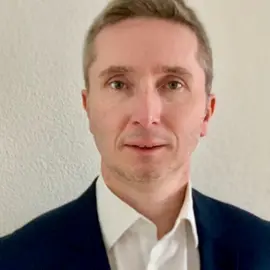
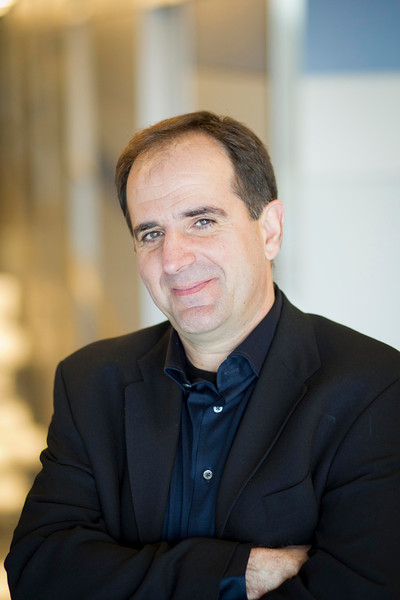
Ali Dziri is a permanent researcher at CentraleSupélec's Cedric Laboratory , focusing on wireless communications, signal processing, and embedded systems. His work spans 2004–2023 with key contributions in UWB communication, IoT networks, video/image transmission, and real-time tracking algorithms. His research interests include: Wireless Communications Signal Processing Embedded Systems Machine Learning IoT Networks Video/Image Compression Recent publications highlight trends in neural networks for channel equalization, MIMO relays for WSNs, and 5G D2D communication protocols. He has no listed scientific awards or advisees.
Olivier Lévêque is a Senior Scientist at the École Polytechnique Fédérale de Lausanne (EPFL), affiliated with the School of Computer and Communication Sciences. He conducts research at the Laboratory of Information Theory (LTHI) and holds teaching responsibilities in both Communication Systems (SSC) and Computer Science (SIN) sections. Additionally, he contributes to the Interface EPFL-Gymnases initiative. Lévêque obtained his Physics diploma (1995) and PhD in Mathematics (2001) from EPFL, with a visiting lectureship at Stanford University's Electrical Engineering Department in 2005-2006. His research explores fundamental aspects of information theory , random matrices , and stochastic calculus , with applications in wireless communications and network theory. Key interests include capacity scaling laws in ad hoc networks, diversity-multiplexing tradeoffs, and mathematical frameworks for communication systems. Recent publications demonstrate broad interdisciplinary engagement, spanning computational thinking assessment (2022), digital education frameworks (2019), satellite positioning systems (2018), and theoretical advances in probability (2018). His work consistently integrates mathematical rigor with practical communication challenges, particularly in wireless network optimization and information-theoretic security. He has supervised four doctoral students at EPFL and teaches courses including Information, Computation, Communication , Markov Chains and Algorithmic Applications , and Cryptography . Lévêque leads research activities within the Laboratory of Information Theory, focusing on theoretical foundations of modern communication systems.
Prof. Dr. Luciano Sarperi is a Lecturer at the ZHAW School of Engineering ’s Institute of Signal Processing and Wireless Communications , focusing on applied R&D with industry partners. His work spans Wireless Communication Systems , Mobile Networks (NR, LTE, NB-IoT), and Software Defined Radio . Expertise in GNSS Localization , Wireless Time-Synchronization , and Interference Cancellation for MIMO systems. Active in UAV navigation, RFI detection, and LoRa/Wi-Fi applications. Research Trends (2025–2004): Peer-reviewed work on MIMO Pre-coding , GNSS for Drones , Blind Signal Processing , and Wireless Standards . Patents in Multi-Cell MIMO and Channel Feedback . Education : PhD in Digital Signal Processing for MIMO-OFDM from the University of Liverpool (2007), M.Sc. in Microelectronic Systems and Telecommunications (2002). Experience : 2010–2017 at Swisscom (Research Engineer), 2007–2010 at Fujitsu Laboratories (U.K.).
Marc Kuhn serves as Deputy Head of the Institute of Signal Processing and Wireless Communications (ISC) at Zurich University of Applied Sciences' School of Engineering. He holds dual roles as Lecturer for Wireless Communication/Communications Engineering and Digital Signal Processing while leading applied research in next-generation wireless systems. His educational credentials include: Doctoral degree (Dr.-Ing.) in Communications Engineering from Saarland University (2002) Diplom-Ingenieur (Dipl.-Ing.) in Electrical Engineering from Saarland University (1998) Certificate of Advanced Studies (CAS) in Higher & Professional Education from ZHAW (2022) Marc Kuhn's research focuses on wireless signal processing challenges across multiple domains. His work addresses critical gaps in: Indoor positioning systems using UWB/WiFi/Bluetooth MIMO-OFDM for mobile networks Cooperative communication in MANETs under mobility Timing synchronization for distributed radar QoS optimization in vehicular networks Powerline communication resilience His publication trajectory (2022-2024) reveals concentrated innovation in cooperative MANET techniques, with 60% of recent work tackling synchronization imperfections through SDR implementations. Key patterns include distributed MIMO architectures for aerial systems and UWB-based localization frameworks that bypass traditional infrastructure constraints. At ZHAW's ISC institute, Kuhn leads the Communication Technology Lab's wireless group while managing the collision avoidance system project for UAVs using embedded SDR technology. His industry experience includes mobile network benchmarking at Wittneben Consult and foundational research at ETH Zurich's Communication Technology Lab spanning 12 years.
Masood Parvania is the Roger P. Webb Endowed Professor at the University of Utah in Electrical and Computer Engineering. He serves as Director of the Utah Smart Energy Laboratory (U-Smart) and Co-Director of the NSF WIRED Global Center . His research focuses on mathematical optimization , control theory , and machine learning applications in power system operation, resilience, and interdependent infrastructure modeling. His work addresses critical challenges including: Equity-aware grid restoration Climate-resilient energy systems Cyber-physical security analysis Hybrid energy storage coordination Extreme heat event mitigation strategies Key research trends across his 15 most recent publications reveal deep integration of: Renewable energy with storage systems Machine learning in real-time grid operation Cybersecurity frameworks for critical infrastructure Equity metrics in energy distribution Honors include: IEEE Outstanding Associate Editor Award (2022) University of Utah Presidential Scholar (2020) IEEE Utah Section Outstanding Educator Award (2017) Multiple Best Reviewer and Distinguished Service Awards As Associate Editor for IEEE Transactions on Power Systems , he actively shapes energy research discourse while leading NSF-funded initiatives like: U.S.-Canada Climate-Resilient Grid Center ($90M+ Western EV Infrastructure Scale-Up Wasatch Multi-Modal Corridor Electrification
Dimitris A. Pados is a Professor and I-SENSE Fellow at Florida Atlantic University, holding the prestigious Charles E. Schmidt Eminent Scholar in Engineering position. He serves as Director of both the Center for Connected Autonomy and Artificial Intelligence and the ExtremeComms Laboratory within the Department of Electrical Engineering and Computer Science in the College of Engineering. Prior to joining FAU in 2017, he spent 20 years at the University at Buffalo, where he held positions ranging from Assistant Professor to Clifford C. Furnas Chair Professor. Professor Pados' research spans two primary domains: Communications Theory and Systems, and Machine Learning and Adaptive Signal Processing. His work in communications includes Cognitive Software-defined Radios and Networks, Interference Avoiding Networking, Secure Wireless Communications, Underwater Cognitive Hi-rate/Long-distance Acoustic Communications, and Autonomous/Unmanned System Communications. In signal processing, he specializes in L1-norm Principal-component Analysis (L1-PCA), Robust Feature Extraction from Faulty Data Sets, Digital Data Embedding/Hiding, and Compressed-sensed Imaging and Video. His research has resulted in numerous high-impact publications and several best paper awards. His recent publications demonstrate a strong focus on robust signal processing techniques, particularly L1-PCA methods, and applications in wireless communications, video processing, and secure transmissions. The research shows consistent contributions to both theoretical foundations and practical implementations, with increasing emphasis on cognitive radio networks, underwater communications, and autonomous systems. 2013 ISWCS Best Paper Award in Physical Layer Communications and Signal Processing 2003 IEEE Transactions on Neural Networks Outstanding Paper Award IEEE ICT 2001 Best Paper Award 2010 IEEE ICC Best Paper Award in Signal Processing for Communications I-SENSE Fellow Charles E. Schmidt Eminent Scholar in Engineering Professor Pados has secured significant research funding through sponsored projects, particularly in wireless communications, signal processing, and autonomous systems. His work on software-defined radio platforms, underwater acoustic networks, and cognitive networking demonstrates strong industry and government interest. He has successfully translated theoretical research into practical implementations, as evidenced by his team's win in the Internet of H2O competition. As Director of the ExtremeComms Laboratory, Professor Pados leads a research group focused on communication systems for challenging environments. The laboratory provides opportunities for graduate students to work on cutting-edge projects in cognitive radio, underwater communications, and autonomous systems. His leadership of the Center for Connected Autonomy and Artificial Intelligence further expands research opportunities across multiple disciplines at Florida Atlantic University.