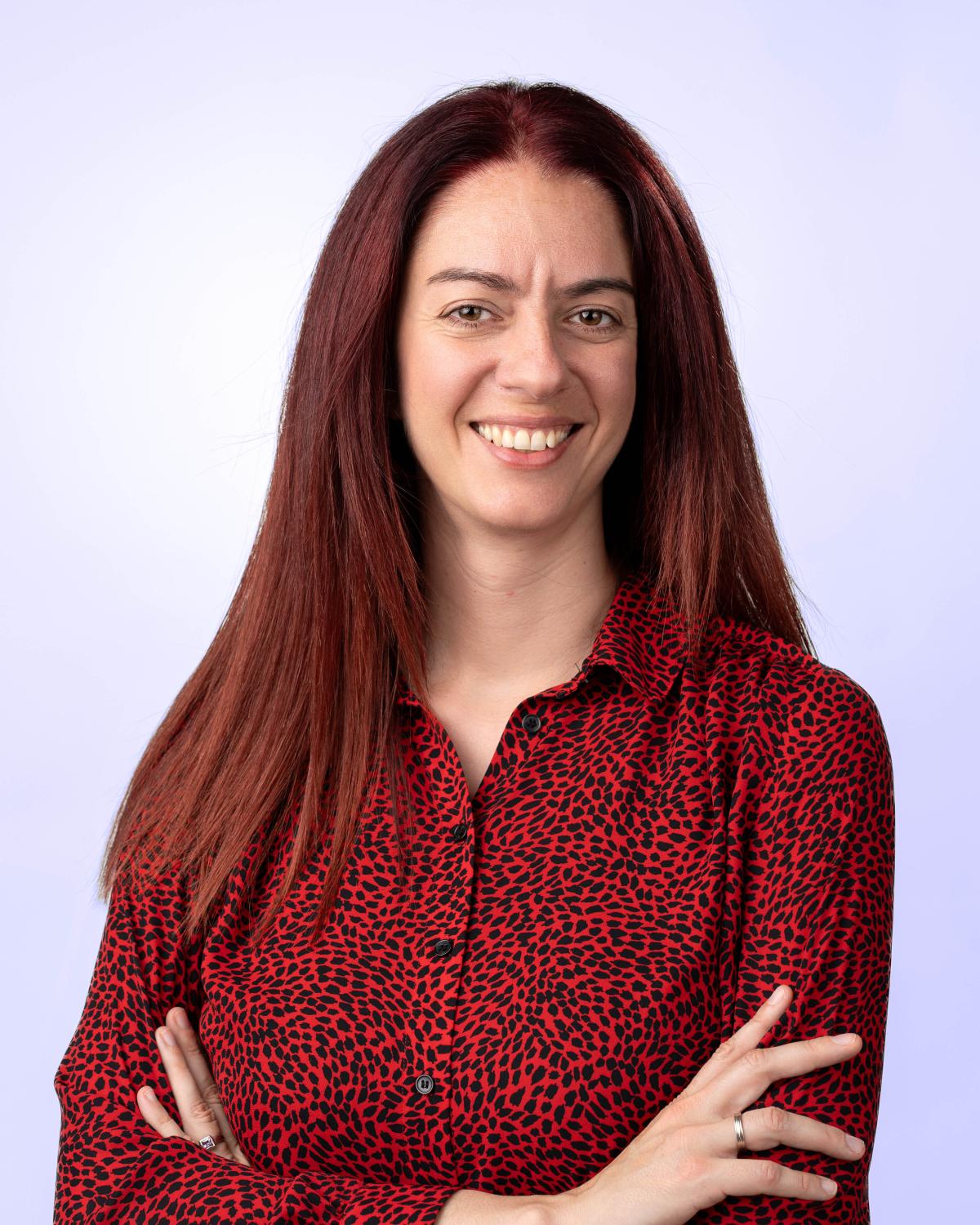
Prof. Eleni Chatzi is a Full Professor and Chair of Structural Mechanics at ETH Zurich's Department of Civil, Environmental and Geomatic Engineering. She holds a PhD from Columbia University (2010) and has held roles from Assistant to Full Professor at ETH since 2010. Her research focuses on intelligent structural monitoring and data-driven asset management, emphasizing nonlinear dynamics and sensor integration. Affiliations : Institute of Structural Engineering, European Academy of Wind Energy (EAWE President), Swiss Community for Computational Methods (SWICCOMAS Chair) Research interests include Structural Health Monitoring (SHM), system identification, and advanced simulation tools. She pioneered work on data-driven diagnostics and self-aware infrastructure, supported by grants like the ERC Starting Grant (2015). Awards include the 2020 Walter L. Huber Prize and 2024 SHM Person of the Year Award. Her work spans wind energy infrastructure, metamaterials for vibration control, and AI-driven structural analytics. Over 600 publications and 200k+ citations highlight her impact. She teaches computational science and structural dynamics in ETH's programs and collaborates globally on sustainable infrastructure projects.
Professor Behzad Fatahi is a distinguished academic in Civil and Environmental Engineering at the University of Technology Sydney (UTS), specializing in geotechnical engineering, railway infrastructure, and sustainable construction technologies. With a career spanning over 16 years at UTS, he has served as Deputy Head of School - Teaching and Learning (2024-present), Head of Discipline (2020-2024), and School Research Coordinator (2012-2017). His research focuses on unsaturated soil mechanics , dynamic soil-structure interaction , and green infrastructure solutions . Academic Appointments : Professor (2024-present), Associate Professor (2017-2024), Senior Lecturer (2011-2017), Lecturer (2008-2011) Research Leadership : Supervised 21 PhD students to completion, developed groundbreaking techniques for landfill waste reuse and tyre-derived aggregates in railway construction His work on seismic resilience of LNG tanks and bioengineered soil stabilization has received international recognition, including the 2023 Best Research Paper Award at the Australasian Association for Engineering Education conference. Professor Fatahi's industry experience includes geotechnical engineering roles at Coffey International and SES Engineering prior to academia. Key Research Contributions : Developed green corridor models for railway lines using coupled flow-deformation equations Pioneered AI-integrated teaching frameworks for civil engineering education Advanced machine learning techniques for intelligent compaction and structural buckling analysis As a Category 1 supervisor , he mentors graduate researchers in Civil Engineering , Geomechanics , and Earthquake Engineering . His peer-reviewed work (>240 publications) demonstrates technical excellence and innovation across multiple geotechnical domains.
Dr. Mark Bissett is Reader in Nanomaterials at the University of Manchester's Department of Materials Engineering. He holds a PhD in Nanotechnology from Flinders University and was Research Assistant Professor at Kyushu University before joining Manchester. He directs the Advanced Nanomaterials Group focusing on 2D material applications. His research integrates graphene, carbon nanotubes, and transition metal dichalcogenides into electrochemical energy storage devices and polymer nanocomposites. Key areas include: Supercapacitor and battery electrode design Tribological coatings for industrial applications Multifunctional structural composites Publications span electrodeposition techniques, composite reinforcement strategies, and nanomaterial synthesis. Recent work shows strong emphasis on graphene-enhanced composites, MXene applications, and energy storage innovations. He teaches nanotechnology and composites courses, and leads the Nanotechnology unit coordination. Industrial collaborations include his role as CSO at MOLYMEM Limited. Laboratory facilities at the National Graphene Institute support his group's experimental work.
Philipp Schlatter is a Professor in the Department of Mechanics at KTH Royal Institute of Technology. His research focuses on fluid mechanics, turbulence, and computational fluid dynamics (CFD), with expertise in high-performance computing and direct numerical simulations (DNS). He leads projects involving scalable CFD frameworks like Neko and Nek5000, and investigates turbulent boundary layers, flow control, and coherent flow structures. His work includes experimental and numerical studies of wing profiles, rotating systems, and transition dynamics. Schlatter teaches courses on computational fluid dynamics and turbulence, emphasizing both theoretical and practical aspects of fluid mechanics. Key research interests include developing numerical methods for high-fidelity simulations, understanding turbulence mechanisms, and optimizing flow control strategies. His contributions span aerodynamics, heat transfer, and the application of machine learning to fluid dynamics problems. Schlatter collaborates extensively on interdisciplinary projects, leveraging advanced computing resources to address complex fluid flow phenomena. Publications highlight advancements in DNS frameworks, Bayesian optimization for flow control, and analysis of turbulent structures in pipe and boundary layer flows. His research also addresses challenges in measurement techniques and uncertainty quantification in CFD simulations.
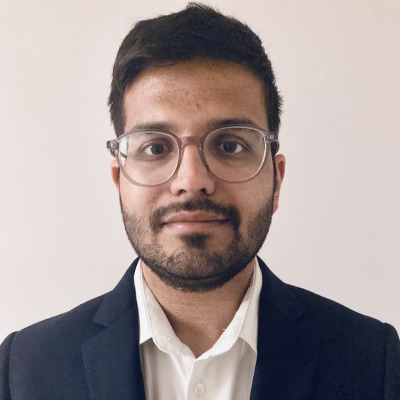
Kshitij Sabnis is a Lecturer in Aerospace Engineering at the School of Engineering and Materials Science, Queen Mary University of London. He serves as Admissions Lead and Outreach & Recruitment Lead for Aerospace Engineering, and Deputy Director of Industrial Engagement (Graduate Attributes). He is affiliated with the Centre for Intelligent Transport and conducts experimental research in high-speed aerodynamics. Education: PhD in Experimental Aerodynamics, University of Cambridge Master’s in Physics Dr Sabnis's research focuses on experimental aerodynamics across various speed regimes, particularly shock/boundary-layer interactions, vortex dynamics, and supersonic flows. His work involves wind tunnel experiments on simplified models to understand complex fluid mechanics in applications ranging from racecar wings to supersonic aircraft intakes. He employs advanced diagnostics and develops novel experimental setups to enhance physical insight into flow phenomena. His recent publications (2019–2025) reflect a strong emphasis on high-speed flow behavior, including shock-induced separation, vortex interactions, and nacelle aerodynamics. Key themes include flow control, wind tunnel design, and validation of turbulence models. His work bridges fundamental fluid dynamics with practical aerospace engineering challenges. Scientific Awards: FHEA (Fellow of the Higher Education Academy) Dr Sabnis actively supervises PhD students and leads externally funded research projects. He has secured grants from EPSRC and the Royal Society, supporting work on schlieren imaging enhancement and small-scale wind turbines for rural energy. He teaches advanced aerodynamics modules and contributes to curriculum and industrial engagement. He leads a research group focused on experimental high-speed aerodynamics and is involved in developing new diagnostic techniques and test rigs. His team investigates vortex interactions and aerodynamic performance under extreme flow conditions.
Yolanda Vidal Segui is an Associate Professor in the Department of Mathematics at the Universitat Politècnica de Catalunya (UPC), affiliated with the Escola d'Enginyeria de Barcelona Est (EEBE). Her research focuses on wind energy systems, predictive maintenance, and structural health monitoring of wind turbines. She leads projects in the CoDAlab and WinTurCoM research groups, specializing in data-driven models, condition monitoring, and failure prognosis. Her work integrates machine learning, mathematical modeling, and sensor technology to enhance turbine reliability and energy efficiency. Dr. Vidal holds a PhD in Applied Mathematics and has authored over 350 publications. Her contributions include advancements in SCADA data analysis, vibration-based diagnostics, and AI-driven condition monitoring systems. She has received several accolades, including the WindEurope Technology Workshop recognition and the IFIT Distinction in Mechanism and Machine Science. Her research bridges academia and industry, addressing challenges in offshore wind turbine integrity and maintenance strategies. Active in professional service, she serves on conference committees and editorial boards (e.g., Mechanical Systems and Signal Processing, Wind Energy). Her work emphasizes sustainable energy solutions and has been applied in real-world scenarios like the Alpha Ventus wind farm. She also contributes to educational initiatives, developing innovative teaching materials for engineering students.
Professor Atilla Ansal is a distinguished academic in Civil Engineering at Özyeğin University's School of Engineering, where he has served as a full-time professor since March 2012 and previously as the Founding Chair of the Civil Engineering Department from 2012-2019. With an extensive career spanning over five decades, Professor Ansal has held prominent positions at Istanbul Technical University, Bogaziçi University's Kandilli Observatory and Earthquake Research Institute, and has served as a visiting professor at numerous international institutions including Northwestern University, University of California, and Tokyo University. Northwestern University, 1978 (Doctorate) Civil Engineering, Istanbul Technical University, 1969 (Master's) Civil Engineering, Istanbul Technical University, 1969 (Bachelor's) Professor Ansal's research focuses on Earthquake Geotechnical Engineering, Soil Dynamics, Seismic Hazard Analysis, Landslide hazard analysis, Seismic Microzonation, and Laboratory and In-Situ Testing of Soil Properties. His work has significantly advanced our understanding of soil behavior under seismic loading, site response analysis, and seismic microzonation methodologies. His research has direct applications in urban planning, earthquake risk mitigation, and performance-based seismic design. Professor Ansal has pioneered approaches to site-specific earthquake characterization and developed methodologies for seismic microzonation that have been implemented in numerous Turkish cities and adopted internationally. His extensive publication record demonstrates consistent contributions to earthquake engineering, with recent work focusing on probabilistic seismic microzonation, 2D basin effects, site-specific response analysis, and performance-based design approaches. His research shows a clear evolution from fundamental soil behavior studies to practical applications in urban risk assessment and mitigation. 7th Prof.N.Ambraseys Lecturer (2024), European Association for Earthquake Engineering 15th Nonveiller Lecturer (2017), Croatian Geotechnical Society Third Prof.Dr. Rıfat Yarar Lecturer (2015), Turkish Civil Engineers Association Third Ord.Prof.Dr. Hamdi Peynircioglu Lecturer (1988) Professor Ansal has advised 15 PhD students and 27 Master's students, shaping the next generation of earthquake engineers. His leadership extends to editorial roles as Editor-in-Chief of the Springer journal 'Bulletin of Earthquake Engineering' since 2002 and Editor-in-Chief for the Springer book series on 'Geotechnical, Geological and Earthquake Engineering'. He served as Secretary General (1994-2014), President (2014-2018), and Vice President (2018-2022) of the European Association for Earthquake Engineering, significantly influencing the field internationally. His work has been supported by numerous grants from Turkish government agencies, international organizations including UNESCO, and collaborative research projects across Europe. Professor Ansal has been instrumental in establishing geotechnical monitoring systems in Istanbul, including vertical arrays for site response analysis. His leadership in the 'Earthquake Master Plan for Istanbul' and 'Seismic Microzonation for Municipalities' projects has created critical infrastructure for earthquake risk management in Turkey's most populous city. His work with GeoIst, Geotechnical Earthquake Engineering and Consultancy Inc. has translated academic research into practical engineering solutions for seismic risk mitigation.
Johan Meyers is a full Professor at KU Leuven's Faculty of Engineering Science, Department of Mechanical Engineering, where he heads the Applied Mechanics and Energy conversion (TME) research unit. He serves as a contact person for TME and is an active member of the KIES – KU Leuven Institute for Energy and Society. His administrative roles include membership on the Council of the Faculty of Engineering Science, the Mechanical Engineering Department Council and Board, and chairing the HPC Steering Committee. Professor Meyers' research focuses on turbulent flow simulation and optimization, with particular emphasis on wind energy applications, atmospheric pollutant dispersion, and computational methods. His work spans Direct Numerical Simulation (DNS), Large-Eddy Simulation (LES), and model reduction techniques for applications in energy engineering. Current research categories include flow control & optimization, wind farm engineering, and atmospheric pollutant dispersion modeling, with specific applications in radioactive release scenarios and wind turbine system optimization. His recent publications demonstrate a strong trend toward wind energy applications, particularly in optimizing wind farm layouts and operations through advanced computational methods. The research shows significant emphasis on Large-Eddy Simulation techniques to study atmospheric boundary layer interactions with wind farms, with growing interest in hybrid wind-solar energy systems and the effects of surface temperature heterogeneity on flow patterns. His work increasingly integrates machine learning approaches to enhance computational efficiency in wind farm modeling. Professor Meyers actively supervises numerous PhD students including Bon, T., Janssens, N., Jamaer, S., and ALREWENY, A., among others. His research is supported by multiple ongoing projects through 2028, including 'Wind-farm co-design in the North-Sea basin given climate and market uncertainty' and 'Reconstruction of turbulence from partial observations,' primarily funded by research councils and industry partnerships. He leads the Turbulent Flow Simulation and Optimization (TFSO) research group, which develops efficient supercomputing simulation tools for turbulent flow applications in energy engineering. The group specializes in wind farm optimization, atmospheric pollutant dispersion modeling, and airborne wind energy systems, with a particular focus on LES studies of wind farm interactions with the atmospheric boundary layer.
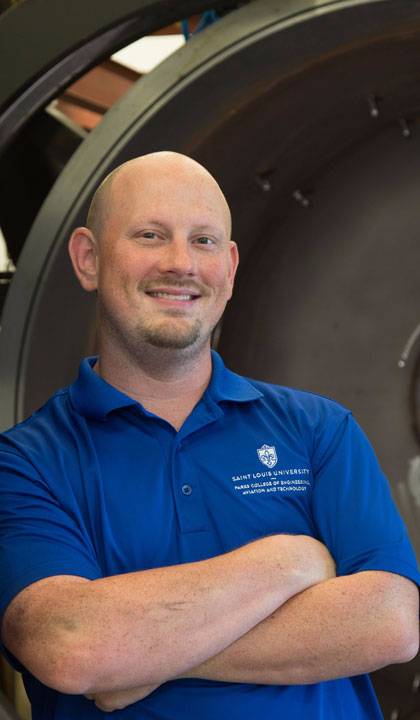
Mark McQuilling is an Associate Professor of Aerospace and Mechanical Engineering at Saint Louis University's School of Science and Engineering. He holds a Ph.D. in Engineering from Wright State University, alongside M.S. and B.S. degrees in Mechanical Engineering from the University of Kentucky. His research focuses on experimental fluid mechanics, low Reynolds number flows, laminar-to-turbulent transition, airfoil design, unsteady aerodynamics (turbomachinery and airdrop systems), bio-fluid flows, and flow control. His work integrates advanced fluid dynamics techniques with practical applications in aerospace and biomedical engineering. Dr. McQuilling oversees the Fluid Systems Laboratory, which includes subsonic and supersonic wind tunnels, a water tunnel, and thermal system facilities. These labs support undergraduate and graduate research, with capabilities such as Laser Doppler Velocimetry, DPIV systems, and strain gauge balances. His thermal research spans micro-scale fluid phenomena to planetary atmospheric modeling, including studies on Uranus/Neptune vortex dynamics and airdrop parachute aerodynamics. Highlighted research areas include low-pressure turbine blade aerodynamics, parachute drag prediction, and bio-fluid studies like pharyngeal airflow analysis in sleep apnea patients. His peer-reviewed publications (over 20 entries) address topics ranging from micro-air vehicle wing design to thermal management in turbine blades. McQuilling is active in professional organizations like AIAA, ASME, and ASEE, and previously worked at the Air Force Research Laboratory. His email is mark.mcquilling@slu.edu.
Maurizio Collu is a Professor in Offshore Renewable Energy Engineering at the Department of Naval Architecture, Ocean and Marine Engineering, Faculty of Engineering, University of Strathclyde, where he has been a faculty member since August 2018. He is actively leading high-impact research in offshore renewable energy systems and holds leadership roles in international committees and editorial boards. His research focuses on the applied mechanics and multidisciplinary modeling of dynamics for offshore renewable energy systems. Key areas include the analysis and design of floating offshore wind turbines and multi-purpose offshore platforms. His work integrates hydrodynamics, structural mechanics, and control systems to develop advanced aero-hydro-servo-elastic coupled models. He is particularly known for pioneering research in floating wind-hydrogen integration and AI-driven offshore maintenance. The recent publications highlight a strong trend toward integrated offshore energy systems, with increasing focus on hydrogen production, fatigue resilience under multiple sea states, and optimization of spar and semisubmersible floating platforms. His work leverages high-performance computing and data-driven methods to improve design and operational feasibility. Calder Prize (2011) Maurizio Collu has directly managed approximately £4.5 million in public research funding across projects totaling £28.5 million, funded by EPSRC, NERC, Innovate UK, ORE Catapult, EU H2020, and others. He is the Principal Investigator or Co-Investigator in major projects such as Ocean RE-Fuel (floating wind-to-hydrogen), The Blue Growth Farm (multi-functional offshore platforms), INNO-MPP (UK-China collaboration), and HOME-Offshore (AI for wind farm maintenance). He actively supervises PhD and postgraduate researchers and collaborates with industry partners ranging from startups to multinational energy firms. He is involved in key research teams and labs focused on offshore renewable energy, including the research group at the University of Strathclyde's Department of Naval Architecture, Ocean and Marine Engineering. He also contributes to international consortia such as the ITTC Ocean Renewable Energy Committee and serves as an advisor to SINTEF Ocean. His work is part of a broader network advancing sustainable offshore energy solutions aligned with UN Sustainable Development Goals.
Andrew J. Goupee serves as the Donald A. Grant Professor of Mechanical Engineering at the University of Maine's Maine College of Engineering and Computing. His office is located in Room 243 of the Ferland Engineering Education and Design Center, and he can be reached at (207) 581-3657 or agoupe91@maine.edu. Dr. Goupee earned his Ph.D. in Mechanical Engineering from the University of Maine in 2010. He maintains significant external engagements as a Visiting Professional at the National Wind Technology Center and Cooperating Faculty at the Advanced Structures and Composites Center. His research program focuses on advancing floating offshore wind technology through: Numerical methods for floating offshore structures Experimental model testing of floating platforms Structural optimization techniques Multiscale methods for heterogeneous materials Dr. Goupee's scholarly work shows a clear progression toward increasingly complex floating wind turbine systems, with emphasis on experimental validation of numerical models and the integration of control systems. His research spans fundamental hydrodynamic principles to full-scale demonstration projects. His research is supported by major funding agencies including the Department of Energy (DOE), National Science Foundation (NSF), National Aeronautics and Space Administration (NASA), and Maine Technology Institute (MTI). Key projects include the FOCAL and NASA Floater ATLANTIS projects, the DOE ARPA-E Aqua Ventus I floating wind turbine demonstration, and development of the W 2 offshore wind-wave generation system. Dr. Goupee teaches core mechanical engineering courses including Dynamics, Mechanical Vibrations, Wind Energy Engineering, and Capstone Design sequences. He is an active member of professional organizations including ASME and ISOPE, contributing to the advancement of offshore engineering standards and practices.
Fabio Pierella is an Associate Professor at the Technical University of Denmark (DTU), affiliated with the Department of Wind and Energy Systems Flows, specializing in Wind Turbine Design Division. His research focuses on offshore wind energy systems, fluid dynamics, and structural engineering. He has contributed to projects like OC6 Phase IV and the DeRisk database, validating numerical models for floating offshore wind structures and extreme wave loads. Key research interests include computational fluid dynamics (CFD), hydrodynamic load modeling, and the design of large-scale floating wind turbines. His work spans numerical simulations, experimental validation, and database development for extreme sea states. Pierella has presented at international conferences on topics like wave-structure interaction and turbine control systems. He received the Best Poster Presentation Award (2024) and contributed to datasets such as the DeRisk Database, which provides critical wave data for offshore wind turbine design. His research emphasizes practical applications, including monopile structural integrity under extreme loads and control strategies for floating platforms. Pierella's activities include conference presentations on ultra-large floating turbines (EMULF2 project) and the impact of wave shape on 15MW turbine loads. His interdisciplinary approach integrates computational models with experimental results to address challenges in offshore renewable energy systems.
Dr. Ajay V. Singh is an Associate Professor in the Department of Aerospace Engineering at the Indian Institute of Technology Kanpur, India. He leads the Combustion and Propulsion Laboratory and has established himself as a leading researcher in combustion science and propulsion technology in India. His work on detonation physics has positioned IIT Kanpur at the forefront of this field with the unveiling of "India's First Detonation Tube Research Facility". Dr. Singh's educational background includes: PhD in Mechanical Engineering from University of Maryland, College Park (2015) M.Tech in Aerospace Engineering from Indian Institute of Technology Kanpur (2008) B.Tech in Mechanical Engineering from U.P. Technical University, Lucknow (2006) His research spans fundamental and applied aspects of combustion science with particular focus on high-speed propulsion systems, detonation cycle engines, gas turbine combustion, soot formation and oxidation, flame-synthesized functional nanoparticles, and fire dynamics. His innovative work bridges theoretical understanding with practical applications in aerospace propulsion, energy systems, and fire safety engineering. The media has widely covered his research, with features in India Today, Times of India, Hindustan Times, and Republic Bharat. Dr. Singh's publication record shows a clear trend toward increasingly sophisticated detonation research and fire dynamics studies, with recent work focusing on turbulent wind-driven flames, detonation inhibition mechanisms, and alternative fuel combustion. His articles consistently address challenges in high-speed propulsion and fire safety, demonstrating both theoretical depth and practical relevance. His scientific contributions have been recognized with numerous prestigious awards including the Distinguished Paper Award from the Combustion Institute (the only faculty member in India to receive this honor), a nomination for the Silver Combustion Medal, multiple Best Paper Awards, and the Exemplary Performance in Teaching Award. As an educator and mentor, Dr. Singh has guided numerous PhD and Master's students through their research. His Combustion and Propulsion Laboratory is supported by multiple research grants from agencies including ISRO, ARDB, SERB, and ANRF. He has developed specialized courses including "Explosion and Detonation Physics," which is the first of its kind at IIT Kanpur. Dr. Singh's laboratory serves as a hub for cutting-edge research in combustion science, featuring India's first Detonation Tube Research Facility and advanced experimental setups for studying flame dynamics, soot formation, and detonation physics. His international collaborations include institutions such as Stanford University, University of Maryland, Peking University, and Beijing Institute of Technology.
Professor Ana Ivanovic is a Personal Chair (equivalent to Full Professor) in the School of Engineering at the University of Aberdeen, specializing in Geotechnical Engineering with a focus on offshore applications. She holds a MEng in Civil Engineering with major in Geotechnics and Foundations from Belgrade and a PhD in Geotechnical Engineering from the University of Aberdeen (2001). She is a Chartered Civil Engineer (CEng) and Member of the Institution of Civil Engineers (MICE) since 2008. MEng Honours degree, 1st class, in Civil Engineering with major in Geotechnics and Foundations, School of Civil Engineering, Belgrade, Yugoslavia (1997) Ph.D. in Geotechnical Engineering, School of Engineering, University of Aberdeen (2001) Professor Ivanovic's research spans two major streams: the dynamic behavior of ground anchorage systems and the impact of trawling gears on the seabed ecosystem. Her work combines numerical modeling with physical experimentation to address critical challenges in offshore renewable energy, subsea pipelines, and marine environmental protection. She has developed sophisticated models for rock-steel interfaces, pipeline buckling, and seabed disturbance from fishing activities, with applications in offshore wind, oil and gas, and sustainable fisheries. Her recent publications reveal a strong focus on offshore renewable energy foundations, particularly rock anchor systems for wind turbines, and the environmental impact of marine activities. Her research consistently bridges theoretical geotechnics with practical engineering applications, often incorporating large deformation numerical analysis and physical testing under realistic seabed conditions. NERC Industrial CASE studentship (2016-2018) examining biogeochemical effects of benthic trawling Innovate UK KTP project (2016-2018) developing 'DeepBuoy' pumpable buoyancy technology EU FP7 BENTHIS grant (2012-2016) studying benthic ecosystem fisheries impact Fisheries Innovation Scotland grant (2015) modeling physical impact of demersal fishing gears EPSRC grant (2008-2011) investigating anchorage head design for multi-strand anchorages Professor Ivanovic supervises numerous PhD and MSc students and serves as External Examiner for Strathclyde and Napier Universities. She regularly reviews manuscripts for leading journals including International Journal of Rock Mechanics and Mining Sciences, Journal of Geotechnical and Geoenvironmental Engineering, and Ocean Engineering. Her work with the Scottish Universities Geotechnical Network (SUGN) and the Society for Underwater Technology's Offshore Site Investigation and Geotechnics Committee demonstrates her commitment to advancing geotechnical knowledge in marine environments.
Prof. Wim Desmet is a full professor at the Faculty of Engineering Science and head of the Department of Mechanical Engineering at KU Leuven . His research focuses on advanced modeling techniques for mechanical systems, including: noise and vibration control in automotive and industrial systems computational acoustics and interval field uncertainty modeling metamaterials for broadband vibroacoustic performance AI-driven diagnostic systems in renewable energy and manufacturing Current research projects address challenges in electric vehicle drivetrains, wind turbine monitoring, and multi-physical digital twin development. He actively contributes to academic governance as: Managing Director of KU Leuven Head of Subdivision HIST Chair of multiple executive committees Member of 15+ academic and administrative councils