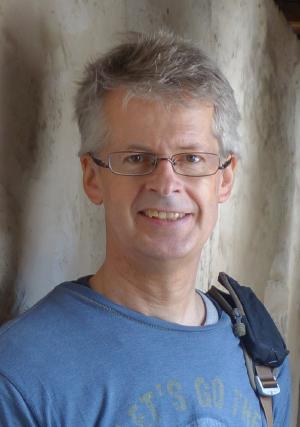
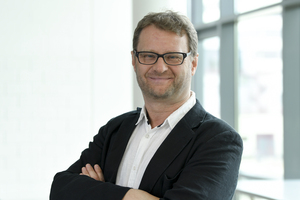
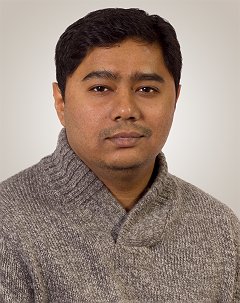
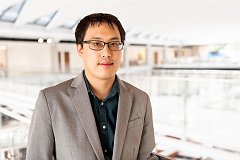
Prof. Dr. Martin Middendorf is a faculty member at the Department of Computer Science , Faculty of Mathematics and Computer Science , Leipzig University , Germany. He leads the Swarm Intelligence and Complex Systems Group and focuses on interdisciplinary research at the intersection of computational methods and biological systems. Fields of Interest Swarm Intelligence Bioinformatics Genome Rearrangement Analysis Combinatorial Optimization Evolutionary Algorithms Task Allocation in Multi-Agent Systems His recent research emphasizes mitochondrial genome annotation , predator-prey dynamics in swarm systems , and metaheuristic algorithms for dynamic optimization . Key trends include de-Bruijn graph applications , pheromone-dependent movement modeling , and automated behavior tracking in social insects . Supervised Students Dr. Nicolas Wieseke Dr. Hoang Thanh Le Dr. Fatma Turna Tobias Jagla Carsten Seemann Prof. Middendorf's group develops tools like DeGeCI 1.1 for mitochondrial gene annotation and explores swarm-controlled emergence in ant clustering systems. They apply swarm intelligence principles to solve real-world problems in vehicle routing , sewer network design , and biomedical signal processing .
Prof. Dr.-Ing. Tim Wilhelm Nattkemper leads the Biodata Mining Group at the Faculty of Engineering , Universität Bielefeld , while holding affiliations with the Center for Biotechnology (CeBiTec) and the Institute for Bioinformatics Infrastructure . His work bridges bioinformatics with marine environmental monitoring , focusing on machine learning and computer vision applications. The group specializes in multivariate bioimage analysis , developing platforms like BioIMAX for web-based high-dimensional data exploration. Research spans from MALDI imaging to deep-sea megafauna classification , integrating information visualization and web technologies . Recent projects address seafloor macrolitter monitoring , coral stress response analysis , and self-supervised learning for diatom classification. Their 15 most recent publications (2023-2025) highlight advancements in marine imaging , automated annotation systems , and AI-driven biodiversity assessment , particularly in polymetallic nodule fields. The group also tackles technical challenges like data imbalance in marine image classification and FAIR data principles implementation. As module responsible for courses like Information Visualization and Introduction to Bioinformatics , Nattkemper contributes to academic training in bioinformatics and data science . His interdisciplinary collaborations span physics , chemistry , and ecology within Bielefeld's Material World strategic research area.
Kjartan Østbye is a full Professor at the University of Inland Norway (INN), based at the Faculty of Applied Ecology, Agricultural Sciences and Biotechnology within the Department of Forestry and Wildlife Management . He is an active member of the research group E4 – Evenstad ecology, evolution and environment , contributing to internationally recognised research in ecology, conservation genetics and fish biology. Research interests revolve around how freshwater organisms adapt to environmental change. His work integrates evolutionary ecology , landscape genetics and ecotoxicology to investigate: adaptive divergence and speciation in post-glacial fishes (sticklebacks, whitefish, Arctic charr); genetic consequences of habitat fragmentation on amphibians and mammals; mercury biomagnification and amino-acid dynamics in subarctic lake food webs; remote-sensing approaches to predict habitat properties and inform conservation. Across more than 50 peer-reviewed publications since the early 1990s, his research exhibits a clear trajectory: early ecotoxicological studies on aluminium toxicity in salmonids evolved into sophisticated genomic and modelling approaches that illuminate how landscape structure, predation regimes and climatic gradients shape biodiversity. Recent work couples field sampling with next-generation sequencing and GIS-based habitat modelling to forecast species distributions under future climate scenarios. Scientific awards & recognition : while specific honours are not listed in the provided text, the volume and impact of his publications (many in top ecology and evolution journals) indicate sustained international recognition. Advising & grants : the extensive publication record implies supervision of numerous graduate students and post-doctoral researchers; however, individual student names are not supplied in the text. External funding has supported large-scale comparative studies across Scandinavian lakes and long-term translocation experiments with Arctic charr. Laboratory & field teams : work is centred at INN’s Evenstad campus, with active field programmes in boreal and subarctic lake systems and collaborations extending to Sweden and beyond.
Dr. Eng. Joanna Strug is a lecturer at the Department of Automation and Computer Science within the Faculty of Electrical and Computer Engineering at Cracow University of Technology. Her research focuses on software testing methodologies, machine learning applications in test automation, and database technologies. Specialization in mutation testing and fault injection Expertise in UML/OC validation and business process testing Active researcher in relational and non-relational database modeling Recent research trends indicate a focus on database technology performance analysis, including: Comparative benchmarking of relational vs. NoSQL databases Cost optimization in mutation testing using machine learning Structural similarity applications for test classification Validation frameworks for service-oriented architectures Model-based testing of business processes Bytecode-level mutant classification Her work appears in prominent venues including: Information Systems Architecture and Technology Artificial Intelligence and Soft Computing Journal of Engineering International Conference on Software Engineering (ENASE)
Eliana Pastor is a Fixed-term Assistant Professor at the Department of Control and Computer Engineering (DAUIN) , Politecnico di Torino , and a member of the SmartData@PoliTO - Big Data and Data Science Laboratory . She teaches courses including Explainable and Trustworthy AI (Computer Engineering) and Business Intelligence for Big Data (Management Engineering) across academic years 2023-2025. Scientific branch: IINF-05/A - Information Processing Systems (Area 0009 - Industrial and Information Engineering) ERC sectors: Algorithms, Artificial Intelligence, Machine Learning, Software Engineering, Web Systems Her research focuses on Algorithm Fairness , Explainable AI , and Trustworthy AI , with applications in speech processing, computer vision, and ethical AI systems. She leads the commercial research project Root Cause Analysis in Mechatronic Systems via Pattern Recognition and Causal AI (2024-2025) and supervises PhD students Eleonora Poeta (Safe and Trustworthy AI) and Alkis Koudounas (Speech Foundation Models). Recent publications address fairness in speech models, video LLMs for zero-shot summarization, and Kolmogorov-Arnold Networks for language understanding Collaborates with DBDM - Database and Data Mining Group (DAUIN) on AI ethics and data science projects
Rémy Boyer is a Professor at the University of Lille, based in room S2.49 of the ESPRIT building on the Cité Scientifique campus. He is affiliated with the CRIStAL research laboratory (Centre de Recherche en Informatique, Signal et Automatique de Lille) and the SIGMA research team. His research focuses on advanced tensor methodologies and signal processing, with core interests in: Tensor Decomposition Signal Processing Multidimensional Data Analysis Machine Learning applications Rank Estimation techniques Professor Boyer has supervised two doctoral theses to completion: Maxence Giraud: "Fast decomposition, rank estimation and performance bound for tensor modeling" (defended March 5, 2025) Ouafae Karmouda: "Tensor methods for multidimensional data: Learning and rank estimation" (defended December 9, 2022) His professional profile and publication list are accessible via his university web presence.
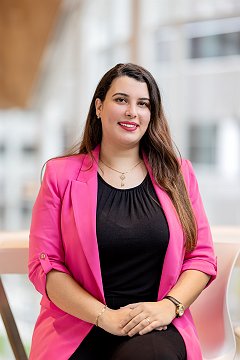
Naowarat Lewis is an Associate Professor at Anglia Ruskin University within the School of Economics, Finance and Law (Faculty of Business and Law). She concurrently serves as a Visiting Professor at Mahidol University, Thailand since 2024. Her multidisciplinary expertise spans Applied Statistics, Information Technology, and Information Science, directly informing her teaching and research in educational technology and statistics pedagogy. Her academic qualifications include: PhD in Computing and Information Science (Anglia Ruskin University) Postgraduate Certificate in Teaching and Learning (Higher Education) (Anglia Ruskin University) MSc in Information Technology (University of East London) BSc (Hons.) in Applied Statistics (University of the Thai Chamber of Commerce) Lewis pioneered the "Lewis Dynamic Model" educational framework examining technology-enhanced learner engagement in Business Statistics. Her research centers on Educational Technology, Serious Gaming, Statistics Education, and ICT for Development, with emphasis on video-based learning, gamification, and interactive pedagogy to improve quantitative skills. She actively integrates software development expertise from her professional background into pedagogical contexts. Analysis of her recent publications reveals consistent focus on technology-driven solutions for statistics education challenges, bridging Education, Business, and Computer Science disciplines through empirical studies and framework development. Key recognitions include: Vice-Chancellor’s Award for Learning and Teaching Excellence Senior Fellowship of the Higher Education Academy Lewis supervises DBA and PhD students while securing substantial research funding including the Low Carbon KEEP project (£79,253.36) and Retained Firefighters Union remote learning platform (£120,000). Her consultancy portfolio features statistical analysis for marketing campaigns (£10,000) and development of web-based learning facilities (£120,000), demonstrating strong industry-academia knowledge exchange. She contributes to editorial boards including Humanities and Social Sciences Communications (Nature Portfolio) and actively participates in curriculum development at Mahidol University, extending her impact through international academic collaboration.
Professor Christian Barton is a leading academic and clinician in physiotherapy at La Trobe University's School of Physiotherapy, specializing in musculoskeletal rehabilitation and implementation science. He maintains an active dual career spanning research, teaching at the Bundoora campus, and private clinical practice treating sports injuries in Melbourne. His educational background includes a PhD and Master of Communications from La Trobe University, a Graduate Certificate in Implementation Science from UCSF, and a Bachelor of Physiotherapy (Honors) from Charles Sturt University. Barton leads major implementation initiatives including GLA:D Australia (education/exercise for osteoarthritis) and TREK (Translating Research Evidence and Knowledge), with research focusing on knee osteoarthritis, patellofemoral pain, running injuries, and digital health solutions. Barton's publication record demonstrates significant impact in orthopedics and rehabilitation science, with recent work examining remote versus face-to-face osteoarthritis management, biomechanical outcomes of exercise therapy, and patient belief systems. As Associate Editor of the British Journal of Sports Medicine , he influences global discourse while advising the Australian Physiotherapy Association on policy. His work bridges clinical practice and research through funded projects including HERknee CRE, KNEECAPs!, and SUPER rehabilitation studies. His research collaborations span international networks with projects implemented across Australia, the UK, Europe, and Scandinavia, reflecting his status as a sought-after speaker and course developer for knee pain management. Barton's expertise in implementation science drives real-world application of evidence through structured programs like GLA:D Australia, which has trained hundreds of physiotherapists nationwide.
Dr Robert Bell is a Senior Lecturer and Head of the Arts & Humanities Program in the College of Arts, Business, Law, Education and IT at Victoria University. He serves as Course Coordinator for the Bachelor of Music and Music Specialisation coordinator for the Bachelor of Education (P-12), with prior lecturing experience at Swinburne University, Melba Conservatorium, and Victorian College of the Arts. His educational background: PhD from Swinburne University BA (Hons) in Music from La Trobe University Specializing in music technology and perception, his research spans Composition, Music Cognition, Physics of Sound, and Psychoacoustics. His PhD developed a percussive sound lexicon for digital libraries, and he investigates online platforms for educational engagement. Industry experience as a performer/producer informs his academic work. Publications reveal dual expertise: systematic percussive sound analysis for cataloging systems and innovative educational applications of online discussion forums. This bridges technical music research with pedagogical innovation in higher education contexts. He has supervised one Masters student (associate supervisor) and currently guides one Honours student (principal supervisor). His 30+ years as a touring percussionist and producer—working with artists like Philip Glass and releasing under Rhythm Boy—enriches his teaching and research perspectives.
Phil McMinn is a Professor of Software Engineering at the University of Sheffield, UK, where he leads the Testing Research Group, one of the largest software testing groups in the UK. His research focuses on developing automated techniques for software testing to help developers maintain robust test suites that effectively find bugs. His primary research interests include Software Testing , Search-Based Software Engineering , Flaky Tests , Mutation Analysis , and Pseudo-Tested Code . Recently, his work has centered on helping developers detect and mitigate flaky software tests, as well as developing mutation analysis approaches to assess test suite quality. His research has been funded by the EPSRC and Meta. Analysis of his recent publications (2023-2025) reveals a strong focus on addressing critical challenges in software testing, particularly around test flakiness, pseudo-tested code detection, and test suite optimization. His work spans both theoretical foundations and practical tool development, with significant contributions to understanding the limitations of current testing practices and developing novel approaches to improve test reliability and effectiveness. Professor McMinn serves as an associate editor for the Software Testing, Verification and Reliability journal and has supervised ten PhD students to completion as first supervisor. He currently mentors five PhD students and a post-doctoral researcher on projects related to test flakiness, mutation analysis, and testing for autonomous systems. He teaches the first-year COM1001 Introduction to Software Engineering module and the third-year COM3529 Software Testing and Analysis module at the University of Sheffield, emphasizing team-based development, automated testing, and code quality improvement through refactoring.
Iftekhar Ahmed is an Associate Professor in Informatics at the Donald Bren School of Information and Computer Science, University of California, Irvine. His research focuses on software engineering, particularly combining software testing, static analysis, and machine learning to develop better tools and techniques for software quality assurance. His educational background includes: PhD in Computer Science (2018) from Oregon State University, advised by Carlos Jensen BSc in Computer Science & Engineering (2007) from Shahjalal University of Science and Technology Dr. Ahmed's research interests center on software testing, static analysis, and the application of machine learning to software engineering problems. He has made significant contributions to mutation analysis, particularly in scaling this technique for real-world software systems. His work often bridges theoretical advances with practical applications, focusing on how to make software testing more effective and efficient for developers. He leads the STAIRS (Software Engineering & Testing Using Artificial Intelligence for Reliable Software) research group at UCI, where his team explores innovative approaches to software reliability through AI and machine learning. His recent publications demonstrate a strong trend toward integrating artificial intelligence with traditional software engineering practices. There's a clear focus on applying machine learning to code analysis, commit message generation, and bug detection, while maintaining rigorous empirical validation through studies of real-world software projects and developer practices. His work spans multiple domains including web accessibility, quantum computing, and Jupyter notebooks, showing both depth in core software engineering topics and breadth across application areas. Dr. Ahmed has received several prestigious awards: IBM Ph.D. Fellowship for academic year 2016-2017 Graduate School tuition relief Scholarship for academic year 2016-2017 IBM Ph.D. Fellowship for academic year 2017-2018 Actively involved in the academic community, Dr. Ahmed serves on program committees for major software engineering conferences including ASE, ICSE, and ESEC/FSE. He is currently accepting PhD students into his research group and emphasizes mentorship and professional development. His research has been supported by various grants that enable his team to explore innovative approaches to software testing and analysis. Dr. Ahmed leads the STAIRS research group at UCI, which focuses on developing AI-powered techniques for software testing and reliability. The group collaborates with industry partners and academic institutions to ensure their research addresses real-world challenges in software development. Current projects include improving mutation testing scalability, analyzing code smells in emerging domains like quantum computing, and developing tools for accessibility testing.
August Shi is an Assistant Professor in the Department of Electrical and Computer Engineering at The University of Texas at Austin. His research focuses on software testing, particularly regression testing, with emphasis on improving reliability with respect to flaky tests and increasing testing speed without compromising quality. Dr. Shi obtained his PhD in Computer Science from the University of Illinois at Urbana-Champaign in 2020. Prior to that, he earned a B.S. in both Computer Science and Electrical and Computer Engineering from The University of Texas at Austin in 2013. Dr. Shi's research interests center on software testing and regression testing , with a particular focus on addressing challenges related to flaky tests . His work aims to make regression testing both more reliable (by tackling issues with flaky tests) and faster (without sacrificing testing quality). His research spans multiple aspects of software testing including test prioritization, test scheduling, flaky test detection and repair, and optimization of continuous development processes. Dr. Shi's publication record shows a consistent focus on flaky tests and regression testing across multiple top-tier software engineering conferences including ASE, ICSE, ISSTA, and ESEC/FSE. His research has evolved from foundational work on test suite reduction and mutant generation to more recent innovations in flaky test classification, debugging, and repair. A notable trend is his increasing application of machine learning techniques to testing problems, particularly in his 2024-2025 publications. Dr. Shi actively contributes to the software engineering research community through committee service on major conferences including ASE, ICSE, ISSTA, and ESEC/FSE, where he has served on program committees for Research Papers, NIER tracks, and Tool Demonstration tracks. Dr. Shi is currently seeking PhD students to work on projects related to his research interests in software testing. He has supervised or co-supervised multiple student projects presented at major software engineering conferences, demonstrating his commitment to mentoring the next generation of researchers.
Manel Abdellatif is a Professor in the Department of Software Engineering and IT at École de Technologie Supérieure (ETS) in Montreal, Canada. Her research spans trustworthy AI, service computing, and software maintenance/evolution, with significant contributions to software engineering conferences including ASE (Tool Demo PC Member 2025), ICSE (Awards Chair 2025), and DeepTest (Committee Member 2026). She actively publishes in top venues like IEEE TSE and ACM TOSEM with recent work on deep learning safety and microservice modernization. Dr. Abdellatif holds an M.Sc. from ÉTS and a Ph.D. from Polytechnique Montréal. Her doctoral research focused on service identification approaches for legacy system migration to SOA, establishing her expertise in software modernization. She maintains strong industry connections through applied projects addressing real-world challenges in system migration and digital transformation. Her research program centers on AI system reliability and software modernization , with three interconnected thrusts: (1) Safety monitoring and testing of deep reinforcement learning systems (SMARLA framework), (2) Microservice migration including antipattern detection and service identification, and (3) Legacy system modernization using machine learning and semantic analysis. She combines empirical studies with practical tool development, often collaborating with industry partners on real systems. Analysis of her 15 most recent publications reveals a clear trajectory toward ensuring trustworthy behavior in AI systems while addressing architectural challenges in modern software. Her work bridges theoretical advances in deep learning testing with practical solutions for microservice adoption, showing increasing focus on formal methods for safety guarantees in autonomous agents. Dr. Abdellatif supervises a dynamic research group with 9 current graduate students working on cutting-edge topics including federated learning anti-patterns (Amirhossein Roudgar), AI-to-microservice migration (Hakim Ghlissi), and deep learning test optimization (Hatem Feki). Her supervision spans both theoretical research (master's theses) and industry-applied projects addressing concrete modernization challenges. Her work is conducted within ETS's Software Systems, Multimedia and Cybersecurity research axis, where she collaborates with colleagues on software quality, IoT systems, and empirical engineering methods. The department's strong industry connections enable her team to validate approaches on real-world systems while maintaining academic rigor.
Professor Chua Tat Seng is a distinguished academic at the National University of Singapore's School of Computing, serving as KITHCT Chair Professor and Director of the NUS-Tsinghua Extreme Search Center (NExT). He also holds Distinguished Visiting Professorships at Tsinghua and Zhejiang Universities in China. PhD in Computer Science (University of Leeds, 1983) Founding Dean of School of Computing (1998-2000) Co-founded ViSenze and 6Estates technology startups His research focuses on unstructured multimodal data analytics, with particular emphasis on multimedia information retrieval, social media analytics, recommendation systems, and trustworthy AI. He has pioneered work in computational wellness and fintech applications, establishing the Lab for Media Search and leading NExT++ research initiatives. Over 300 publications in leading venues (CVPR, SIGIR, WWW, AAAI) Recipient of ACM SIGMM Technical Achievement Award (2015) Supervised 37 PhD students since 2004 Editorial leadership in ACM Transactions and IEEE Multimedia Recent work explores multimodal LLMs, knowledge editing techniques (AlphaEdit), and 3D generation frameworks, reflecting his commitment to advancing web intelligence and user empowerment.
Dr. Conor Muldoon is a Senior Lecturer in Software Engineering at the Department of Computing and Mathematics, Manchester Metropolitan University. His research focuses on distributed artificial intelligence, sensor networks, and multi-agent systems with applications in environmental monitoring and smart home technologies. Previously, he held postdoctoral positions at University College Dublin (UCD) and the University of Oxford, supported by prestigious fellowships including the INSPIRE Marie Curie and Government of Ireland Embark awards. He earned a Ph.D. in Computer Science from UCD, along with a first-class B.Sc. in Computer and Software Engineering and a Postgraduate Certificate in Higher Education Teaching. His research portfolio includes developing water quality forecasting systems, citizen science platforms (e.g., COBWEB), and autonomic energy management solutions. He has published extensively in journals and conferences, addressing topics such as sensor network optimization, incentive mechanisms for crowdsourcing, and adaptive middleware for ambient intelligence. Dr. Muldoon is a Fellow of the Higher Education Academy and supervises PhD candidates in areas like multi-agent systems and environmental informatics. Education: Ph.D. in Computer Science, University College Dublin B.Sc. (Honours) in Computer and Software Engineering, University College Dublin Postgraduate Certificate in Teaching and Learning in Higher Education His work bridges theoretical computer science with real-world applications, emphasizing sustainability and participatory technologies. Key projects include the Dublin Bay Water Quality Modelling and the MERA Data Extraction Toolkit. Awards include recognition for his contributions to agent-based systems and environmental data science.