Jun Zheng is a Professor in the Department of Computer Science & Engineering at New Mexico Tech. His research focuses on mobile security, mobile human-computer interaction (HCI), smart grid security, and network anomaly detection. Key projects include developing deep learning models for smart grid fraud detection, UAV swarm security, and biometric authentication using electromyography signals. He has published extensively in top-tier venues, with notable work in IEEE journals and conferences. Recent themes include optimizing UAV-assisted IoT networks, securing home area networks, and enhancing mobile malware detection via image-based analysis. His research bridges cybersecurity and energy systems, applying machine learning to address challenges in smart grid resilience, mobile device security, and human-centered computing. No awards or specific grants are explicitly listed, but his prolific publication record highlights sustained academic contributions.
Dr Ben Pickering is a Research Fellow at the University of Leeds and affiliated with the National Centre for Atmospheric Science. His work focuses on developing advanced rainfall retrieval systems using satellite data and machine learning techniques, with applications in near real-time nowcasting over Africa. His research integrates meteorology and engineering to improve forecasting tools and societal decision-making. He collaborates with institutions in the UK and Africa to develop practical web-based nowcasting solutions and promotes interdisciplinary collaboration through forecasting testbeds. Dr Pickering is actively involved in postgraduate supervision, scientific outreach, and leads a weekly weather discussion forum at the University of Leeds. He emphasizes the value of extracurricular engagement and interdisciplinary exploration in shaping a successful career in natural sciences. He advocates for diversity in the natural sciences, recognizing its broad societal and environmental impacts, and aims to bridge gaps between academia and industry through commercially viable research applications in meteorological measurement technologies.
Priit Vahter is a Professor of Applied Economics at the University of Tartu's School of Economics and Business Administration, leading the Department of International Business and Innovation. He holds a Doctorate in Economics from the University of Nottingham (2010) and has extensive academic and professional experience, including roles at the University of Warwick, Aston University, and the Bank of Estonia. His research focuses on innovation economics, productivity determinants, foreign direct investment (FDI), and global value chains. He has supervised over 40 master's and doctoral students, contributing to impactful studies on topics like gender wage gaps, firm performance, and digital innovation. Dr. Vahter has received prestigious awards, including the Estonian Academy of Sciences’ Mihhail Bronštein Award (2025) and the University of Tartu Badge of Distinction (2024). He actively contributes to academic governance, serving on the University’s Academic Committee and the European International Business Academy’s board. His work bridges theoretical economics with practical policy analysis, particularly in Estonia and emerging markets. Key research interests include: analyzing how innovation impacts firm-level gender wage disparities, studying the role of multinational corporations in knowledge transfer, and leveraging web data to predict company innovativeness. His recent articles explore automation’s effect on soft skills, dynamics of abandoned innovations, and complementarities between technological and organizational innovation. Dr. Vahter leads the research project 'Innovation Complementarities and Productivity Growth' (2020–2025), funded by the Estonian Research Council, and collaborates internationally on EU-funded studies. He has authored/co-authored over 90 publications in journals like Research Policy and Journal of International Business Studies , and regularly reviews for top-tier journals.
Peter Popov is a Reader at the Centre for Software Reliability (CSR) , City St George's, University of London , where he has been employed since 1997. He specializes in software dependability , fault tolerance , and stochastic modeling of critical infrastructures. Before his current position, he was an Associate Professor at the Bulgarian Academy of Sciences (1990-1997) and a Research Fellow at City St George's. Peter's academic journey began with a PhD in Computer Science from the Kiev National University of Technologies and Design (1989), following his BEng in Computer Engineering from the National Technical University of Ukraine (KPI, 1982). He has worked as a visiting scientist at renowned institutions including the Coordinated Science Laboratory at the University of Illinois at Urbana-Champaign , LAAS-CNRS in Toulouse, and Duke University . His research interests span Software reliability assessment System dependability Software fault-tolerance Performance evaluation Interdependencies of critical infrastructures He has contributed extensively to projects such as ReSIST , IRRIIS , DISPO , and AFTER , focusing on the dependability of composite systems and critical infrastructure resilience. Key publication trends reveal expertise in Stochastic modeling of autonomous vehicle safety Software diversity for fault tolerance Interdependency analysis in critical systems Bayesian reliability assessment Performance evaluation of distributed protocols Security implications in cyber-physical systems Peter has supervised several PhD students , including those researching autonomous vehicle resilience , safety assurance with ML components , and adaptable web services . His professional activities include serving on program committees for ISSRE , SAFECOMP , and EDCC conferences, as well as editorial contributions to CEUR Workshop Proceedings . He is proficient in Bulgarian , English , and Russian , with peer-review capabilities in all three languages.
André Lamúrias serves as an Assistant Professor in the Department of Computer Science at NOVA School of Science and Technology, Universidade Nova de Lisboa, Portugal. His academic journey includes a postdoctoral position at Aalborg University's Department of Computer Science (DKWE group) and prior work at Priberam Labs. He completed his PhD at LASIGE, Faculdade de Ciências, Universidade de Lisboa. His research specializes in biomedical information extraction from scientific papers, electronic health records, and genomics data using machine learning algorithms integrated with domain ontologies. Current projects include metagenomic binning with graph neural networks and low-resource biomedical document processing. His work bridges computational methods with biological applications through extensive GitHub development. Lamúrias teaches Bioinformatics, Algorithms and Data Structures for Biology, Artificial Intelligence Techniques for Biology, Databases, and Artificial Intelligence courses at both MSc and BSc levels. His publication record shows consistent output in top bioinformatics journals including BMC Bioinformatics, Frontiers, and Journal of Cheminformatics, with research evolving from chemical entity recognition to advanced metagenomic analysis. He actively supervises MSc students on projects spanning information extraction in low-resource scenarios, cell type classification, genome recovery, and document retrieval systems. His GitHub profile demonstrates ongoing technical contributions with 28 commits in the last year across multiple repositories.
Dr. Xiaojun Luo serves as a Senior Lecturer in Financial Technology at the University of the West of England (UWE Bristol), affiliated with the Faculty of Business and Law and the Department of Accounting, Economics and Finance. He joined UWE Bristol in 2018 as a Research Fellow and was promoted to Senior Lecturer in 2021. Education: Bachelor Degree from Huazhong University of Science and Technology PhD from City University of Hong Kong Nanodegree in Full Stack Web Development Nanodegree in Front End Web Developer Nanodegree in Blockchain Developer Dr. Luo's research bridges financial technology and sustainable energy systems, with core expertise in blockchain applications for cryptocurrency and energy networks. His work integrates artificial intelligence and machine learning to develop fintech valuation models while advancing building energy modelling and renewable energy systems for decarbonisation. He particularly focuses on cross-disciplinary solutions connecting financial markets with sustainable infrastructure. Research Leadership: Completed as PI/Co-I: HEIF: Fintech Valuation Models – Online Event Vice Chancellor Early Career Researcher: AI and blockchain-enabled smart multi-energy network framework Ongoing as PI: Vice Chancellor Accelerator Programme: Blockchain platforms for peer-to-peer energy sharing Dr. Luo actively mentors students through dissertation supervision and project guidance, welcoming new PhD candidates in fintech and sustainable energy domains. His teaching portfolio includes Blockchain, Cryptocurrency, Financial Management, and Machine Learning applications.
Hongrae Lee is a researcher specializing in database systems, natural language processing, and data mining. His work bridges structured data management with language models, focusing on tasks like natural language to SQL translation, similarity joins, and efficient data processing. His research interests include: Database query optimization and similarity search Language model applications for text generation and hallucination correction Web data curation and structured data ecosystems Cloud storage optimization and distributed systems Hongrae Lee's recent publications (2022-2023) highlight trends in large language models (LLMs) for dialogue applications, attributed text generation, and acronym disambiguation with weak supervision. Earlier work (2016-2007) established foundational techniques in database scalability, LSH-based similarity estimation, and geographical data thinning. He has collaborated extensively with researchers at institutions like Google, Seoul National University, and University of British Columbia on projects such as WebTables, LaMDA, and Google Fusion Tables. His contributions span both theoretical advancements (e.g., variance-aware query optimization) and practical systems (e.g., CloudRAMSort, T5-based disambiguation).
Susan D. Wolfsthal, MD is a Clinical Professor in the Department of Medicine at the University of Maryland School of Medicine, serving as Associate Chair for Education and Residency Program Director for the Internal Medicine Residency Program. She oversees clinical training for over 130 residents and 12 fellowship programs, ensuring compliance with accreditation standards while advancing educational excellence through innovative curriculum design. Her educational background includes: B.A. in Biology (Magna Cum Laude), University of Rochester (1972-1976) M.D., Johns Hopkins University School of Medicine (1976-1980) Internship and Residency in Medicine, Johns Hopkins Hospital (1980-1983) Dr. Wolfsthal's research focuses on graduate medical education reform, specializing in competency-based curricula, faculty development, and assessment systems. She pioneered HRSA-funded initiatives in cultural sensitivity training, evidence-based medicine integration, and entrustable professional activities frameworks. Her work bridges educational theory with practical implementation, emphasizing resident milestone achievement through appropriate supervision levels and innovative evaluation tools. Analysis of her publication record reveals consistent leadership in transitioning medical education from knowledge-based to competency-driven models. Key trends include the operationalization of entrustable professional activities, development of specialty-specific assessment tools, and integration of web-based training for critical areas like palliative care and infection control. Her scholarship consistently addresses systemic challenges in residency training while providing implementable solutions. Her distinguished honors include the Celeste L. Woodward Professorship in Humanitarian Medical Practice and recognition as a Founding Member of the National Gold Humanism Society. Additional accolades span teaching excellence awards from students and residents, departmental leadership recognition, and sustained contributions to medical education scholarship. Celeste L. Woodward Professor of Humanitarian and Ethical Medical Practice (2001) C. Lockard Conley Award for Excellence in Resident Teaching and Research (2003) Senior Residents’ Award for Excellence in Teaching (2003) Multiple Student Marshall and Hooding awards (2005-2014) Chairman’s Special Achievement Award (2016) Fellow, American College of Physicians (1990-present) Academy of Educational Excellence Fellowship (2014) As Principal Investigator on four HRSA grants, Dr. Wolfsthal has developed nationally recognized educational frameworks while mentoring faculty and fellowship directors. Her clinical practice in internal medicine grounds her educational leadership in current medical practice, and she co-directs the medical student physical diagnosis course. Her administrative oversight encompasses all aspects of resident training from curriculum design to evaluation systems, ensuring alignment with evolving accreditation requirements.
Georgia Heirchanteri is an Assistant Professor at the Department of Industrial Design and Production Engineering, School of Engineering, University of West Attica. She holds a PhD in Engineering from the National Technical University of Athens (2014) with a specialization in Industrial Archaeology, following postgraduate studies in Architecture-Spatial Design (2004). Her academic journey includes teaching roles at the Technical University of Athens and a retroactive appointment as University Lecturer in Graphic Design since 1992. Education: Graduate of Architecture (Aristotle University of Thessaloniki), Graphic Design (Technical University of Athens), Postgraduate in Architecture-Spatial Design (NTUA) Current Role: Assistant Professor (since 2020), Postdoctoral Researcher (2017-present), Supervising Architect (2019-present) Her research focuses on interdisciplinary intersections between Industrial Architecture, Cultural Heritage Preservation, and Environmental Graphic Design. Key areas include: Study of Greek Industrial Architecture (19th-early 20th century), particularly electricity production facilities Preservation strategies for industrial heritage as cultural assets Graphic Design applications in spatial communication and signage systems Industrial Design process from ideation to implementation Sustainable urban development and circular economy models Recent publications analyze topics spanning smart energy systems , heritage resilience , climate-responsive design , and nano-material innovations . She leads the 'Design and Development of Innovative Knitted Textile and Apparel Products - SAPKE' laboratory since 2021, contributing to textile engineering research.
Uğur Başarmak is an Associate Professor at the Faculty of Education , Kırşehir Ahi Evran Üniversitesi , specializing in Computer and Educational Technologies Education . With over 20 years of experience, his research focuses on educational material development , technology integration , and digital citizenship . PhD (2009-2013) and MSc (2008) in Computer and Educational Technologies Education from Gazi University Master's in Electronics and Computer Education (2002-2005) and B.Sc. in Electronics and Computer Education (1992-1996) from Marmara University His research explores computational thinking , coding education , and technology barriers in education. Recent work includes Metaverse integration in learning environments and digital citizenship curricula . Articles emphasize teacher self-efficacy , project-based learning , and STEM education . Key projects include STEMkar Robotlar (2018-2019) and international collaborations like HORIZON-MSCA (2024). He has supervised 4 master’s theses and served as a principal investigator in 15+ research projects since 2011.
Andrzej Skalski serves as a Professor and Deputy Head of the Department of Metrology and Electronics within the Faculty of Electrical Engineering, Automatics, Computer Science and Biomedical Engineering at AGH University of Science and Technology in Kraków. He actively participates in the Biomedical Engineering Discipline Council and maintains his primary workplace in Building B-1, Room 206, with contact via skalski@agh.edu.pl. His research spans Medical Imaging, Computer Vision, and Mixed Reality applications in healthcare, with concentrated expertise in medical image segmentation, surgical navigation systems, and 3D visualization techniques. Recent work demonstrates innovative integration of deep learning for vascular structure analysis, development of cloud-based diagnostic platforms like DECODE, and implementation of extended reality solutions for surgical precision and anatomy education. His scholarship bridges engineering principles with clinical practice to solve complex biomedical challenges. Analysis of his 2024-2026 publications reveals dominant trends in markerless surgical navigation, noninvasive vascular disease management, and educational technology for anatomy instruction. Key thematic clusters include: (1) Deep learning-driven segmentation of vascular and fracture structures in CT/X-ray data, (2) Mixed reality frameworks for surgical guidance and biopsy procedures, and (3) Systematic evaluations of digital versus traditional methods in medical education. These works consistently emphasize clinical applicability and technological innovation. Dr. Skalski leads collaborative initiatives including the DECODE platform for peripheral artery disease management and the PENGWIN 2024 Challenge for pelvic fracture segmentation benchmarking. His leadership in the Biomedical Engineering Discipline Council underscores institutional influence, while his extensive publication record indicates active supervision of graduate researchers despite no explicit student listings in available records. Current projects focus on WebGL-based medical visualization and mixed reality surgical navigation systems.
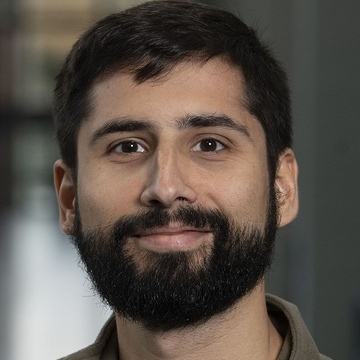
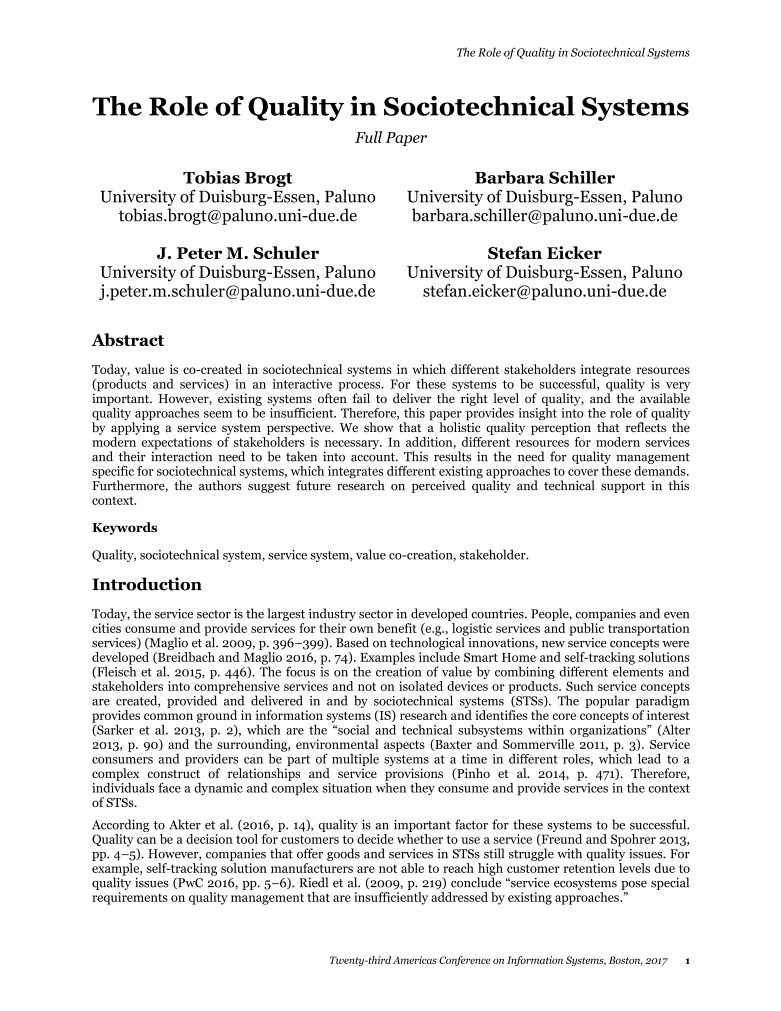
J. Peter M. Schuler is a part-time lecturer and research assistant at the University of Duisburg-Essen, Faculty of Business and Economics . He specializes in Information Systems , focusing on digitalization, process management , and quality models for hybrid products and sociotechnical systems. His work includes developing semantically structured web solutions for higher education and analyzing IT systems in decentralized organizational contexts. Education: Diplom in Business Informatics (2008), University of Duisburg-Essen. His research explores quality factors in self-tracking solutions , smart connected products , and holistic quality management . He has contributed to the design of microformats for course catalogues and evaluated IT carve-out processes . Articles highlight trends in agile software development , blockchain systems , and user-centered design across disciplines. As a project manager for WIWI-TYPO3 , he leads digital transformation initiatives and chairs committees for habilitation and appointment processes . His supervised theses cover Logistics 4.0, AI voice assistants, and technology ethics , though student names are not explicitly listed.
Prof. Dr. Michael Seufert is a Full Professor and Chairholder at the University of Augsburg since October 2023, leading the Chair of Networked Systems and Communication Networks within the Faculty of Applied Computer Science. Previously, he served as a Private Lecturer at the University of Würzburg and completed his Habilitation in Computer Science there in 2023. His academic journey includes a PhD in Computer Science from the University of Würzburg (2017) with a thesis on Quality of Experience and Access Network Traffic Management of HTTP Adaptive Video Streaming, which earned him two prestigious Best Dissertation Awards. His research focuses on Quality of Experience (QoE) of Internet applications, artificial intelligence and machine learning for communication networks, measurement and analytics of encrypted network traffic, and data-driven proactive user-centric network management solutions. His work bridges theoretical foundations with practical applications in network monitoring, security, and performance optimization. Recent research has increasingly incorporated machine learning techniques to address challenges in network management, traffic analysis, and user experience assessment. Prof. Seufert's publication record shows a clear evolution from foundational work on QoE modeling and HTTP adaptive streaming toward more sophisticated applications of machine learning in network operations. His recent publications (2023-2025) demonstrate a strong emphasis on practical ML applications for network monitoring, security, and optimization, with particular attention to real-world constraints and performance requirements. The research spans multiple subfields including encrypted traffic analysis, explainable AI for network management, edge computing, and quality assessment for emerging applications. CNOM Young Professional Award of the IEEE Communications Society (ComSoc) Technical Committee on Network Operations & Management (CNOM) (2024) Best Dissertation Award 2018 of KuVS (Communication and Distributed Systems) special interest group Best Dissertation Award of the IEEE Communications Society (ComSoc) Technical Committee on Network Operations & Management (CNOM) Prof. Seufert actively supervises research projects and advises students through thesis projects and practical modules. His teaching portfolio includes Communication Systems, Management of Communication Networks, Practical Introduction to Internet-Technologies, and seminars on Networked Systems. He leads a research group focused on networked systems and communication networks, with current projects exploring machine learning applications in networking, as evidenced by the organization of the 3rd International Workshop on Machine Learning in Networking (MaLeNe 2025).
Carlos Delgado Kloos is a Full Professor and Director of the Telematics Engineering Department at Universidad Carlos III de Madrid (UC3M), Spain. He is affiliated with the Escuela Politécnica Superior and leads research and innovation in educational technology, learning analytics, and AI-enhanced education. Education: Specific degree details are not provided in the text. Research Interests: His research spans educational technology , learning analytics , MOOCs , and AI applications in education . He explores how data-driven insights can enhance learning outcomes, student engagement, and instructional design. His work also includes smart learning environments , hybrid classrooms , and the use of generative AI in curriculum development and student support. Research Trends: His recent publications (2020–2025) reflect a strong focus on leveraging AI and machine learning to support education. Topics include predictive modeling for academic dropout, AI chatbots for programming education, micro-credentials, and the impact of telepresence technologies in hybrid classrooms. His work is highly interdisciplinary, combining computer science, education, and data science. Scientific Contributions: Director of the Telematics Engineering Department at UC3M Active researcher in learning analytics and AI in education Leads national and international R&D projects Advising & Grants: While specific student names and grants are not listed, his role as department director and prolific publication record indicate active supervision of graduate students and leadership in funded research initiatives. Labs & Teams: He is associated with two official research groups at UC3M: the Telematic Applications and Services Group (GAST) and the Network Technologies Group (NETTEC), both recognized by the university for their contributions to telematics and educational innovation.
Professor Malka Gorfine Orgad is a distinguished faculty member in the Department of Statistics and Operations Research at the School of Mathematical Sciences, Tel Aviv University. She has held the position of Professor since 2016, following her promotion from Associate Professor (2014-2016). Additionally, she maintains a long-standing affiliation as an Affiliate Investigator at the Division of Public Health Sciences, Fred Hutchinson Cancer Research Center in Seattle since 2003. Prof. Gorfine Orgad earned her MA (1994) and PhD (1999) in Statistics from the Hebrew University of Jerusalem under the supervision of Professors Banjamin Yakir and David Zucker. Her academic journey includes previous appointments as Associate Professor at Harvard School of Public Health (2011-2012) and at the Technion - Israel Institute of Technology (2010-2014), where she served as Senior Lecturer prior to that. Her research focuses on survival data analysis, non-parametric statistics, biostatistics, and machine learning. Specifically, she investigates inference based on Survival Deep Learning, natural experiment methods for causal inference, and various challenges of causal inference with survival outcomes. She has developed several innovative methodologies for survival analysis, particularly in the areas of competing risks, semi-competing risks, and illness-death models. Analysis of her recent publications reveals a strong emphasis on practical applications of survival analysis methodology to real-world health problems, particularly related to cancer and infectious diseases like COVID-19. Her work frequently bridges theoretical statistical development with practical implementation through software packages, demonstrating her commitment to making advanced methods accessible to applied researchers. Associate Editor of JASA Applications and Case Studies (2022 - present) Associate Editor of EJS (2022 - present) Associate Editor of Scandinavian Journal of Statistics (2021 - 2024) Co-Editor of Biometrics (2017 - 2019) Associate Editor of Biometrics (2009 - 2016) Member of Editorial Board of Lifetime Data Analysis (2013 - 2016) Prof. Gorfine Orgad actively mentors students at all levels, currently supervising one postdoc, two PhD students, and four MSc students, with numerous former students who have completed their degrees under her guidance. She serves as co-chair of the STRATOS TG8 (Survival Analysis Topic Group), which provides guidance on survival analysis methods for observational studies. She has also developed multiple software packages including PyMSM, PyDTS, frailty-LTRC, HHG, and others that implement her methodological contributions for the broader research community.