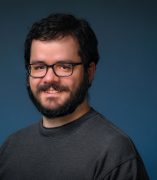
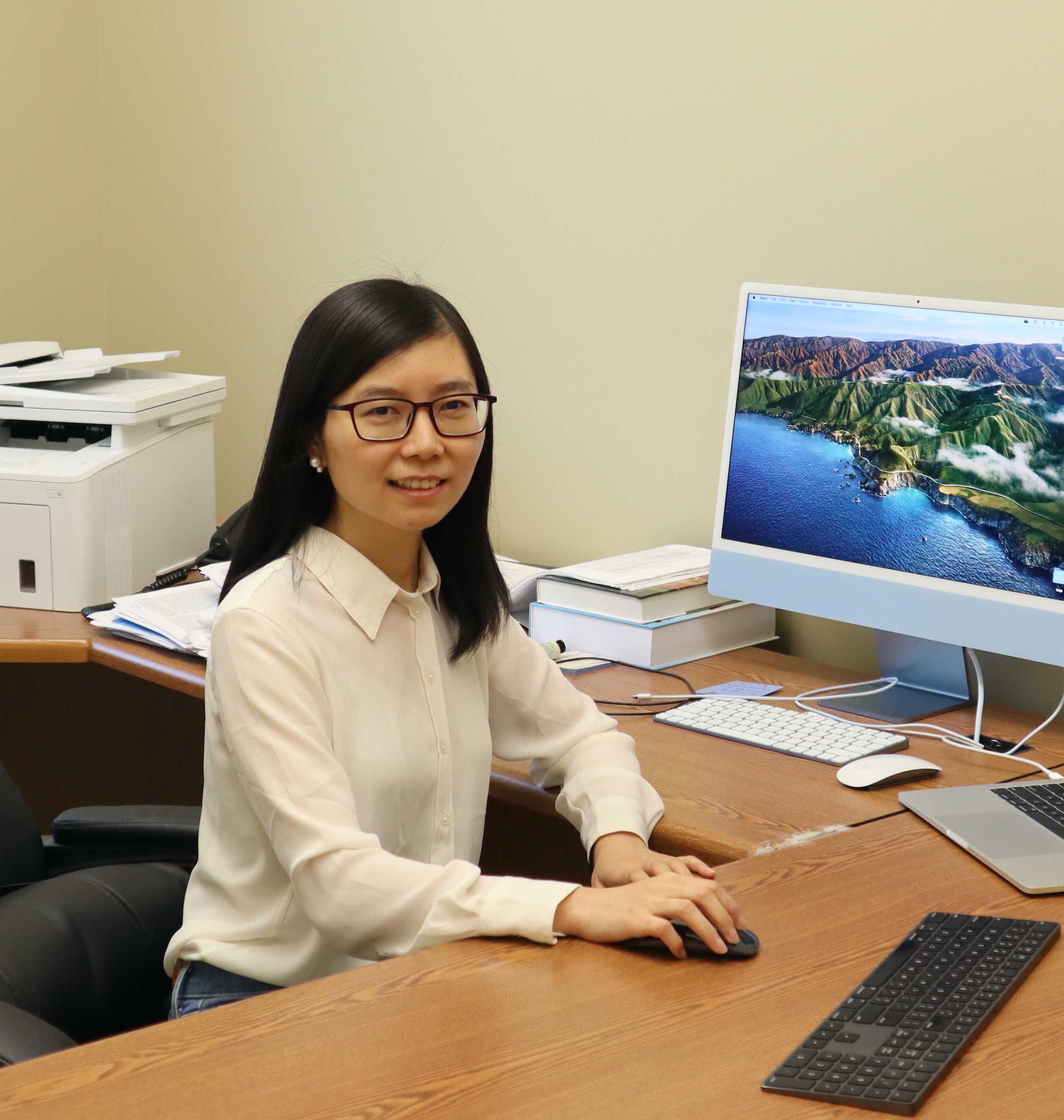
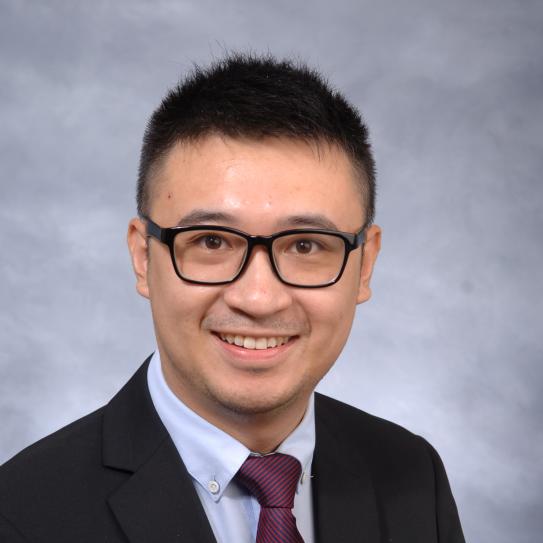
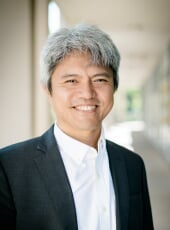
Sebastian Schemm is a Heisenberg Fellow at the Department of Applied Mathematics and Theoretical Physics (DAMTP), University of Cambridge, a position regarded as equivalent to a non-permanent Associate Professor. He leads research within the Atmosphere-Ocean Dynamics group and previously held an ERC Starting Grant-funded Assistant Professorship (without tenure track) at ETH Zurich. Education and Career Path PhD (2013) and MSc (2010), ETH Zurich, Switzerland Postdoctoral researcher, University of Bergen, Norway (2014–2017) Postdoctoral researcher, Laboratoire de Météorologie Dynamique, ENS Paris (2017–2018) Assistant Professor (ERC Starting Grant), ETH Zurich (2020–2024) Heisenberg Fellow, DAMTP, University of Cambridge (2025–present) Research Focus Schemm’s work centres on atmospheric and climate dynamics, spanning turbulence to planetary scales. Core themes include the physics of extratropical cyclone life cycles, jet-stream and storm-track dynamics, Rossby waves and teleconnection patterns, high-resolution atmospheric modelling, and the integration of machine-learning techniques for parameter estimation, data assimilation, and kilometre-scale global simulations. He also contributes to large-scale initiatives such as ECMWF’s WeatherGenerator. Scientific Awards and Editorial Service DFG Heisenberg Fellowship (2025) ERC Starting Grant (2020–2024) European Meteorological Society Young Researcher Medal (2019) Co-Editor, Weather and Climate Dynamics (EGU) Co-Editor, Quarterly Journal of the Royal Meteorological Society PhD Supervision & Funding He currently supervises PhD students at both Cambridge and ETH Zurich, with funding streams including the Cambridge CREATES Doctoral Training Partnership and Swiss/EU grants. Ongoing students explore reinforcement-learning parameterisations, jet-stream–storm-track relationships, mid-latitude eddy energetics, machine-learning ensemble forecasting, and Bayesian parameter estimation in LES. Active Projects EU Horizon project WeatherGenerator (led by ECMWF) PASC HiRAD-Gen : High-Resolution Atmospheric Downscaling Using Generative Models
Geert Deconinck is a full professor at KU Leuven , leading the Electrical Energy Systems and Applications (ELECTA) research group within the Department of Electrical Engineering (ESAT). He also serves as scientific leader of the EnergyVille research center's algorithms domain, focusing on smart electrical networks and thermal systems. M.Sc. and Ph.D. from KU Leuven Head of ELECTA since 2012 (10 professors, 8 postdocs, 70+ PhDs) Over 8 million EUR research budget in last 5 years 44 completed PhDs and 10 current advisees IEEE Transactions editorial board member His research spans smart grid architectures , distributed control , and cyber-physical security , with recent focus on EV-grid integration , renewable energy democratization , and multi-carrier energy systems . Current projects include: Smart Charging - E-Mobility meets Renewable Energy Early Detection and Defense Systems for Smart Grids Open-source P2P energy sharing platforms Microgrid control strategies for PV-battery systems Awarded IET Fellow and IEEE Senior Member status, his work combines machine learning with power systems engineering through both theoretical modeling and experimental validation . He has contributed over 575 publications with 9800+ Google Scholar citations.
Fabio Miranda is an Assistant Professor at the Department of Computer Science, University of Illinois at Chicago (UIC) . His research bridges visualization , machine learning , data management , and computer graphics to enable interactive visual analysis of large-scale urban datasets . He has developed systems like UrbanRama (for VR navigation) and The Urban Toolkit (a grammar-based framework), which have been deployed in academia, industry, and government agencies. Education: Ph.D., Computer Science , New York University (2018) M.S., Computer Science , Pontifical Catholic University of Rio de Janeiro (2011) B.S., Computer Science , Federal University of Minas Gerais (2009) Research Interests center on urban visual analytics , 3D analytics , and machine learning for accessibility . His work addresses challenges like sunlight access , sidewalk quality assessment , and commuting flow modeling , often collaborating with urban planners, climate scientists, and occupational therapists. Scientific Recognition includes awards at IEEE VIS , SIBGRAPI , and SIGMOD . His research is funded by NSF , NIH , DOT , and DPI , with media coverage in The New York Times , The Economist , and Architectural Digest . Teaching includes courses like CS 524: Big Data Visualization and Analytics and CS 424: Visualization and Visual Analytics . He emphasizes web-based systems, dataflow frameworks, and interdisciplinary collaboration, with open positions for PhD , MSc , and undergraduate researchers .
Dr. Li Chen is an Alfred and Helen Lamson/BORSF Endowed Associate Professor in the School of Computing and Informatics at the University of Louisiana at Lafayette. She leads the CELESTIAL research lab, focusing on distributed systems and networking for machine learning and AI. Her research interests include federated learning, cloud computing, and resource optimization. Dr. Chen holds a Ph.D. from the University of Toronto and has received awards such as the NSF EPSCoR RII Track-4 grant and the BoRSF Endowed Professorship. Education: Ph.D. (2018), M.A.Sc. (2015) in Electrical and Computer Engineering from University of Toronto; B.Eng. (2012) in Computer Science from Huazhong University of Science and Technology. She also visited Hong Kong Polytechnic University (2013-2014). Research spans federated learning frameworks (e.g., SEAFL, FedClust), cloud resource scheduling (e.g., Hadar, HarmonyBatch), and applications in weather forecasting (e.g., MMST-ViT). Her work is supported by NSF, Louisiana BoRSF, and industry partners like XRMedix. Awards include the Alfred and Helen Lamson/BORSF Endowed Professorship (2024-2027), NSF EPSCoR grant (2024-2026), and best paper recognitions at IEEE conferences. She advises a diverse group of graduate students and has supervised alumni now in academia and industry. Teaching includes courses on computer networks, operating systems, and distributed systems. She organizes workshops and tutorials (e.g., 2023 Summer Tutorial on ML & Meteorology) and serves on conference committees such as INFOCOM and IWQoS.
Confidence Duku is a researcher at Wageningen University & Research, specializing in climate resilience and agricultural systems. Their work integrates climate science, hydrology, and machine learning to address food security, deforestation impacts, and flood forecasting in data-scarce regions. Research Interests: Climate change modeling in Eastern Africa Hydrology-guided neural networks for flood forecasting Agricultural resilience (common bean, green gram) under climate stressors Economic impacts of deforestation in Brazil Climate services for financial institutions and SMEs Notable Contributions: Developed frameworks for climate-smart business planning and flood prediction, with a focus on regions like East Africa and Brazil. Their work emphasizes ecosystem services and adaptation strategies. Collaborations: Active in multi-institutional projects, including partnerships with SNV and Copernicus. Led LVVN projects on cascading climate risks and reforestation impacts.
Dr. Yuzhang Lin is an Assistant Professor in the Department of Electrical and Computer Engineering at NYU Tandon School of Engineering. Previously, he held an Assistant Professor position at the University of Massachusetts Lowell (2018–2023). He earned his Ph.D. from Northeastern University and B.Eng./M.S. from Tsinghua University. His research focuses on smart grids, renewable energy systems, cyber-physical resilience, and machine learning applications. He leads editorial roles for IEEE Transactions on Power Systems and chairs IEEE PES Task Forces on standard test cases and distribution system operations. Dr. Lin’s research has been funded by NSF, DOE, ONR, and others. He is a recipient of the NSF CAREER Award and Northeastern’s Graduate Student Outstanding Research Award. His work emphasizes data-driven solutions for grid resilience, including state estimation, cyber-physical defense, and distributed energy integration. The Lin Group actively seeks PhD candidates interested in advancing smart grid technologies. Education: Ph.D. (Northeastern University), B.Eng./M.S. (Tsinghua University) Grants: NSF, DOE OE/EECE/CESER, ONR, NYSERDA, MassCEC Service Roles: IEEE PES Task Force Co-chair (Standard Test Cases), Secretary (Distribution System Operations Subcommittee) Publications span top journals/conferences, focusing on state estimation, inverter-based resource control, and machine learning for grid systems. His lab develops cutting-edge tools for power system resilience and renewable energy integration.
Chee-Wooi Ten is a tenured Professor in the Department of Electrical and Computer Engineering at Michigan Technological University, where he has served since 2010 and achieved tenure in 2016. He concurrently holds an Affiliated Professor appointment in Applied Computing and directs both the PSERC Site and ICC CPS Center. His institutional roles emphasize cyber-physical security integration within power infrastructure. His educational background includes: PhD in Electrical Engineering from University College Dublin (2009) MSc in Electrical Engineering from Iowa State University (2001) BSc in Electrical Engineering from Iowa State University (1999) Ten's research pioneers cyber-informed security engineering strategies for bulk power systems, focusing on quantifying rare events through system risk models and data science. His work bridges power grid interactions with robotics and transportation systems to advance decarbonization and electrification. Key methodologies include validating cyber-physical security frameworks against steady-state and dynamic grid approaches, with emphasis on attack/defense combinatorics and smart home technologies. This transdisciplinary approach supports the fourth industrial revolution's resilience requirements. His publication trends reveal strong focus on risk-aggregated substation testbeds using generative adversarial networks, cyber insurance models for power systems, and cascading failure analysis from switching attacks. Recent works increasingly integrate machine learning with physics-based modeling to address cybersecurity threats in inverter-based resource integration and distribution emergency operations. Ten has secured over $6.5M in active funding including: $2M DOE grant (MTU portion $105,000) for CyDERMS Center on DERs/Microgrids cybersecurity $704,409 CyManII award for secure digitalization in smart manufacturing $1.05M DOE ARPA-E grant for decarbonized freight transportation modeling NSF CyberCorps Scholarship for Service program ($3.38M) His grants consistently address risk management through data-driven and physics-based modeling, with industry partnerships through PSERC and utility collaborations. As ICC CPS Center Director, he leads research on cyber-physical security testbeds and coordinates the PSERC Summer Transformation School. His team develops validation frameworks for NERC CIP compliance while addressing practical pain points in OT cybersecurity for grid operators.
Lars Nordström is a Professor at the Division of Electric Power and Energy Systems within KTH Royal Institute of Technology, Stockholm, Sweden. His work bridges control systems , communication networks , and power systems , with a focus on future architectures, functionality, and quality aspects of ICT for power grid operations. He has led initiatives such as the Swedish Centre of Electric Power Engineering and served as Thematic Leader for Smartgrids in KIC InnoEnergy. In 2014, he was a Visiting Professor at Washington State University. Education : Ph.D., MSc.EE Nordström's research explores the intersection of smart grids , machine learning , and cybersecurity for power systems. Key areas include: Wide-Area Monitoring and Control (WAMC) systems Decentralized control strategies for DC microgrids Impedance modeling using neural networks Data-driven methods for islanding detection ICT reliability and protocol design for grid operations His recent publications emphasize machine learning applications in power systems, including LSTM networks for EV charging management, graph attention networks for stability monitoring, and digital twin approaches for cyber-attack mitigation. These works span disciplines such as Smart Grids, Power Electronics, and Data Science. Scientific Recognitions : Senior Member, IEEE Senior Member, CIRED Senior Member, Cigre Past Chairman, Swedish IEC TC57 Mirror Committee Nordström actively teaches and examines graduate courses like Communication and Control in Electric Power Systems and Computer Applications and Machine Learning in Electric Power Systems . His work influences industry practices through collaborations on digital substations, energy market analysis, and resilience strategies.
Professor Patricia H. Reiff is a Professor in the Department of Physics and Astronomy at Rice University and Associate Director for Outreach Programs at the Rice Space Institute. Her research focuses on space plasma physics, magnetospheric dynamics, auroras, and space weather. She has led missions like the Magnetospheric Multiscale (MMS) and contributed to the Dynamics Explorer, Polar, and Cluster missions. Reiff has pioneered public education initiatives, including the Discovery Dome portable planetarium system and the 'Totality!' planetarium show, reaching global audiences. She has trained fourteen PhD students and directs the Master of Science Teaching (MST) program, which has produced 36 teacher alumni as of 2024. Education: B.S. Physics (Oklahoma State University, 1971), M.S. Space Science (Rice University, 1974), and Ph.D. Space Physics and Astronomy (Rice University, 1975). Her research uses data from missions like MMS and citizen science projects like Citizen CATE to study magnetic reconnection and space weather effects. Key research interests include solar wind-magnetosphere-ionosphere interactions, magnetospheric reconnection, and the societal impacts of space weather. She has authored over 160 refereed publications and holds an H-index of 40. Reiff’s awards include AGU Fellow (1997), the Athelstan Spilhaus Award (2009), and NASA Group Achievement Awards. She is a vocal advocate for STEM education, frequently appearing in media to discuss eclipses and space science, including her role as a solar eclipse tour guide and science commentator.
Leonardo Chamorro is a Professor in the Department of Mechanical Science and Engineering at the University of Illinois at Urbana-Champaign (UIUC), with affiliations in Earth Science and Environmental Change, Aerospace Engineering, and Civil and Environmental Engineering. His research focuses on fluid dynamics, renewable energy systems, and turbulence modeling. He holds a Ph.D. in Civil Engineering from the University of Minnesota (2010) and has held academic positions at UIUC since 2013, advancing to Full Professor in 2024. Chamorro's work spans experimental and theoretical investigations of wind and hydrokinetic energy, geophysical flows, and particle dynamics. His research group, the Renewable Energy & Turbulent Environment Group (RE-TE-G), explores topics like tidal flow multifractality, vortex dynamics, and bio-inspired robotics. Key achievements include Nature and Lab on a Chip cover articles, and contributions to turbulence modeling for tidal energy systems. He has received awards such as the Best Paper Award in Energies (2018) and recognition for pandemic-related research (2021). His editorial roles include associate editorships at journals like Journal of Renewable and Sustainable Energy and Frontiers in Energy Research . Chamorro has supervised numerous graduate students and postdocs, contributing to over 150 peer-reviewed publications since 2009.
Constantine (Costa) Samaras is the Trustee Professor of Civil and Environmental Engineering and Director of the Wilton E. Scott Institute for Energy Innovation at Carnegie Mellon University. He is also affiliated with the Department of Engineering and Public Policy and holds a courtesy appointment in the Heinz College of Information Systems and Public Policy. Director, Scott Institute for Energy Innovation Trustee Professor, Civil and Environmental Engineering Affiliated Faculty, Engineering and Public Policy Courtesy Faculty, Heinz College of Information Systems and Public Policy His research focuses on systems engineering approaches to climate resilience , clean energy transitions , and infrastructure security . Key areas include: Transportation electrification and automation Climate adaptation for infrastructure Energy policy under uncertainty AI impacts on energy systems Equity in decarbonization National security implications of energy Costa Samaras co-authored 15 recent studies spanning energy burden analysis, climate hazard indices, AI training energy optimization, and nature-based infrastructure solutions. His work emphasizes transdisciplinary collaboration between engineering, policy, and climate science. Notable scientific recognition includes being named Professor of the Year by the Pittsburgh Section of the American Society of Civil Engineers in 2018. He has led significant policy engagements including White House service (2021-2024) as Principal Assistant Director for Energy and Chief Advisor for Clean Energy Transition. Current affiliations include: Founder/Director, Center for Engineering and Resilience for Climate Adaptation Founder/Director, Power Sector Carbon Index Former Senior Researcher, RAND Corporation (2009-2014) Former Adjunct Senior Analyst, RAND Corporation (2014-2021)
Dr. Alister Smith is a Reader (Associate Professor) in Geotechnics at Loughborough University, where he directs the £1M National Engineered Slope Simulator (NESS) – the world’s first climate-controlled facility testing clay slope deterioration. His £6.7M research portfolio addresses geotechnical infrastructure resilience under climate change. Innovations include acoustic emission (AE) landslide early warning systems deployed across five continents, with the Community Slope SAFE project recognized in REF2021. Current work includes the RAINDROP doctoral training cluster on infrastructure prognosis and the £4.9M EPSRC ACHILLES programme on climate impacts. Awards: Philip Leverhulme Prize, ICE Thomas Telford Premium (twice), and Hawley Award for Engineering Innovation. He serves on the Lilly Fellows Program Board and edits for the International Journal of Christianity and Education.
Peter Huybers is a Professor of Earth and Planetary Sciences and Environmental Science and Engineering at Harvard University , where he investigates the climate system and its societal implications, including interactions between volcanism and glaciation , extreme temperature predictability , and climate change impacts on food production . Research interests span climate change attribution , paleoclimate reconstruction , drought dynamics , crop yield modeling , and earth system feedbacks . His work often integrates art-historical analysis with climate science, as seen in studies of 19th-century air pollution through Turner and Monet paintings . Scientific awards include funding from Harvard Data Science Initiative (2023) for projects on climate change and food supply volatility Amazon Web Services (2023) grant His 20+ peer-reviewed articles since 2020 focus on climate proxies , hydrological modeling , solar forcing , and agricultural-climate interactions , with recent work in Nature , PNAS , and Science Advances . Advising : Mentored 10+ PhD students including Parker Liautaud , Duo Chan , and Marena Lin , while leading research teams with current members like Greta Berendes and Caro Park . Former staff include Jon Proctor and Lucas Vargas Zeppetello , the latter now at UC Berkeley (2024).
Kaighin McColl is an Associate Professor at Harvard University with joint appointments in the Department of Earth and Planetary Sciences and the School of Engineering and Applied Sciences. His research focuses on the terrestrial water cycle and its interactions with weather and climate over land. PhD from MIT (2017) with NSF Graduate Research Fellowship Bachelor's degrees in environmental engineering and applied mathematics from University of Melbourne (2009) Research interests include: Water limitation effects on evapotranspiration Surface energy balance dynamics Atmospheric boundary layer behavior Convective precipitation mechanisms Applications to storm, drought, and heatwave forecasting Scientific contributions span 15 recent articles analyzing soil moisture dynamics, climate engineering impacts, and land-atmosphere interactions. His work has practical implications for wildfire prediction and climate adaptation strategies. Scientific Awards: Sloan Research Fellowship in Earth System Science NSF CAREER award Kavli Fellow by the National Academy of Sciences McColl advises graduate students including Tara Gallagher, Aidan Matthews, and Mariya Pershyna. His lab emphasizes international collaboration and interdisciplinary research requiring physics, mathematics, and climate science expertise. Teaching responsibilities include two different undergraduate course teaching fellowships during PhD training.
Saurabh Amin is a Professor in the Department of Civil and Environmental Engineering at the Massachusetts Institute of Technology (MIT), where he also serves as the Edmund K. Turner Professor and Undergraduate Officer. He is a Principal Investigator at the Laboratory of Information and Decision Systems and holds affiliations with the Operations Research Center and the Center for Computational Science and Engineering. His educational background includes: B.Tech. 2002, Indian Institute of Technology (IIT) Roorkee M.S. 2004, University of Texas (UT) Austin Ph.D. 2011, University of California (UC) Berkeley Saurabh Amin's research focuses on the design and control of infrastructure systems using game theory and optimization in networks. His work spans three main areas: resilient network control, information systems and incentive design, and optimal resource allocation in large-scale infrastructure systems. By concentrating on critical infrastructure domains including highway transportation, electric power distribution, and urban water networks, his research develops innovative theory and tools to enhance system performance against both stochastic and adversarial disruptions. His approach involves modeling cyber-physical interactions in infrastructures to assess vulnerabilities, developing detection and response tools for failures at various scales, and designing economic incentive schemes that improve aggregate public good while accounting for dependencies and private information among strategic entities. Amin's work bridges mathematical systems theory with practical civil engineering applications, creating a rigorous theoretical foundation for infrastructure resilience that addresses diverse failure mechanisms from natural disasters to deliberate malicious actions. His recent publications demonstrate a strong focus on decarbonization of energy systems, resilient infrastructure planning under climate uncertainty, optimization methods for complex networked systems, and game-theoretic approaches to sustainable infrastructure management. His work increasingly integrates artificial intelligence and machine learning techniques with traditional control theory to address contemporary challenges in infrastructure resilience and sustainability. The research shows a clear trajectory toward addressing climate change impacts on infrastructure systems while maintaining economic efficiency and operational reliability. Professor Amin has received numerous prestigious awards and honors: Common Ground Excellence in Teaching Award, 2025 HSCC Test-of-Time Award, 2024 MIT CEE, Distinguished Service and Leadership Award, 2023 Samuel M. Seegal Prize (SoE) – inspiring students in pursuing and achieving excellence, 2022 Earll M. Murman for Excellence in Undergraduate Advising, 2022 C3.ai Digital Transformation Institute Research Award, 2020 MIT, Ole Madsen Mentoring Award, 2020 MIT, Energy Initiative Research Award, 2020 National Academy of Engineering, China-America Frontiers of Engineering Symposium speaker, 2019 MIT, Robert N. Noyce Career Development Professor, 2015-2018 Google Faculty Research Award, 2015 National Science Foundation CAREER Award, 2015 Siebel Energy Institute Research Award, 2015 MIT, Solomon Buchsbaum AT&T Research Fund Award, 2012 Professor Amin has been actively involved in significant research projects including the C3.ai DTI project on Causal Reasoning for Real-Time Attack Identification in Cyber-Physical Systems and another on Learning in Routing Games for Sustainable Electromobility. He serves as the chief scientist on multi-institutional NSF grants, including the $9 million Foundations of Resilient Cyber-Physical Systems (CPS) project. His teaching portfolio includes courses such as 1.008 Engineering for a Sustainable World, 1.104 Sensing and Intelligent Systems, 1.020 Engineering Sustainability: Analysis and Design, and 1.208 Resilient Networks. As Undergraduate Officer, he plays a key role in shaping the educational experience for civil and environmental engineering students at MIT. Professor Amin leads the Resilient Infrastructure Networks Lab at MIT, where his team develops theoretical foundations and practical tools for infrastructure resilience. The lab focuses on the intersection of control theory, game theory, and optimization applied to cyber-physical infrastructure systems. Current research directions include pandemic-resilient urban mobility and hurricane-resilient smart grid operations, reflecting the lab's commitment to addressing pressing societal challenges through rigorous systems engineering approaches.