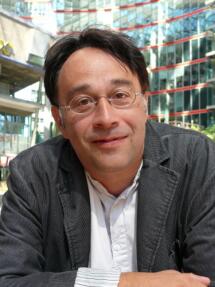
Florian Marquardt is the Scientific Director and Head of the Theory Division at the Max Planck Institute for the Science of Light in Erlangen, Germany, and holds a part-time professorship at Friedrich-Alexander-Universität Erlangen-Nürnberg (FAU). He leads a research group focused on the intersection of quantum physics, optics, and machine learning, contributing to foundational and applied advances in quantum technologies. His educational background includes a PhD summa cum laude from the University of Basel (2002), followed by postdoctoral research at Yale University and in the Swiss National Center for Competence in Research. He served as a Junior Professor at LMU Munich (2005–2010) and Full Professor at FAU (2010–2016) before joining MPL. Marquardt's research spans cavity optomechanics , quantum many-body physics , neuromorphic computing , and machine learning for physics . His group develops minimalist theoretical models to explain experimental phenomena and explores how AI can automate scientific discovery. He is particularly interested in energy-efficient analog computing devices inspired by neural networks and in leveraging physics to improve machine learning. The recent publications reflect a strong trend toward integrating artificial intelligence with quantum science, including automated experiment design, quantum error correction via neural networks, and neuromorphic photonics. There is also sustained work in quantum measurement, topological photonics, and nonequilibrium dynamics, showing both breadth and depth in theoretical physics. Emmy-Noether Fellowship (DFG, 2007) Walter Schottky Prize (DPG, 2009) ERC Starting Grant (2011) Marquardt actively supervises research and teaches advanced courses such as 'Machine Learning for Physicists' and 'Foundations of Quantum Mechanics' at FAU. His group participates in major research networks including the Max Planck School of Photonics, ELLIS, and the European Laboratory for Learning and Intelligent Systems. The Theory Division fosters collaborations on quantum technologies and neuromorphic systems, with strong emphasis on interpretability, generalization, and hardware implementation.