- Machine Learning
- Theoretical Neuroscience
- Data Science
- +۱۶ مورد دیگر
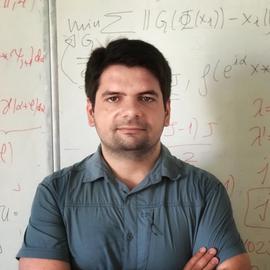
Georgios Exarchakis is a Lecturer at the University of Bath, specializing in Machine Learning, Theoretical Neuroscience, and Data Science. His research emphasizes transparent and interpretable modeling, with applications in Neuromorphic Engineering, Health Science, and Quantum Chemistry. He has held research positions at IHU Strasbourg, Institut de la Vision, and École Normale Supérieure, and earned his PhD from the University of Oldenburg. Education: Dr. rer. nat. in Machine Learning, 2016, Carl von Ossietzky University of Oldenburg M.Sc. in Computational Science, 2012, Goethe University Frankfurt Diploma in Mathematics, 2008, Aristotle University of Thessaloniki His research interests span Interpretable Machine Learning, Invariant Representations, Sparse Coding, Wavelet Scattering, Probabilistic Models, and Deep Learning . He investigates how models can extract meaningful, stable features from complex data, drawing inspiration from biological systems and theoretical neuroscience. His work often bridges theory and application, particularly in quantum chemistry and neurotechnology. His recent publications highlight a strong focus on efficient and interpretable models , including wavelet scattering for molecular property prediction, discrete sparse coding, and clustering algorithms for event-based vision. The articles show a consistent theme of developing mathematically grounded, invariant, and scalable methods for data analysis. He is the developer or a key contributor to open-source libraries such as Kymatio (Scattering Transforms in Python) and ProSper (Probabilistic Sparse Coding), which facilitate the use of advanced signal processing and learning techniques in the research community. Georgios has taught Machine Learning courses at the University of Strasbourg, École Polytechnique, and Oldenburg. He has collaborated with leading researchers like Stéphane Mallat and Jörg Lücke. His work is published in top-tier venues including CVPR, NIPS, JMLR, and JCP.