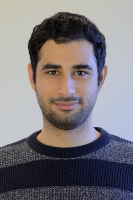
Farbod Hassani is a Researcher in Cosmology at the University of Oslo, Norway, with a focus on dark energy, modified gravity, and large-scale structure. He holds a PhD from the University of Geneva (2020) and MSc/BSc degrees from Sharif University in Physics and Mathematics. His research explores nonlinear cosmological dynamics using N-body simulations and effective field theory. Key areas include probing dark energy models, gravitational wave signatures from dark sector phenomena, and machine learning applications in cosmological datasets. Education: PhD in Cosmology - University of Geneva (2016-2020) MSc in Physics/Cosmology - Sharif University (2014-2016) BSc in Physics & Pure Mathematics - Sharif University (2009-2014) Recent work analyzes cosmic velocity fields, dark matter halo properties, and gravitational wave emission from domain walls. He contributes to the Euclid mission by simulating non-standard cosmologies. Hassani's studies bridge theoretical frameworks (e.g., k-essence, effective field theory) with observational probes like lensing and large-scale structure. Lab affiliations include the Cosmology and Extragalactic Astronomy group at UiO. Current projects focus on instability mechanisms in dark energy models and relativistic N-body simulation techniques.
Bjørn Egil Asbjørnslett is a Professor of Marine Systems Design at the Department of Marine Technology, Norwegian University of Science and Technology (NTNU). He serves as Director of NTNU Ocean and Coast, a strategic research area focusing on marine innovation. Additionally, he manages the Bachelor in Engineering (Aquaculture) and Minor in Aquaculture programs. His research spans deep-sea mining systems , ship design complexity , Arctic shipping , and resilient maritime logistics . He leads projects on vessel design for offshore mining, emergency response optimization, and aquaculture logistics. His recent work emphasizes technology transfer from oil/gas to deep-sea mining , multi-stakeholder design solutions , and analytical methods for vessel performance prediction . He has received no explicitly stated awards but is actively engaged in cross-disciplinary collaborations with industry and academia. His advising focuses on doctoral students in marine systems engineering and design methodologies.
Jacob Wüsthoff Linder is a Professor of Physics at the Norwegian University of Science and Technology (NTNU), affiliated with the Department of Physics and the Faculty of Natural Sciences since 2013. He holds a Ph.D. in Physics from NTNU (2009) and has been a Principal Investigator at the Center of Excellence QuSpin since 2017. He serves as a Divisional Associate Editor for Physical Review Letters (since 2024) and contributes to the Great Norwegian Encyclopedia, authoring entries on Quantum Physics, Material Physics, and Atomic/Nuclear Physics. His research focuses on quantum condensed matter theory, particularly the interplay of superconductivity, magnetism, and spin-orbit coupling in nanoscale materials. Key competencies include condensed matter physics, Dirac materials, quantum field theory, and theoretical physics. Collaborations with international experimental groups and theoretical modeling drive his work on quantum transport and nonequilibrium phenomena. Recent publications highlight advancements in spin-split superconductors, altermagnet physics, and superconductor-ferromagnet interfaces. His work bridges fundamental theory with technological applications, such as spintronics and quantum sensors.
Henrik Kalisch is a Professor of Applied Mathematics at the Department of Mathematics, University of Bergen, where he also serves as Deputy Head of Department. His research focuses on mathematical modeling of nearshore processes, wave breaking, surfzone circulation, and wave hazards in coastal zones. Dr. Kalisch received his Ph.D. in 2001 from the University of Texas at Austin. His academic career has established him as a leading researcher in fluid mechanics, partial differential equations, and numerical analysis, with over one hundred scientific publications to his name. Professor Kalisch's research spans several key areas in applied mathematics and fluid dynamics. His work on surface water waves investigates fluid particle motion, wave breaking mechanisms, wave shoaling processes, and the influence of vorticity on wave dynamics. In the domain of wave-ice interaction , he studies moving loads on ice sheets, marginal ice zone dynamics, and interactions with internal waves. His contributions to hyperbolic conservation laws include work on singular solutions and their physical interpretation, while his research on mathematical properties of model equations examines existence, uniqueness, and stability of traveling waves and soliton interactions. His research has practical applications in wave energy devices, tidal energy, carbon storage, and ice road safety. His recent publications reveal a strong focus on developing and analyzing mathematical models for wave phenomena, particularly Boussinesq-type models, KdV equations, and their variants. The research shows increasing integration of computational methods with theoretical analysis, and growing attention to practical applications in coastal engineering and polar science. There's also a notable trend toward interdisciplinary collaboration, particularly with oceanographers and engineers working on real-world wave problems. Professor Kalisch serves as co-editor-in-chief for "Water Waves: An interdisciplinary journal," published by Birkhäuser-Springer-Nature, demonstrating his leadership in the field. Methods for real-time wave forecasting and phase control of wave energy converters (Bergen Universitetsfond, 2021-2022) MegaRoller (European Commission Horizon 2020 grant) Norwegian Research Network in Mathematical Models in Geophysical Flows (Research Council of Norway, 2016-2019) Internal Waves in the Marginal Ice Zone (Hydralab grant from European Commission) Nonlinear PDE in Spaces of Analytic Functions (Research Council of Norway, 2012-2017) Wavemaker (Research Council of Norway, 2006-2010) Professor Kalisch has supervised numerous graduate students, including current PhD candidates Enrique Martinez, Olufemi Ige, and Anders Norevik, as well as several Master's students. His former PhD students include Maria Bjørnestad (2021), Evgueni Dinvay (2019), Vincent Teyekpiti (2018), and others who have gone on to careers in academia, industry, and research institutions worldwide. He has chaired curriculum committees and developed courses in applied mathematics, fluid mechanics, and numerics at both undergraduate and graduate levels. His research group at the University of Bergen includes postdoctoral researchers like Bashar Khorbatly, adjunct professors like Francesco Lagona, PhD students, and Master's students working collaboratively on various aspects of wave dynamics and mathematical modeling.
Yan Li is an Associate Professor at the Department of Mathematics, University of Bergen. His affiliations include the Fluid Mechanics research group and the Faculty of Mathematics and Natural Sciences. He holds a Doctoral degree from the Norwegian University of Science and Technology (NTNU) in 2017. His research focuses on fluid dynamics, oceanography, and offshore engineering, with specializations in wave-current interactions, rogue wave formation, and numerical modeling of ocean phenomena. Notable honors include the Prize to Outstanding Young Researchers from China’s Ministry of Education (Ph.D. level) and the 2018 Outstanding Student Poster and PICO Award. He leads projects such as the ERC-funded 'OceanCoupling' (2024–2029) and the Research Council of Norway’s 'Water wave modulation' grant (2019–2022). His research interests span wave dynamics in shear currents, nonlinear wave evolution, and the impact of bathymetry on extreme waves. Recent work includes studies on Stokes drift, particle trajectories in shear flows, and dispersive wave focusing mechanisms. He advises multiple PhD and master’s students, including Zirui Xin (SJTU) and Zibo Zheng (NTNU). Teaching responsibilities include Fluid Mechanics (MAT 253) and Functions of a Complex Variable (MAT 213). His publications address topics like wave packet behavior across depth transitions, statistical analysis of weakly nonlinear waves, and experimental validation of numerical models.
Dr. Leiv Øyehaug is an Associate Professor at the Department of Computer Science, Faculty of Technology, Art and Design, Oslo Metropolitan University. His research focuses on computational modeling of biological systems through interdisciplinary approaches combining mathematics and physiology. Neuroglial interactions and ion dynamics Cardiomyocyte calcium handling mechanisms Mathematical modeling of skin pigmentation processes Systems biology approaches to complex physiological phenomena Øyehaug's work spans multiple disciplines with key contributions in neuronal activity modeling, cardiac calcium signaling, and dermal system analysis. He collaborates extensively with physiological research groups while maintaining mathematical rigor in his models. The publications demonstrate a strong focus on using quantitative approaches to understand pathophysiological mechanisms in both neural and cardiac contexts.
Gerhard Henning Olsen serves as an Associate Teaching Professor in the Department of Materials Science and Engineering at the Norwegian University of Science and Technology (NTNU), where he directs both the bachelor's programme in Chemistry and Materials Engineering (BIKOM) and the master's programme in Materials Science and Engineering (MSMT). His teaching portfolio centers on foundational courses including General Chemistry for Engineers and Introduction to Materials Science, with emphasis on innovative pedagogical approaches for engineering students. Dr. Olsen completed his MSc in Materials Chemistry (2007-2012) and PhD in Materials Science (2012-2016, advised by Tor Grande) at NTNU, followed by postdoctoral research at Cornell University (2017-2019). His academic journey reflects deep integration of Norwegian and international research training. His research bridges educational innovation and advanced materials physics. In education, Olsen pioneers digital exam systems and student-active learning methodologies, particularly for laboratory instruction. His materials science work investigates structure-property relationships in functional oxides, specializing in defect chemistry and strain engineering of ferroelectric thin films through combined computational (DFT) and experimental approaches. This dual focus enables cross-pollination between pedagogical development and materials discovery. Publication analysis (2012-2021) reveals progressive specialization: early work established fundamental mechanisms in tungsten bronzes and manganites, while recent research addresses applied challenges in tunable dielectrics for millimeter-wave applications and thin-film manufacturing. This trajectory demonstrates increasing technological relevance while maintaining theoretical rigor in electronic materials design. No major scientific awards or fellowships are documented in available sources. As an educator, Olsen has supervised 28 bachelor's students across twelve externally collaborative projects and two master's theses (as of spring 2025), with recent work focusing on chemistry education research. His supervision model emphasizes industry-academia partnerships, reflecting NTNU's engineering education philosophy. While specific grant details aren't public, his sustained publication output suggests consistent project funding typical for materials science academics.
Yingying Qin is a Postdoctoral Fellow at UiT The Arctic University of Norway, Department of Physics and Technology, and a member of the research group Ultrasound, Microwaves and Optics . Her work is centered on advanced optical imaging techniques and computational methods for microscopy. Research Interests: Computational imaging and optical microscopy 3D refractive index reconstruction from coherent optical data Multiple scattering and full-wave electromagnetic modeling Label-free microscopy techniques Her recent publications demonstrate a strong focus on developing and validating numerical models for optical microscopy, particularly in addressing inverse problems and improving imaging resolution without the need for fluorescent labeling. Labs & Teams: She is affiliated with the Ultrasound, Microwaves and Optics research group within the Department of Physics and Technology at UiT.
Aslak Tveito is a Professor and Simula Fellow at Simula Research Laboratory, working within the Department of Computational Physiology. His research spans computational physiology, biophysics, and scientific computing with a strong focus on cardiac electrophysiology and mathematical modeling. Dr. Tveito's research interests center on computational physiology, particularly in the domain of cardiac electrophysiology. His work integrates mathematical modeling, numerical analysis, and computational techniques to understand cardiac function at multiple scales - from cellular to tissue level. He has made significant contributions to developing computational frameworks for modeling excitable tissues, with particular emphasis on the heart. His research bridges the gap between theoretical mathematics and practical physiological applications, creating models that can predict cardiac behavior under normal and pathological conditions. The publication record reveals a strong trend toward increasingly detailed cellular-level modeling of cardiac electrophysiology. Recent work focuses on nano-scale phenomena, stem cell-derived cardiomyocyte modeling, and the development of efficient computational frameworks that maintain physiological accuracy. His research demonstrates a consistent trajectory from macroscopic cardiac models toward cellular and subcellular resolution, with growing integration of experimental data from microphysiological systems. There's also a clear emphasis on practical applications, particularly in drug testing and arrhythmia mechanisms. Dr. Tveito has established himself as a leading researcher in computational cardiac electrophysiology through his extensive publication record spanning multiple decades. His work has been published in high-impact journals across computational biology, physiology, and applied mathematics. His research program demonstrates strong continuity in mathematical modeling of cardiac systems, with evolving focus toward higher-resolution cellular models and integration with experimental cardiac microphysiological systems. The collaborative nature of his work is evident through numerous co-authorships with both computational scientists and experimental biologists.