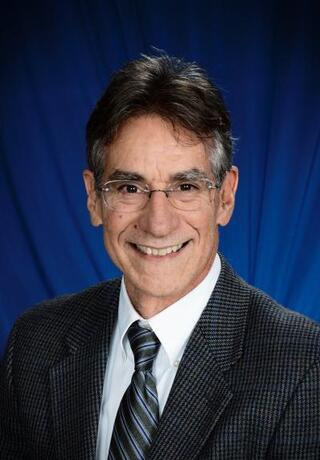
Mahdi Safa is an Instructional Assistant Professor at the University of Houston's Cullen College of Engineering, Department of Civil and Environmental Engineering. His research focuses on digital transformation in construction, supply chain optimization, workplace safety, and disaster management. He has published extensively on topics such as AI applications in engineering, pandemic response logistics, and ethical challenges in smart city development. Research interests include leveraging emerging technologies (IoT, blockchain, AI) to enhance construction processes and safety. His work also addresses global challenges like energy efficiency in buildings, offshore infrastructure resilience, and mental health in the construction industry. Notable contributions include frameworks for vaccine supply chain management during pandemics, analysis of workplace conflicts affecting safety, and strategic project readiness assessments. Though no awards or grants are listed in the provided text, his publications indicate active involvement in interdisciplinary research collaborations. Contact: msafa@central.uh.edu
Konstantinos Skindilias holds the position of Senior Lecturer in Data Science at the University of Greenwich's School of Computing and Mathematical Sciences, within the Faculty of Engineering and Science. Concurrently, he serves as a Director in a Big-4 firm advising investment banks, bridging academic and industry expertise. His qualifications include a BSc, MSc, and PhD in relevant fields. His research focuses on quantitative finance, stochastic modeling, derivatives pricing, and risk management. Key areas include market risk methodologies, volatility calibration, and energy commodity analysis. He specializes in developing models for contingent claims pricing, portfolio insurance strategies, and regulatory frameworks like SIMM. Publications emphasize advanced numerical techniques such as Markov chain approximations for derivatives pricing and volatility forecasting. His work addresses practical challenges in turbulent markets and energy security, with contributions to both theoretical and applied finance domains. No scientific awards or grants are explicitly listed in the provided information. His dual role in academia and financial services highlights his interdisciplinary engagement, though specific lab affiliations or teams are not detailed here.
Prof. Klaus Adam is a leading economist holding dual professorships at the University of Mannheim and University College London (UCL, on leave). He specializes in macroeconomics with a focus on monetary and fiscal policy design, learning mechanisms in economic expectations, and their applications to asset pricing and business cycle dynamics. His research has significant policy relevance, particularly regarding inflation targeting and central bank strategies. Adam earned his Ph.D. in Economics from the European University Institute, Florence (2001). His career includes former roles at the University of Oxford’s Nuffield College and the European Central Bank. He currently serves as a Research Professor at the Deutsche Bundesbank, member of the German Ministry of Finance’s Academic Advisory Board, and Scientific Chair of the Euro Area Business Cycle Network (EABCN). His research interests encompass: Monetary policy frameworks and inflation targeting Fiscal policy interactions and sovereign debt dynamics Expectations formation and its impact on asset prices Business cycle fluctuations and macroeconomic stability Adam has been recognized with prestigious roles including Research Fellowships at the CEPR and CFS, and membership in the Heidelberg Academy of Sciences. His recent work emphasizes bridging theoretical insights with practical policy design, particularly in addressing challenges posed by low inflation environments and falling natural interest rates.
Professor Eric Smith is a distinguished faculty member in the Department of Economics at the University of Essex, where he has held a professorship since 1990. He has served as Head of Department (2009-2012) and maintains significant academic influence through roles such as Associate Editor of the European Economic Review and former Director of the Royal Economic Society Easter School. His extensive network includes long-term visiting positions at the University of British Columbia, McMaster University, University of Pennsylvania, Georgetown University, Rutgers University, University of North Carolina, and the Federal Reserve Bank of Atlanta. His educational foundation comprises a BA from Williams College (1983) and a PhD from the University of Pennsylvania (1990), establishing his expertise in economic theory and empirical analysis. Smith's research program centers on search and matching frictions across labour and housing markets, investigating how matching mechanics influence market flows, wage/price determination, and income distribution. His pioneering work on human capital portfolios examines skill accumulation dynamics and their implications for economic inequality. Additional research explores macroeconomic policy interactions with micro-level market structures, particularly in industrial organization and public economics contexts. This interdisciplinary approach bridges theoretical modeling with empirical validation across diverse economic domains. His publication record demonstrates consistent high-impact contributions, with recent works in the Journal of Economic Theory (2025) and Review of Economic Dynamics (2020) advancing understanding of wage dynamics and housing market activity. These studies collectively form a cohesive research trajectory examining how institutional structures and individual behaviors shape market outcomes under frictional conditions. Economic and Social Research Council (ESRC) funding for Business and Local Government Data Research Centre (2018, 2023) Current supervision of PhD candidates Panupong Sukkerd (Technological Change, Labour Markets) and Devisri Eight successfully completed doctoral and master's supervisions including Junko Iwagami (2020) and Aline Maria Souza Menezes (2017) As an educator, Smith teaches Advanced Macroeconomics (EC324) and Economic and Public Policy (EC974), integrating his research on labour markets and macroeconomic policy into classroom instruction. His academic support hours (Thursdays 13:00-14:00, Fridays 10:00-11:00) reflect ongoing engagement with students at Colchester Campus (5B.327).
Jian Li is an Assistant Professor of Data Science in the Department of Applied Mathematics and Statistics and Computer Science at Stony Brook University, part of the College of Engineering and Applied Sciences. He is affiliated with the AI Innovation Institute (AI3) and the Institute for Advanced Computational Science (IACS). His research focuses on Reinforcement Learning, Federated Learning, Stochastic Optimization, and Trustworthy AI systems, with applications in wireless networks and edge computing. Previously, he held positions at SUNY-Binghamton and the University of Massachusetts Amherst. Dr. Li holds a Ph.D. in Computer Engineering from Texas A&M University (2016) and a B.E. from Shanghai Jiao Tong University (2012). His work has garnered prestigious awards, including the NSF CAREER Award (2024), NSF CISE CRII Award (2021), and multiple best-paper recognitions. He actively mentors students, including Shufan Wang and Adebayo Braimah, who have achieved notable academic accolades. His research explores theoretical advancements in RL and systems security, with grants from NSF, ARO, and DOE. Recent activities include organizing workshops at ACM SIGMETRICS 2025 and serving as an Area Chair for NeurIPS 2025. He leads the DIENS Lab, focusing on AI-driven systems and large-scale networked intelligence.
Alcino Azevedo is an Associate Professor of Finance at Aston Business School, University of Aston. He serves as Research Director of the Economics, Finance and Entrepreneurship Department. Previously, he held roles at Alliance Manchester Business School and Hull University Business School, where he led the MSc Financial Management program. His academic background includes a PhD in Investments under Uncertainty and Competition from the University of Manchester (2009), an MSc in Finance from Universidade Católica Portuguesa, and an Engineering degree from Universidade do Minho. He combines academic rigor with industry experience from roles in manufacturing management. His research focuses on real options analysis, strategic investment timing under uncertainty, and risk management in financial markets. He has published in top journals like the Journal of Financial Economics and European Journal of Operational Research , and frequently presents at conferences such as the Financial Management Association and Real Options conferences. His work addresses topics like voluntary delisting strategies, wind farm location optimization, and derivatives effectiveness in firm value creation. He is also active in reviewing for high-impact journals including the RAND Journal of Economics and Journal of Economic Dynamics and Control . Teaching responsibilities include modules on Advanced Corporate Finance and Derivatives. He actively supervises PhD students in real options, risk management, and corporate finance. His research extends to energy economics, corporate governance impacts on hedging decisions, and policy analysis for renewable energy investments.
Bruce Jacob is a Professor in the Cyber Science Department within the School of Engineering, Computing, and Weapons at the United States Naval Academy, where he joined in Fall 2022. Prior to USNA, he served as a professor of Electrical & Computer Engineering at the University of Maryland for 25 years, establishing himself as a leading expert in memory systems and computer architecture. Dr. Jacob received his A.B. in Mathematics from Harvard in 1988 and his Ph.D. in Computer Science & Engineering from The University of Michigan in 1997. Before graduate school, he worked in Boston start-ups as a software engineer at Boston Technology and later as chief engineer and system architect at Priority Call Management, which was successfully acquired in the late 1990s. His research focuses on memory systems, computer architecture, and memory devices, with significant contributions to memory system design across industry and government sectors. Jacob has designed computer-system architectures and memory-system architectures for major organizations including Micron (Hybrid Memory Cube DRAM architecture), Cray (Black Widow memory system), Northrop Grumman (experimental ultra-low-power datacenter), and the European Commission (1024-core Teraflux chip). His work spans resistive memory systems, non-volatile memory, memory simulation, and hardware security. His publication record demonstrates consistent leadership in memory systems research, with recent work focusing on ReRAM development, trusted execution environments for in-storage computing, and advanced memory simulation techniques. His research shows a clear trajectory toward monolithic memory integration, 3D stacking, and addressing the semantic gap between software and memory systems. Fellow of the IEEE Patent in memory-systems design Three patents in electric guitar circuit design Featured in Washington Post, Los Angeles Times, Chronicle of Higher Education, and NPR for guitar-related innovations Jacob has written two textbooks on computer memory systems and numerous articles spanning memory systems, computer design, embedded systems, operating system design, and even ventured into astrophysics and algorithmic composition. His DRAMsim memory simulator has become an industry standard tool. His practical industry experience complements his academic work, having consulted for major technology companies on memory system design challenges.
Mike Burton is a Professor and Chair in Volcanology at the University of Manchester's Earth and Environmental Sciences department. His research focuses on volcanic processes, gas emissions, and eruption forecasting, with emphasis on remote sensing and numerical modeling. He collaborates closely with volcano observatories to improve monitoring techniques. Key areas include magma dynamics, degassing processes, and the impact of volcanic activity on climate. Recent work includes studies on the 2021 Cumbre Vieja eruption (La Palma), Fagradalsfjall (Iceland), and Soufrière Hills (Montserrat). His projects involve advanced remote sensing technologies and satellite data analysis to quantify gas emissions and eruption dynamics. Burton has been a Principal Investigator in major initiatives like the EUROVOLC network and CarbSens remote sensing system development. Publications highlight contributions to understanding magma degassing, volcanic plumes, and the role of volatiles in eruptions. His interdisciplinary approach integrates field observations, lab experiments, and computational models to address global volcanic hazards and climate interactions. Media engagements include expert commentary on recent eruptions worldwide.
Jie Li is the Rodney C. Ewing Collegiate Professor of Earth and Planetary Sciences and Professor of Earth and Environmental Sciences at the University of Michigan. She holds a Ph.D. in Earth and Planetary Sciences (Harvard University, 1998) and an M.A. in Geophysics (Harvard University, 1997). Her research focuses on Earth and planetary materials under extreme conditions, leveraging high-pressure techniques like diamond-anvil cells and synchrotron facilities. Key interests include terrestrial planet evolution, core composition, and dynamics of planetary interiors. Recent studies explore light elements in Earth’s core, Mercury’s magnetic field origin, and early Earth crust formation. Her work bridges experimental geochemistry, mineral physics, and computational modeling to understand planetary interiors. Notable contributions include pioneering studies on iron spin states in the lower mantle and the role of metallic melts in mantle dynamics. She collaborates globally, advancing methodologies for high-pressure experiments. Her research has been featured in outlets like Mashable India , highlighting her insights on Earth’s core dynamics and planetary science. Li’s lab emphasizes interdisciplinary approaches to unraveling the origins of planetary materials and their evolution over geological time.
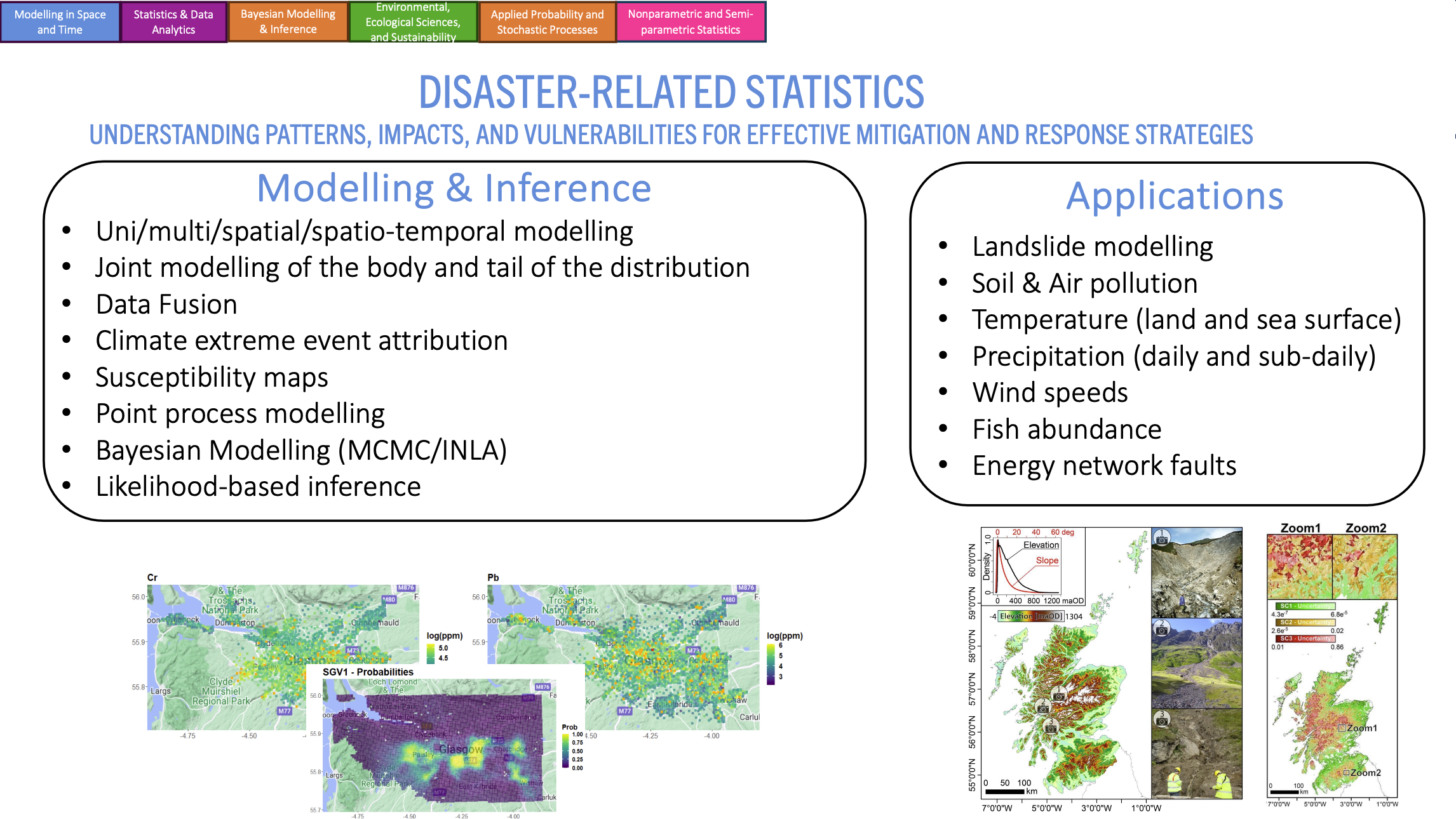
Dr. Daniela Castro Camilo is a Senior Lecturer in Statistics at the University of Glasgow's School of Mathematics & Statistics. Her research focuses on extreme value theory applied to environmental hazards, including landslides, climate extremes, and risk assessment. She leads projects like the Mitigating Landslides Impacts in Scotland (MLIS) and Geostatistical Binary Models for Extremes (GEOBEx) , funded by the Scottish Government and EPSRC. She collaborates with institutions such as the British Geological Survey and the Met Office. Her work bridges statistical methodology and environmental applications, with notable contributions to landslide hazard modeling and spatial extremes. She actively participates in international conferences and organizes events like the ESS-sponsored session at the 2024 RSS Conference. She is a core member of GLE²N (Glasgow-Edinburgh Extremes Network), fostering interdisciplinary research in statistical risk analysis. Recent projects include developing probabilistic forecasting tools for weather-driven faults in electricity networks and advancing Bayesian methods for extreme event prediction. Her research emphasizes practical solutions for resilience to environmental disasters, combining cutting-edge statistical techniques with real-world data challenges.
Joseph G. Altonji is the Thomas DeWitt Cuyler Professor of Economics at Yale University and a Research Associate at the National Bureau of Economic Research (NBER). He previously held faculty positions at Columbia University and Northwestern University, and served as a visiting professor at Princeton and Harvard. His academic affiliations include memberships in the Econometric Society, the American Academy of Arts and Sciences, and the Society of Labor Economists (past president). He received the IZA Prize in Labor Economics (2018) and has advised numerous federal and academic bodies, including the Federal Reserve Bank of Chicago and the President’s Council of Advisors on Science and Technology. Altonji’s research focuses on labor economics, applied econometrics, and inequality dynamics. Key areas include labor market fluctuations, education economics, family income dynamics, and wage determination. Current projects address school choice impacts on inequality, graduate degree returns, and the interplay between marriage, earnings, and family income. His methodological contributions include techniques to address selection bias in observational studies, particularly in evaluating school and neighborhood effects. Publications highlight trends in advanced degree returns, decomposition of earnings into wage and hours effects, and analyses of pandemic-era labor market shifts. His work often bridges econometric rigor with policy relevance, emphasizing empirical strategies to isolate causal effects. Altonji’s advisory roles reflect his engagement with real-world economic challenges, from STEM education to unemployment insurance policy design.
Enrique G. Mendoza is a Professor of Economics at the University of Pennsylvania's Department of Economics, housed within the School of Arts and Sciences. Previously, he held the Neil Moskowitz Professorship at the University of Maryland and taught at Duke University. He has extensive experience with international organizations including the IMF and Federal Reserve, and has served as a visiting scholar globally. He earned his Ph.D. (1989) and M.A. (1986) from the University of Western Ontario and a B.A. (1985) from Anahuac University, Mexico City. His research focuses on international macroeconomics, macroprudential regulation, financial crises, and fiscal policy. Key themes include sovereign debt dynamics, global liquidity imbalances, and the impacts of globalization. Recent work examines mechanisms like capital controls and their side effects, as well as modeling approaches to open-economy instability. Mendoza's research underscores the interconnectedness of global economic systems, emphasizing policy frameworks for emerging markets. His articles consistently address systemic risks and policy design in volatile environments. He has advised international institutions and contributed to policy debates on financial stability and debt sustainability. His work bridges theoretical models with real-world policy challenges, particularly in managing crises and optimizing regulatory frameworks.
William Burke is an Associate Professor in the Department of Agricultural, Food, and Resource Economics at Michigan State University (MSU), affiliated with the College of Agriculture & Natural Resources. His research focuses on agricultural policy, food security, and poverty dynamics in Africa, with extensive fieldwork in Zambia, Malawi, and The Gambia. He holds an MSc and PhD from MSU (2009, 2012), following Peace Corps service in The Gambia (2001–2003). Burke’s work includes analyzing fertilizer subsidies, soil management, and gender disparities in resource access. He has held roles at Stanford University and consultancies with organizations like the MwAPATA Institute in Malawi. Research interests include poverty dynamics, sustainable intensification, and cost-benefit analysis of agricultural policies. He contributes to multivariate statistical methods, notably developing the 'craggit' package in Stata. Awards include the 2017 Bruce Gardner Memorial Prize for policy analysis and recognition for top-cited papers in Agricultural Economics. Burke advises the Food Tank Board and serves on The African Journal of Agricultural and Resource Economics editorial board. Educations: PhD & MSc in Agricultural Economics (MSU, 2012 & 2009) Awards: Multiple accolades for policy research and academic contributions Labs/Initiatives: Innovation Lab for Food Security Policy, MwAPATA Institute collaboration His recent work addresses climate impacts on Malawi’s agriculture, fertilizer price volatility, and gender gaps in land access. Teaching includes multivariate statistics and survey design at MSU, Stanford, and the University of Zambia.
Marc Paolella is a Full Professor of Empirical Finance at the University of Zurich's Department of Finance. His academic journey includes roles as Associate Professor (2003–2006) and Assistant Professor (1999–2003) at Kiel University and visiting positions at the University of Geneva. He holds a Dr. sc. pol. (1998) and Habilitation (2002) from Kiel University, alongside degrees from SUNY Stony Brook and Colorado State University. His research focuses on financial econometrics, emphasizing portfolio optimization, risk prediction, and saddlepoint approximation theory. He has authored four textbooks, including works on probability theory, statistical inference, and GARCH models. Over 50 journal articles span leading venues like the Journal of Econometrics and Journal of Financial Econometrics. Paolella's contributions include developing methods like CHICAGO for portfolio risk calculation and the COMFORT model for non-Gaussian returns. He serves as Editor-in-Chief of the journal Econometrics and holds editorial roles at multiple journals. Awards include the Elected Fellowship at the IETI and recognition for impactful research. His teaching spans advanced courses in financial econometrics, probability theory, and mathematical finance. He has supervised numerous theses and leads the Quantitative Finance program at the Science ETH UZH. Research grants include Swiss National Science Foundation funding for portfolio optimization under non-elliptical distributions.
Dr. Jacob Wong is a Lecturer in the School of Economics and Public Policy at the University of Adelaide, affiliated with the Faculty of Arts, Business, Law and Economics. His research focuses on macroeconomics, with specializations in labor markets, monetary policy, and structural econometric modeling. He holds a position in the Department of Economics and is actively involved in supervising PhD and Master’s students. Contact details include email jacob.wong@adelaide.edu.au and phone 83135500 at Nexus 10, North Terrace campus. Research Interests: Dr. Wong’s work explores labor market dynamics, wage determination mechanisms, and the strategic interactions in wage posting models. He also investigates transparency in monetary policy, information asymmetry in macroeconomic decision-making, and the implications of policy announcements on economic behavior. Supervision: He has co-supervised over 15 PhD candidates and one Master’s student since 2007, covering topics such as structural macroeconomic modeling, labor market volatility, climate change impacts on agriculture, and business cycle fluctuations. Notable supervisees include Mr. Francesco Roncone (PhD, 2020–2024) and Dr. David John Hoey (PhD, 2008–2016). No scientific awards or grants are explicitly listed in his profile, though his research contributions are evidenced through publications in journals like the Review of Economic Dynamics and the Canadian Journal of Economics .