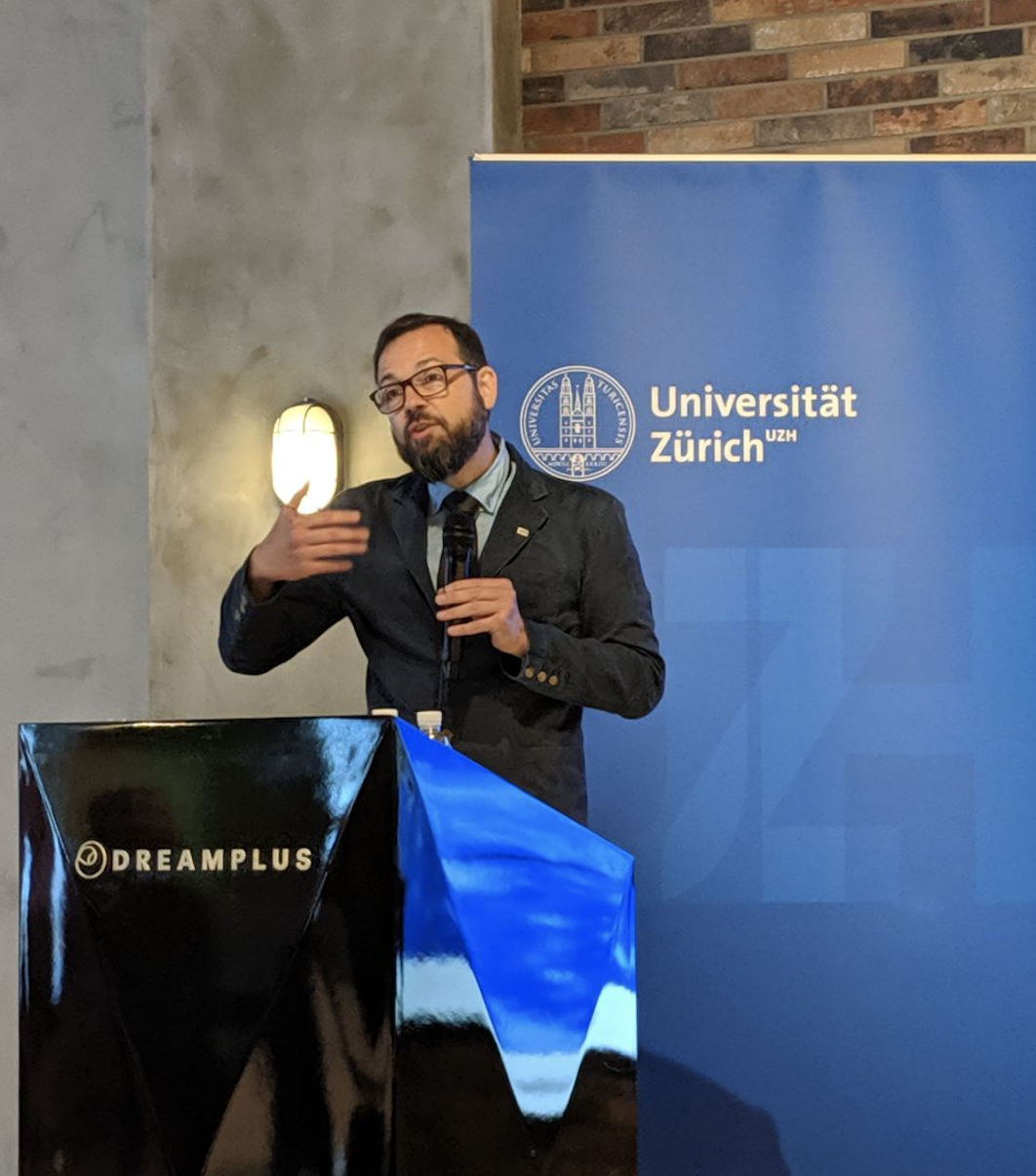
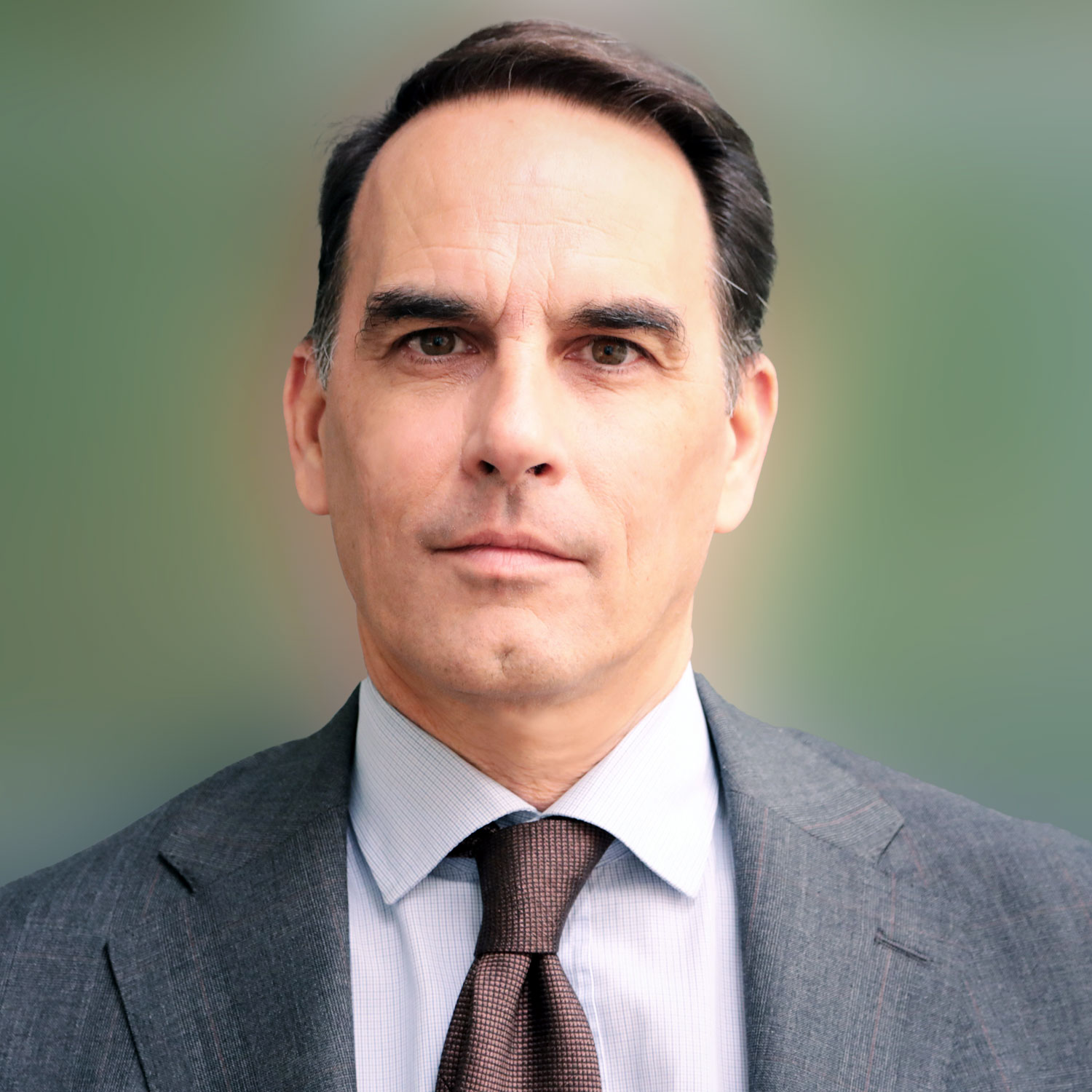
Prof. Dr. Günther Dissertori is a Full Professor and Rector of ETH Zurich, where he oversees teaching and academic affairs. His academic journey began at the University of Innsbruck, followed by a doctoral position at CERN, and he joined ETH Zurich as an Assistant Professor in 2001 before becoming a Full Professor in 2007. Academic Role: Full Professor of Particle Physics Institutional Leadership: Rector of ETH Zurich (since 2022) Contact: guenther.dissertori@sl.ethz.ch Research Interests: Dissertori's work spans Particle Physics and Experimental Physics , notably contributing to the CMS experiment at CERN, which was instrumental in the Higgs boson discovery. His group also developed cost-effective PET devices, leading to the spin-off Positrigo AG . Research keywords include Detector Development , Medical Imaging , and Quantum Physics . Teaching Excellence: Recognized with multiple Golden Owl awards (2005–2020) and the Credit Suisse Award for Best Teaching (2013), Dissertori is celebrated for his pedagogical impact in the Department of Particle Physics. Scientific Contributions: His publications include advancements in CMOS technology, quantum dynamics, and medical applications, reflecting interdisciplinary expertise in high-speed electronics, environmental science, and architectural history.
Swiss Federal Institute of Technology in LausanneSwitzerland
Giovanni De Micheli is a Full Professor at École Polytechnique Fédérale de Lausanne (EPFL), holding appointments in both the School of Computer and Communication Sciences (IC) and the School of Engineering (STI). He is affiliated with the Integrated Systems Laboratory (LSI) and serves as Scientific Director of EcoCloud. His primary office is located in INF 341 building at EPFL's Lausanne campus where he conducts research and teaching activities. Professor De Micheli's research spans multiple domains in electronic design automation and integrated circuit design. His primary interests include: Integrated Circuit Design and Hardware Synthesis Logic Optimization and Boolean Methods Nanoelectronics and 2D Electronics Quantum Computing and Emerging Technologies Low-Power Electronics and Energy-Efficient Systems Electronic Design Automation for Novel Computing Paradigms His recent publications demonstrate a strong focus on advancing logic synthesis techniques for both conventional and emerging technologies. Professor De Micheli's work bridges theoretical foundations with practical applications, particularly in adapting traditional EDA methods to novel computing paradigms like quantum computing and superconducting electronics. His research group has made significant contributions to the development of efficient algorithms for circuit optimization across multiple technology domains, with particular emphasis on area, power, and delay optimization while maintaining functional correctness. Professor De Micheli has supervised numerous doctoral students throughout his career at EPFL, mentoring over 40 PhD candidates whose research spans various aspects of electronic design automation, circuit design, and emerging technologies. His students have gone on to make significant contributions in both academia and industry. As Scientific Director of EcoCloud, Professor De Micheli leads research initiatives focused on energy-efficient computing systems and sustainable cloud infrastructure. His laboratory, the Integrated Systems Laboratory, serves as a hub for interdisciplinary research connecting computer science, electrical engineering, and materials science, with particular focus on next-generation computing technologies.
Charles M. Jones is a Professor of Finance at Columbia Business School, Columbia University, with an extensive publication record spanning several decades. His research focuses on market microstructure, high-frequency trading, short selling, retail investor behavior, and stock market liquidity. His work has appeared in top finance journals including the Journal of Finance, with his most recent publication "Nonstandard Errors" appearing in the June 2024 issue. Professor Jones's research interests center on understanding how financial markets function at a granular level. His work on market microstructure examines the mechanics of price formation, liquidity provision, and the impact of trading technologies on market quality. His research on short selling has been particularly influential, investigating when short sellers trade, what information they possess, and how regulatory interventions like short sale bans affect market functioning. His more recent work has explored the rise of retail trading through platforms like Reddit and its implications for price discovery, particularly during events like the GameStop phenomenon and the COVID-19 pandemic. Analysis of his publication trends reveals a consistent focus on market efficiency and price discovery mechanisms, with increasing attention to retail investor behavior in recent years. His work spans both theoretical modeling and empirical analysis of market data, often utilizing high-frequency datasets to examine intraday trading patterns. The interdisciplinary nature of his research bridges finance, economics, and information science, contributing to both academic understanding and practical market regulation. Professor Jones has collaborated extensively with researchers across the globe, as evidenced by his numerous co-authored papers with scholars from institutions worldwide. His work has significant implications for market regulators seeking to understand the impact of technological changes and regulatory interventions on market quality and efficiency.
Zurich University of Applied Sciences (ZHAW)Switzerland
Dr. Jacinta Edebeli serves as a Researcher and Group Lead at the Zurich University of Applied Sciences (ZHAW), School of Engineering, within the Meteorology, Environment and Aviation Research Unit. Her work focuses on aviation environmental impacts, air quality monitoring, and sustainable aviation solutions through advanced measurement systems and policy-relevant research. Her research expertise spans: Aviation emissions (gaseous and particulate matter) Urban air quality monitoring using lung-deposited surface area (LDSA) metrics Sustainable aviation fuels (SAF) impact assessment Aviation meteorology and environmental regulation Real-time emission monitoring networks for urban environments Recent publications demonstrate concentrated work on non-volatile particulate matter (nvPM) characterization from aircraft engines, SAF emission comparisons, and ultrafine particle microphysics. Her research bridges technical aviation engineering with public health outcomes through advanced aerosol measurement techniques. She actively leads and contributes to critical projects: Net4Cities : Deputy project leader developing real-time monitoring networks for European zero-pollution action plans Renewable Fuels and Chemicals for Switzerland : Project leader advancing SAF implementation EASA SAMPLE IV : Completed project leader for aircraft emissions certification Multiple AGEAIR projects investigating in-service engine emissions and aging effects As SAE E-31 network member and ORCID-registered researcher (0000-0003-2465-1783), she operates at the forefront of aviation environmental regulation with state-of-the-art facilities at ZHAW's Winterthur campus.
Prof. Eva-Marie Meemken is an Assistant Professor at the Department of Environmental Systems Science, ETH Zürich. Her research focuses on sustainability goals in global food systems, analyzing policies and institutional arrangements related to poverty reduction, gender equality, and food security in lower-income countries. She leads the Food Systems Economics and Policy Group, affiliated with the Institute for Environmental Decisions (IED), Institute of Agricultural Sciences (IAS), World Food System Center (WFSC), and ETH4D. Education: PhD Agricultural Economics (summa cum laude), University of Göttingen (2017) MSc Agricultural Economics, University of Hohenheim (2013) BSc Agricultural Sciences, University of Kassel-Witzenhausen (2011) Professional Experience: Since 2022: Assistant Professor (tenure track), ETH Zürich 2020–2022: Assistant Professor, University of Copenhagen 2019–2020: Postdoc, Cornell University 2018–2019: Postdoc, University of Minnesota 2017–2018: Postdoc, University of Göttingen Research Interests: Her work explores diverse actors in food systems (farmers, cooperatives, companies) and their roles in sustainable development. Current research emphasizes policy design for decent work, gender equality, and resilience in global agrifood supply chains. Teaching: She teaches the course World Food System in ETH Zürich’s Autumn Semester 2025.
Prof. Claudio J. Tessone is a Professor of Blockchain and Distributed Ledger Technologies at the Department of Informatics, University of Zurich. He serves as Head of the Blockchain and Distributed Ledger Technologies group, Chairman of the UZH Blockchain Center, and is incharge of the NetSci Society. His academic background includes a PhD in Physics (Complex Systems) and an Habilitation in Complex Socio-Economic Systems from ETH Zurich. Education: PhD in Physics (2006): Thesis on synchronization in stochastic systems, Universitat de les Illes Balears, Spain Habilitation (2015): Thesis on agent-based modeling of socio-economic systems, ETH Zurich Master in Physics (1999): Thesis on stochastic resonance, Instituto Balseiro, Argentina Research Interests: Prof. Tessone specializes in modeling complex socio-economic and socio-technical systems, with a focus on blockchain-based systems. His work explores crypto-economics, blockchain scalability, decentralized finance (DeFi), and the interplay between micro-level agent behavior and macro-level emergent properties. Notable areas include transaction network analysis in Bitcoin/Ethereum, consensus mechanisms (Proof-of-Stake/Work), and blockchain governance models. Publications Trends: Recent articles emphasize empirical blockchain analysis (e.g., Ethereum microvelocity, Bitcoin mesoscopic structure), DeFi arbitrage strategies, and privacy-preserving blockchain applications in healthcare. His work bridges theoretical agent-based models with real-world blockchain datasets, addressing both technical and socio-economic dimensions of distributed ledger technologies. Grants & Labs: Director of the UZH Summer School on Blockchain and Certificate of Advanced Studies program. Active in interdisciplinary collaborations through the URPP Social Networks (2015–2021) and ETH Zurich’s Systems Design group (2007–2014). Labs/Initiatives: Leads the UZH Blockchain Center, a hub for academic-industry research on blockchain applications in finance, governance, and digital transformation.
Swiss Federal Institute of Technology in LausanneSwitzerland
Academic Profile: Damir Filipovic is a Full Professor and the Swissquote Chair in Quantitative Finance at the College of Management of Technology (CDM) of École Polytechnique Fédérale de Lausanne (EPFL), Switzerland. He previously held academic positions at the University of Vienna, University of Munich, and Princeton University, and served as Head of the Vienna Institute of Finance. Research Focus: Quantitative finance, risk management, stochastic processes, term structure modeling, volatility risk, and machine learning applications in financial markets. Industry Collaboration: Co-developed the Swiss Solvency Test for insurance capital requirements while consulting for the Swiss Federal Office of Private Insurance. Publications: Contributed extensively to journals like Journal of Financial Economics, Mathematical Finance, and Annals of Applied Probability, with a textbook on Term-Structure Models. Academic Service: Editorial board member of multiple journals and organizer of advanced workshops on systemic risk and financial technology. Recent Research: His work emphasizes machine learning for portfolio risk management, kernel-based yield curve estimation, and robust stochastic modeling. Keynote speaker at international conferences on finance and insurance mathematics, with over 15 recent publications in 2023-2025 addressing high-dimensional financial problems, neural control systems, and causal inference in market data. Education: Ph.D. in Mathematics from ETH Zurich (2000). Graduate of ETH Zurich and University of Vienna. Teaching & Mentorship: Supervises current and former EPFL Ph.D. students in quantitative finance, including Nicolas Camenzind, Joshua Hayes, Andrea Ruglioni, and ten others. Former students like Damien Ackerer and Lotfi Boudabsa now lead research in risk management. Labs & Programs: Directs EPFL's Finance and Technology Programme, leads the Computational Finance Group (CSF) at EPFL, and contributes to Swiss Finance Institute initiatives. Scientific Leadership: Served on EPFL Committee of Academic Evaluation and Doctoral Program Finance committee.
University of Applied Sciences and Arts LucerneSwitzerland
Fabio Sigrist is a Professor of Applied Statistics and Data Science at the Institute of Financial Services Zug (IFZ) , part of the Lucerne University of Applied Sciences and Arts . He also holds a Senior Scientist and Lecturer position at the Seminar for Statistics, ETH Zurich . His career spans academic research, industry consulting, and project leadership in finance and data science. PhD in Statistics (2013), ETH Zurich MSc in Mathematics with distinction (2008), ETH Zurich MEd in Mathematics Education (2008), ETH Zurich Sigrist’s research focuses on integrating Machine Learning with Spatial Statistics for applications in Financial Econometrics and Credit Risk . His work includes developing novel algorithms like GPBoost and KTBoost , advancing spatio-temporal modeling , and applying tree-based boosting to financial problems. Projects such as CreHos (credit risk in hospitality) and NISMO (interpretable real estate modeling) highlight his interdisciplinary approach. His publications address challenges in large-scale spatial data , loss given default modeling , and stock volatility prediction . He contributes to software development with tools like spate (R package) and varycoef (spatially varying coefficients).
Swiss Federal Institute of Technology in LausanneSwitzerland
Andreas Fuster is an Associate Professor of Finance and SFI Senior Chair at the Swiss Finance Institute (SFI) @ EPFL, and a Research Fellow at the Centre for Economic Policy Research (CEPR). He previously worked at the Federal Reserve Bank of New York and the Swiss National Bank, where he maintains a part-time research advisor role. His research focuses on empirical finance (household finance, real estate, banking, fintech), macroeconomics, and behavioral economics, with recent work examining technological advancements in credit markets. He teaches courses in financial engineering, macroeconomics, and financial econometrics at EPFL. As Director of the Doctoral Program in Finance at EPFL and academic co-director of the EPFL Executive Education Fintech program, he oversees academic development and executive training. His editorial roles include Associate Editor at the Review of Financial Studies and Journal of Financial Economics . Education: Ph.D. from Harvard University, M.Phil. from Oxford University, B.A. from University of Lausanne (all in economics). Research Interests: Empirical finance, macroeconomics, behavioral and experimental economics, fintech, mortgage markets, and banking regulation. External Roles: Co-organizer of the BIS-CEPR-SCG-SFI Conference on Financial Intermediation and SNB-CIF Conference on Cryptoassets and Financial Innovation. Grants & Awards: Recognition for contributions to financial stability and policy analysis (no specific awards listed). His work has been published in top journals such as the Quarterly Journal of Economics and Review of Financial Studies. He advises on sustainable digital finance through Innosuisse and contributes to policy analysis via CEPR and the Federal Reserve Bank of NY.
Alan M. Taylor is a prominent Research Fellow at National Bureau of Economic Research (NBER) and Centre for Economic Policy Research (CEPR) . He holds a permanent affiliation with Columbia University in the United States, where he contributes to economics research. His research spans financial history , macroeconomic policy , international trade , and capital market dynamics . Key themes include credit cycles , monetary policy , economic crises , and historical financial systems . He has extensively analyzed the trilemma of exchange rates, monetary policy, and capital mobility, and pioneered work on long-term rate of return data across capital assets. His recent publications focus on financial stability , credit booms , and macroeconomic consequences of pandemics . Collaborative works with economists like Òscar Jordà, Moritz Schularick, and Kevin H. O'Rourke demonstrate interdisciplinary engagement. His empirical methodology emphasizes local projections , historical econometrics , and long-run equilibrium modeling in international finance.
René M. Stulz is the Everett D. Reese Chair of Banking and Monetary Economics at The Ohio State University's Max M. Fisher College of Business , where he also serves as Director of the Dice Center for Research in Financial Economics . He has held academic positions at MIT, University of Chicago, and University of Rochester. Ph.D., Massachusetts Institute of Technology Marvin Bower Fellowship (Harvard Business School) Doctorat Honoris Causa (University of Neuchâtel) Risk Manager of the Year (Global Association of Risk Professionals) His research spans corporate finance , financial institutions , and asset pricing , with recent work on unicorns , cyberattack economic impacts , and banking regulation . His articles show expertise in market volatility , governance , and financial globalization . Stulz has won multiple scientific awards and served as editor of the Journal of Finance and Journal of Financial Economics . He consults for the IMF , World Bank , and major financial institutions , and has testified in federal/state courts .
Konrad Adler is an Assistant Professor at the School of Finance, University of St. Gallen. He earned his PhD in 2019 from Toulouse School of Economics and held a PostDoc position at the University of Bonn (2020-2023) within the Finance Group. His research focuses on Corporate Finance, Banking, and Macroeconomics with Financial Frictions. His recent publications address passive investing, financial covenants, green finance, globalization, and overlapping ownership. These works span keywords like Finance, Economics, Sustainability, and International Business, with subfields including Loan Spreads, Risk Assessment, Environmental Economics, and Market Competition. Dr. Adler’s office is located at Büro 51-4007, Unterer Graben 21, 9000 St. Gallen. No scientific awards or student advising details are explicitly mentioned in the provided texts.
Ke Xu is an Assistant Professor at the Department of Finance, Faculty of Business and Economics, University of Victoria. His research bridges finance, econometrics, and cryptocurrency, focusing on market microstructure, high-frequency trading, and price discovery mechanisms. He has extensively studied Bitcoin ETFs, fractional cointegration models, and machine learning applications in financial markets. Key Research Areas: Market Microstructure High-Frequency Trading Cryptocurrency Dynamics Price Discovery Machine Learning in Finance Financial Econometrics Article Trends: Xu’s work spans empirical analyses of Bitcoin ETFs, volatility modeling (e.g., affine GARCH), and algorithmic trading strategies. His recent papers explore mini flash crashes using machine learning, regulatory impacts on market quality, and sustainable crypto portfolios.
Valeri V. Nikolaev is Associate Professor of Accounting at the University of Chicago Booth School of Business. His research examines financial contracting, accounting quality measurement, and the impact of political risk on credit markets, with recent focus on AI applications for financial disclosure analysis. Research concentrations: Debt covenant design Earnings quality identification Political risk quantification AI-driven financial analysis Recent publications investigate ChatGPT's utility in processing financial disclosures and methodological approaches to measuring firm-level political risk exposure through textual analysis of corporate communications.
Daniele Caramani is a Full Professor of Comparative Politics at the University of Zurich's Faculty of Philosophy, Institute of Political Science, where he holds the Chair of Comparative Politics since 2014. He also serves as the Ernst B. Haas Chair at the European University Institute in Florence, directing the European Governance and Politics Programme at the Robert Schuman Centre for Advanced Studies (currently on leave from UZH). His teaching includes courses on Comparative Politics, Political Systems and Theories, Political Representation, and Reforming Representative Democracy. His educational background includes a baccalauréat from the Lycée International de Saint-Germain-en-Laye, followed by BA and MA degrees from the University of Geneva, and a Ph.D. from the European University Institute in Florence. He attended methods summer schools at Essex and Michigan. Caramani's research focuses on comparative and historical political science with emphasis on political cleavages, electoral geography, party systems, European integration, and globalization. His work often employs quantitative time series reaching back to the 19th century, examining mass democratization, state formation, nationalism, and industrialization. He is particularly known for analyzing the interplay between territorial and functional cleavages at national, European, and global levels. His recent publications reveal a clear trajectory from national party systems (The Nationalization of Politics, 2004) to European integration (The Europeanization of Politics, 2015) and now to global cleavages (with his ERC Advanced Grant project GLOBAL). His current work examines technocratic representation, populist challenges, and the evolution of global political alignments using automated text analysis of historical documents dating back to 1843. Stein Rokkan Prize for Comparative Social Science Research (2004) Lijphart-Przeworski-Verba Dataset Award from Comparative Politics section of the American Political Science Association (2012) Vincent Wright Memorial Prize for best article in West European Politics (2006) Caramani has directed major research projects including the ERC Advanced Grant project GLOBAL analyzing global cleavages. He has been instrumental in developing significant datasets like the Constituency-Level Elections Archive (CLEA), which received the APSA award in 2012 and now covers over 2,025 elections from 180 countries with GeoReferenced Electoral Districts. His academic leadership extends to editing the comprehensive textbook Comparative Politics (Oxford University Press, sixth edition, 2023). As Director of the European Governance and Politics Programme at the European University Institute, Caramani leads research on European integration and governance. He also co-directs the Constituency-Level Elections Archive (CLEA), a major resource for electoral studies that includes historical maps from 74 countries. His work continues Stein Rokkan's legacy in comparative social science, as evidenced by his 2023 Stein Rokkan Memorial Lecture.