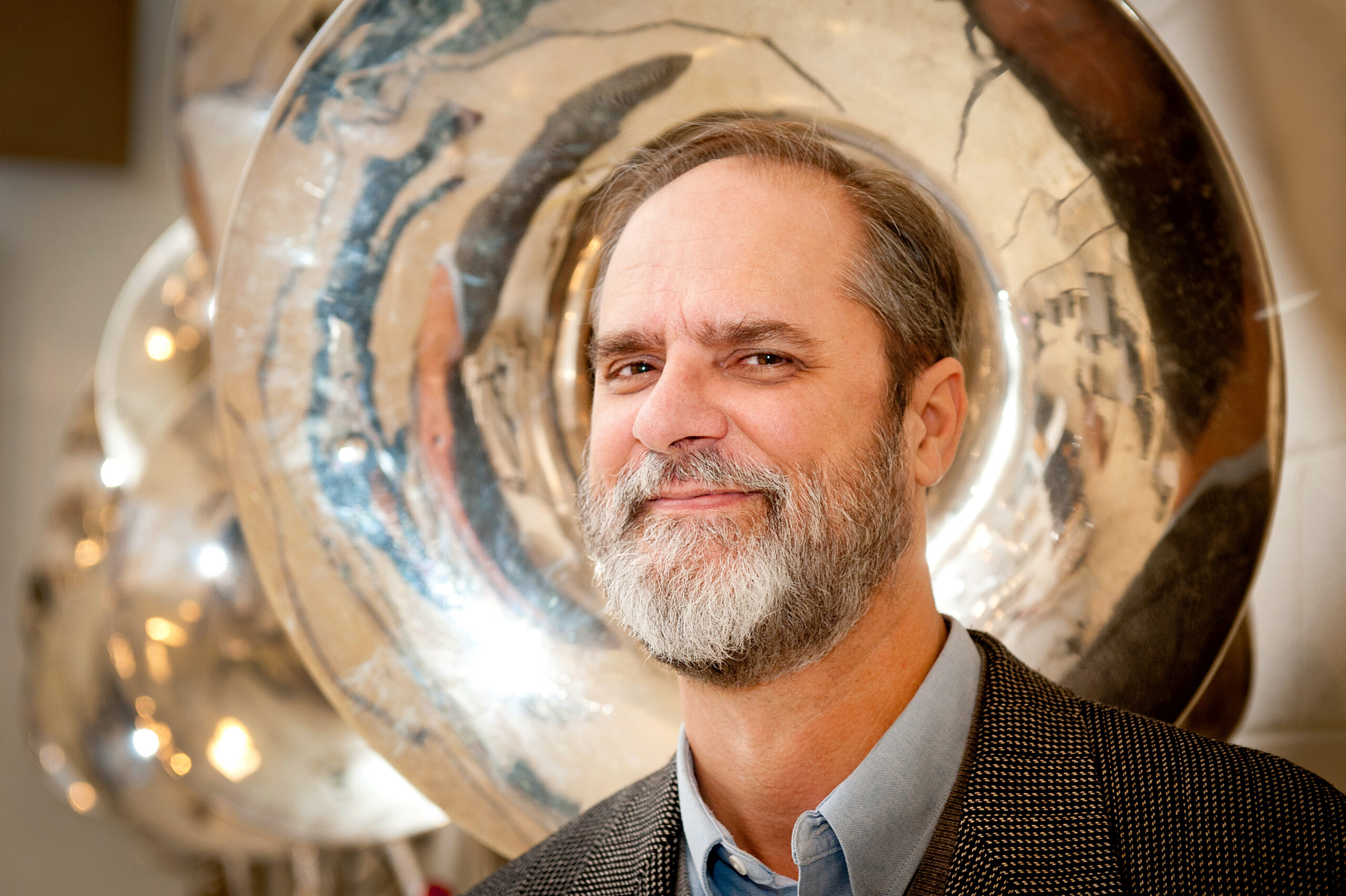
Rodney Waschka II is a Professor and Director of Arts Studies at North Carolina State University's College of Humanities and Social Sciences. He also directs the Arts NOW Series, presenting contemporary arts events. His expertise spans music composition, algorithmic processes, and electronic music. Waschka's works are globally recognized, with recordings across international labels. His operas like Saint Ambrose and Sappho's Breath showcase interdisciplinary collaboration. Recent works include A Note for Joe Alexander (2024) and In Memoria di Linda Garzoli Cardosi (premiering 2025). His research explores genetic algorithms in music composition and dynamical systems as compositional tools. Education: Doctor of Musical Arts in Computer Music/Media from the University of North Texas. Awards and recognitions include features in Computer Music Journal , Musical Opinion , and international festivals. He actively commissions new works and has performed across Europe, North America, and Australia. The Arts NOW Series, under his leadership, connects contemporary art forms with academic disciplines like mathematics, politics, and climate science. Notable collaborations include the Aizuri Quartet and filmmaker projects like Boris Karloff: The Man Behind the Monster (2022).
Simon de Szoeke is a Professor in the College of Earth, Ocean, and Atmospheric Sciences at Oregon State University. His research focuses on atmosphere-ocean interaction and its influence on climate, with particular emphasis on tropical regions. He conducts observational studies and modeling work to understand air-sea interactions, cloud processes, and their representation in climate models. Dr. de Szoeke received his Ph.D. in Atmospheric Sciences from the University of Washington in spring 2004, with a dissertation on "Evolution of the cross-equatorial atmospheric boundary layer in the east Pacific: observations and models." He earned his B.A. summa cum laude in Physics with departmental honors and Mathematics from the University of Oregon Robert D. Clark Honors College in 1997. His research interests center on atmosphere-ocean interaction, stratiform clouds, and tropical meteorology . He investigates how clouds influence the Earth's radiative heating, the processes responsible for the transition from stratiform to cumuliform clouds, and the role of inversion strength in cloud maintenance. His work on the Madden-Julian oscillation (MJO) involves analyzing data from the DYNAMO international field campaign to study air-sea flux feedbacks and the role of sea surface temperature in tropical weather phenomena. Dr. de Szoeke is particularly known for his groundbreaking research on cold pools in the tropical ocean, which he describes as "footprints" of convection. His research shows that these cold, invisible phantoms play an important role in the atmospheric heat budget and can organize towering clouds at their intersection points. Contrary to previous assumptions, he found that cold pools are drier than their surroundings, challenging existing theories about their role in convection. His scientific contributions include numerous publications on air-sea interaction, tropical meteorology, and cloud processes. His research has been supported by major field campaigns including DYNAMO in the Indian Ocean and VOCALS in the southeastern Pacific, with findings published in leading journals such as Journal of Climate, Bulletin of the American Meteorological Society, and Monthly Weather Review. Dr. de Szoeke teaches courses in atmospheric sciences including The Changing Climate (AS 320), Atmospheric Thermodynamics and Cloud Physics (AS 411/511), and Large-Scale Interactions of the Atmosphere and Oceans (AS 615). He has advised several graduate students, including June Marion who graduated in summer 2014 with a thesis on turbulent heat flux estimates, as well as Michael Makiyama and Kathryn Verlinden.
Laurie San Martin is a Professor of Music at the University of California, Davis, serving as department chair and undergraduate advisor for music majors with last names N-Z. She holds a PhD in Theory and Composition from Brandeis University and a B.A. in Music from UC Davis (1991). Her primary roles include teaching composition, music theory, and recital preparation, while maintaining active involvement in compositional research and performance activities. Research & Creative Work: San Martin specializes in contemporary concert music for chamber ensembles, orchestra, and chorus. Her compositions explore intersections of texture and line, often incorporating experimental techniques and cross-cultural influences. Notable works include Witches (2018), a chamber-choral piece with lyrics by Lucy Corin; Night Owls (2024), a Barlow Endowment-commissioned work for Ensemble Ari; and Elective Affinities (2013), blending Korean gayageum with string quartet. She frequently collaborates with ensembles like Earplay, Left Coast Chamber Ensemble, and Volti. Performed internationally in Europe, South America, and Asia Recipient of prestigious awards including the Guggenheim Fellowship (2016), Andrew Imbrie Award (2018), and Barlow Endowment commissions Teaching & Mentorship: As an advisor, she supports music majors while mentoring emerging composers through programs like the Pacific Chamber Orchestra's Dream American workshop. Her pedagogical focus includes fostering creativity and technical mastery in composition students. Recent Activities: In 2023, she served as guest faculty at the Cortona Sessions in Italy, where her works Octurnal , Miniatures , and Conveyer Belt Dreaming were performed. Ongoing projects include a 2025 residency at the São Paulo Contemporary Composers Festival and a new work for the Empyrean Ensemble. Awards & Recognition: Her accolades reflect her impact on contemporary music, including the League of Composers-ISCM Fellowship and ASCAP Morton Gould Young Composer Awards. She has held residencies at prestigious institutions like the MacDowell Colony and Yaddo.
Marco Uvietta is an Associate Professor of Musicology and History of Music at the Department of Literature and Philosophy, University of Trento. He holds a Laurea in Music Disciplines from the DAMS of Bologna (1991) and a PhD in History and Analysis of Musical Cultures from Sapienza University of Rome (1999). His academic career includes roles as a Researcher (2005–2016) and Associate Professor (2016–present) at the University of Trento. He teaches courses on Music History and Ethnomusicology and contributes to the PhD program in European Cultures. His research focuses on two main areas: 1) Musical Philology, particularly in 19th-century Italian opera (e.g., critical editions of Verdi’s Requiem and Bellini’s La straniera), and 2) Analysis of 20th-century musical language, with significant contributions on Luciano Berio’s style and compositional processes. He has authored numerous scholarly works, including books and articles on composers like Berio, Debussy, Stravinsky, and Martucci. Uvietta is actively involved in editorial projects, such as directing critical editions for Ricordi and contributing to the Rossini Critical Edition. He holds leadership roles in academic committees, including the editorial board of Il Saggiatore Musicale . His compositional works, influenced by his analytical research, have been performed by prestigious ensembles worldwide, including the Arditti Quartet and Monteverdi Cello Octet. Notable awards include recognition in composition competitions (e.g., Guido d’Arezzo International Competition), and his works span orchestral, choral, and chamber music. Uvietta’s interdisciplinary approach bridges historical musicology with contemporary compositional practice, reflecting his dual expertise as a scholar and composer.
Rev. Dr. hab. Piotr Wiśniewski, Professor at the John Paul II Catholic University of Lublin, serves as Vice-Rector and Head of the Department of Research on Religious Monody and Polyphony. His work focuses on liturgical musicology , Gregorian chant , and medieval Polish church music traditions . He has led projects like "Liturgical and Musical Sources of the Cistercian Abbey in Kraków-Mogila" and managed the "Musica Ecclesiastica" journal. Specializes in 12th-16th century Polish liturgical manuscripts Key interests: Psalmody Provenance , Carmelite/Pauline Chant Traditions , Post-Vatican II Liturgical Music His research spans Norwegian monumentalism , Polish organ culture , and Gregorian rhetoric in passion cantatas . Recent Coryphaeus of Polish Music 2024 award recognizes his contributions. 2024: Inner Reward 1st Degree 2018: Rector's Award at KUL 2015: Active Salary Policy Recognition He has taught at universities in Ružomberok and Bamberg, supervised over 60 diploma theses , and reviewed works for Studia Elbląskie and Liturgia Sacra . Current projects involve European liturgical codices and Polish national music heritage .
Rhonda Hackworth is an Associate Professor of Music Education in the Department of Music at the University of Mississippi, within the College of Liberal Arts. She serves as Head of Music Education and Graduate Program Coordinator, overseeing graduate studies and directing thesis and dissertation research. Her academic work bridges teaching, research, and performance, with a strong focus on the health and pedagogical development of music educators. Research Interests: Dr. Hackworth specializes in vocal health for music teachers and students, examining how teaching practices affect vocal well-being. She also investigates music perception, particularly how textual and musical elements interact to shape emotional responses. Her research contributes to both pedagogical strategies and occupational health in music education. She has published in leading journals such as Journal of Research in Music Education , International Journal of Music Education , and Journal of Music Teacher Education . Her publications reflect a consistent focus on vocal health, teacher training, and music cognition. Themes across her work include the impact of teaching experience on vocal strain, vocal hygiene awareness among educators, and the perceptual effects of music-text interactions. She actively presents her findings at international, national, and state-level conferences across the U.S. and abroad, including in Greece, China, and Italy. Scientific Awards: No specific awards mentioned in the text. Dr. Hackworth advises graduate students in music education, supervising theses and dissertations. She teaches foundational and advanced graduate courses such as Foundations of Music Education (MUS 619) , Research in Music Education (MUS 620) , and Intelligent Music Teaching (MUS 622) . While no grants are explicitly mentioned, her sustained research output and conference presence suggest active scholarly engagement. Her educational leadership extends beyond the classroom into program coordination and curriculum development. Dr. Hackworth is affiliated with the Department of Music at the Oxford campus of the University of Mississippi. She is part of the Graduate Program in Music (M.M.) and contributes to the academic and artistic mission of the College of Liberal Arts. Though no formal lab or research center is named, her work likely involves collaborative research teams and student-led projects in music education and vocal health.
Chris Bergson is an Associate Professor of Guitar at Berklee College of Music in Boston, where he teaches private guitar lessons, slide guitar, and songwriting. He is affiliated with the Guitar Department under the College of Performing Arts. A graduate of the Manhattan School of Music with a Bachelor of Music in Jazz Performance, Bergson is internationally recognized as a guitarist, singer, and songwriter rooted in blues, jazz, and American roots music. Bachelor of Music (BM), Jazz Performance, Manhattan School of Music, 1999 Bergson's research and artistic interests center on blues and jazz guitar performance, songwriting, and the cultural dimensions of American roots music. His work blends traditional forms with modern expression, emphasizing authenticity, emotional depth, and technical mastery. He explores the intersections of Delta blues, soul, funk, and jazz, often integrating horn arrangements and collaborative improvisation. His recent recordings reflect a consistent evolution in style and thematic depth, moving from early jazz-blues fusion to mature, soul-infused compositions. Albums like Comforts of Home (2024), All I Got Left (2021), and Bitter Midnight (2017) showcase sophisticated guitar work, live-in-studio energy, and lyrical sincerity. These works emphasize live performance, collaboration with guest artists like Ellis Hooks and Bernard Purdie, and a deep connection to New York’s musical identity. Inducted into the New York Blues Hall of Fame as a Master Blues Artist, 2015 MOJO Magazine's No. 1 Blues Album of the Year 2008 for Fall Changes Five consecutive albums named among MOJO Magazine's Top 10 Blues Albums of the Year Multiple MOJO, Gitarist, and Soul Bag Magazine accolades across 2011–2024 Appointed Jazz Ambassador of the USA by the Kennedy Center and U.S. State Department Bergson has developed a significant career as an educator and performer, drawing from over 25 years of global touring and recording. He mentors students in developing their unique voice and practical performance skills, informed by his extensive experience as both bandleader and sideman. He has not received public grants, but his work is supported through album releases, performance tours, and institutional affiliation with Berklee. His performances span major festivals in the U.S., Europe, Russia, and West Africa, reflecting a broad international reach. Bergson leads the Chris Bergson Band and frequently collaborates with vocalist Ellis Hooks, forming a dynamic duo often compared to Sam & Dave. His recording projects often involve tight-knit ensembles, including horn sections arranged by Jay Collins and European touring bands featuring French and Dutch musicians.
Michale Fee is the Glen V. and Phyllis F. Dorflinger Professor of Neuroscience at the Massachusetts Institute of Technology (MIT) , where he serves as Department Head of Brain and Cognitive Sciences and Investigator at the McGovern Institute for Brain Research . His research focuses on understanding how the brain generates and learns complex sequential behaviors using songbirds as a model system. Education: B.E. in Engineering Physics, University of Michigan (1985) Ph.D. in Applied Physics, Stanford University (1992) Research Interests: Fee’s work combines advanced electrophysiological techniques , optical imaging , and computational modeling to study neuronal circuits underlying sequence learning and motor control in songbirds. His lab investigates how neural circuits support vocal learning, temporal coordination, and behavioral adaptation. Scientific Awards: MIT Fundamental Science Investigator Award (2017) MIT School of Science Teaching Prize (2016) BCS Award for Excellence in Teaching (2015) Lawrence Katz Prize (2012) Dart Scholar (2003) Advising and Grants: Fee has mentored numerous PhD students , Masters students , and postdoctoral researchers . He leads the Fee Laboratory at MIT, which develops innovative neurotechnologies and contributes to global neuroscience collaborations , including the Simons Collaboration on the Global Brain.
Stuart MacRae is a Senior Research Fellow and Lecturer in Composition at the Royal Conservatoire of Scotland's School of Music. He holds a PhD from the University of Edinburgh and has held prestigious roles such as BBC Scottish Symphony Orchestra Composer-in-Association (1999–2003) and Lammermuir Festival Composer in Association (2017–2019). His research focuses on operatic word-setting, tonal harmony, and artistic responses to the Anthropocene. Education: PhD, University of Edinburgh (2014) MMus, Guildhall School of Music and Drama (1997) BMus, University of Durham (1996) His research interests include operatic composition, reimagining tonal structures, and environmental themes. Notable works include the opera Anthropocene (2019), which toured internationally and won multiple awards, and Ghost Patrol (2013), honored with the South Bank Sky Arts Award. His music has been performed by leading ensembles like the London Sinfonietta and recorded by NMC and Delphian. Recent projects include collaborations with Louise Welsh and commissions for Scottish Opera. He has been awarded the Large Scale New Work Award (2020) and Creative Scotland Bursary (2014).
Zachary Wallmark is an Associate Professor of Musicology and Area Chair of Musicology and Ethnomusicology at the University of Oregon's School of Music and Dance. His interdisciplinary research bridges musicology, cognitive science, and sound studies, with a particular focus on musical timbre and its relationship to emotion, meaning, and cultural context. Wallmark maintains a joint affiliation with the Center for Translational Neuroscience at the University of Oregon, reflecting his cross-disciplinary approach. His research interests span popular music studies, timbre analysis, music cognition, and sound studies, with particular attention to how musical timbre functions in emotional response, aesthetic judgment, and music sociology. Wallmark's work explores these themes across diverse musical contexts including American popular music, free jazz, extreme heavy metal, and traditional Japanese music. Wallmark's publications reveal a consistent focus on timbre as a critical yet undertheorized dimension of musical experience. His work spans empirical studies of timbre perception, corpus analyses of timbre semantics, interdisciplinary investigations of timbre's role in meaning-making, and theoretical explorations of timbre's relationship to cultural and social contexts. Recent publications increasingly integrate cognitive neuroscience methodologies with traditional musicological approaches. GRAMMY Museum Foundation Scientific Research Grant UO Presidential Fellowship in Humanistic Study AMS Ruth A. Solie Award Social Sciences and Humanities Research Council (SSHRC) of Canada Partnership Grant National Endowment for the Humanities (NEH) Fellowship Wallmark's research has received significant external funding from prestigious organizations including the NEH and the GRAMMY Museum Foundation. He is active in the Analysis, Creation, and Teaching of Orchestration (ACTOR) group, an international research partnership funded by the Canadian Social Sciences and Humanities Research Council. His work has been presented at major international conferences including the American Musicological Society (AMS), Society for Music Perception and Cognition (SMPC), Society for Music Theory (SMT), and Society for Ethnomusicology (SEM). Wallmark has also been invited to lecture at notable venues including the National Academy of Sciences in Washington, D.C. Beyond his academic work, he is a published composer, commercial musician, jazz bassist, and performer of the Japanese shakuhachi flute.
Professor Martin Clayton is a leading scholar in Ethnomusicology at Durham University's Department of Music. He holds a BA in Music/Hindi (SOAS, 1988) and a PhD in Ethnomusicology (SOAS, 1993). His work focuses on Hindustani classical music, rhythmic analysis, and embodied musical interaction. He has directed major research projects like the EU-funded EnTimeMent and AHRC-funded 'Interpersonal Entrainment in Music Performance.' Clayton is a Fellow of the British Academy (2020) and former editor of the British Journal of Ethnomusicology. His research explores cross-cultural musicology, computational analysis of performance, and rhythmic entrainment across global traditions. Education: Bachelor of Arts in Music and Hindi (SOAS, University of London, 1988) Doctor of Philosophy in Ethnomusicology (SOAS, University of London, 1993) Research Interests: Clayton’s work bridges ethnomusicology with computational methods, focusing on rhythmic structures in Indian classical music, embodied performance practices, and cross-cultural musical interactions. His studies analyze gesture-sound relationships, temporal frameworks in rag performance, and the social dimensions of musical entrainment. Recent projects integrate machine learning and computer vision to classify ragas and analyze performer movements in ensemble contexts. Publications Overview: His 15+ years of research span theoretical works (e.g., Time in Indian Music , 2000), edited volumes (e.g., Experience and Meaning in Music Performance , 2013), and interdisciplinary studies combining ethnography with computational analysis. Recent work emphasizes multimodal data collection to study synchronization in global music traditions, including Japanese gagaku and Indian khyal. Awards: British Academy Fellowship (2020), Leverhulme Trust Major Research Fellowship Advising & Grants: Supervised doctoral students focusing on Indian music, global guitar practices, and embodied music interaction. He led a £1.2M AHRC grant (2016–2018) on interpersonal entrainment and co-investigated projects on Khyal music and South Asian cultural networks. Labs/Teams: Collaborates with interdisciplinary teams on projects like the Interpersonal Entrainment in Music Performance (IEMP) initiative, developing tools such as the movementsync R package for synchrony analysis. Active in global music research networks, including ESEM and the British Forum for Ethnomusicology.
Bruno Tucunduva Ruviaro is an Associate Professor in the Department of Music within the College of Arts and Sciences at Santa Clara University, where he has taught since Fall 2012. Originally from Brazil, Ruviaro is a composer and performer with a specialization in electronic music. Prior to joining Santa Clara, he studied and worked at the Center for Computer Research in Music and Acoustics (CCRMA) at Stanford University. Ruviaro's primary research focus is Music Composition with a strong emphasis on Electronic Music. His specific interests include electronic music composition, laptop orchestras, live-electronics, acousmatic music, and sampling & musical borrowing. He also explores secondary interests spanning theater, dance, linguistics, speech, radio art, Linux, intellectual (im)property issues, and the intersection of music & politics. His work demonstrates a consistent exploration of how technology transforms musical creation and performance. Ruviaro's scholarly output reveals a strong trajectory in electronic and computer music composition, with particular attention to laptop orchestras and musical borrowing practices. His recent works like Pós-Tudos and Mozart and the Elections demonstrate his continued innovation in contemporary composition, while publications such as From Schaeffer to* lorks and Intellectual Improperty reveal his theoretical engagement with the evolving nature of musical instruments and copyright in digital contexts. His compositions frequently incorporate technology in innovative performance setups, as seen in works utilizing smartphones and unconventional sound production methods. Ruviaro is the director of SCLOrk (Santa Clara Laptop Orchestra), continuing a tradition from his time at Stanford where he was part of SLOrk (Stanford Laptop Orchestra). He teaches courses including Intro to Electronic Music (MUSC 9), SCLOrk - Santa Clara Laptop Orchestra (MUSC 157), Music Theory III (MUSC 3), Experimental Sound Design (MUSC 115), Form and Analysis (MUSC 113), and Beginning Composition (MUSC 37), along with private composition lessons. His educational contributions include A Gentle Introduction to SuperCollider , making complex music programming more accessible to students.
Professor Stephanie Pitts is a Professor of Music Education and Director of the Sheffield Performer and Audience Research Centre (SPARC) at the University of Sheffield. She holds a BA, MEd, PhD, PGCE, and is a Fellow of the Higher Education Academy. Her work focuses on musical participation, concert audiences, and qualitative research methods. She leads the AHRC-funded 'Understanding Audiences for the Contemporary Arts' project, exploring engagement across UK cities. Pitts also investigates lifelong musical engagement, music education impacts, and lapsed participation. She has supervised numerous PhD students, many securing academic roles. Education: BA, MEd, PhD, PGCE Affiliations: SPARC, AHRC-funded projects, collaborations with Music in the Round, Birmingham Contemporary Music Group, and Sheffield Music Hub Her research spans audience behavior, music education policy, and the cultural value of arts engagement. Notable studies include 'Valuing Musical Participation' (2005) and 'Chances and Choices' (2012). Awards include the Senate Teaching Excellence Award and FHEA. Teaching includes modules on music education, community engagement, and music psychology. She directs the MA Music Psychology in Education, Performance and Wellbeing. Current projects examine leisure-time music groups' societal impacts and pandemic resilience in creative freelancers. Key Grants: AHRC grants totaling £500k+, including 'Understanding Audiences' (2017), 'Cultural Value' (2013), and 'Music, Place and People' (2013) Professional Roles: Honorary Professor at University of Queensland, editorial board member for multiple journals, and advisor to Ireland's Music Generation project SPARC serves as a hub for interdisciplinary research on performers and audiences, bridging academia and arts practice.
Professor Jonathan Cole is a composer, teacher, and conductor at the Royal College of Music (RCM), where he has taught since 2005 and served as Head of Composition since 2022. His work bridges experimental composition, music-theatre, and site-specific pieces, earning acclaim from the London Sinfonietta, which premiered three of his works and recorded Testament with Oliver Knussen. Born 1970, Cole studied under Simon Bainbridge, Malcolm Williamson, and Louis Andriessen 1997-2006: Works like Ouroboros II and Testament nominated for RPS Awards 2006: Shift toward Luigi Nono-inspired works, exploring score-performer dynamics and London's environmental sounds 2009-2013: Composer-in-association with London Contemporary Orchestra, premiering burburbabbar za (wordless opera) Co-founded re:sound collective in 2012 for unconventional venue performances Cole’s compositions, such as Lucier Clock (2021) and 50 Florentine Breaths (2016), emphasize spatialization, breath techniques, and the tension between structure and decay. His 2025 co-authored article Personal realities I examines artistic identity in conservatoires. Scientific Awards: Royal Philharmonic Composition Prize (1999) RCM Fellowship (2018) RPS Award Nominations for Ouroboros II and Testament Cole mentors research students like Daniel Musashi and has led educational grants such as the Leverhulme LPO Young Composers Scheme (2007-2012). He collaborates with ensembles including the London Sinfonietta, BBC Philharmonic, and Chicago Symphony Orchestra.
Aura Satz is a Visiting Professor at the School of Arts & Humanities, Royal College of Art , with expertise in Critical Practice and Art & Curating. Her work spans film, sound, performance and sculpture with focus on distributed voice and listening strategies. Visiting Artist, School of the Arts Institute of Chicago (2021-2025) Lectured at London Consortium, Goldsmith's College and Slade School of Fine Art Research focuses on: History of sound technology and resistance to standardization Gender roles in WWII ballistic research and computing Emergency sirens as metaphor for societal alarm fatigue Interdisciplinary collaborations with astrophysics and medical research Recent article trends show: 2023-2025 works on warning systems and emergency sound Long-term exploration of sound notation and technological history Scientific Awards: CPH Dox NEW:VISION Award (2024) St. Moritz Art Film Festival Best Feature (2024) Shortlisted at multiple international festivals (2015-2025) Key collaborations include: Warning Research Centre at UCL Nuclear Consulting Group Harvard Centre for Astrophysics Research partnerships with EMPAC and Sonic Acts