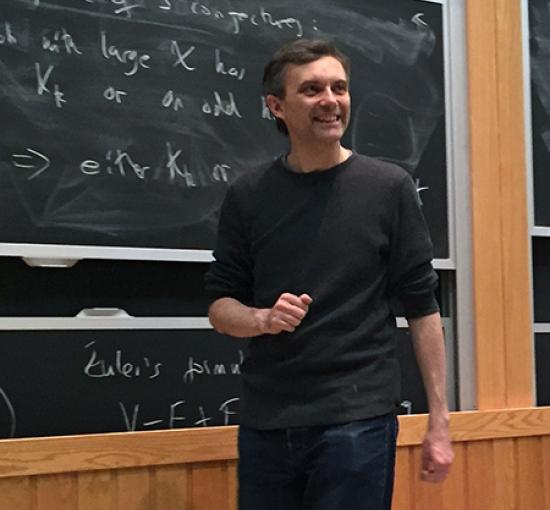
Professor Alexander Scott is a faculty member at the University of Oxford, holding positions as Professor of Mathematics and Dominic Welsh Tutor in Mathematics at Merton College. His research focuses on combinatorics, probability, algorithms, and graph theory, with a particular interest in the interplay between local and global structures in networks. He has organized the Oxford Combinatorics Seminar and co-founded the online Oxford Discrete Mathematics and Probability Seminar, fostering collaboration in these fields. Professor Scott’s work bridges theoretical foundations with applications in statistical physics and algorithmic design. He has supervised numerous graduate students in combinatorics and regularly teaches undergraduate courses in analysis and discrete mathematics. His contributions include advancements in extremal graph theory, probabilistic methods, and structural combinatorics, with over 150 publications in prestigious journals. He actively organizes academic events such as the annual One-Day Meeting in Combinatorics, hosting speakers from around the world. Despite the absence of explicit awards noted, his prolific research output and academic leadership reflect significant contributions to the field. His current interests continue to explore the Erdős-Hajnal conjecture, induced subgraph densities, and algorithmic challenges in combinatorial structures.
Paschalis Vassilios is an Assistant Professor at the Department of Visual Arts and Art Sciences, University of Ioannina. He serves as the Laboratory Manager for the Animation Workshop-3D Animation, contributing to multimedia research and education with expertise in drawing, sketching, 3D animation, and digital imaging. His contact details include the email vpaskalis@yahoo.gr and a direct line at 26510-05923.
Hank Childs is a Professor in the School of Computer and Data Sciences at the University of Oregon, specializing in scientific visualization and high-performance computing. He leads the Research Group on Computing and Data Understanding at eXtreme Scale (CDUX) and has held leadership roles including Interim Executive Director of the School of Computer and Data Sciences. His educational background includes a Ph.D. (2006) and B.S. (1999) in Computer Science from the University of California at Davis. Prior to academia, he worked for 14 years at Lawrence Livermore and Lawrence Berkeley National Laboratories, where he served as architect of the VisIt open-source visualization tool. Research interests center on visualizing extreme-scale scientific datasets from supercomputers, with a focus on in situ visualization for cosmology, seismology, and fluid dynamics. He has pioneered projects like VTK-m and Ascent, and his work explores power-performance tradeoffs and data-parallel algorithms for GPUs. Recent publications emphasize scalable visualization techniques for exascale computing, with 15 notable works from 2021-2020 covering particle advection, in situ triggering, and power-aware frameworks. His research has been honored with multiple best paper awards at IEEE LDAV, EGPGV, and SC conferences. DOE Early Career Award (2012) University of Oregon Faculty Excellence Award (2018) 4+ million dollars in research funding since 2013 5 Best Paper awards in 2021 alone As an educator, he received four consecutive CIS Best Teacher Awards (2014-2019). He has served as Associate Editor for IEEE Transactions journals and organized numerous visualization workshops including Dagstuhl seminars and Shonan workshops.
Laurence Bertrand Dorléac is a Full Professor of Contemporary History (Art History) at Sciences Po Paris, affiliated with the Centre for History (CHSP). She serves as Chairperson of the Fondation Nationale des Sciences Politiques and leads the bilingual "Art and Society" seminar since 2004, publishing its newsletter. Research focuses on cultural history, art history, and political history of art Specializes in visual history, war representations, and material culture Active in editorial collaborations and international exhibitions Her recent work explores intersections of art with AI, environmental politics, and historical trauma. She supervises multiple HDR and PhD students in art history and cultural analysis. No explicit scientific awards mentioned, though her projects receive institutional support like Fondation de France. Her publications span monographs, exhibition catalogs, and interdisciplinary essays.
Ashley Cordes (Coquille/KōKwel) serves as an Assistant Professor of Indigenous Media in Environmental Studies and Data Science at the University of Oregon's College of Arts and Sciences. She is also a recent American Council of Learned Societies Fellow whose research bridges Indigenous science and technology studies, digital media, and environmental/place-based studies. Her educational background includes a PhD in Media Studies with an outside area in Native American Studies from the University of Oregon (2019), an MA in Communication from Hawaii Pacific University (2012), and a BA in Communication with a Journalism Certificate from Loyola Marymount University (2010). Cordes' research centers on how Indigenous culture and technology producers leverage digital media, emerging technologies, and discourse to advance Tribal sovereignty, cultural revitalization, and the resurgence of Indigenous knowledge systems. Her work specifically examines AI, blockchain, and cryptocurrency through Indigenous epistemologies, challenging dominant narratives about technological progress and financial systems. She has published in journals such as Cultural Studies >Critical Methodologies , Journal of International and Intercultural Communication , and Feminist Media Studies , and is the author of Indigenous Currencies: Leaving Some for the Rest in the Digital Age (MIT Press). Her recent publications reveal a consistent focus on decolonial approaches to technology, with particular attention to Indigenous data sovereignty, environmental justice, and alternative economic systems. The trajectory of her work shows increasing engagement with AI ethics from Indigenous perspectives, culminating in her contributions to the Indigenous Protocol and Artificial Intelligence position paper. American Council of Learned Societies Fellow Contributor to Indigenous Protocols and Artificial Intelligence Working Group Cordes actively mentors doctoral students in Indigenous digital media and participates in multiple research collectives including Abundant Intelligences, CHoRUS Network (focusing on ethical data gathering in Indigenous contexts), Indigenous Protocols and Artificial Intelligence, and the Climate Resilience Taskforce. Her community-engaged work includes the Storying on the Coquille River project, which addresses climate change impacts on salmon populations through digital humanities approaches. She maintains strong connections to her Coquille Nation community, serving on the Climate Resilience Taskforce and as Chair of the Culture and Education Committee, ensuring her academic work remains grounded in community needs and Indigenous knowledge systems.
Jana Schaich Borg is an Assistant Research Professor at the Social Science Research Institute at Duke University. She specializes in integrating neuroscience, computational modeling, and emerging technologies to study social decision-making processes and their interactions with internal value representations. As a data scientist, she collaborates with interdisciplinary teams to develop novel statistical approaches for analyzing high-dimensional, multi-modal data. Research interests include Moral psychology and computational ethics Human-AI interaction in decision-making Automated social behavior analysis Neuroscience of social cognition Interdisciplinary data science education Recent publications highlight her focus on ethical AI development, moral preference modeling, and automated behavioral analysis. She teaches IDS 707: Data Visualization at Duke University.
Ruth Fong is a Teaching Professor at the Department of Computer Science, Princeton University , where she teaches foundational and advanced AI/ML courses (COS324, COS126) while leading the Looking Glass Lab in explainable AI research. She collaborates closely with the Visual AI Lab and Professor Olga Russakovsky . Education: PhD in Visual Geometry Group, University of Oxford (advised by Andrea Vedaldi , funded by Rhodes Trust and Open Philanthropy ) MSc in Neuroscience, University of Oxford (with Rafal Bogacz , Ben Willmore , and Nicol Harper ) AB in Computer Science, Harvard University (with David Cox and Walter Scheirer ) Research Focus: Pioneering Explainable AI and ML Fairness , with emphasis on post-hoc model understanding, interpretable-by-design architectures, and human-AI interaction frameworks. Her work spans computer vision, self-supervised learning, and neuroscience-inspired methodologies. Publication Trends: Recent papers (2023-2025) analyze interactive explanations , concept salience , and gender artifacts in vision datasets . Earlier work (2017-2020) established foundational techniques in extremal perturbations , backpropagation saliency , and neural network interpretability . Scientific Awards: Princeton Engineering Council Teaching Award (2025) Keller Center Summer Course Development Grant (2025) CHI Honorable Mention Paper Award (2023) Open Philanthropy AI Fellowship (2018) Rhodes Scholarship (2015) Advising: Directly mentored 10 Princeton undergraduates on IW/senior theses projects spanning generative AI , medical imaging fairness , and interactive visualization tools . Grants include Princeton SEAS and Open Philanthropy funding for the Looking Glass Lab. Lab & Team: Leads the Looking Glass Lab with 6 graduate/postgraduate members including Rawand Aziz , Matthew Barrett , and Ben Wachspress . Collaborates with faculty across Princeton and Oxford.
Stephen Marshall is Professor of Urban Morphology and Urban Design at The Bartlett School of Planning, University College London. He also served as Visiting Professor at the Department of Architecture and Urban Studies, Politecnico di Milano, Italy from 2019 to 2021. With over twenty-five years of experience in the built environment fields, initially in consultancy and subsequently in academia, Professor Marshall has established himself as a leading expert in urban morphology and design. His educational background includes a Doctor of Philosophy from University College London (2001), a Postgraduate Diploma from Edinburgh College of Art (1995), a Master of Science from the University of Leeds (1989), and a Bachelor of Engineering from the University of Glasgow (1988). Professor Marshall's principal research focuses on urban morphology and street layout, examining their relationships with urban formative processes including urban design, coding and planning. His work bridges urban design theory with practical applications, exploring how cities evolve through complex interactions of physical form, social processes, and planning interventions. He has written or edited several influential books including 'Streets and Patterns' (2005), 'Cities, Design and Evolution' (2009), and 'Urban Coding and Planning' (2011). His recent publications reveal a growing interest in applying complexity science to urban morphology, with particular attention to biological analogies for understanding self-organizing cities. He has pioneered research on digital participation methods in urban planning, exploring how online platforms can enhance public engagement in urban space design. His work consistently bridges theoretical urban morphology with practical applications for contemporary urban challenges like pandemic adaptation and sustainable transport. Professor Marshall has served as Chair of the Editorial Board of Urban Design and Planning from its launch to 2012, and is now co-editor of Built Environment journal. His editorial work has significantly shaped scholarly discourse in urban planning and design. He leads several significant research initiatives including the Incubators of Public Spaces project, which explores digital platforms for co-creating urban spaces, and the Self-Organising Built Environment project, which investigates biological analogies in urbanism. These projects reflect his interdisciplinary approach to understanding and shaping urban environments, connecting with Sustainable Development Goal 11 (Sustainable Cities and Communities).
Peter W. Klein is an Emmy Award-winning full professor at the University of British Columbia's School of Journalism, Writing, and Media within the Faculty of Arts. He founded the UBC Global Reporting Centre and served as director of the school from 2011 to 2015. Klein also holds an affiliation as a faculty associate at the UBC School of Public Policy and Global Affairs. He runs the Global Reporting Program, a year-long course that works with master's journalism students from UBC and other universities worldwide. Klein's research focuses on Global Journalism, Innovation in Journalism, Documentary Production, and Investigative Reporting. His work emphasizes collaborative international reporting frameworks, solutions-focused empowerment journalism, and the ethical dimensions of global reporting practices. He has developed long-term investigative projects like Hidden Costs, which examines the hidden costs of global commerce through data, field reporting, academic research, and artistic exhibits. His scholarly output demonstrates consistent focus on international reporting practices, fixer-journalist relationships, data journalism, and environmental investigations. The articles reveal a career-long commitment to investigative methodologies with emphasis on cross-border collaboration, ethical reporting frameworks, and innovative storytelling approaches that bridge journalism with academic research. Emmy Award for Best Investigation (National Academy of Television Arts & Sciences) Sigma Delta Chi award Edward R. Murrow award Rosalynn Carter Mental Health Journalism fellowship Ochberg Fellow at Columbia University's Dart Center 2011 UBC President's Award for Public Education through Media Klein has supervised numerous student-led investigative projects through the International Reporting Program and Global Reporting Program, working with news organizations including The New York Times, Toronto Star, The Guardian, PBS Frontline, Vice News and Al Jazeera. His research projects have received funding from SSHRC and CIHR, including the Hidden Costs initiative and Million Dollar Meds project. He has also collaborated with the Peter Wall Institute for Advanced Studies on solutions-focused empowerment journalism projects.
Pardis Emami-Naeini is an Assistant Professor of Computer Science at Duke University, with joint appointments in the Sanford School of Public Policy and the Department of Electrical and Computer Engineering. She serves as the Director of the Duke Interdisciplinary Security, Privacy, and Interaction Research (InSPIre) lab and is a Duke Science and Technology Scholar. Her interdisciplinary work bridges computer science, public policy, and electrical engineering, with a focus on developing usable privacy and security solutions that empower individuals from diverse sociodemographic backgrounds. Dr. Emami-Naeini earned her Ph.D. in Computer Science from Carnegie Mellon University in 2020, followed by postdoctoral research at the University of Washington (2020-2022). Her research sits at the intersection of security, privacy, and human-computer interaction, with particular expertise in IoT security, technology-enabled abuse, reproductive health privacy, and smart city security. She has published extensively at flagship venues including IEEE S&P, CHI, CSCW, and SOUPS, with her work covered by major media outlets such as Wired and The Wall Street Journal. Her recent publications reveal a clear trajectory toward examining the human dimensions of security and privacy in emerging technologies, from LLM chatbots for mental health to social robots and period-tracking apps in the post-Roe v. Wade landscape. Her work consistently emphasizes the need for privacy-aware design that accounts for diverse user needs and contexts, particularly for vulnerable populations. Google Systems and ML Research Gift Award (2025) Google AI Research Scholar Program Award (2024) Top 5% Instructor in Duke Trinity College (2024) ORAU Ralph E. Powe Junior Faculty Enhancement Award (2023) Duke Science and Technology Scholar (2022) IEEE S&P paper highlighted in IEEE Security and Privacy Magazine (2021) CyLab Presidential Fellowship (2019) Dr. Emami-Naeini actively mentors several Ph.D. students including Jabari Kwesi, Jessie Cao, and Hiba Laabadli, as well as undergraduate and master's students. Her research has influenced key organizations including the National Institute of Standards and Technology (NIST), Consumer Reports, and the World Economic Forum in creating usable security and privacy labels for smart devices. She serves on numerous program committees including USENIX Security and CHI, and has participated in NSF grant review panels, demonstrating her growing leadership in the security and privacy community. Her InSPIre lab conducts user-centered research to uncover security and privacy needs of diverse stakeholders, with a particular focus on marginalized communities. The lab's work spans multiple domains including intimate partner violence, reproductive health, virtual reality, and smart cities, always with a strong emphasis on translating research findings into practical tools and policy recommendations.
Prof. Dr.-Ing. Ahmad Osman is a Professor at the Saarland University of Applied Sciences (htw saar), specializing in Test Technologies and Test Methods within the Faculty of Engineering. He also holds an Adjunct Professor position at Laval University in Quebec, Canada, in the Department of Electrical Engineering and Computer Science. His research focuses on Artificial Intelligence applications in Signal and Image Processing for Non-destructive Testing (NDT) , with extensive work on Deep Learning , 3D Ultrasound Tomography , and Sensor Data Fusion in industrial contexts. Engineering Artificial Intelligence Signal Processing Image Processing Non-destructive Testing Quality Control Augmented Reality Osman leads the AutomaTiQ research group and serves as Head of the Algorithms/Signal and Data Processing Department at Fraunhofer IZFP . His recent publications (2017–2022) emphasize Deep Learning for defect detection in CFRP , Terahertz Imaging for artwork diagnostics, and Acoustic Sensors for agricultural quality control. He has organized international conferences on Structural Health Monitoring and contributed to Springer books on NDT technologies. His projects include ComforTex-AI (2024) and development of 3D positioners for ultrasound measurements. Collaborations span institutions in Germany, Canada, Italy, and Brazil, with advisory roles in the German Society for NDT and technical committees for conferences in Montreal and Egypt.
Timothy Bretl is a Professor of Aerospace Engineering at the University of Illinois at Urbana-Champaign, holding the Severns Faculty Scholar position since 2021. He also serves as Associate Head of the Aerospace Engineering department. His research focuses on robotics, control systems, rehabilitation robotics, and engineering education. Bretl earned his Ph.D. from Stanford University (2005), with prior degrees from Swarthmore College. He holds affiliate roles across multiple departments, including Neuroscience, Coordinated Science Laboratory, and Computer Science. Education: Ph.D. in Aeronautics and Astronautics, Stanford University (2005) B.A. in Mathematics and B.S. in Engineering, Swarthmore College (1999) His research spans engineering education innovations, robotic manipulation, and brain-machine interfaces. Notable awards include the NSF CAREER Award (2010), Best Manipulation Paper (2012), and multiple teaching honors like the Rose Award for Teaching Excellence (2016). Bretl’s work integrates theoretical foundations with practical applications in prosthetics, autonomous systems, and educational technology. He has advised numerous projects on robotics, control systems, and human-robot interaction. His lab explores advanced topics like elastic rod manipulation, magnetic positioning, and curriculum reform in STEM education. Collaborative projects include partnerships with industry and interdisciplinary teams at the Beckman Institute.
Stephen Bach is an Assistant Professor in the Computer Science Department at Brown University, where he leads the BATS (Bach's Awesome Team of Students) research group. His research focuses on improving how humans teach computers through programmatic weak supervision and methods for learning from fewer examples like zero-shot and few-shot learning. His primary research interests include weak supervision, data programming, probabilistic soft logic (PSL), statistical relational learning (SRL), information extraction, zero-shot learning, and few-shot learning. Bach's work often focuses on exploiting high-level, symbolic or semantically meaningful domain knowledge, with applications in information extraction, image understanding, scientific discovery, and data science. Bach's recent publications show a strong focus on language models, weak supervision techniques, and multimodal learning, particularly examining the capabilities and limitations of models like CLIP. His research has increasingly emphasized practical applications in low-resource settings and cross-lingual scenarios. Best Paper Award at NeurIPS Workshop on Socially Responsible Language Modelling Research (SoLaR) 2023 Larry S. Davis Doctoral Dissertation Award Selected for oral presentation at ICLR 2024 Best of VLDB 2018 paper selection Bach advises numerous Ph.D., Master's, and undergraduate students, many of whom have gone on to positions at leading tech companies, research institutions, and graduate programs. His research group has developed several influential frameworks including Snorkel (for weak supervision), PSL (Probabilistic Soft Logic), T0 (for zero-shot task generalization), ZSL-KG (for zero-shot learning with knowledge graphs), TAGLETS (for semi-supervised learning with auxiliary data), and WISER (for programmatic weak supervision in sequence tagging).
Dr. H.V. Jagadish is a Professor in the Computer Science and Engineering department, focusing on database systems, data science, and ethical AI. He emphasizes mentorship and independence in research, guiding students to become colleagues through collaborative growth. Research Focus His work spans Data integration and fairness in machine learning Query processing and knowledge graph analysis Reproducibility and ethical data management Advising and Research Dr. Jagadish encourages open communication, frequent feedback, and proactive student-driven research. He supports internships and conference attendance, prioritizing SIGMOD and VLDB for presentations.
Prof. Willemijn van Dolen is a Professor in the Section of Marketing at the Faculty of Economics and Business, University of Amsterdam. Her research focuses on consumer behavior, marketing strategies in digital environments, and the psychological impacts of communication in service encounters. She has extensively studied topics such as visual influence in consumer decisions, corporate greenwashing detection, and the role of humor in service interactions. Her academic career includes notable contributions to understanding online consumer behavior through multimodal datasets and AI frameworks. She has published widely on social media analytics, CSR communication, and child helpline effectiveness, bridging psychological insights with practical marketing applications. Prof. van Dolen’s work emphasizes empirical investigations into customer engagement, ethical consumption, and the interplay between digital platforms and human decision-making. Her research demonstrates a consistent focus on real-world applications, from optimizing brand posts on Instagram to analyzing CEO communication during global crises. Her studies often employ interdisciplinary methods, combining marketing theory with data science and behavioral economics. Despite her prolific output (over 50+ publications), no specific scientific awards are highlighted in the provided texts.