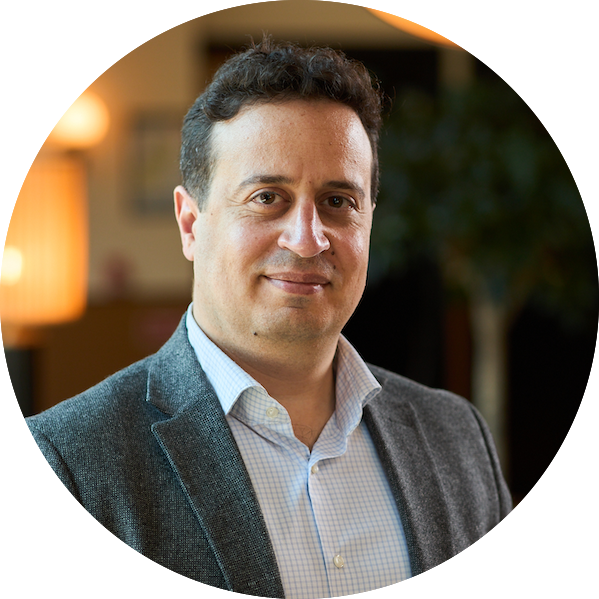
Jörgen Ahlberg is an Adjunct Associate Professor at the Computer Vision Laboratory (CVL) within the Department of Electrical Engineering (ISY) at Linköping University. He specializes in computer vision, focusing on facial recognition, thermal infrared imaging, and radar micro-Doppler analysis. University: Linköping University Department: Department of Electrical Engineering (ISY) Lab: Computer Vision Laboratory (CVL) Email: jorgen.ahlberg@liu.se His research spans facial recognition, hyperspectral imaging, UAV-based wildlife detection, and advanced tracking algorithms. Recent work includes detection-guided attention mechanisms for radar target classification and self-supervised learning frameworks for tracking applications. He received the Entrepreneurial Teacher of the Year award at Linköping University in 2023. His academic contributions are reflected in publications covering thermal infrared tracking, biometric data filtering, and multi-sensor surveillance systems.
Fredrik Kahl is a Professor at Chalmers University of Technology, leading the Computer Vision Group under the Department of Signal Processing and Medical Technology. His research spans Computer Vision , Machine Learning , and Medical Image Analysis , with a focus on geometric deep learning and 3D reconstruction. University: Chalmers University of Technology Department: Signal Processing and Medical Technology Email: fredrik.kahl@chalmers.se His work addresses rotation equivariance , out-of-distribution detection , and privacy-preserving representations . Recent publications explore Gaussian splatting for 3D edge mapping, semi-supervised learning frameworks, and symmetry encoding in ReLU networks. Projects include collaborations with institutions like Wallenberg AI, Autonomous Systems and Software Program and grants from VINNOVA and Vetenskapsrådet (VR) .
Kim Astor is a Postdoctoral Researcher at Uppsala University's Department of Psychology, specializing in Developmental Psychology. Based at Von Kraemers allé 1A och 1C in Uppsala, Astor conducts empirical research at the intersection of child development and artificial intelligence. Research interests span two primary domains: Children's Interaction with AI : Investigating trust in AI systems, learning impacts, and developmental implications of screen-based AI/social robots Social Development in Infants : Examining gaze following mechanisms, nonverbal communication, cultural variations, and influences of parental mental health Methodologically focused on eye-tracking and cross-cultural studies, including fieldwork in Bhutan. Recent publications (2018-2025) reveal strong trends in: AI-manipulated video techniques for infant gaze analysis Cross-cultural resilience studies amid war/climate change Maternal depression impacts on joint attention Theoretical frameworks for gaze following development Work appears in top journals including Psychological Science , Developmental Psychology , and Child Development . Altmetric attention shows significant engagement: 8 news outlet pickups for 2022 Bhutan study 92 Mendeley readers for 2020 Royal Society paper 31 X/Twitter mentions across multiple publications Astor's collaborative network includes Gustaf Gredebäck (Uppsala), Herbert Ainamani (Uganda), Linda van den Berg (Netherlands), and Joshua Juvrud (Bhutan studies). Current projects focus on establishing empirical guidelines for children's AI interactions before societal entrenchment of these technologies.
Knut Åkesson is a Professor in Automation at the Department of Electrical Engineering, Chalmers University of Technology. His research focuses on rigorous methods for verification and control in safety-critical autonomous systems, optimization of high-variability production systems, and applications of computer vision and deep learning in industrial automation. He serves as lecturer/examiner for courses in automatic control and model-based development of cyber-physical systems. He is the master program director for Systems, Control, and Mechatronics. Research Interests: Knut's work spans formal verification of cyber-physical systems, collision-free trajectory planning for robots, and fault localization in automation systems. His methods integrate Bayesian optimization, deep reinforcement learning, and model predictive control for dynamic obstacle avoidance. Recent Publications (2025-2022): His 15 most recent articles address challenges in multimodal motion prediction, conflict-free electric vehicle routing, structural coverability for automation systems, and falsification techniques using SMT solvers. These papers appear in venues such as IEEE Robotics and Automation Letters , IEEE Transactions on Embedded Computing Systems , and IEEE International Conference on Automation Science and Engineering . Projects: Knut leads initiatives like The Smart and Connected Worker (ArtWork) (VINNOVA, 2024–2026) and contributes to AIHURO-Intelligent Människa-Robot-Samarbete (VINNOVA, 2023–2026). His work often involves collaboration with industry partners such as Volvo Group.
Dr. Åsa Fasth Berglund is an active researcher at Chalmers University of Technology within the Production Systems department. Her work focuses on industrial digitalization, human-automation collaboration, and Industry 4.0 implementation strategies. She leads multiple research initiatives funded by VINNOVA and the European Commission, with 30+ documented projects since 2006. Her core research explores: Cognitive automation frameworks for manufacturing operators Human-robot co-production systems Extended reality (XR) applications in industrial settings Digital work instruction methodologies Sustainable and flexible production system design Publication analysis reveals consistent focus on Industry 4.0 technologies since 2016, with recent emphasis on operational flexibility, human-robot collaboration, and digital twins. Her work frequently combines empirical case studies with technical implementation frameworks. Dr. Berglund has secured significant research funding including: DIH World (EU Commission, 2020-2023) FAKTA Automation (VINNOVA, 2019-2022) Stena Industry Innovation Lab (Stena Foundation, 2018-2020) 5G-Enabled Manufacturing (VINNOVA, 2018-2020) She co-leads the Production Systems research group and established the Stena Industry Innovation Lab at Chalmers, focusing on applied industry solutions. Current projects investigate digital twins for sustainable manufacturing and AI-driven cognitive automation.
Elisa Rigosi is a Researcher in the Department of Biology at Lund University, Faculty of Science, specializing in sensory biology and neuroethology. She investigates how insect sensory systems function, with a strong focus on visual processing and the neurotoxic effects of pesticides on non-model pollinators such as hoverflies. She joined David O’Carroll’s lab in 2016 and has since led interdisciplinary research projects on sublethal pesticide impacts on insect brains and behavior. Master’s in Neurobiology, University of Pisa, Italy PhD in Neurophysics, Chemical Ecology, and Cognitive Science, University of Trento, Italy Postdoctoral Fellowship, Visual Physiology & Neurobotics Laboratory, University of Adelaide, Australia Her research centers on insect vision, neural asymmetries, photoreceptor physiology, and ecotoxicology. She employs techniques such as in vivo calcium imaging, intracellular recording, and behavioral assays to study sensory transduction and neural processing in insects. Her work contributes to understanding pollinator decline and pesticide risk assessment. Recent publications highlight trends in neurotoxicology, particularly the effects of neonicotinoids like imidacloprid on pollinators. Her studies integrate electrophysiology, optical mapping, and machine learning to assess visual acuity, contrast sensitivity, and neural circuit modulation. She also explores structural and temporal neural asymmetries in insects, linking sensory processing to behavior. Scientific contributions include: Coordinating interdisciplinary projects on pesticide neurotoxicity Developing novel oral bioassays for toxicity testing Advancing understanding of insect visual systems across species Supervising doctoral and master’s research Rigosi actively supervises graduate students and contributes to externally funded research projects, including those supported by FORMAS. She regularly presents her findings at international conferences such as the International Conference on Invertebrate Vision and KIC ERA meetings. Her collaborative network spans institutions in Sweden, Australia, and beyond, focusing on sustainable solutions for pollinator health. She is involved in multiple active research initiatives, including electrophysiological studies of photoreceptors, optical eye mapping, and machine learning–enhanced contaminant detection. Her lab integrates neurobiological techniques with environmental science to address pressing ecological challenges.
Linda Hartman is a Senior Lecturer in Mathematical Statistics at the Centre for Mathematical Sciences, Faculty of Science, Lund University. She is actively involved in interdisciplinary research within the MERGE (ModElling the Regional and Global Earth system) initiative and contributes to Lund University’s profile areas in Engineering Health, Aerosols, and Nature-based Future Solutions. Her work bridges statistics with applications in medicine, environmental science, and technical development. Academic Rank: Senior Lecturer Department: Centre for Mathematical Sciences University: Lund University Research Affiliations: MERGE, LTH Profile Areas (Engineering Health, Aerosols), LU Profile Area (Nature-based Future Solutions) Her research focuses on applied statistics in environmental, climate, and medical sciences. She specializes in statistical modeling and data analysis for sustainability, cancer research (particularly breast and ovarian cancer), and climate change. Her work supports the UN Sustainable Development Goals related to health, climate action, and responsible consumption. The recent publications highlight her interdisciplinary reach, spanning aerosol science, oncology, and climate advocacy. Her articles reflect a strong trend in applying advanced statistical methods to real-world problems in medicine and environmental systems, often in collaboration with domain experts. She contributes both to peer-reviewed research and public discourse on climate policy. Her scientific recognition includes: W-sektionens pedagogiska pris 2023 – awarded for excellence in teaching and pedagogical innovation. Linda Hartman is actively involved in supervising students and advancing pedagogy in higher education. She has supervised master’s level research, such as the thesis on baseball statistics. She is deeply committed to teaching innovation, employing active and cooperative learning strategies. She contributes to organizing pedagogical seminars and is responsible for developing and teaching key courses in mathematical statistics and data analysis, including the advanced course on statistical learning and visualization. Her grants and projects include work on prognostic factors in breast cancer radioresistance and fog patterns at Swedish airports, demonstrating sustained external funding and collaboration. She is a key member of research teams in both medical and environmental domains, contributing statistical expertise to interdisciplinary projects. Her leadership in organizing conferences and workshops, such as the ELLITE Focus Period Symposium on Machine Learning for Climate Science, underscores her active role in the academic community.
Göran Falkman is an Associate Professor of Computer Science at the University of Skövde, working within the Department of Information Technology at the School of Informatics. His research spans artificial intelligence, machine learning, big data analytics, and human-computer interaction, with applications in transportation, healthcare, and defense domains. His educational background includes a PhD in Computing Science and he holds the Swedish academic title of Docent in Computer Science. He has supervised numerous PhD students including Niclas Ståhl, Rakesh Rana, Ulrika Ohlander, and Maria Riveiro. Falkman's research interests focus on developing AI systems that effectively support human decision-making. His work includes driver intention recognition, uncertainty quantification in deep learning, maritime anomaly detection, and cockpit interface design for fighter pilots. He has developed approaches for interactive clustering, visual data analysis, and information fusion that bridge the gap between complex algorithms and human understanding. His recent publications demonstrate a strong trajectory in applying deep learning to transportation safety, particularly driver intention recognition, while maintaining his longstanding interest in human-centered AI systems. His work shows increasing sophistication in uncertainty modeling and probabilistic approaches to machine learning. Falkman has led major research projects including BISON (Big Data Fusion), BIDAF (Big Data Analytics Framework), and collaborations with Saab Aeronautics on human-machine interfaces for distributed decision-making in aviation contexts. He has supervised numerous PhD students across diverse applications of AI, from drug design to fighter pilot teamwork, demonstrating his ability to guide research at the intersection of theory and practical application. His work consistently addresses the challenge of making complex AI systems transparent and trustworthy for human users.
Marcus Nyström is a Researcher at Lund University Humanities Lab and part of the eSSENCE: The e-Science Collaboration . He holds a PhD in Information Theory (2008) and was appointed Associate Professor of Ergonomics in 2015. His work focuses on eye tracking methodology , including instrument development and data analysis techniques. Research Areas : Eye Movement Physiology, Human-Computer Interaction, Cognitive Science, Deep Learning for Eye Tracking Projects : ADAPT2 (adaptive developer tools), GANDER (code review eye tracking), eSSENCE@LU (astronomy VR visualization) Recent publications analyze eye tracking fundamentals , deep learning frameworks , and multi-tracker systems . He contributes to journals like Behavior Research Methods and conferences on eye tracking research. His work intersects with UN Sustainable Development Goals related to Quality Education and Industry Innovation .
Mikael Nilsson is a Senior Lecturer and key member of the Faculty of Engineering (LTH) at Lund University , Sweden. He is affiliated with the Centre for Mathematical Sciences and serves as Programme Director for the international master's program in Machine Learning, Systems and Control since 2019. Education : M.Sc.E.E. and Ph.D. in Applied Signal Processing (2007) from Blekinge Institute of Technology Research Focus : Developing novel Machine Learning models with emphasis on Deep Neural Network Designs Applications in Computer Vision (3D object estimation, traffic safety, radiation therapy) Applied research in Engineering Health and Natural & Artificial Cognition profile areas Recent Research Outputs (2022-2023): Medical imaging segmentation for cancer therapy (Radiation Oncology) Urban traffic surveillance systems (IEEE ITSC) 3D shape estimation from monocular vision Multi-view pose estimation via segmentation masks Yield forecasting using satellite-ground data fusion Key Collaborations : Swedish Government Agency for Innovation Systems (Vinnova) - DAIDESS project (2023-2026) Interdisciplinary work in Engineering Health and Medical Imaging Industrial collaboration with Axis Communications AB (2016-2019)
Christofer Karlsson is a Researcher at the Infection Medicine department within Biomedical Center (BMC) at Lund University . His work focuses on proteomics and host-pathogen interactions in bacterial infections. His research applies mass spectrometry-based proteomics to study Streptococcus pyogenes and Staphylococcus aureus pathogenesis. Key projects include COVID-19 proteome profiling and computational methods development for proteomics data analysis. Recent publications highlight therapeutic antibody degradation by pathogens, lung fibrosis mechanisms , and proteomic landscape mapping in sepsis. His work contributes to UN Sustainable Development Goal 3 (Good Health) .
Johan Lind is a senior associate professor in ethology at Linköping University and deputy director of the Centre for Cultural Evolution at Stockholm University. His research focuses on the evolutionary mechanisms underlying animal and human cognitive capacities, particularly in memory, associative learning, and cultural development. He has held postdoctoral and visiting fellowships at St Andrews University and Cambridge University, respectively. Key Research Areas: Cognitive evolution, associative learning, human cultural uniqueness, and behavioral ecology Notable Contributions: Critique of Dunbar's number, development of A-learning theory, analysis of sequence representation in cognition Scientific Awards: No explicit awards mentioned in the provided texts. Collaborations: Regular collaborator with Stefano Ghirlanda and Magnus Enquist on associative learning models and cognitive evolution.
Hazem Torfah is a tenure-track Assistant Professor at the Computer Science and Engineering Department at Chalmers University of Technology, where he leads the Safe and Trustworthy Autonomous Reasoning lab (STARlab). Previously, he was a postdoctoral researcher in the EECS Department at UC Berkeley, USA, and obtained his Ph.D. in 2019 from Saarland University, Germany. His research focuses on developing theoretical foundations and techniques for constructing safe and reliable autonomous cyber-physical systems. Hazem earned his Ph.D. from Saarland University in 2019, followed by postdoctoral research at UC Berkeley. His educational background has positioned him at the forefront of formal methods research for autonomous systems. His research interests center on the formal specification, verification, and synthesis of cyber-physical systems, with a particular focus on quantitative approaches for verifying and explaining system behavior. He investigates methods to ensure safety and reliability in autonomous systems through runtime monitoring, specification mining, and assurance frameworks. His work bridges theoretical computer science with practical applications in autonomous driving and robotics. An analysis of his recent publications reveals a strong focus on runtime monitoring techniques for operational design domains, specification mining for predictive safety, and frameworks for runtime assurance of cyber-physical systems. His work frequently combines formal methods with machine learning to address safety challenges in autonomous systems, with applications primarily in autonomous driving. Hazem's research is funded by the Wallenberg AI, Autonomous Systems, and Software Program, reflecting the significance and potential impact of his work in the field of assured autonomy. He has supervised several Master's students, including Samuel Collier Ryder and Johannes Holmgren (2025), and Lucas Karlsson and George Kayembe (2024). His teaching includes courses on Formal Methods for Security, Oracle-Guided Inductive Synthesis, and Data Structures and Algorithms. As the leader of STARlab, Hazem directs research on safe and trustworthy autonomous reasoning, focusing on developing methods to ensure the reliability and explainability of autonomous cyber-physical systems through formal verification techniques.
Magnus Thordstein is an Adjunct Assistant Professor at the Department of Biomedical and Clinical Sciences within Linköping University , Sweden. His research focuses on neuromodulation techniques such as repetitive transcranial magnetic stimulation (rTMS) and transspinal direct current stimulation (tsDCS) , targeting nervous system imbalances in conditions like epilepsy and chronic pain . Thordstein collaborates with neurosurgery , neurology , and algology specialties through clinical studies.
Björn Johansson is a Professor at Linköping University in the Department of Computer Science (IDA) , affiliated with the Human-Centered Systems (HCS) division. His research focuses on human interaction with complex systems, particularly in energy systems, crisis management, and autonomous systems, using simulation and game-based methods. Leading the "Att vända strömmen" project (funded by Swedish Energy Agency) to address sustainability challenges in energy systems Co-developing "megagames" for understanding societal polarization and climate change Collaborating with Saab on aviation interface design and autonomy research His recent publications span AI in smart grids, ERP cloud migration, and resilience in autonomous systems. He teaches courses in Cognitive Systems Engineering and Crisis Management, and co-leads the SkyLab research environment for future aviation concepts. Current grants include SEK 24.5 million from the Swedish Energy Agency and SEK 33.4 million from the Kamprad Family Foundation.