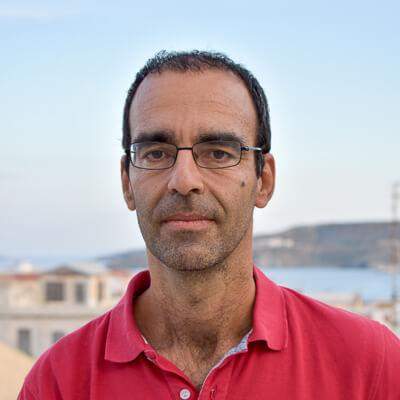
Robbert Reijnen is a Researcher at the Department of Information Systems within the Industrial Engineering and Innovation Sciences school at Eindhoven University of Technology . His work focuses on algorithmic approaches for complex optimization problems in industrial contexts. Research interests include: Deep Reinforcement Learning for dynamic systems Graph Neural Networks in scheduling optimization Adaptive parameter control in evolutionary algorithms Multi-objective optimization frameworks Recent publications highlight applications in job shop scheduling, vehicle routing, and differential evolution techniques. He has received recognition through scientific awards : Winner of MLVRP2023 GECCO competition (2023) Active in organizing academic workshops like EURO Meets NeurIPS 2022 Vehicle Routing Competition , and teaching Algorithmic programming for operations management . His work contributes to UN Sustainable Development Goals related to efficient resource management.
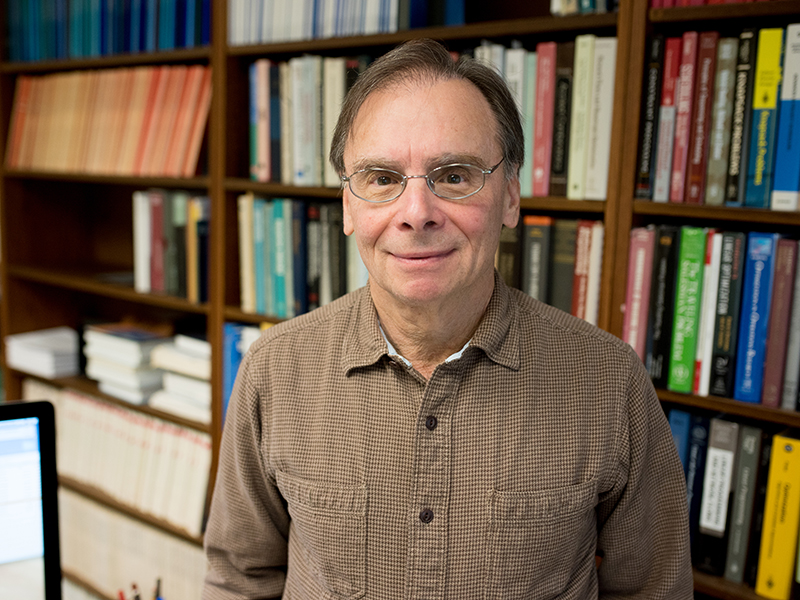
David Rey is a Professor at SKEMA Business School in Sophia Antipolis, France. His research focuses on optimization, game theory, and artificial intelligence applied to transportation and logistics. He holds a PhD in Operations Research from Université Grenoble Alpes (2012) and a Habilitation à Diriger des Recherches (2023) from Université de Toulouse. Previously, he was a Senior Lecturer at UNSW Sydney (2016–2021) and has held postdoctoral positions at rCITI UNSW. He leads the URBANE project, exploring green last-mile delivery solutions, and serves on editorial boards like Transportation Letters . Awards include multiple ARC grants and the INFORMS TSL Best Paper Award Committee role (2025). Education: Habilitation à Diriger des Recherches (2023), Operations Research, Université de Toulouse PhD (2012), Operations Research, Université Grenoble Alpes Master (2008), Sciences/Mathematics, Pontifical Catholic University of Rio de Janeiro Engineering Degrees (2004–2005), Electrical Engineering, University of Montpellier Research Interests: David’s work emphasizes optimization techniques (bilevel, stochastic, mixed-integer programming), game theory, and AI applications in transport systems. Key areas include drone delivery, autonomous vehicle integration, congestion pricing, and resilient logistics networks. His methods address real-world challenges like pandemic response, electric vehicle charging infrastructure, and fair resource allocation. Grant Highlights: URBANE (EU Horizon-funded), 2022–present 4 ARC grants as Lead Chief Investigator, including projects on concrete mixes, ethics in transport systems, and workforce logistics optimization Advising & Grants: Directed/co-directed 15+ PhD theses across SKEMA and UNSW Sydney Active in grant writing and editorial roles, including Transportation Science and Logistics Society Workshop (2024–2025) Labs/Teams: Leads the SKEMA Centre for Analytics and Management Science, focusing on analytics-driven solutions for business and urban systems.
Ataç Selin is a Researcher at the University of Applied Sciences and Arts Western Switzerland (HES-SO), affiliated with the Interdisciplinary Institute for Business Development (IIDE) at HEIG-VD. She holds a PhD in Transportation Science from EPFL (2023) and focuses on optimizing vehicle sharing systems, logistics, and sustainable urban mobility. Her work integrates simulation-optimization frameworks to address challenges in bike/car sharing systems, electric vehicle infrastructure, and craft beer distribution logistics. Education: PhD in Transportation Science (2023), École Polytechnique Fédérale de Lausanne (EPFL) MSc in Operations Research (2016), Middle East Technical University (METU) BSc in Industrial Engineering (2013), Middle East Technical University (METU) Research Interests: Her research spans vehicle routing optimization, demand forecasting in transportation networks, and decision-making frameworks for sustainable systems. She has pioneered a holistic management framework for vehicle sharing systems, emphasizing rebalancing strategies, clustering algorithms, and environmental impact mitigation. Key Projects: "Craft Beer Distribution Optimization" (2024), funded by Innosuisse, focuses on collaborative logistics platforms for Swiss craft breweries. "Light Electric Vehicle Sharing Systems" (2024), developing decision support tools for EV infrastructure. Awards: Recipient of the EPFL EDCE Mobility Award (2021) for contributions to VSS optimization and the METU Best Graduate Performance Award (2016).
Prof. Dr. Özgür ÖZPEYNİRCİ is a faculty member at İzmir Ekonomi Üniversitesi's İşletme Fakültesi, leading the Lojistik Yönetimi department since 2015. He holds a PhD in Industrial Engineering from Orta Doğu Teknik Üniversitesi (2008). His research focuses on multi-objective decision making, combinatorial optimization, and logistics system design. He has authored influential papers in journals like Management Science and European Journal of Operational Research , with notable contributions to pharmacy duty scheduling and shipment consolidation problems. Prof. ÖZPEYNİRCİ has received the MCDM Doctoral Dissertation Award (2011) and serves on editorial boards such as the İzmir Review of Social Sciences. He has advised over 10 PhD and master's students, and his current projects include multi-modal logistics optimization and inverse multi-criteria sorting algorithms. His academic career includes roles as Department Chair and Deputy Dean, alongside leadership in national research projects funded by TÜBİTAK. Teaching responsibilities span logistics planning, optimization, and supply chain management, with courses like LOG 301 Lojistik Planlama ve Modelleme I . His work bridges theoretical advancements with practical applications in healthcare, emergency response, and international logistics.
Prof. Nysret Musliu is an Associate Professor at TU Wien's Department of Databases and Artificial Intelligence within the Faculty of Informatics. His primary affiliation is with the E192-02 research area, focusing on optimization, scheduling, and AI applications. He leads projects like 'Artificial Intelligence in Employee Scheduling' and 'Predictive Analytics for Emergency Call Infrastructure,' demonstrating expertise in combinatorial optimization and real-world problem-solving. Academic Rank: Associate Professor Institution: TU Wien Key Projects: AI-driven scheduling, constraint programming, metaheuristics Research interests include scheduling algorithms, constraint programming, and hybrid optimization methods. His work bridges theoretical advancements with industrial applications, addressing challenges in manufacturing, healthcare, and transportation. Recent publications emphasize hyper-heuristics, large neighborhood search, and AI integration for complex scheduling problems. Notable contributions include systematizing test laboratory scheduling and developing exact methods for oven scheduling. His research group collaborates on projects involving personnel scheduling, production leveling, and parallel machine optimization.
Prof. Damianos Gavalas is a Professor and Vice Head of the Department of Product and Systems Design Engineering at the University of the Aegean, Greece. He also serves as an Adjunct Professor at the Hellenic Open University. His research focuses on mobile/pervasive computing, extended reality, wireless networks, optimization algorithms, and transportation systems. He has authored over 200 publications, with an h-index of 37, and has led major research projects such as SMARTBUY (H2020) and iDeliver (Erasmus+). Education: PhD in Electronics Engineering (University of Essex, 2001), MSc in Telecommunications (University of Essex, 1997), BSc in Informatics (University of Athens, 1995). Research Interests: Mobile & Pervasive Computing Wireless Sensor Networks Immersive Technologies (AR/VR) Intelligent Transportation Systems Optimization Algorithms Awards: Recipient of Best Paper Awards, ranked top 2% in Networking & Telecommunications (Stanford, 2022). Advising & Grants: Supervised 3 completed PhDs and numerous MSc projects. Coordinated EU-funded projects including HoPE (EC/CIP7), MOVESMART (FP7), and eCOMPASS (FP7). Labs/Teams: Involved in interdisciplinary teams focusing on smart cities, cultural heritage technologies, and automotive systems.
Seokcheon Lee is a Professor of Industrial Engineering at Purdue University's Edwardson School of Industrial Engineering. He is affiliated with the Global Engineering Program, contributing to interdisciplinary research and education. His work focuses on optimization, logistics, and emergency response systems, leveraging advanced methodologies such as reinforcement learning, clustering analysis, and simulation modeling. Key areas include drone-assisted delivery systems, supply chain resilience, and social welfare-based decision-making frameworks. His research bridges theoretical models with practical applications in transportation, healthcare, and sustainable energy systems. Research interests center on the intersection of operations research and real-world challenges, including multi-agent systems, vehicle routing, dynamic scheduling, and resource allocation. He explores solutions for emergency medical services (EMS) logistics, food accessibility, and renewable energy integration. Notable contributions include frameworks for flying warehouses, citizen responder networks, and energy-efficient routing protocols. His publications span over two decades, addressing topics like UAV task allocation, microgrid scheduling, and supply chain preparedness. While no specific awards are listed, his work has been supported by institutional recognition. Advising and grant details remain unspecified, though his extensive publication record reflects active research collaboration. He contributes to lab initiatives in drone logistics, healthcare systems optimization, and smart city infrastructure design.
Jonathan Bard is a Professor of Operations Research & Industrial Engineering at the University of Texas at Austin, holding the Industrial Properties Corporation Endowed Faculty Fellowship in Engineering. He serves as Associate Director of the Center for the Management of Operations Logistics and Assistant Graduate Advisor for the Manufacturing Systems Engineering Program. His academic journey includes a D.Sc. in Operations Research from George Washington University, an M.S. in Aeronautics & Astronautics from Stanford University, and a B.S. in Aeronautical Engineering from Rensselaer Polytechnic Institute. Dr. Bard's research focuses on algorithm development for airline operations, vehicle routing, machine scheduling, and large-scale optimization. He is internationally recognized for expertise in bilevel programming and postal operations. His work integrates decomposition techniques for hierarchical planning and multicriteria decision-making in socio-economic systems. Bard advises government agencies and corporations, and contributes to editorial boards of journals like International Journal of Production Research and IEEE Transactions on Engineering Management . His recent articles address challenges in freight rail scheduling, kidney exchange systems, waste management optimization, and healthcare logistics. Awards include Fellowships from INFORMS and IIE, and Senior Membership in IEEE. Bard’s consulting spans industries, emphasizing real-world applications of operations research principles.
Bo Li is an Assistant Professor in the Department of Statistics at the University of California, Berkeley . His research bridges statistical theory with applications in machine learning, optimization, and autonomous systems. Education: PhD in Statistics (2006), advised by Peter Bickel Email: boliboli@gmail.com Bo Li's research focuses on machine learning , control systems , and energy-efficient optimization . His work addresses challenges in autonomous vehicle navigation, solar panel positioning, and stochastic energy routing problems. Key themes include predictive control frameworks, multi-agent coordination, and uncertainty handling in dynamic systems. Recent publications highlight 2025 and 2024 advancements in model predictive control (MPC) , generalized Nash equilibrium for autonomous racing, and stochastic optimization for energy systems. His work spans vehicle routing , solar energy tracking , and multi-agent control , emphasizing data-driven approaches and real-world validation.
Dr. Wissam Fawaz is a professor-level academic with extensive contributions to optical networking, vehicular communication systems, and UAV-aided network solutions. His work spans over two decades, focusing on Quality of Service optimization , Free Space Optical (FSO) communications , and Mobile Edge Computing (MEC) . Key collaborations with Chadi Abou-Rjeily, Maurice Khabbaz, and Ken Chen Published in IEEE Transactions on Wireless Communications , IEEE Communications Magazine , and Computer Networks Research interests center on network reliability , resource allocation , and next-generation communication architectures . His work explores: UAV-based network repair mechanisms QoS differentiation in optical and vehicular networks Machine learning integration for MEC task offloading Buffer-aided cooperative FSO systems Recent publications (2022) demonstrate innovations in: Acoustic synchronization protocols D2D-enabled Het-MEC systems Lyapunov-optimized resource allocation
Giusy Macrina is a Researcher at the Department of Mechanical, Energy and Management Engineering (University of Calabria, Italy). Her work focuses on Operations Research and Machine Learning applications to complex logistics and transportation problems. Specializes in Vehicle Routing Problems with drones and crowd-shipping Develops hybrid algorithms combining mathematical optimization and artificial intelligence Active in green logistics and sustainable transport systems Collaborates with international institutions like Amazon Her research spans smart mobility , energy-efficient delivery systems , and IoT localization challenges . Recent publications demonstrate her focus on integrating machine learning into traditional optimization problems . She teaches courses in Management Engineering , including Methods and Tools for Engineering and Production Management and Control at the graduate level. Her work addresses both static and dynamic optimization challenges in logistics and energy systems.
Marco Locatelli is a Full Professor in the Department of Computer Engineering at the University of Parma, Italy. His research focuses on Global Optimization , Operations Research , and Computational Mathematics , with applications in Robotics and Optimization Algorithms . Education: Ph.D. in Computational Mathematics and Operations Research (University of Milano/Napoli, 1997); Laurea in Computer Science (University of Milano, 1992). Positions: Post-Doc (University of Trier, Firenze); Assistant/Associate Professor (University of Torino); Full Professor (University of Parma since 2010). His research spans Global Optimization over intervals, multistart algorithms, concave optimization, packing problems, and convex underestimators. Recent work includes Multi-Agent Pathfinding and Speed Planning with energy/time optimization, leveraging Machine Learning and Dynamic Programming . He has received distinguished accolades, including the Europt Fellow (2018), Best Paper in the Journal of Global Optimization (2016), and co-authored a SIAM-published book on Global Optimization (2013). He serves on editorial boards of top-tier journals like Computational Optimization and Applications and Operations Research Letters . Scientific Awards: Al Zimmermann's Programming Contest Winner (Circle Packing) AIRO Award for Daniele Depetrini's Master Thesis (2007) Chairman's Recognition of Outstanding Paper (2009 IEEE Congress) Europt Fellow (2018) His teaching includes Operations Research and Algorithms for Decision Support across multiple Italian universities (Torino, Parma, Firenze). He has contributed to Research Projects like MoSPRAS, MOST, and COSO, addressing real-world optimization challenges in healthcare, robotics, and transportation.
Mauro Vallati is a Full Professor of Artificial Intelligence at the Department of Computer Science, School of Computing and Engineering, University of Huddersfield. He is also the Director of the Centre for Autonomous and Intelligent Systems and holds leadership roles in several AI-focused research centres, including the Centre for Planning, Autonomy and Representation of Knowledge and the Centre of Artificial Intelligence for Mental Health. Additionally, he is a member of the Sustainable Living Research Centre. Vallati is currently accepting PhD students and is an active researcher with over 200 publications. His research expertise lies in Artificial Intelligence, with a strong focus on Automated Planning and Argumentation. He applies these techniques to real-world problems, particularly in Urban Traffic and Mobility, which is the central theme of his UKRI Future Leaders Fellowship. He also explores innovative applications of AI in Medicine and Computational Creativity. His work aligns with UN Sustainable Development Goals, especially in sustainable cities and communities. The recent articles highlight a consistent trend in applying AI and planning techniques to urban mobility challenges, including traffic signal optimization, autonomous vehicle routing, and passenger demand prediction. There is also a strong theoretical foundation in argumentation, plan robustness, and macro-actions. The research spans both practical implementations and algorithmic advancements, with increasing emphasis on sustainability and real-world impact. Scientific Awards and Recognitions: UKRI Future Leaders Fellow ACM Senior Member ACM Distinguished Speaker on AI for the UK Vallati has secured significant research funding through projects such as AI4ME, AI for Autonomic Urban Traffic Control, MIREL, and SimplifAI. He supervises PhD students and early-career researchers, contributing to the development of the next generation of AI scientists. His leadership in organizing key academic events, such as the UK Planning and Scheduling Special Interest Group workshop, underscores his active role in the international AI community. He leads and contributes to multiple research centres, including the Centre for Autonomous and Intelligent Systems, where he drives innovation in AI applications for traffic, mental health, and sustainability. His interdisciplinary collaborations span engineering, computer science, and environmental research, particularly evident in projects involving textile waste recycling and legal text mining.
Dr. Balbina Casas Mendez is a Professor in the Department of Statistics, Mathematical Analysis and Optimization at the University of Santiago de Compostela (USC) , affiliated with the Galician Mathematical Research and Technology Center (CITMAga) and the MODESTYA research group focused on optimization, decision-making, and statistical models. She holds a doctorate from USC (1996) for her thesis on cooperative games with graph-restricted communication, advised by Dr. José Manuel Prada Sánchez. Her research lies at the intersection of Game Theory , Operational Research , and Mathematical Economics , with emphasis on cooperative games, power indices, bankruptcy rules, and multi-issue allocation problems. Her work applies these concepts to real-world scenarios like food distribution logistics, European Union decision-making, and healthcare data analysis. Recent publications highlight her expertise in: Algorithmic methods for power indices in coalition-structured games Heuristic solutions for logistics and agricultural planning Statistical approaches to feature influence in classification problems Axiomatic characterizations of game theory solutions She has co-authored over 31 works since 2000, with significant contributions to journals like the European Journal of Operational Research and International Journal of Game Theory .
Mahdi Bashiri is an Associate Professor in the Department of Analytics, Technology and Operations at Leeds University Business School, University of Leeds. He is also affiliated with the Centre for Decision Research (CDR). Previously, he held leadership roles at Coventry University, including Co-lead of the Sustainable Operations and Consumption research cluster and Associate Head of School in Research. Education: Details not explicitly provided in the text. His research spans Supply Chain Analytics, Operations Research, Stochastic Programming, Matheuristics, Home Healthcare Planning, and Wildfire Risk Management . He develops mathematical models and algorithms to solve complex decision-making problems in both public and private sectors. His work enables policymakers and business leaders to make data-driven, impactful decisions. He teaches modules in operations management, supply chain management, and business analytics at undergraduate, postgraduate, and doctoral levels. The recent articles reflect a strong trend in applying stochastic programming and matheuristic algorithms to real-world challenges such as wildfire risk management, home healthcare planning, sustainable logistics, and automated delivery systems . His publications appear in elite journals like European Journal of Operational Research and Transportation Research Part E , indicating consistent high-impact contributions to operations research and supply chain management. Scientific Awards: Exceptional Performance Award, Coventry University, 2021 Young National Top Scientist Award, Academy of Sciences of the Islamic Republic of Iran, 2013 Mahdi has secured multiple research grants, including from the British Academy and USAID, focusing on humanitarian logistics and environmental resilience. He has successfully supervised over 10 PhD students and welcomes new PhD candidates and visiting researchers. He is an active reviewer and serves on the editorial advisory board of Transportation Research Part E . He is a member of the Operational Research Society. Labs and Research Groups: Centre for Decision Research (CDR), University of Leeds Formerly Co-lead, Sustainable Operations and Consumption Research Cluster, Coventry University