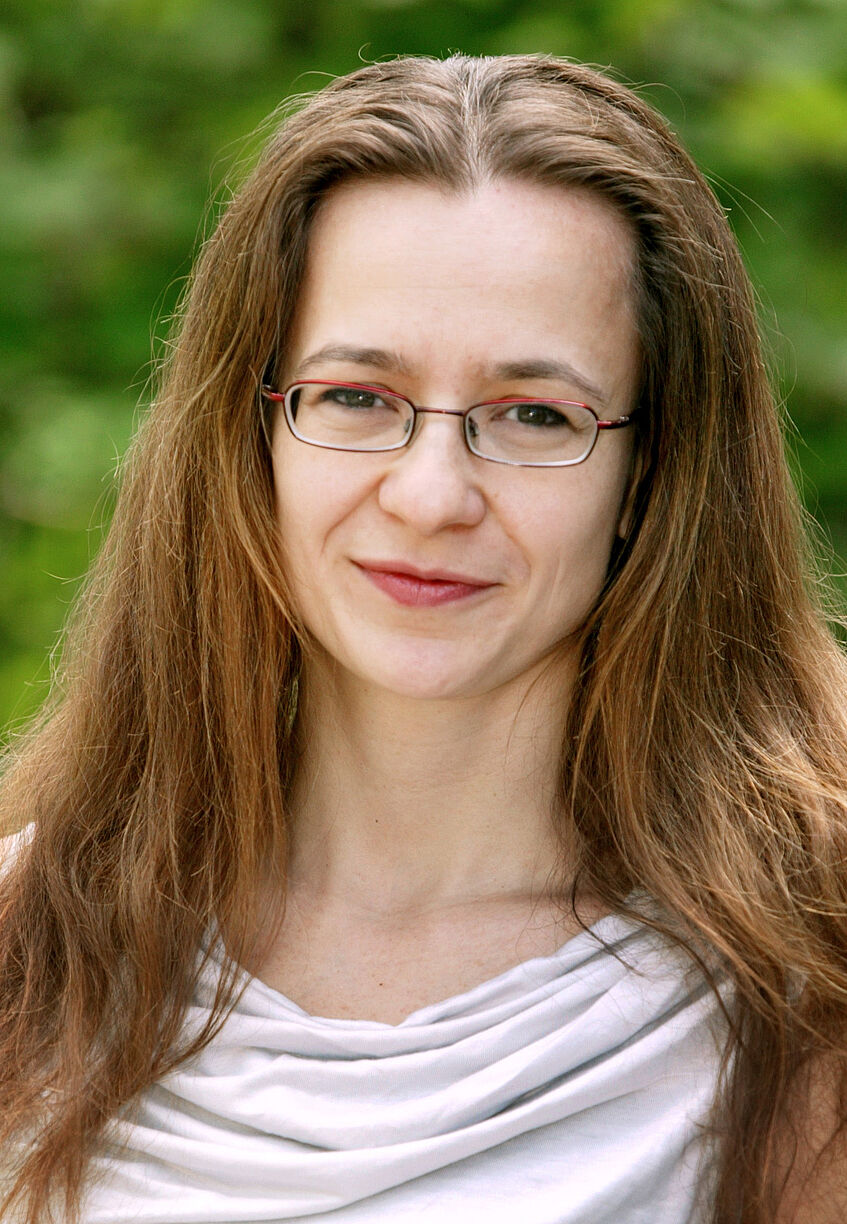
Simon Decker is a researcher in the Faculty of Life Sciences at an unspecified institution, specializing in the Department of Pharmaceutical Sciences. His work focuses on advanced drug delivery systems and molecular targeting strategies. Department: Pharmaceutical Sciences Research Areas: Nanocarrier design, gene therapy, immune modulation, and RNA-based therapeutics Decker's research explores innovative approaches to enhance therapeutic efficacy through targeted delivery mechanisms, including ligand engineering and endosomal escape optimization. His work intersects pharmacology, immunology, and biotechnology. Recent publications highlight trends in oligonucleotide delivery systems, viral vector retargeting, and peptide ligand design for receptor-specific therapies. Key subfields include epidermal growth factor receptor targeting, siRNA complexation, and macrophage interaction dynamics.
Institute of Science and Technology AustriaAustria
Sandra Siegert is a Professor in the Life Sciences Department at the Institute of Science and Technology Austria (ISTA). Her research focuses on understanding how microglia interact with neuronal networks in both healthy and diseased states, particularly in the context of neuropathological disorders. She integrates knowledge from virology, immunology, molecular biology, neuroscience, and applied mathematics to study microglia's role in brain maintenance and disease progression. Education Dr. phil. nat in Neurobiology from the University of Basel (2005-2010) Diploma in Biological Sciences from Goethe-Universität Frankfurt am Main (2000-2005) Research Interests Dr. Siegert's work emphasizes microglia's response to environmental cues, their epigenetic regulation, and their contribution to neurological disorders like schizophrenia and Alzheimer's disease. Key areas include: Microglia-neuron communication in retinal and cortical circuits Role of microRNAs (e.g., miR-137) in synaptic plasticity 60-Hz light entrainment effects on brain plasticity Applied topology for analyzing cellular networks Human iPSC-derived microglia modeling Publication Trends Her recent articles highlight interdisciplinary approaches to studying microglia in retinal organoids, mitochondrial dynamics in stress response, and chimeric GPCR tools for modulating neuroimmune activity. Collaborative work spans gene therapy vectors (AAV2/6), synaptic dysfunction in schizophrenia, and ketamine/light entrainment effects on perineuronal nets. Scientific Contributions EMBO short-term fellowship (2011) FWF Austrian Science Fund grant P 37131 (2023-2026) European Research Council grant 715571 (2017-2022) Human Frontiers Science Program grant (2012-2015) Multiple Swiss National Science Foundation grants (2011-2012)
Manfred Kaltenbacher is a University Professor at Vienna University of Technology, specifically in the Institute of Fundamentals and Theory in Electrical Engineering. He holds multiple prestigious positions and has received significant recognition including a Doctor Honoris Causa from Budapest University of Technology and Economics and election to the Austrian Academy of Sciences. His research spans computational electromagnetics, acoustics, and materials science with over 200 publications and numerous active research projects. Professor Kaltenbacher's research interests focus on advanced computational methods for electromagnetic and acoustic phenomena. His work encompasses finite element analysis for magnetics and acoustics, hysteresis modeling, aeroacoustics, and computational physics. He has made significant contributions to the simulation of electromagnetic devices, noise propagation, and the development of numerical methods for multiphysics problems. His research bridges theoretical developments with practical engineering applications across multiple domains including Advanced Materials Science, Information and Communication, Mobility & Production, and Sustainable Systems. His recent publications show a strong trend toward integrating machine learning with traditional physics-based modeling, particularly in magnetics and acoustics. There's significant focus on developing advanced numerical methods like the Discontinuous Galerkin method for outdoor noise propagation and improving hysteresis models for electromagnetic devices. His work often addresses multiphysics challenges, combining electromagnetics with acoustics, fluid dynamics, and structural mechanics, with applications spanning from electric motors to noise barriers and energy systems. Professor Kaltenbacher has received notable scientific recognition: Doctor Honoris Causa (Dr. h.c.) from Budapest University of Technology and Economics (2020) Election to the Austrian Academy of Sciences (Österreichische Akademie der Wissenschaft) (2017) He actively leads multiple research projects including "Verlust E-Blech" (focusing on loss models for electrical sheets), "VAMM" (noise barriers), "ECHODA" (energy efficient cooling), and "eMotorWinding" (eMotor winding design). His research funding spans multiple domains including electromagnetics, acoustics, and energy efficiency applications. While the text mentions "Supervised Work (1)", specific student names aren't provided in the available information. Professor Kaltenbacher collaborates extensively across institutions, with recent activities showing collaboration with Budapest University of Technology and Economics and other international partners. His research group appears to focus on computational methods for electromagnetic and acoustic phenomena, with particular expertise in finite element methods and multiphysics simulations, as evidenced by his numerous publications and active projects through 2025.
Christian Vogel is a Senior Lecturer affiliated with the Institute for Signal Processing and Speech Communication at TU Graz. His work focuses on advanced signal processing techniques, analog/digital conversion systems, and mixed-signal architectures. Key research areas include time-interleaved ADC error correction, digital predistortion for RF systems, and EVM estimation methodologies. Education: Holds a Dr.techn. (Doctor of Engineering) and Dipl.-Ing. (Diploma in Engineering). His research emphasizes practical applications in mixed-signal systems, including calibration techniques for high-resolution ADCs, nonlinear system compensation, and energy-efficient transmitter design. Recent work explores optimization-based quantization, crest factor reduction in envelope tracking, and adaptive filtering for digital predistortion. Publications span over 15 years, addressing topics ranging from PWM-based RF transmission to all-digital phase-locked loops. His contributions bridge theoretical signal processing with hardware implementation challenges in modern electronic systems. Teaching expertise includes analog and digital signal processing, with authorization to teach at TU Graz. Active in industry-academia collaboration, his work aims to improve system performance in telecommunication and embedded electronics.
Gregor Kastner is Professor and Deputy Head of the Institute of Statistics at the University of Klagenfurt. His research focuses on Bayesian statistics, time series analysis, econometrics, and computational methods, with applications in finance, economics, and environmental modeling. He develops statistical software including packages for stochastic volatility modeling in R. Kastner's methodological work centers on Bayesian inference for high-dimensional problems, developing efficient computational algorithms for complex models. His applied research examines volatility dynamics in financial markets, macroeconomic forecasting, and spatial analysis of economic indicators. Recent projects include Bayesian nonparametric clustering for evaluating agricultural subsidies in Europe, sparse vector autoregressions for high-dimensional forecasting, and stochastic volatility models for commodity markets. He maintains active collaborations across economics, finance, and environmental science disciplines.
Vienna University of Economics and BusinessAustria
Birgit Rudloff is a Full Professor at the Institute for Statistics and Mathematics at Vienna University of Economics and Business. With a PhD in Financial Mathematics from Martin-Luther-University Halle-Wittenberg, her research focuses on multivariate risks, set-valued risk measures, optimization algorithms, and game theory applications in finance. She leads significant research projects in financial mathematics and vector optimization. Her research interests span dynamic set-valued risk measures, markets with transaction costs, systemic risk measurement, and algorithms for solving vector optimization problems. Recent work explores Nash equilibria computation and convex projections in unbounded spaces. Research outputs demonstrate strong focus on convex optimization techniques in financial mathematics, risk measurement methodologies, and game theory applications. Recent publications show growing interest in machine learning approaches for optimization problems. 2021 SIAM-FME Conference Paper Prize 2021 WU Star Journal Award Advises doctoral students and postdoctoral researchers in financial mathematics and optimization theory. Current research group includes postdocs and PhD students working on vector optimization and risk measures.
Vienna University of Economics and BusinessAustria
Dr. Andrea Wagner is a faculty member at the School of Statistics and Mathematics (Vienna University of Economics and Business, WU). Her research focuses on convex optimization , vector optimization , and DC programming , with applications in locational analysis and mathematical economics . Education: Dr.rer.nat. (PhD equivalent) in Statistics and Mathematics Research Interests: Andrea specializes in solving complex optimization problems, particularly unbounded convex vector optimization and semi-obnoxious facility location using Manhattan distances. Her work bridges theoretical mathematics with practical applications in economics and urban planning. Publication Trends: Recent articles emphasize computational methods for multi-objective optimization, duality theory applications, and algorithmic solutions for non-convex problems, reflecting her interdisciplinary approach. Scientific Awards: GOR Young Researchers Award (2020) Scholarship from Society of Friends and Patrons of Martin Luther University Halle-Wittenberg (2014) Ebert Beratung und Innovation GmbH Advancement Award (2010) Traveling Scholarship from General Endowment Fund of Theoretical Physics and Mathematics (2010)
Overview Peter Puschner is a full Professor at the Faculty of Informatics at TU Wien, specializing in Computer Engineering and Real-Time Systems. He serves as Faculty Representative for Research and Infrastructure, overseeing strategic initiatives in informatics research and infrastructure development. His academic role also includes leading the Service Unit Infrastructure (E199-02) and heading the Cyber-Physical Systems department (E191-01). Education and Roles Puschner holds a Diplom-Ingenieur (Dipl.-Ing.) and a Dr.techn. from TU Wien, alongside the title Ao.Univ.Prof. His roles include teaching and supervising students in advanced topics such as Operating Systems, Real-Time Systems, and Scientific Research methodologies. He has been actively involved in curriculum design for Computer Science and Business Informatics programs. Research Interests His research focuses on: Timing Analysis: WCET analysis for real-time systems, especially in multi-core and mixed-criticality environments. Embedded Systems: Designing time-predictable architectures for safety-critical applications. Communication Networks: Time-triggered protocols for automotive and industrial systems. Publications and Tools Puschner has authored over 160 publications, including seminal work on the Platin WCET analysis tool and the T-CREST multi-core architecture. His recent work emphasizes compiler-driven timing predictability and dual-path code paradigms. Grants and Awards Recipient of the Marie-Curie Fellowship (2003) and a founding member of the IFIP 10.2 WG on Embedded Systems. His projects have been funded by the EU (e.g., T-CREST, Multicores Partitioning), FWF, and industry collaborations. Students and Supervision He has supervised numerous PhD and Master’s students, including Elias Maroun (2024), Matthias Platzer (2022), and Bledar Cilku (2018). Key topics include WCET analysis, memory hierarchy design, and secure communication protocols. Labs and Teams Puschner leads the Real-Time Systems Lab, collaborating with industry partners (e.g., automotive, aerospace) to develop safety-critical embedded systems. His team contributes to open-source tools like Platin and the Patmos processor.
Francesco Profumo serves as Rector of Polytechnic University of Turin since 2005 and previously as Dean of the Faculty of Engineering (2003-2005). He holds a Professorship in Electrical Machines and Drives at the same institution since 1996, following a professorship at University of Bologna (1994-1996). His international experience includes Visiting Professorships at University of Nagasaki (1996-1997) and University of Wisconsin, Madison (1986-1988). Prof. Profumo's research focuses on advanced electrical machine systems and power electronics, specializing in high-power devices, novel electrical machine structures, integrated electromechanical design, and power conversion technologies. His work particularly addresses high-response servo drives, fuel cell power conditioning, and energy-saving applications in electrical plants. This research bridges theoretical innovation with industrial implementation in automotive traction, renewable energy systems, and industrial motor drives. His publication record from 2002-2008 demonstrates consistent contributions to dual three-phase motor drives, sensorless control techniques, and multiphase drive systems. Key thematic areas include thermal management in integrated drives, fault-tolerant control architectures, and energy-efficient electrical plant design, with publications predominantly appearing in IEEE Transactions journals. Major recognitions include multiple honorary doctorates from Technical University of Riga, Politechnica of Bucharest, and University of Miskolc, alongside IEEE-IAS paper prizes (1991, 1992, 1997) and IIEE-IPEC first prize (2005). Additional distinctions comprise honorary professorships at University of Cordoba and Jiao Tong University, and the Signum Aureum award from University of Miskolc. No information regarding student advising or research grants appears in the source materials. Similarly, laboratory affiliations or team leadership details beyond administrative roles are not documented.
Luigi Naldini is a renowned Italian scientist and academic at San Raffaele Vita-Salute University , serving as Director of the San Raffaele Telethon Institute for Gene Therapy (SR-Tiget) since 2008. Over a 25-year career, he has revolutionized gene therapy through lentiviral vector development, impacting genetic disease treatment, cancer immunotherapy, and stem cell research.
Philipp Bringmann is a Researcher at the Institute of Analysis and Scientific Computing (E 101) at TU Wien, Austria. His work focuses on numerical methods for partial differential equations (PDEs), with specializations in adaptive finite element methods (FEM), least-squares formulations, and discontinuous Petrov-Galerkin techniques. He holds a PhD in Mathematics from Humboldt-Universität zu Berlin (2020) and has held postdoctoral positions at both TU Wien and Humboldt-Universität. Research Interests : Numerical solution of PDEs Least-squares finite element methods Adaptive mesh refinement Iterative linearization techniques Applications in computational mechanics Teaching : Current: Least-Squares Finite Element Methods (Winter 2024/25) Past: Numerical methods for PDEs (Winter 2023/24) Software Contributions : octAFEM3D: 3D adaptive finite element software MooAFEM: MATLAB-based adaptive FEM toolkit Recent Talks : Presented work on adaptive FEM with inexact solvers at the Chemnitz Finite Element Symposium 2024 .
University of Natural Resources and Life Sciences ViennaAustria
Georg Smesnik is a Researcher at the Institute of Bioprocess Science and Engineering , part of the Department of Biotechnology and Food Science at the University of Natural Resources and Life Sciences, Vienna (BOKU) . He works at the location Muthgasse 18, 1190 Wien, Austria, and his research focuses on bioprocess optimization for gene therapy vectors using mammalian cell systems. Research Interests His work intersects: Bioprocess Engineering Molecular Biotechnology Cell Biology Genetics and Epigenetics Gene Therapy Production Pharmaceutical Biotechnology Publication Trends Georg's 2023 publications analyze the cellular behavior of HEK293 cells under evolutionary pressures, focusing on genetic and epigenetic limitations for vector production in gene therapy applications. His research contributes to understanding how cellular engineering can enhance bioproduction efficiency.
Sebastian Forster is a Professor at the University of Salzburg , affiliated with the Faculty of Digital & Analytical Sciences and the Department of Computer Science . He leads the Big Data Algorithms Group and holds administrative roles as Vice Dean, Local Coordinator of CIVIS Hub 5, and coordinator of the supplementary study programme "Informatikkompetenz für alle." His research focuses on algorithms for big and fast data, particularly distributed and dynamic algorithms applied to graphs, networks, and complexity theory. Education: Ph.D. in Computer Science (University of Vienna, 2011–2015) M.Sc. in Computational Intelligence (Vienna University of Technology, 2008–2011) B.Sc. in Computer Science (University of Passau, 2005–2008) Research Agenda: Forster's work addresses the theoretical and mathematical challenges of prior-free algorithms in the post-Moore's Law era. His key contributions include advancements in graph algorithms , fine-grained complexity , and network science . Recent publications span distributed Laplacian methods , dynamic graph sparsifiers , and approximate shortest path solutions , reflecting a blend of algorithmic design and hardness analysis. Scientific Awards: Heinz Zemanek Award (OCG) Award of Excellence (BMWFW) Academic Service: He has served on program committees for ICALP 2025, STACS 2024, FOCS 2023 , and other major conferences. He actively reviews for journals like Journal of the ACM and funding bodies such as BSF and ISF . Co-organized the Dagstuhl Seminar 22461 on Dynamic Graph Algorithms.
Prof. Birgit Rudloff is a Full Professor at the Institute for Statistics and Mathematics, Vienna University of Economics and Business (WU). She holds the title of Deputy Institute Chair and leads a research group focused on optimization and financial mathematics. Her work bridges dynamic programming, set-valued risk measures, and systemic risk analysis, with applications in finance and economics. Affiliations: Vienna Graduate School on Computational Optimization (VGSCO), FWF-funded projects. Education: Habilitation (2016), Ph.D. (2006) in Financial Mathematics, M.Sc. (2002). Research Interests: Multivariate dynamic programming, set-valued Bellman principle, time consistency in optimization, systemic risk measurement, and algorithm development for vector optimization. Her group explores financial risk modeling under transaction costs and dynamic game equilibria. Publications: Over 47 peer-reviewed articles in top journals (e.g., Operations Research, Mathematical Programming ). Recent work includes set-valued systemic risk measures and Nash equilibrium approximations in convex games. Grants: FWF (€1.8M), OeNB (€170k), NSF-funded research communities. Labs/Teams: Leads a team of 3 PostDocs and 2 PhD students, fostering cross-disciplinary projects with experts in optimization, dynamic systems, and computational finance.
University of Natural Resources and Life Sciences ViennaAustria
Reingard Grabherr is a full Professor of Molecular Biotechnology at the University of Natural Resources and Life Sciences, Vienna (BOKU), affiliated with the Institute of Molecular Biotechnology within the Department of Biotechnology and Life Sciences. She has been a leading figure in biotechnological research since her appointment as professor in 2017 and previously served as Head of the Department of Biotechnology. Her research focuses on molecular biotechnology , particularly in the areas of recombinant protein expression , virus-like particle (VLP) vaccines , glycosylation engineering , and genetic modification of lactic acid bacteria . She utilizes advanced systems such as the baculovirus expression platform and Escherichia coli for biopharmaceutical production. Her work bridges fundamental enzymology—especially in mollusc glycosyltransferases—with applied goals in vaccine development and gene therapy. Analysis of her recent publications reveals a strong trend toward vaccine design , particularly using VLPs for influenza and other pathogens, optimization of viral vector production (AAV, baculovirus), and glycoengineering in non-mammalian systems. Her group actively explores inducible expression systems , CRISPR-based tools , and process control in biomanufacturing. Her scientific excellence has been recognized with multiple awards: BOKU Inventor of the Year (2019) HOUSKA Prize 1st Place (2014) INITS First Prize (Wilde, Krammer, Mairhofer) ÖGMBT Research Prize (2011) APART Scholarship (1998) Science2business recognition (2008, 2007) She has supervised numerous master’s and doctoral theses , mentoring students in diverse areas of molecular biotechnology. Her research has been supported by major grants from the Austrian Science Fund (FWF) , Christian Doppler Society , and FFG . She leads or has led projects such as the CD Laboratory for Genetically Engineered Lactic Acid Bacteria and the CD Laboratory for Knowledge-Based Production of Gene Therapy Vectors. Grabherr is actively involved in scientific dissemination, giving lectures at international conferences and contributing to public understanding of science, including commentary on the Covid-19 antibody test and vaccines .