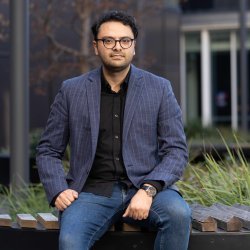
Dr Ehsan Nabavi is a Senior Lecturer in Technology and Society at the College of Asia and the Pacific (CPAS), Australian National University (ANU). He leads ANU’s Responsible Innovation Lab, focusing on responsible computing, modeling, and AI ethics. His interdisciplinary work bridges technical and social sciences, particularly addressing wicked problems in sustainability and water governance. Current Affiliation: ANU (CPAS), since 2020 Former Roles: Research Fellow at ANU School of Cybernetics (2018–2020), Harvard Kennedy School (2016–2017) Visiting Positions: SOAS University of London, University of Bonn (ZEF) His research spans responsible AI , transdisciplinary modeling , and socio-technical systems , as reflected in his publications across journals like Nature Humanities and Social Sciences Communications , IEEE Transactions on Technology and Society , and Water Alternatives . His recent articles emphasize ethical AI deployment, human-water systems, and integrating social aspects into modeling. Labs: Responsible Innovation Lab (ANU) Future Work: Developing frameworks for responsible AI in sustainability and policy contexts
Hassan Z. Ashtiani is an Associate Professor in the Department of Computing and Software within the Faculty of Engineering at McMaster University. His academic profile shows consistent engagement in both teaching and research activities, with evidence of active participation in major machine learning conferences and journals through 2025. Dr. Ashtiani's research focuses on the theoretical foundations of machine learning, with particular expertise in privacy-preserving algorithms, Gaussian mixture models, and adversarial robustness. His work bridges statistical learning theory with practical algorithm design, often addressing fundamental questions about sample complexity and computational efficiency in learning systems. A significant portion of his recent work explores the intersection of differential privacy with statistical learning, developing methods for private density estimation and distribution learning. Analysis of his publication record reveals a strong trend toward increasingly sophisticated theoretical frameworks for private and robust learning. His work consistently appears in top-tier venues including NeurIPS, ICML, COLT, and ALT, with recent contributions extending into agnostic private density estimation and robust learning with tolerance. The research demonstrates progression from foundational work on nearest neighbor search and clustering algorithms toward more complex problems in private learning of high-dimensional distributions. Dr. Ashtiani teaches across multiple levels of computer science education, including undergraduate courses in Automata and Computability (COMPSCI 2AC3) and Principles of Programming (COMPSCI 2S03), as well as graduate-level courses such as Fundamentals of Machine Learning (COMPSCI 4ML3) and Theoretical Foundations of Unsupervised Learning (CAS 775). His teaching portfolio shows consistent involvement in machine learning education since at least 2019, with evidence of teaching multiple sections each academic year. His scholarly impact is reflected in mentions across 3 news outlets, reference in 1 policy source, engagement from 7 X users, and 90 readers on Mendeley, suggesting growing recognition of his contributions to theoretical machine learning.
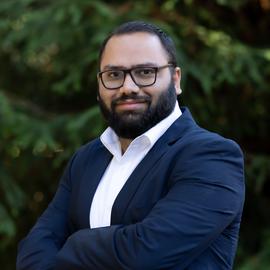
Luigi De Russis is an Associate Professor at the Department of Control and Computer Engineering (DAUIN) within Politecnico di Torino . He serves as Deputy Director of DAUIN and is a member of the PIC4SeR (PoliTO Interdepartmental Centre for Service Robotics). His academic roles focus on Human-Computer Interaction , Digital Wellbeing , and Artificial Intelligence applications. Research interests: Accessibility, Conversational agents, Developers tools, Digital wellbeing, Intelligent user interfaces, Internet of Things Teaching: Courses in Human-AI Interaction, Web Applications, and Computer Vision at undergraduate and graduate levels Leadership: Vice-President of ACM SIGCHI (2024-), Executive Committee member (2021-2024) His research explores: Digital wellbeing education for teens through gamified systems AI-assisted UI design tools Smart home interaction via multimodal commands End-user development for self-control technologies Integration of accessibility guidelines in AI systems Recent article trends show a focus on generative AI for interface design, attention-capturing heuristics, and educational systems for step-by-step learning. He has received the Most Influential Paper Award (2024) and Best Late Breaking Results Award (2025) from ACM SIGCHI. Scientific awards: Award of Scientific Excellence, University of Salamanca (2011) Most Influential Paper Award, International Conference on Intelligent Environments (2024) Best Late Breaking Results Paper Award, ACM SIGCHI Symposium (2025) As advisor, he supervises PhD students in Artificial Intelligence and Computer Engineering , focusing on topics like user-centered AI, generative models, and digital self-control interfaces. He leads the ELITE research group and contributes to commercial projects including TEIA (AI tourism) and MAPP (interactive museums).
Sainyam Galhotra is an Assistant Professor in the Department of Computer Science at Cornell University. His research focuses on developing data science tools for effective and responsible analytics, leveraging techniques from causal inference, data management, theoretical computer science, machine learning, and human-computer interaction to address challenges in trustworthy system design including robustness, explainability, and fairness. Education: Postdoc: University of Chicago PhD: University of Massachusetts Amherst (supervised by Barna Saha) BTech: Indian Institute of Technology Delhi (IIT Delhi) (supervised by Prof. Amitabha Bagchi) Research Interests: Dr. Galhotra's research spans several interconnected areas in data science and artificial intelligence. His work primarily focuses on Responsible Data Science , where he develops methods to ensure that data-driven systems operate fairly and transparently. Within this broad area, his specific interests include: Causal Inference techniques for understanding cause-effect relationships in complex data Algorithmic Fairness approaches to mitigate bias in machine learning systems Explainable AI methods that make black-box models more interpretable Data Management systems for efficient and reliable data processing Entity Resolution techniques for integrating data from multiple sources Trustworthy System Design that addresses robustness, explainability, and fairness His recent publications demonstrate a clear trend toward developing frameworks that combine causal reasoning with practical data management systems, particularly focusing on how to make data-driven decisions more transparent and equitable. The intersection of database systems with fairness considerations appears to be a particularly active area of his research. Scientific Awards: Rising Star in Data Science at the Data Science Institute, UChicago (Oct 2021) Computing Innovation Fellowship Award Recipient (by CRA, CCC and NSF) (Apr 2021) DAAD AInet Fellow (Feb 2021) ACM SIGMOD Entity Resolution Programming Contest – Top 5 finalist (May 2020) Most reproducible paper award in SIGMOD 2018 and 2019 (Jun 2019) First recipient of Krithi Ramamritham Computer Science Scholarship (Jun 2019) Best paper award in SIGSOFT FSE 2017 (May 2017) Dr. Galhotra is actively seeking students to collaborate with on his research projects. His work has been supported by various fellowships and awards, including the prestigious Computing Innovation Fellowship. He has mentored several students through his research projects, with a focus on developing the next generation of data scientists who can build responsible and trustworthy systems. His research group appears to focus on the intersection of database systems and responsible AI, developing tools like HypeR for causal reasoning, Ver for view discovery, and Nexus for correlation discovery in spatio-temporal data. This work suggests a cohesive research agenda centered around making data systems more transparent, fair, and user-friendly.
Hasti Seifi is an Affiliated Associate Professor at the Department of Computer Science (DIKU), University of Copenhagen, specializing in Human-Centred Computing. Her research focuses on haptics, augmented reality, and human-robot interaction. Institution: University of Copenhagen Department: Department of Computer Science Section: Human-Centred Computing Research interests include: Designing innovative haptic feedback systems Exploring tactile experiences in augmented reality Developing human-robot interaction frameworks Creating generative models for haptic design Investigating social touch technologies Advancing mid-air and ultrasound haptic interfaces Recent publications demonstrate a strong focus on: Generative haptic modeling for AR/XR systems Human-robot interaction dynamics Text input in extended reality environments Visual-haptic multisensory integration Ultrasound mid-air haptic design tools Social touch technologies
Jamie Morgenstern is an Associate Professor at the Paul G. Allen School of Computer Science & Engineering , University of Washington . She was previously an assistant professor at Georgia Tech and a Warren Center Fellow at University of Pennsylvania . Expertise: Ethics & Fairness, Human-Centered AI, Machine Learning Education: PhD in Computer Science from Carnegie Mellon University (2015) Her research examines the social impact of machine learning and ensuring ML models do not exacerbate societal inequalities. She investigates robustness to human-generated training data, fairness in clustering and active learning, and algorithmic equity in recommendation systems. Recent publications focus on interactive ML systems , fairness constraints , and privacy-preserving methods across conferences like NeurIPS, ICML, and AIES. Key subfields include multimodal learning , membership inference attacks , and data equity . Scientific Awards: NSF Career award for "Strategic and Equity Considerations in ML" Simons collaboration project Simons Award for Graduate Students in Theoretical Computer Science (2014-2016) NSF GFRP fellowship Microsoft Research Graduate Women's Scholarship Spotlight presentation at NeurIPS 2015 Mentoring: She advises current PhD students Rachel Hong , Jie (Claire) Zhang , and Yuanyuan (Chloe) Yang . Former advisees include Daniel Jiang (MS), Bhuvesh Kumar (PhD), and Angel (Alex) Cabrera (BS). Grants: Funded by NSF Career award and Simons collaboration projects. Previously supported by Simons, NSF, and Microsoft Research fellowships. Labs & Collaborations: Collaborates with researchers like Michael Kearns , Aaron Roth , and Avrim Blum . Affiliated with the Allen School's Artificial Intelligence research group.
Jeffrey L. Krichmar is a Professor in the Department of Cognitive Sciences and Department of Computer Science at the University of California, Irvine. His academic journey includes a B.S. in Computer Science from the University of Massachusetts Amherst (1983), an M.S. in Computer Science from The George Washington University (1991), and a Ph.D. in Computational Sciences and Informatics from George Mason University (1997). Prior to UCI, he served as Assistant Professor at George Mason University (1997-1999) and Senior Fellow at The Neurosciences Institute (1999-2007). University of California, Irvine (2007-present) George Mason University (1997-1999) The Neurosciences Institute (1999-2007) His research focuses on neurorobotics , exploring how embodied cognition and biologically plausible neural models can enhance robotic systems. Key areas include spiking neural networks , neuromodulation , path planning , and interactive tactile robots for therapeutic applications. His work bridges neuroscience , robotics , and cognitive science , with applications in autonomous vehicles , neuroprosthetics , and AI explainability . Recent publications emphasize spiking neural networks for navigation , neuromodulated attention , and neuromorphic hardware integration. The development of CARLsim, a GPU-accelerated spiking neural network simulator now in version 6.0, represents a major technical contribution. His team's work on socially assistive robots like CARL-SJR targets therapeutic applications for autism and ADHD. Scientific Awards IJCNN 2020 Best Paper Award Finalist for Best Student Paper at IJCNN 2018 Best Paper Award at IEEE IJCNN 2009 Grants include National Science Foundation funding for neural models of decision-making (2009). His lab (Cognitive Anteater Robotics Laboratory) develops systems that use large-scale brain simulations for autonomous behavior , with applications in adaptive robotics , sensorimotor learning , and neuroethology . Current projects explore neuromodulatory influences on attention systems and cognitive flexibility .
Seth Frey is an Associate Professor in the Department of Communication at the University of California, Davis, with affiliate status at Indiana University's Ostrom Workshop and as Research Director at Metagov. His research focuses on computational social science approaches to understanding self-governance in complex social systems, particularly through the lens of online communities as model institutions. Education: Ph.D. in Cognitive Science and Informatics (complex systems), Indiana University, 2013 B.A. in Cognitive Science, UC Berkeley, 2004 Research Interests: Frey specializes in computational approaches to institutional analysis and the cognitive science of strategic behavior . His work examines how communities design governance systems to overcome collective action problems, with emphasis on: Emergent institutional structures in digital commons Policy-as-data through NLP and institutional grammar frameworks Cognitive mechanisms underlying cooperative behavior Design principles for participatory change in online platforms His methodology integrates large-scale data analysis, web-based experiments, and computational modeling across diverse contexts including Minecraft, Reddit, and professional sports ecosystems. Publication Trends: Recent publications (2023-2025) demonstrate a cohesive trajectory toward computational institutional analysis, with increasing focus on NLP-driven policy analysis (e.g., NLP4Gov), decentralized governance architectures (DAOs, multi-level platform governance), and the cognitive foundations of collective action. His work consistently bridges theoretical institutional analysis with practical applications in digital community design, showing particular growth in translating Ostrom's design principles into computational frameworks. Awards: Honorable Mention Award for Best Paper at ACM CSCW 2019 Advising and Grants: Frey mentors students interested in data science applications at the intersection of communication, cognition, and complex systems, emphasizing resourcefulness and intellectual curiosity. His research has secured substantial funding from: National Science Foundation (NSF) NASA Ford Foundation Google Open Source Foundation He actively encourages aspiring graduate students with strong self-directed research skills to explore computational approaches to social phenomena. Labs and Teams: He leads the Computational Communication Lab at UC Davis and co-directs the Institutional Grammar Research Initiative. Through Metagov, he develops the 'Governance API' framework for modular community governance. His past affiliations include Disney Research (Walt Disney Imagineering) where he applied complexity science to theme park systems, and the New England Complex Systems Institute (NECSI). Current collaborations span Ethereum governance, Minecraft server ecosystems, and Colorado's cannabis monitoring infrastructure.
Byron Boots is the Amazon Professor of Machine Learning in the Paul G. Allen School of Computer Science and Engineering at the University of Washington, where he directs the UW Robot Learning Laboratory. He also serves as a Principal Research Scientist in the Seattle Robotics Lab at NVIDIA Research and co-chairs the IEEE Robotics and Automation Society Technical Committee on Robot Learning. Dr. Boots received his Ph.D. from the Machine Learning Department in the School of Computer Science at Carnegie Mellon University, where he was a member of the Sense, Learn, Act (SELECT) Lab co-directed by Carlos Guestrin and his advisor Geoff Gordon. Prior to joining the University of Washington faculty, he was an Assistant Professor in the School of Interactive Computing within the College of Computing at Georgia Tech, and before that, he completed a post-doc in the Robotics and State Estimation Lab directed by Dieter Fox at the University of Washington. Professor Boots' research focuses on the intersection of machine learning, artificial intelligence, and robotics, with particular emphasis on developing theory and systems that tightly integrate perception, learning, and control. His work spans computer vision, state estimation, localization and mapping, high-speed navigation, motion planning, and robotic manipulation. His group develops algorithms drawing from deep learning and neural networks, nonparametric statistics, graphical models, nonconvex optimization, quantum physics, online learning, reinforcement learning, and optimal control. The research demonstrates a strong theoretical foundation while maintaining practical relevance to real-world robotic systems. His recent publications reveal a clear trend toward integrating advanced machine learning techniques with robotics, particularly in model predictive control, motion planning, and learning-based approaches to robot control. His work shows increasing focus on developing theoretically grounded methods that can handle the complex, nonlinear dynamics of real-world robotic systems while maintaining computational efficiency. The publications span top venues including ICRA, CoRL, IROS, and NeurIPS, demonstrating broad impact across multiple subfields of robotics and AI. Finalist for Best Systems Paper at Conference on Robot Learning (CoRL-2021) Multiple papers selected for oral presentations at top robotics conferences Work recognized for theoretical contributions and practical applications in robot learning As director of the UW Robot Learning Laboratory, Boots leads a vibrant research group focused on fundamental and applied research in robot learning. The lab maintains strong collaborations with NVIDIA Research and has produced numerous high-impact publications that bridge theory and practice. Professor Boots teaches courses in autonomous robotics, machine learning, and reinforcement learning, contributing to both undergraduate and graduate education at the University of Washington.
Garreth Tigwell is an Assistant Professor in the School of Information at RIT, co-directing the CAIR Lab with Dr. Kristen Shinohara. His research focuses on accessibility in digital design, particularly for disabled users, addressing challenges faced by novice and expert creators. His work spans topics like accessible prototyping tools, cultural considerations in design, and inclusive mixed reality interfaces. Education: BSc in Psychology, University of Dundee, 2012 MSc (Distinction) in User Experience Engineering, University of Dundee, 2014 PhD in Human-Computer Interaction (HCI), University of Dundee, 2019 Research Interests: Designing accessible digital systems for blind, deaf, and low-vision users Adaptable user interfaces for mixed reality and textured surfaces Cultural dimensions in accessibility pedagogy Authentication methods for visually impaired users Articles Trends: Recent work emphasizes AR/VR accessibility, cultural design frameworks, and haptic authentication. His studies often involve collaborations with global researchers and industry partners. Awards: Best Paper (MobileHCI 2022) CHI Honorable Mention (2023, 2024) NSF-funded research projects Advising & Grants: Active in mentoring graduate students and securing grants. His lab focuses on born-accessible AI tools and inclusive design education. Teaches courses like HCI Research Methods and Future Interactions. Labs/Teams: Co-leads the CAIR Lab, which develops technologies to bridge accessibility gaps in digital design and prototyping.
Dr. Corey B. Jackson is an Assistant Professor in The Information School at the University of Wisconsin–Madison, affiliated with the Robert & Jean Holtz Center for Science and Technology Studies, Institute for Diversity Science, and Data Science Institute. His research bridges human-centered computing, CSCW, and design epistemologies, focusing on socio-technical systems for equitable participation in AI and citizen science. He teaches courses in Interaction Design, User Experience, and Digital Information. Education: Ph.D. Library & Information Science, Syracuse University, 2019 M.S. Library & Information Science, University of Illinois, Urbana-Champaign, 2012 B.A. Political Science, University of Illinois, Urbana-Champaign, 2010 Research Interests: Jackson’s work emphasizes designing systems for transparency, accountability, and democratic participation in technologies. He explores AI fairness, citizen science, and civic technology. His methodologies include mixed methods and socio-technical analysis. Key Awards: ACM CSCW 2020 Honorable Mention (Best Paper) NSF HCC Grant (2021–2024) Rockefeller Foundation Grant (2021) Chan Zuckerberg Initiative Grant (2022–2023) Advising & Grants: Jackson mentors Ph.D. students in HCI and citizen science. His grants total over $612k, supporting projects like AI audit tools and environmental justice initiatives. He co-directs the Collaborative Computing Group. Labs & Teams: Collaborative Computing Group at UW-Madison; affiliated with interdisciplinary institutes advancing data science and diversity in science.
Sam Emaminejad is an Associate Professor in the Department of Electrical and Computer Engineering at the Henry Samueli School of Engineering and Applied Science, University of California Los Angeles (UCLA). His research focuses on developing advanced wearable bioelectronic systems for continuous, noninvasive health monitoring and personalized therapeutics. Key Research Areas: Biomarker detection via flexible sensors Microfluidic and ferrobotic systems Stress and drug level monitoring Biodegradable and breathable wearable materials Recent Trends: Analysis of sweat and interstitial fluids using microneedles, aerogel skins, and programmable microfluidics. Machine learning integration for physiological evaluation is prominent. Awards & Collaborations: While specific awards aren't listed, he collaborates with major UCLA Health and Engineering faculty, including Ali Khademhosseini and Dino Di Carlo, on projects funded by NIH T32 grants and institutional fellowship programs. Grants & Labs: Leads projects in NIH-funded wearable sensor research, including the development of autonomous systems for cystic fibrosis and glucose monitoring. His lab explores ferrobotic swarms and hydrogel-based interfaces for clinical and consumer applications.
Professor Eduardo Velloso is an academic staff member at the School of Computer Science , University of Sydney . He is a member of the Centre for AI Trust and Governance and holds a PhD in Computer Science from Lancaster University and a Bachelor of Computer Engineering from Pontifical Catholic University of Rio de Janeiro. Teaches COMP4447/5047 - Pervasive Computing and INFO1111 - Computing Professionalism Research Interests focus on distributed collaboration in mixed reality , human-AI interaction , and HCI theory and methodology . His work integrates Engineering, Design, and Psychology to explore gaze interaction, adaptive agents, and multimodal interfaces. Key projects include Blended Whiteboard for remote MR collaboration and GazeGrip for mobile accessibility. Publication Trends show expertise in Virtual Reality , Mixed Reality , and Human-AI Interaction , with recent work on Algorithmic Recourse and Immersive Educational Tools . Awards include ACM Best Paper Awards at CHI, UIST, TOCHI, and DIS venues. Scientific Awards 2024 ACM CHI & DIS Honorable Mentions 2022 UoM-FEIT Teaching & Learning Award 2019 UoM-CIS Excellence in Research Award 2015 ACM UIST Best Paper Award Advising includes supervision of research students Marvin, Tinghui LI, and Wendi YU in projects on asynchronous MR collaboration , situationally-induced impairments , and physical environment integration . His lab explores AI-assisted interaction and context-aware computing through projects like SpinalLog and LiftSmart .
Kevin Moberly is an Associate Professor in the Department of English at Old Dominion University (ODU), affiliated with the College of Arts & Letters. He holds a Ph.D. in English from the University of Louisiana at Lafayette (2005), an M.A. in Creative Writing (2000), and a B.A. in English from Berry College (1995). His research focuses on medievalism, digital humanities, and computer game studies, with notable grants including a 2011 College of Arts & Letters Summer Research Fellowship ($6,000) and a 2015 Center for Learning and Teaching Faculty Innovator Grant ($3,000). Moberly’s work bridges medieval scholarship and modern digital media, addressing themes like fan culture, corporate revisionism, and virtual economies. His publications span journals such as Studies in Medievalism , Computers and Composition , and Eludamos , alongside book chapters on game studies and technical communication. He has received numerous teaching awards, including the 2010 Shining Star Teaching Award and recognition for co-organizing the 2007 Computers and Writing Online Conference. His research interests include the intersection of medieval narratives with contemporary cultural phenomena, digital pedagogies, and the rhetoric of free speech in online spaces. Moberly has contributed to initiatives like the Examining the Evolution of Gaming anthology and co-authored studies on modding in technical classrooms. His work often critiques societal structures through interdisciplinary lenses, blending literary analysis with digital media theory.
Henrique O'Neill is an Associate Professor (with Habilitation) in the Department of Marketing, Operations and General Management at ISCTE - University Institute of Lisbon, Portugal. He is an Integrated Researcher at ISTAR-Iscte - Research Center in Information Sciences, Technologies and Architecture. His research focuses on information systems adoption, organizational strategy, and process optimization in healthcare, finance, and public administration. Education: PhD in Business Organization and Management - University of Cranfield (1995) Master's in Electrical and Computer Engineering - Higher Technical Institute (1987) Bachelor's in Electrical Engineering - Higher Technical Institute (1983) Research Interests: His work spans business/IT strategy, systems modeling, process analysis, and technology implementation. Key domains include healthcare informatics, banking systems, and Industry 4.0 applications. He emphasizes practical solutions for organizational performance through technology integration. Publication Trends: Recent articles explore intelligent business systems, telemedicine, design science methodologies, and supply chain innovation. His work consistently bridges theoretical frameworks with sector-specific applications in healthcare, education, and logistics. Professional Engagement: Member: Portuguese Telemedicine Association, Order of Engineers Commissioner: INEM (National Institute of Medical Emergency) reform study Director: Center for IT Development (2010-2014) Advising & Projects: Supervises 7 graduate students (1 PhD, 6 Master's). Leads EU-funded projects including: Atlantic Crossing (2024-2025): US-Portugal academic collaboration in AI/cybersecurity AAL4ALL (2011-2015): Ambient Assisted Living ecosystem UNITE (2000-2002): Ubiquitous teamwork platforms