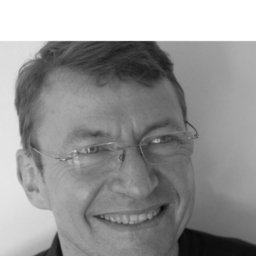
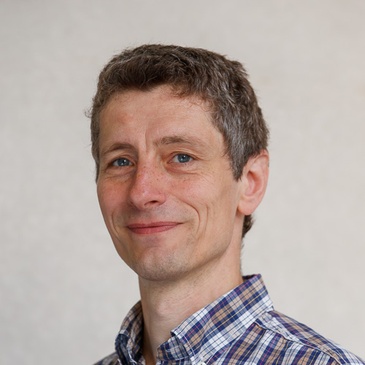
Prof. Dr. Marc Nieper-Wißkirchen is a University Professor (W3) for Algebra and Number Theory at the Institute of Mathematics, University of Augsburg, since 2008. He has held visiting positions at the Max Planck Institute for Mathematics in Bonn and the University of Cambridge, and served as a Junior Professor at Johannes Gutenberg University Mainz (2004–2008). Since October 2021, he has been Vice Dean of the Faculty of Mathematics, Natural Sciences and Technology (MNTF). Education: Diploma in Mathematics (2000) from the University of Cologne, preceded by preliminary diplomas in physics (1997) and mathematics (1997). His doctoral studies (2000–2002) under Prof. Daniel Huybrechts focused on characteristic classes and Rozansky-Witten invariants of hyperkähler manifolds. His research spans algebraic geometry, differential geometry, and mathematical physics, with a focus on hyperkähler manifolds, Hilbert schemes of points, irregular singular connections, and Stokes phenomena. He has contributed to the understanding of Rozansky-Witten invariants, Chern numbers, and topological aspects of differential equations. Recent publications include works on Betti structures of hypergeometric equations (2022) and Stokes matrices for confluent hypergeometric equations (2022), reflecting his ongoing exploration of differential equations' geometric underpinnings. Earlier works address Hochschild homology, equivariant cohomology, and operads in algebraic contexts. His computational contributions include software demonstrations for elliptic curve arithmetic, Collatz sequences, and Google Matrix simulations. Technical expertise includes programming languages (TeX, PHP, HTML) and systems (Unix/Linux, Zope/Plone).
Olivier Buffet is a Researcher at INRIA, working at the INRIA Center at Université de Lorraine / LORIA since November 2007. He is affiliated with the LORIA laboratory (Lorraine Laboratory of Computer Science and its Applications), which focuses on computer science research. His work spans multiple institutions, having previously held positions at NICTA's Statistical Machine Learning program (2004-2006), RSISE at ANU (2004-2006), and LAAS at CNRS (2006-2007). Dr. Buffet received his engineering degree from Supélec and a DEA (Diplôme d'Etudes Approfondies) from Henri Poincaré University. He completed his PhD in computer science under the supervision of François Charpillet and Alain Dutech at LORIA / INRIA Nancy Grand-Est, defended on September 10, 2003. He later defended his habilitation to supervise research (HDR) on December 18, 2017. Dr. Buffet's research focuses on artificial intelligence, particularly in the areas of automated planning and scheduling, reinforcement learning, and decision-making under uncertainty. His work extensively explores Markov Decision Processes (MDPs), Partially Observable MDPs (POMDPs), and Decentralized POMDPs (Dec-POMDPs), with applications ranging from multi-agent systems to traffic management and adaptive conservation strategies. His research often bridges theoretical foundations with practical applications, developing algorithms that can handle complex decision problems in uncertain environments. His publication record demonstrates a consistent focus on advancing methods for planning and decision-making under uncertainty. Over the past decade, his work has increasingly addressed decentralized and multi-agent settings, developing novel approaches for coordination among multiple decision-makers with partial information. More recently, his research has explored interpretable solutions for adaptive management problems, particularly in environmental contexts, and advanced theoretical understanding of properties like Lipschitz continuity in POMDP value functions. Dr. Buffet has received recognition for his contributions to the field, including: Winner of the probabilistic track in the Fifth International Planning Competition (IPC-06) Best Paper award at AAMAS-14 for "Exploiting separability in multi-agent planning with continuous-state MDPs" Best Paper award at JFSMA-13 for "Synchronisation de véhicules autonomes aux croisements d'un réseau de routes" Best Paper award at CAp'11 for "Une extension des POMDP avec des récompenses dépendant de l'état de croyance" As an educator and mentor, Dr. Buffet has supervised numerous PhD students including Arnaud Glad, Mauricio Araya-Lòpez, Mohamed Tlig, Arsène Fansi, and Manel Tagorti. He has also guided many interns and research projects. His teaching experience includes tutored sessions on discrete and deterministic optimization, decision making under uncertainty, and computer science for industrial engineering at École des Mines de Nancy, as well as courses on Unix shell and C programming at Université Henri Poincaré. Dr. Buffet has been actively involved in the academic community, serving as Co-Conference Chair of the 30th International Conference on Automated Planning and Scheduling (ICAPS 2020) in Nancy. He has organized multiple meetings of the French workgroup JFPDA (formerly PDMIA) and chaired several workshops on planning and scheduling under uncertainty. He previously served on the editorial boards of Revue d'Intelligence Artificielle (RIA) and Journal of Artificial Intelligence Research (JAIR), and has been a reviewer for numerous prestigious journals and conferences in artificial intelligence.
Manfred Gerstner serves as Professor at Munich University of Applied Sciences within the Faculty of Electrical Engineering and Information Technology (Faculty 04). He teaches Mathematics 1, Master's Seminar in Electrical and Information Engineering, and TI3: Programming courses during winter semester 2025. His research spans critical technical domains: Software Engineering methodologies Advanced Mathematics including Numerical Analysis Statistical modeling and Stochastics Core Algorithms and Data Structures Multi-language Programming (R, Ruby, Python, JavaScript, Java, C/C++) Unix/Linux system architecture As Examination Board Chair for the Master's in Electrical and Information Engineering, he supervises external Bachelor's and Master's theses on software-intensive or mathematically rigorous topics. Students must identify thesis opportunities via company partnerships, practical semester experiences, or internal institute projects before contacting him for office hour consultations.
Prof. Dr. Peter Kneisel is a Professor of Computer Science and the Dean of the College of Mathematics, Natural Sciences and Computer Science (MNI) at Technical University of Central Hesse (THM) . He also serves as the Head of the Social Media Systems program and Director of the Institute of Information Science . His career at THM has spanned over two decades, with roles including Vice Dean, administrative leadership in curriculum design, and industry collaboration. Educational Background: Promotion (PhD) in Computer Science at Universität Karlsruhe (now KIT), focusing on distributed systems, embedded systems, robotics, and AI as part of the EU-ESPRIT project "REX". Academic training in Informatik (Computer Science) at Helsinki University of Technology and Universität Karlsruhe. Student assistant in German internet development and Unix administration at Karlsruhe's "Informatik Rechnerabteilung" and "Institute for Process Computer Technology & Robotics". His research emphasizes web engineering and software development in distributed environments, with a focus on agile methodologies and socio-technical aspects. He bridges computer science and humanities through Digital Humanities (history, archaeology, religious studies) and explores "Human Digitalities"—humanities in computer science. As Dean, he drives digitalization of administrative processes at THM. Collaborations and Industry Engagement: Supervises doctoral theses with Prof. G. Taentzer (University of Marburg) and Prof. K. Lorenz (JLU Giessen). Partners with companies like SAP AG , Viessmann AG , Alcedis GmbH , and B. Braun Meldungen AG for internships, dual degree programs, and graduate placements. Member of THM's KITE Competence Center and the Digitalization competence group of Central Hesse universities.
Timo Hönig is a Professor and Head of the Chair for Operating Systems and System Software at the Faculty of Computer Science, Ruhr-University Bochum. His research focuses on energy efficiency, persistent memory systems, computer security, and system software design. Current projects include DFG-funded SUSTAINET-inNOvAte and DOSS , with former projects like InvasIC (DFG/Transregio 89) and Antillas (BMBF/VDI). He serves on program committees for HotCarbon, DIMES, DSN, DATE, and other conferences. His recent publications address energy profiling, carbon-aware memory placement, kernel security, and persistent OS design. He has received best paper awards at SBESC'22 and ISORC'17. Scientific Awards: Best Paper at SBESC'22 Best Paper at ISORC'17 His teaching includes courses on operating systems, resource-efficient systems, and energy-aware computing. He has advised numerous research collaborations on embedded systems, concurrency, and sustainable computing.
Margit Meyer is a researcher at the Systems Engineering Laboratory (STL) within the Faculty of Engineering at Saarland University of Applied Sciences. She specializes in desktop and server virtualization (Red Hat Virtualization, Linux KVM), software equipment and maintenance (Unix, Linux, MS Windows), and Internet services (email, web servers, wiki). Phone: +49(0)681 5867-145 Email: Margit.Meyer@htwsaar.de Location: Room 8213, Goebenstraße 40, 66117 Saarbrücken Research Focus: Virtualization technologies (Red Hat Virtualization, KVM) Operating system maintenance (Unix/Linux/Windows) Web/email server administration Collaboration on innovative teaching tools
Prof. Redha Gouicem holds the Chair of Operating Systems at RWTH Aachen University. His research focuses on operating system design, virtualization, and multicore scheduling, with an emphasis on formal verification and performance optimization. Professorship: Operating Systems Location: RWTH Aachen University, Germany Research interests include: Multicore scheduling algorithms Binary translation and virtualization Formal verification of OS components CPU frequency scaling and performance optimization Comparison of scheduling models in Unix/Linux Domain-specific languages for scheduler development Recent work explores hypervisor-agnostic guest overlays, weak memory model translation, and provably correct multicore schedulers. His publications demonstrate technical depth in system software design and concurrency management. Current affiliations: RWTH Aachen University Chair of Operating Systems
Diomidis Spinellis is Professor of Software Engineering in the Department of Management Science and Technology at the Athens University of Economics and Business, Greece, where he heads the Business Analytics Laboratory (BALab). He also holds a position as Professor of Software Analytics in the Department of Software Technology at the Delft University of Technology. His academic career spans multiple prestigious institutions and research domains. Spinellis's research interests center on software engineering, IT security, and computing systems. He has made significant contributions through his work on code quality, software tools, program comprehension, and debugging methodologies. His research bridges theoretical foundations with practical applications, evident in his development of widely-used open-source tools and his contributions to operating systems like Apple's macOS and BSD Unix. His scholarly output includes over 300 technical papers with more than 10,500 citations, demonstrating substantial impact across the software engineering community. His publications span diverse topics including software analytics, program comprehension, debugging techniques, and open-source software quality. Among his notable recognitions are two award-winning, widely-translated books: Code Reading and Code Quality: The Open Source Perspective , followed by Effective Debugging: 66 Specific Ways to Debug Software and Systems in 2016. His work has been influential in both academic and industry settings. IEEE Software editorial board member for a decade Editor-in-Chief of IEEE Software for four years Elected member of IEEE Computer Society Board of Governors (2013-2015) Senior member of ACM and IEEE Spinellis actively contributes to the software engineering community through tool development (CScout, UMLGraph, dgsh), conference leadership roles, and mentoring activities. His professional service includes program committee memberships across major software engineering conferences including ICSE, ESEC/FSE, and ASE.
Dr. Gunter Bolch was a Professor and former head of the Performance Modelling and Process Control research group at the Department of Computer Science 4 (Distributed Systems and Operating Systems) of Friedrich-Alexander-Universität Erlangen-Nürnberg. He held positions such as Akademischer Direktor and was a Visiting Professor at institutions like the Catholic University of Rio de Janeiro. His work focused on performance modeling using queueing networks, stochastic Petri nets, and Markov chains, with applications in telecommunications and operating systems. Education: Studied Telecommunication at Technical Universities of Karlsruhe and Berlin (Ph.D. 1973). Retired in 2006 but remained active in research and academia until his passing in 2008. Research interests spanned performance evaluation, process control, and analytical methods for computer systems. He authored/co-authored 7 books and over 130 publications, including influential works on queueing networks and MOSEL modeling language. Key contributions include the PEPSY and MOSEL tools for performance analysis. Collaborated internationally on conferences like ASMTA and ESS. His work integrated theoretical models with practical applications, impacting both academia and industry.
Konstantinos Mamouras is an Assistant Professor at the Department of Computer Science, Rice University. His research focuses on programming abstractions for data streams, runtime verification for cyber-physical systems, program semantics, and Kleene Algebra with Tests. Rice University, Houston, TX Department of Computer Science Research Interests : Design of programming abstractions for streaming data Runtime verification of cyber-physical systems Formal methods in program verification Kleene Algebra with Tests (equational theories) Efficient automata-based processing Quantitative monitoring frameworks Recent Scientific Contributions : 2025: Membership Testing for Semantic Regular Expressions (PLDI 2025) 2024: HybridSA GPU regex acceleration (OOPSLA 2024) 2024: Efficient regex with lookaround (POPL 2024) 2023: Bit Vector Automata for regex (OOPSLA 2023) 2021: Quantitative monitoring framework (RV 2021) Scientific Awards : 🏆 Distinguished Paper Award, PLDI 2024 🏆 Best Paper Award, EuroSys 2021 🏆 EATCS Best Theory Paper Award, FoSSaCS 2015 Advising : Mentored PhD student Lingkun Kong (2023) Advised MSc student Zhifu Wang (2022) Current advisees: Alexis Le Glaunec and Agnishom Chattopadhyay Teaching : Spring 2023: IoT Programming and Data Analysis (COMP 418/518) Fall 2022: Reasoning about Algorithms (COMP 382) Spring 2021: Reasoning about Software (COMP 403/503)
Christopher Olbertz is a lecturer at the Computer Science Department within the College of Engineering at Saarland University of Applied Sciences. He teaches programming and software development courses, focusing on languages like C++, Java, Python, and Kotlin, as well as frameworks such as Spring and SpringBoot. His teaching emphasizes practical applications in software architecture, database systems, and web technologies. His research interests include: Object-Oriented Programming (C++ vs. Java) Software Design Patterns Dependency Injection and Layered Architecture Automated Testing and Performance Evaluation Cross-Platform Application Development Modern Java Features (Lambda Expressions, Collection API) He supervises bachelor theses on topics ranging from web-based applications and REST APIs to software testing and cross-platform development, often in collaboration with industry partners like Mercedes Benz Bank, ZF Friedrichshafen, and SAP Hybris.
Prof. Dr. Norbert Marwan is Deputy Head of the Research Department Complexity Science at the Potsdam Institute for Climate Impact Research (PIK) and holds additional affiliations with the Institute of Geosciences and Institute of Physics and Astronomy at the University of Potsdam. His work spans interdisciplinary applications of complex systems analysis in Earth science, paleoclimatology, and biomedical modeling. Dr. Marwan’s research focuses on: Nonlinear time series analysis using recurrence plots and complex networks High-dimensional climate data modeling and tipping point detection Development of tools for paleoclimate proxy records and monsoon system analysis Applications in cave science, speleothem dating, and planetary boundaries His recent publications (2024–2025) demonstrate cross-disciplinary impact across climate science , neuroscience , geohazards , and nonlinear dynamics , with methodological innovations in recurrence networks , ordinal pattern measures , and spatiotemporal modeling . Dr. Marwan also leads cave research expeditions globally and maintains rigorous technical standards for collaborators, requiring proficiency in Unix systems, MATLAB/Python/Julia, and LaTeX. He contributes to PIK-wide seminars on nonlinear data analysis and paleoclimate research, while developing frameworks for climate resilience and disease modeling through network approaches.