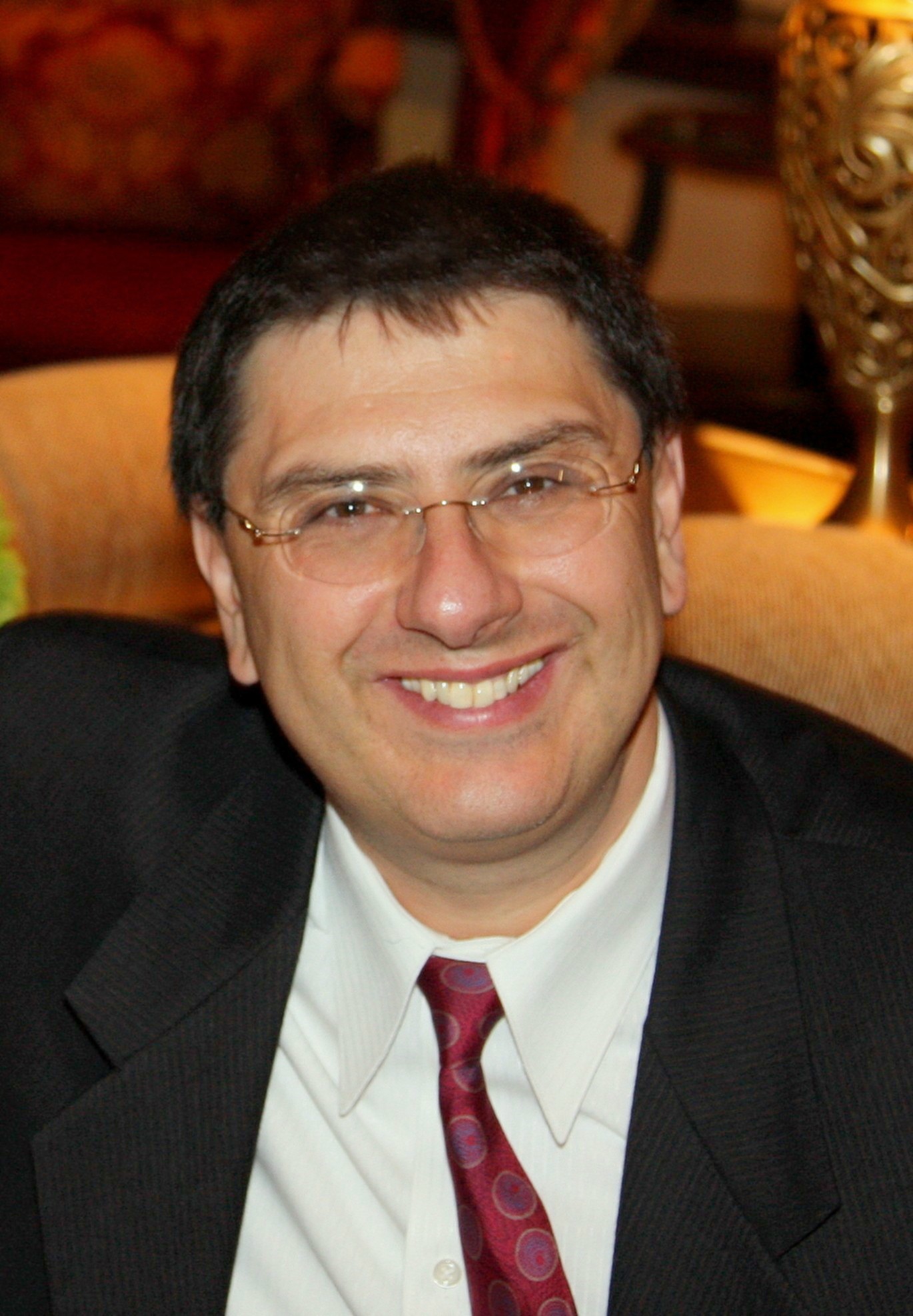
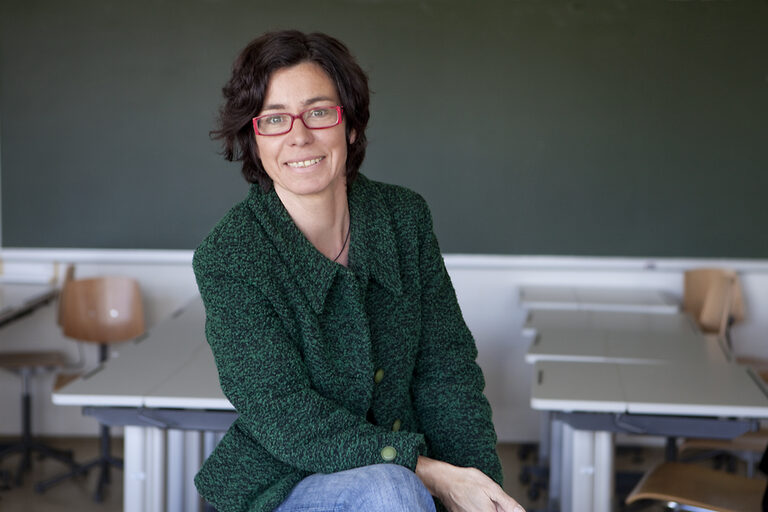
Rocco Servedio is a Professor in the Department of Computer Science at Columbia University, where he leads research in theoretical computer science with a focus on computational complexity theory, learning theory, and the role of randomness in computation. He previously served as Chair of the Computer Science Department from 2018 to 2021. He holds a Ph.D., MS, and AB in Mathematics from Harvard University. His research interests include property testing, computational learning theory, and algorithmic lower bounds. He has contributed to foundational work in areas like junta testing, trace reconstruction, and convexity testing. Servedio has held leadership roles in major conferences such as STOC, CCC, and COLT, and has mentored students through courses like Unconditional Lower Bounds and Derandomization . Education: Ph.D. in Computer Science, Harvard University MS in Computer Science, Harvard University AB in Mathematics, Harvard University His research bridges theoretical computer science and applied mathematics, with recent work exploring the intersection of Gaussian processes, convex geometry, and algorithmic efficiency. Servedio's contributions to the field are exemplified through his involvement in high-impact conferences and his leadership in advancing fundamental computational theories.
Rafail Ostrovsky is the Norman E. Friedman Chair in Knowledge Sciences at UCLA Samueli School of Engineering, where he serves as a Distinguished Professor of Computer Science and Mathematics. He also directs the Center for Information and Computation Security at UCLA. His academic leadership extends to his role as a foreign member of Academia Europaea and his fellowship in multiple prestigious organizations including the National Academy of Inventors, AAAS, ACM, IEEE, and IACR. Professor Ostrovsky's research spans multiple domains in theoretical computer science, with primary focus on cryptography, secure computation, and algorithms. His work on garbled circuits, zero-knowledge proofs, and private information retrieval has had significant theoretical and practical impact. He has pioneered research in secure multi-party computation, oblivious RAM, and cryptographic protocols that maintain privacy while enabling complex computations on sensitive data. His research bridges theoretical foundations with practical applications in secure systems, ranging from database security to hardware-based cryptographic primitives. Ostrovsky's publication record shows a consistent trajectory of innovation in cryptographic theory and its applications. His recent work focuses on optimizing secure computation protocols for efficiency while maintaining strong security guarantees, with particular attention to communication complexity, round complexity, and practical implementations. He has made significant contributions to homomorphic encryption, non-malleable commitments, and zero-knowledge proofs, often developing techniques that transform theoretical constructs into practically viable solutions. 1993 Henry Taub Prize 2017 IEEE Computer Society Edward J. McCluskey Technical Achievement Award 2018 RSA Award for Excellence in Mathematics (RSA Prize) 2022 W. Wallace McDowell Award (highest award from IEEE Computer Society) Fellow of National Academy of Inventors, AAAS, ACM, IEEE, and IACR Foreign member of Academia Europaea With over 350 peer-reviewed publications and 16 issued USPTO patents, Professor Ostrovsky has significantly shaped the field of cryptography and secure computation. His mentorship has cultivated numerous students and postdocs who have gone on to make their own contributions to the field. His editorial roles on prestigious journals including Journal of ACM and Algorithmica reflect his standing in the theoretical computer science community. His leadership extends to chairing major conferences including FOCS 2011 and serving on over 40 international conference program committees. As Director of the Center for Information and Computation Security at UCLA, Professor Ostrovsky leads a team focused on advancing the theoretical foundations and practical applications of secure computation. His center serves as a hub for interdisciplinary research connecting cryptography with systems security, network protocols, and hardware security. The center's work spans from foundational cryptographic primitives to real-world applications requiring privacy-preserving computation.
Sidharth Jaggi is a Professor at the School of Mathematics, University of Bristol, with over 19 years of experience in Information and Data Sciences through the lens of Information Theory. His work emphasizes fundamental performance limits and algorithm design for systems under adversarial threats. Education: B.Tech, M.Phil, PhD Research interests focus on adversarial communication, information-theoretic security, coding theory, and sparse data estimation. He leads the CAN-DO-IT team (Codes, Algorithms, Networks – Design and Optimization for Information Theory), integrating theoretical tools into practical applications like secure distributed computing and robust data storage. Recent publications highlight advancements in adversarial channels , group testing , and privacy-preserving coding . Trends include covert communication under spectral constraints, causal feedback benefits, and efficient algorithms for high-dimensional problems. Current projects include "Information Theory for Interactive Distributed AI" (2024–2029), exploring interactive systems under adversarial constraints.
Yu-Ling Chang is an Associate Professor at the University of California, Berkeley, School of Social Welfare. Her research examines the relationships between poverty, inequality, and social safety net programs, with a focus on welfare-to-work systems, unemployment insurance reforms, and cross-national comparisons of social protection policies. She has secured significant grants from institutions like the Administration for Children and Families and the Upjohn Institute. PhD in Social Welfare from the University of Washington (2016) MSW and BSW from National Taiwan University Her work spans U.S. state-level policy analysis and global collaborations with institutions in Hong Kong, Taiwan, and Switzerland. Key themes include racial equity in CalWORKs, gendered impacts of unemployment insurance, and the role of financial capability in poverty reduction. She has published extensively on post-Great Recession welfare dynamics and cross-state/federal policy variations. Recent research explores unconditional basic income (UBI) in Taiwan and the U.S., ecosocial policies addressing climate change, and pandemic-era welfare reforms. Her scholarly contributions have been recognized with awards such as the Hellman Fellows Fund and the Upjohn Institute’s Early Career Research Award. Keynote speaker at the Global Welfare Regime Project (2023) Advisor for peer-reviewed journals and conferences Active in professional networks including the East Asian Social Policy Research Network and Scholars Strategy Network
Sarah Halpern-Meekin is the Vaughan Bascom Professor of Women, Family and Community, and Professor of Human Development & Family Studies at the University of Wisconsin–Madison’s School of Human Ecology. She holds affiliations with the La Follette School of Public Affairs, Department of Sociology, and multiple research centers including the Institute for Research on Poverty. Her research focuses on low-income families, romantic relationships, and government policies, with a particular emphasis on unconditional cash transfers and social poverty. Halpern-Meekin’s educational background includes a PhD in Sociology and Social Policy from Harvard University, a BA in Politics from Brandeis University, and a postdoctoral fellowship at Bowling Green State University. Her work bridges qualitative and quantitative methods, examining topics like labor force participation gaps among men, the impact of cash transfers on families, and the role of relationship instability in child well-being. Her research highlights themes such as the psychological and material effects of economic policies, the resilience of marginalized populations, and the interplay between individual agency and structural inequities. Notable projects include the Baby’s First Years Study, which investigates long-term impacts of cash transfers on child development. Halpern-Meekin has contributed to policy debates through media engagements, including discussions on pandemic-era poverty and the design of effective social safety nets. Her work underscores the importance of both financial and social resources in alleviating poverty and fostering family stability.
Peter Nickolas is an Associate Professor and Honorary Fellow at the School of Mathematics and Applied Statistics, University of Wollongong, Australia. His research focuses on pure mathematics, particularly in topology, group theory, and distance geometry. His work includes studies on harmonic continued fractions, quasihypermetric spaces, and topological groups. He has collaborated with researchers such as Safavi-Naini, Tonien, Elfard, and Wolf across disciplines like cryptography and functional analysis. He has received funding from Discovery Projects for research on approximate authentication systems. His academic supervision includes completed higher-degree research projects in areas related to continued fractions and free paratopological groups. Honorary Fellow
Sidharth Jaggi is a Professor in the School of Mathematics at the University of Bristol, specializing in Information Theory and Coding Theory with applications in secure data systems. His work provides unconditional information-theoretic security guarantees for communication/storage systems under malicious attacks. Education: B.Tech M.Phil PhD Research Focus: Professor Jaggi develops theoretical frameworks for adversarial communication, covert channels, and sparse signal estimation. His CAN-DO-IT research team (Codes, Algorithms, Networks – Design and Optimization for Information Theory) bridges abstract mathematics with real-world applications in distributed data storage, secure computing, and epidemic testing via group-testing methodologies. Key innovations include fundamental limits for stealthy communication and robust coding against jamming adversaries. Publication Trends: Recent works analyze density-dependent group testing structures, causality benefits in security against limited-view adversaries, and hybrid coding strategies for jamming channels. These publications demonstrate convergence of information theory, high-dimensional geometry, and optimization for next-generation secure data systems. Research Leadership: Principal Investigator for "Information Theory for Interactive Distributed AI" (2024-2029) Research Group: Leads the CAN-DO-IT team focusing on theoretical foundations for secure, robust information systems with tangible industrial applications in data processing infrastructure.
Stefan Rass is a full Professor at Alpen-Adria-Universität Klagenfurt (AAU), with additional affiliation at Johannes Kepler University Linz (JKU). He holds the academic title Univ.-Prof. (Universitätsprofessor) and possesses advanced degrees including PD (Privatdozent), Dipl.-Ing. (Diplom-Ingenieur), and Dr. (Doctor). His research spans multiple institutions and projects, with a focus on security and risk management through game theory applications. Professor Rass's research interests center around Security and Risk Management, Decision and Game Theory for Security, Security Infrastructures (including Key Distribution and Management, PKI, and Authentication), Unconditional and network security, Applied Quantum Cryptography, and Complexity Theory and Statistics in Security. His work bridges theoretical computer science with practical security applications, particularly in quantum networks and critical infrastructure protection. His recent publications demonstrate a strong trend toward interdisciplinary security research, combining game theory with quantum cryptography, robotics security, and AI-powered penetration testing. The articles reveal increasing focus on practical applications of theoretical security concepts, with notable work in quantum networks, deniable encryption techniques, robotics security benchmarking, and AI-assisted security testing. His research shows consistent evolution from theoretical foundations toward real-world implementation challenges. Professor Rass leads multiple ongoing research projects including Machine Learning for Risk Management, Safe and Secure Robotic Systems Engineering (SEEROSE), Simulation and analysis of critical network infrastructures in cities (ODYSSEUS), and security for cyber-physical value networks Exploiting smaRt Grid systems (synERGY). These projects, primarily funded by FFG (Austrian Research Promotion Agency), demonstrate his leadership in securing critical infrastructure and developing next-generation security frameworks.
Prof. Dr. Ute Fischer is a sociologist and economist at Dortmund University of Applied Sciences and Arts, specializing in civil society dynamics, social policy, and gender studies. Her research explores topics such as polarization in crises, community organizing, unconditional basic income (UBI), and civic engagement. She leads projects like the 'Civil Society - Polarizations through Crises' initiative (2021–present) and has been funded by institutions like FH Dortmund. Her work bridges theory and practice, emphasizing participatory democracy and social cohesion. Key research focuses include UBI’s social potential, gender dynamics in labor markets, and the role of community structures in crisis management. Publications span over four decades, addressing themes from post-reunification East Germany labor markets to modern issues like Corona policy opposition and digital work conditions. Her teaching includes courses on social policy and community development in the 2025 summer semester. Recent Projects : 'SoR Sponsors' (2022–2024), Corona-related civic engagement studies in Unna (2020–2022), and migrant women’s entrepreneurship (2009–2010). Awards : None explicitly listed, though her extensive peer-reviewed publications and funded projects highlight academic impact. Grants : Multiple projects funded by FH Dortmund, including work on sanctions in social welfare (2014–2015) and gender-specific career paths (2003–2006). Labs/Teams: Active in the 'Citizens’ Network' initiative (2017–2018) and collaborates with Dierk Borstel through a blog analyzing societal trends and policy implications.
Neil Howard is a Reader (Associate Professor) in the Department of Social & Policy Sciences at the University of Bath, where he serves as Director of the Centre for Development Studies. He co-leads international policy experiments in Dhaka, Bangladesh and Hyderabad, India through the CLARISSA and WorkFREE projects, and leads the Bath UBI Beacon initiative to establish Bath as a national center for Universal Basic Income scholarship. His ORCID is 0000-0003-2328-8230 and he can be reached at N.P.Howard@bath.ac.uk. Howard's research focuses on the intersection of social protection, labor governance, and development. As an anthropologist of development turned social protection scholar, he ethnographically examines exploitative and 'unfree' labor targeted by the Sustainable Development Goals, with particular attention to Unconditional Basic Income (UBI) combined with community organizing. He frequently collaborates with Terre des Hommes on participatory action research with child migrants, street-connected children, and child workers. His work challenges conventional paradigms in anti-trafficking discourse, advocating for politically engaged approaches that respect children's agency. His extensive publication record shows consistent focus on UBI experiments, child labor interventions, and ethical research practices. The work demonstrates strong engagement with community perspectives across Global South contexts, emphasizing participatory approaches to social protection and labor governance. Recent publications particularly highlight cash plus interventions in Bangladesh and ethical considerations in UBI experimentation. Vice-Chancellor's Engage Awards for Public Engagement (2025) Howard is open to supervising new students and serves as an external examiner for PhD theses. His research is supported by significant funding including ESRC IAA, European Research Council, Humanity United, and Mustardseed Trust grants totaling projects through 2026. He actively engages with policy communities through the Basic Income Earth Network (where he serves on the Executive Committee) and regular public presentations on UBI and social protection. Howard co-leads the CLARISSA project in Bangladesh (https://clarissa.global/) and WorkFREE project in India (https://www.work-free.net/), both combining UBI with participatory community organizing. Through the Bath UBI Beacon initiative (https://www.bath.ac.uk/campaigns/bath-beacon-universal-basic-income/), he aims to establish the University of Bath as the leading national center for UBI scholarship in the UK, fostering interdisciplinary research on basic income and its societal implications.
Dr. Lucianne Groenink is an Associate Professor of Psychopharmacology at Utrecht University's Faculty of Science. She serves as Principal Investigator at the Utrecht Institute of Pharmaceutical Sciences (UIPS) and is an affiliated partner of the UMC Brain Center Utrecht. With over 15 years of continuous academic service since 2007, she has established herself as a leading researcher in psychoneuroimmunopharmacology and methodological approaches to enhance research quality. Her research interests focus on anxiety pharmacology, neuroscience, psychopharmacology, and animal models of psychiatric disorders, with particular emphasis on neuro-immune interactions. Groenink's work integrates systematic reviews, meta-analyses, and advanced data synthesis techniques to improve drug development processes for psychiatric conditions. Her innovative approach applies adverse outcome pathway (AOP)-like network methodologies to identify potential drug targets and improve research quality. Analysis of her recent publications (2021-2025) reveals a consistent focus on systematic approaches to psychopharmacology, with particular emphasis on cannabinoid research, SSRIs, fear learning mechanisms, and neuro-immune interactions. Her work demonstrates strong translational value, bridging preclinical animal studies with clinical applications while addressing methodological challenges in the field. Registered Pharmacologist (Dutch Pharmacology Society) Fellow member of the European College of Neuropsychopharmacology Ambassador of SYRCLE (Systematic Review Centre for Laboratory animal Experimentation) Senior research qualification (SKO, since 2007) Certified Pharmacologist (since 2012) As an educator, Groenink serves as Programme coordinator of the College of Pharmaceutical Sciences (CPS), a three-year international Bachelor's program. She mentors numerous graduate students across various research projects and has secured substantial funding from national organizations (NWO, ZonMW) and pharmaceutical industries (Servier, Grunenthal, Abbvie, Neurolixis, Nutricia Research). Her research group actively collaborates with immunopharmacology and experimental pharmacology teams within Utrecht University's Pharmacology division. Groenink's laboratory focuses on integrating existing pharmacological data through machine learning and meta-analyses to identify novel drug targets and generate maps for complex physiological systems. Her work significantly contributes to defining best practices for animal studies and informing human research in psychopharmacology.
Omri Weinstein is an Assistant Professor in the Department of Computer Science at Columbia University. His research bridges Information Theory, Data Structures, and Optimization, focusing on dynamic data structures and dimensionality-reduction techniques to accelerate optimization and search. He received his PhD from Princeton University and was a Simons Society Junior Fellow at the Courant Institute (NYU). Education: PhD in Computer Science, Princeton University Simons Society Junior Fellowship, Courant Institute (NYU) His work explores the theoretical foundations of data structure lower bounds, communication complexity, and secure computation. Recent research includes advancements in dynamic matrix inversion for linear programming, oblivious near-neighbor search, and the interplay between matrix rigidity and data structure efficiency. Key trends in his publications include: Proving polynomial and super-logarithmic lower bounds for static and dynamic data structures Developing novel techniques in information complexity and protocol compression Applications in parallel algorithms, compressed data structures, and algorithmic game theory Scientific Awards: NSF CAREER Award Simons Society Junior Fellow Best Paper Award at CSR '13 Advising and Grants: Advised PhD students Hengjie Zhang and Shunhua Jiang MsC student Victor Lecomte and postdoc Alexander Golovnev Research funded by NSF CAREER Award on data structure lower bounds Labs and Teams: Omri is affiliated with the Theoretical Computer Science Group at Columbia and leads the Data-Structure Lower Bounds Reading Group.
Sophia Yakoubov is an Associate Professor at the Department of Computer Science, Aarhus University, specializing in cryptography and secure multi-party computation. Her research focuses on advancing protocols for dynamic networks, threshold schemes, and privacy-preserving systems. Key affiliations: ORCID Email: sophia.yakoubov@cs.au.dk Research Interests : Yakoubov's work centers on cryptographic protocols for secure communication in incomplete networks, ring signatures for anonymity, and optimizing multi-party computation (MPC) efficiency. She explores adaptive corruptions, modular security frameworks, and broadcast-optimal protocols. Recent Projects : Leads the SCI: Secure Computation Infrastructures for Retail project (2024-2027), focusing on cryptographic solutions for retail industry security. Her publications address YOSO (You Only Speak Once) MPC, threshold signatures, and post-quantum security models. Collaborations : Works with researchers like Dan Boneh (Stanford), Rosario Gennaro (City College), and Daniele Venturi (Sapienza). Engaged in international projects on secure computation and distributed systems.
Leonardo Pellegrina is an Assistant Professor (RTT) at the Department of Information Engineering (DEI) of the University of Padua, where he joined in March 2023 and advanced to a tenure-track position in March 2025. He is a member of the AIDA Lab and previously completed his Ph.D. at the same institution under Prof. Fabio Vandin, with a visiting research period at Brown University's Department of Computer Science under Prof. Eli Upfal from December 2018 to July 2019. His research focuses on developing practical and theoretically sound algorithms for Data Mining and Computational Biology, with particular expertise in pattern mining, graph algorithms, and cancer phylogenetics. His work bridges theoretical computer science with real-world applications in biology and healthcare, emphasizing statistical rigor and computational efficiency. Analysis of his recent publications reveals a strong trend toward statistically-sound pattern mining with applications in computational biology. His research combines advanced sampling techniques, Rademacher averages, and hypothesis testing to develop efficient algorithms for large-scale data analysis, with significant contributions to cancer evolution modeling and metagenomics. His scientific achievements include: Teaching Award of Merit from University of Padova (November 2024) Honorable mention for 2021 SIGKDD Dissertation Award Best PC member of ACM The Web Conference 2023 Best PC member of ACM The Web Conference 2022 RECOMB 2019 Travel Fellowship Dr. Pellegrina has secured significant research funding including a Senior type B grant (December 2022) and a Junior type B grant (December 2020) from the Department of Information Engineering. His collaborative work includes supervision of students like Sijing Tu and extensive collaboration with researchers including Fabio Vandin, Matteo Riondato, and Diego Santoro. As part of the AIDA Lab at the University of Padua, he contributes to a vibrant research environment focused on data science and artificial intelligence applications, with particular emphasis on biomedical data analysis and algorithm development.
Raymond A. Yeh is an Assistant Professor in the Department of Computer Science at Purdue University since Fall 2022. Previously, he was a Research Assistant Professor at Toyota Technological Institute at Chicago (TTIC) and completed his PhD in Electrical Engineering at the University of Illinois at Urbana-Champaign (UIUC) in 2021. His research focuses on machine learning and computer vision, particularly in developing algorithms for effective and explainable models across audio, vision, language, and multi-agent systems. Education: Ph.D., Electrical Engineering, UIUC (2021) M.S., Electrical Engineering, UIUC (2016) B.S., Electrical Engineering, UIUC (2014) Research Interests: His work bridges machine learning and computer vision, emphasizing equivariance in neural networks, robustness, and scalable algorithms. Key areas include: Generative models (diffusion models, inpainting) Equivariant deep learning architectures Multi-modal reasoning (vision-language) 3D reconstruction and simulation Recent Contributions: Recent work includes model immunization techniques, scale-equivariant networks, and novel datasets like Tree-D Fusion. His publications span top venues (CVPR, NeurIPS, ECCV) with 4,551 total citations (h-index 18 as of 2025). Awards: Google PhD Fellowship (2018) Best Paper Runner-up at CVPR Workshop (2024) National Science Foundation (NSF) Grant (2024) Purdue Seed for Success Award (2024) Teaching: Courses include Introduction to AI, Computer Vision with Deep Learning, and Foundations of Deep Learning. Student evaluations consistently score above 4.5/5.0. Labs: Leads the Purdue Vision and Learning Lab, focusing on advancing AI through robust, interpretable models with practical real-world applications.