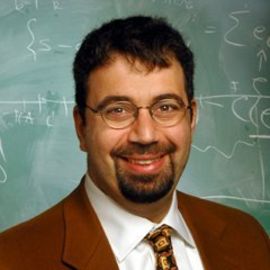
Daron Acemoglu is a Professor of Economics at the Massachusetts Institute of Technology, specializing in political economy, institutional economics, and societal development. His research examines how institutions shape economic outcomes, democracy, and inequality. Recent Publications: Democracy and Society (2024) analyzes global democratic challenges and the rise of right-wing movements. No more bread and games (2019) critiques unconditional basic income and advocates for participatory economic opportunities. Key Research Themes: His work bridges macro-level institutional analysis with micro-level societal dynamics, emphasizing the interplay between political systems, economic policies, and long-term prosperity.
Dr. Sara Bizarro is a Lecturer in the Department of Philosophy at the University of New Orleans. She holds a Ph.D. in Philosophy from the University of Lisbon (2004) and an M.A. in Philosophy of Mind from the same institution (2000). Previously, she was a Visiting Scholar at New York University and Tulane University. Her research specializes in interdisciplinary areas including Philosophy and Film, Ethics (Meta-Ethics, Applied Ethics), Wittgenstein studies, Social and Political Philosophy, and Unconditional Basic Income (UBI) policy. She is currently an editor for the American Philosophical Association's Philosophy of Film blog, an associate researcher at the University of Minho's Centre for Ethics, Politics and Philosophy, and a consultant for the UBIEXP research project. Dr. Bizarro's publications demonstrate strong focus on ethical analyses of cultural artifacts, with recurring themes in film philosophy (e.g., A Clockwork Orange , Hotel Rwanda ), social justice (racism, sexism, abortion), and economic policy (Basic Income). Recent works show increased engagement with accessible philosophy education through digital platforms. Honors and Awards First Place Essay Prize, Portuguese Philosophy Society (2019) for co-authored book Rendimento Básico Incondicional Post-Doc Scholarship, Portuguese Foundation for Science and Technology (2006) Ph.D. Scholarship, Portuguese Foundation for Science and Technology (2001) She maintains active advocacy as founder of the Portuguese Basic Income Association and contributor to international UBI conferences including the 2018 Congress in Lisbon.
Mark Unbehend is a Lecturer and Researcher at the Saarland University of Applied Sciences (School of Social Sciences) since 2010. His work focuses on child protection systems , children's rights , and social inequality in the Greater Region (Germany, France, Belgium, Luxembourg). Specializes in cross-border child welfare policies (e.g., CAPACITI project) Researches poverty, social reporting, and unconditional basic income Teaches social science fundamentals and educational policy Research Trends: Recent publications analyze international child protection frameworks , participatory rights , and comparative policy analysis . He co-authored studies on systemic gaps in implementing the UN Convention on the Rights of the Child and developed educational materials on play-based learning. Projects: Led the creation of bilingual films for the Eur&Qua research project to visualize child protection systems, and contributed to a synopsis on cross-border child protection in the Greater Region. Contact via mark.unbehend@htwsaar.de or phone +49 (0) 681 5867 - 713 (Room 11.04.14, Saarbrücken).
Mario Schmidt is an anthropologist specializing in economic practices, narratives, and discourses in rural Western Kenya and Nairobi, with a focus on cultural classification of money, the experimentalisation of development aid, and urban migration. His work bridges historical and contemporary analysis of food systems, economic pressures, and the influence of the Durkheim School on local economic understandings. Key Research Areas : Economic anthropology, cash transfers, behavioural economics, masculinities, migration, anthropology of food. Projects : The promise of free money : Analyzes local perceptions of unconditional cash transfers and universal basic income in Kenya. Selling economic choices : Examines tensions between behavioral science's quantitative methods and local qualitative understandings of money. Men under pressure : Explores male migrants' struggles with expectations of success in Nairobi. Restoration, reform, or revolution of patriarchy : Investigates Kenyan masculinity consultants' social media and workshops.
Dr. Emil Husted serves as Associate Professor and Deputy Head of Department at the Department of Organization, Copenhagen Business School, where he also functions as Teaching Coordinator. His academic profile bridges organization studies and political science through rigorous investigation of radical political entities and their organizational dynamics. His core research examines political organization within radical parties, social movements, and activist networks, with specific focus on how entities like Denmark's Alternativet and Spain's Podemos maintain radical identities while engaging parliamentary politics. Primary research domains include radical politics , discourse theory applications , and digital organizing , extending to empirical studies of Occupy Wall Street, Trump administration dynamics, and online prepper communities. Current projects investigate the organizational culture of the Danish Parliament. Analysis of Husted's 15 most recent publications reveals dominant thematic trajectories in alternative political organization, characterized by recurring exploration of trust mechanisms, apocalyptic imaginaries, and communicative constitution of collective action. His methodological approach consistently integrates discourse theory with process perspectives, producing interdisciplinary contributions that connect organization studies with political science through sustained collaboration with scholars like Sine Nørholm Just and Erik Mygind du Plessis. No scientific awards are documented in available sources. Administrative responsibilities as Deputy Head of Department and Teaching Coordinator indicate significant departmental leadership, though specific details regarding student advising, research grants, or laboratory affiliations remain unreported in current documentation.