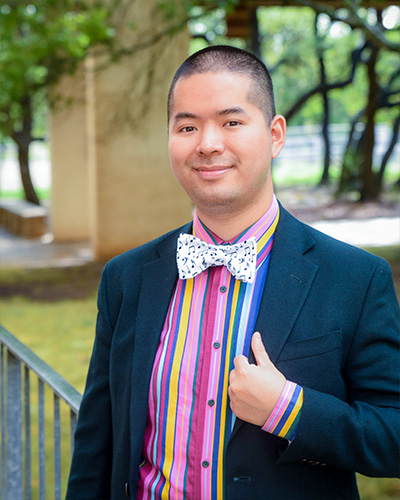
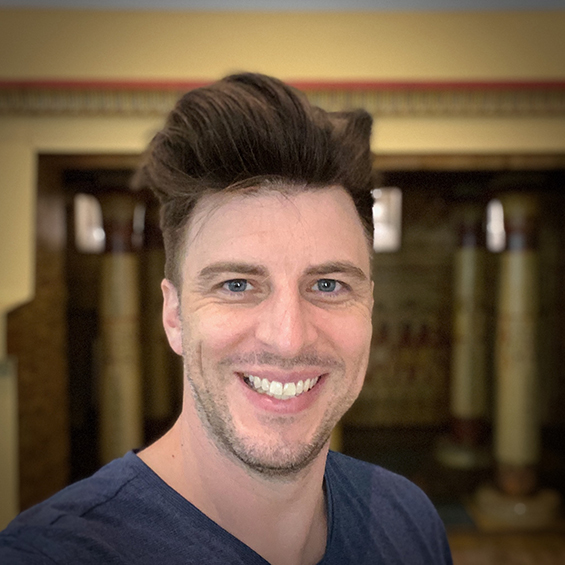
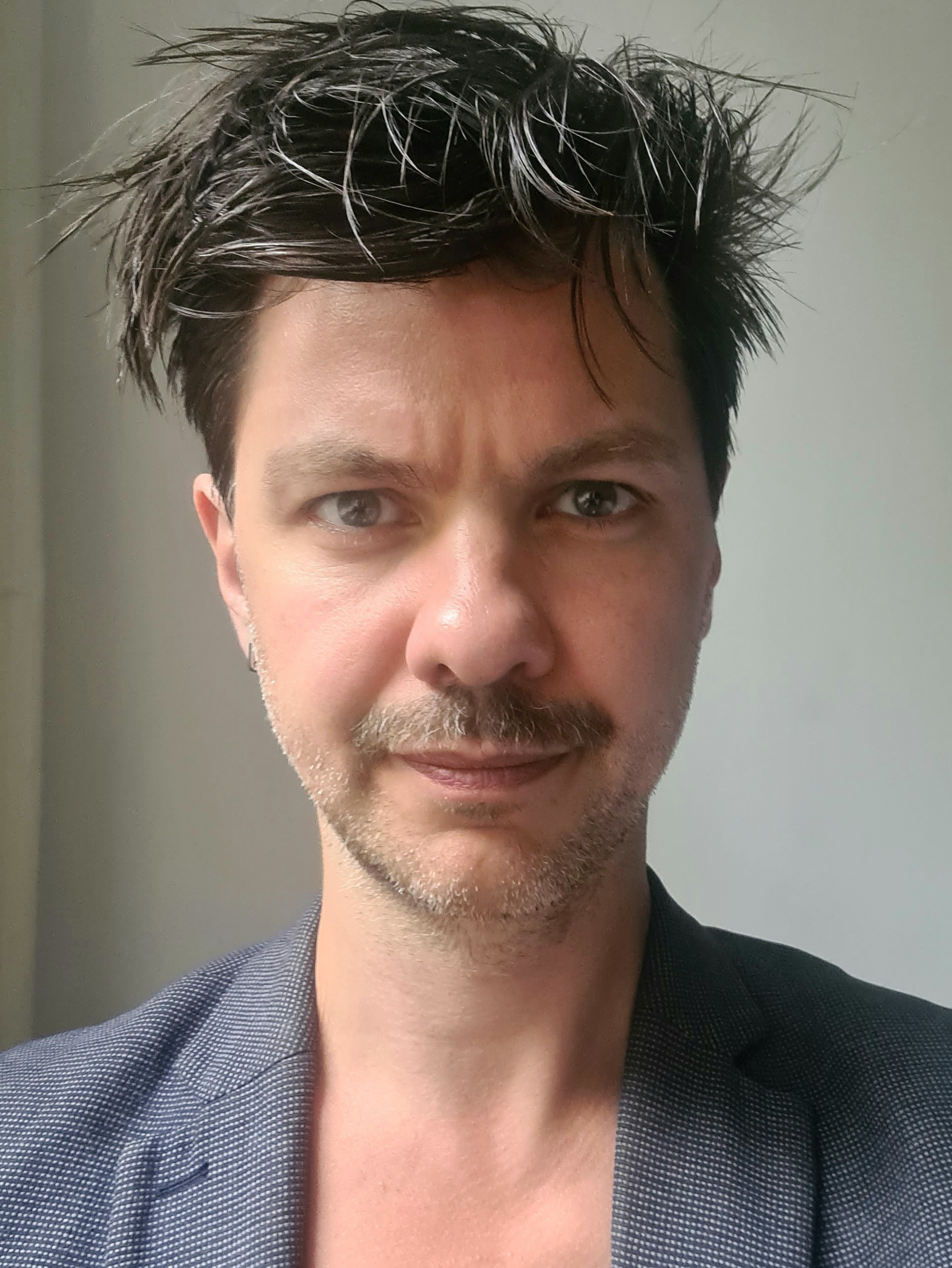
Pablo Apolo is a Lecturer at EINA School of Design (Universitat Autònoma de Barcelona) specializing in design projects, transmutation of the body, and creative experiences. He is also actively involved as a teacher of art and creativity with the Fundació Pere Tarrés and collaborates with institutions like Universidad Politécnica de Madrid (UPM) and Elisava (Barcelona School of Design). His professional work includes co-directing the creative laboratory La Bobería and developing exhibitions such as 'Prototipos Patria Bobé' and 'masks.' He currently works as an artist and multidisciplinary designer in the Malpaís space, focusing on experimental and collective creation.
Thomas B. Yee serves as Assistant Professor of Instruction in the Department of Music within UTSA's College of Liberal and Fine Arts, specializing in composition and theory with research focused on Holocaust remembrance and social justice through music. His educational background includes: B.A. from Pepperdine University M.M. from The University of Texas at Austin DMA from The University of Texas at Austin Yee's scholarly mission centers on transmuting human narratives into transformative musical works , with primary expertise in ludomusicology (video game soundtracks) and music semiotics . His compositions address historical trauma and racial injustice, notably in his opera Eva and the Angel of Death about Holocaust survivor Eva Mozes Kor. His artistic achievements include: Performances by NOW Ensemble, Ensemble Mise-En, and Indiana University Symphonic Band International recognition at ISCM World Music Days Composition awards from Hear No Evil and Voices of Change Yee has secured research funding from the Austin Cultural Arts Division, Schusterman Center for Jewish Studies, and Friends of Texas Holocaust and Genocide Commission. He teaches Aural Skills I/II, Basic Skills I, and History of Recorded Music under mentorship from Donald Grantham, Nina C. Young, Robert Hatten, and Jerry Junkin.
Ethan Peterson is an Assistant Professor in the Department of Nuclear Science and Engineering at the Massachusetts Institute of Technology, where he leads the neutronics group at the Plasma Science and Fusion Center. His research focuses on radiation transport and transmutation methods, reactor design optimization, and uncertainty quantification for fusion technologies. PhD in Experimental Plasma Physics, University of Wisconsin–Madison Research interests center on developing predictive nuclear modeling for fusion reactor design, emphasizing high-fidelity Monte Carlo simulations using OpenMC. His work addresses unique challenges in fusion neutronics including complex geometries, tritium breeding, and materials testing, with applications to projects like SPARC, LIBRA, and ARC tokamaks. Recent publications demonstrate expertise in neutron shielding design, computational validation, and multi-physics simulations for fusion systems. He teaches courses in neutron physics, Monte Carlo methods, and plasma physics seminars.
Charlotte BECQUART is Professor at Centrale Lille Institute, University of Lille, France, and member of the Physical Metallurgy and Materials Engineering team within the Materials and Transformations Unit (UMET, CNRS UMR 8207). Since 1993 she has conducted research on atomic-scale modeling of irradiation damage in metallic alloys using ab initio, molecular dynamics and kinetic Monte Carlo methods. Education & Background Metallurgy and thermodynamics applied to development, modeling and surface treatments. Working at École Nationale Supérieure de Chimie de Lille since 1993. Research Focus Her work centers on understanding irradiation damage at the atomic scale, particularly embrittlement mechanisms in Pressurized Water Reactor (PWR) vessel steels and materials for fusion reactors such as tungsten divertor components. She employs advanced simulation techniques including ab initio calculations, molecular dynamics and kinetic Monte Carlo methods to study deformation, phase change and damage phenomena. Research Trends Recent publications demonstrate a strong emphasis on multi-scale modeling of irradiation effects in metallic systems, statistical analyses of displacement cascades, nanocavity diffusion in tungsten, radiation-induced segregation at grain boundaries, and development of machine-learned interatomic potentials for complex alloys. The research spans nuclear materials, computational materials science and advanced alloys for energy applications. PhD Supervision She has successfully supervised 12 defended theses since 2012 and currently co-directs 3 ongoing doctoral projects (2022–2025) focusing on mesoscopic scale modeling of irradiated steels, multi-scale modeling of shape memory alloys and oxide-cladding interface characterization for future nuclear fuels. Affiliations & Teams UMET – Materials and Transformations Unit, CNRS UMR 8207, University of Lille. Physical Metallurgy and Materials Engineering research team. Collaborates with EDF, CEA and international fusion programs.
Robert Willim is a Senior Lecturer and Associate Professor in Digital Cultures at Lund University's Faculty of Humanities , Department of Arts and Cultural Sciences . As both a researcher and artist, he combines cultural analysis with artistic practice to explore the intersections of technology, materiality, and societal transformation. Role : Senior Lecturer, Associate Professor Department : Digital Cultures, Division of Ethnology Contact : robert.willim@kultur.lu.se Research Interests Industrial Cool : Transformation of traditional industries in postindustrial societies Materiality : Vital materiality and decay imaginaries Art-Research Interfaces : Using art as 'probes' for conceptual transmutation Digital Cultures : Evolution of technological imaginaries and practices Publications demonstrate expertise in technological mediation, digital mundanity, and postindustrial materiality, with recent works like Mundania (2024) and Sound Automation (2024) highlighting his focus on automation and cultural analysis. Teaching includes courses in digital culture project work, idea development, and visual culture methodology. Activities show extensive academic engagement through conference organization (e.g., 20 Years of Sound Environments ), seminar participation, and artistic events like BEYOND SITE / SIGHT (2024).
Rakesh Chawla is an Honorary Professor at EPFL, affiliated with the School of Basic Sciences (SB) and the Department of Physics. He holds roles at both EPFL and the Paul Scherrer Institute (PSI), where he directed the Laboratory of Reactor Physics and Systems Engineering. His career includes positions as Extraordinary Professor (1994) and Full Professor (1997) at EPFL, focusing on nuclear engineering education and reactor experiments (e.g., CROCUS reactor). Education: PhD in Nuclear Engineering from Imperial College, University of London (1970). Early career included roles at the UK Atomic Energy Authority and the Indian Institute of Technology Kanpur. Research interests span experimental/analytical work on advanced nuclear systems' safety, fuel cycle dynamics, waste transmutation, and reactor behavior analysis. He has supervised 11 doctoral theses at EPFL, contributing to nuclear energy innovation and safety. Labs/Teams: Former director of PSI's Laboratory of Reactor Physics and Systems Engineering, collaborating on projects like the PROTEUS research reactor.
Brian Zimerle is a Part-Time Lecturer of Art in the Department of Art at the University of Southern Maine's College of Arts, Humanities, and Social Sciences. He splits his time between Maine and Philadelphia and works as lead mountmaker at the Penn Museum of Archaeology and Anthropology, which heavily influences his artistic practice. Education: MFA from Cranbrook Academy of Art and BFA from The School of the Art Institute of Chicago. His research interests center on replication and generation loss in ceramics and sculpture, drawing inspiration from science, history, and the human-built environment. He creates diminished replicas that retain charged presence despite diverging from originals. Collaborations include recreating Sumerian ceramic vessels for ancient beer recipes with Great Lakes Brewing Company. Exhibitions include the Springfield Museum of Art, Zanesville Museum of Art, and the Oriental Institute at the University of Chicago. His work bridges archaeology and contemporary art through material transmutation and cultural memory. No scientific awards listed. Teaching and creative work are primary focus areas.
Belinda Kong is a Professor of Asian Studies and English at Bowdoin College, specializing in global Asian literatures and cultures. Her research focuses on Sinophone cultural expressions, diaspora narratives, and pandemic studies, particularly analyzing the 2003 SARS outbreak and its cultural impact. She has authored two major books: SARS Stories: Affect and Archive of the 2003 Pandemic (2024) and Tiananmen Fictions Outside the Square (2012), which explore epidemic narratives and diasporic political aesthetics. Her work bridges literary analysis with critical theory, addressing themes like biopolitics, transnational memory, and posthumanism. Kong has been a key figure in curating exhibitions like Without Apology: Asian American Selves, Memories, Futures (2023-2024). She was honored with a nomination for the 2022 Karofsky Faculty Encore lecture, recognizing her teaching excellence and scholarly impact. Education: PhD (2005), MA (1999) in English from University of Michigan; BA (1998) in English/Philosophy from College of William and Mary. Her interdisciplinary approach spans literature, public health, and visual culture. Research Highlights: Kong’s SARS scholarship challenges Anglophone misrepresentations of pandemic origins, centering marginalized voices. Her articles in Prism: Theory and Modern Chinese Literature and Journal of Narrative Theory demonstrate her commitment to rethinking cultural resilience in crises.
Dr. Iain Findlay-Walsh is a Lecturer in Music at the University of Glasgow, specializing in sound art and experimental music practices. His research integrates field recording, studio production, and autoethnographic methods to explore personal listening, sonic perception, and virtuality in music. He co-directs the Immersive Experiences Lab, focusing on VR in arts research, and serves on the UoG XR Strategy Group and SCCA EDI committee. Key research areas include sound art, first-person field recording, and the intersection of digital media with auditory experience. Notable works include A Transmutation Music (2025) and Listener Musics (2021). He has received the Kenneth Elliot Postgraduate Scholarship (2014) and Glasgow Educational Trust Award (2010). Teaching focuses on experimental music practices, sound design, and spatial audio. He supervises doctoral research on topics like album innovation and posthuman philosophy. His creative outputs span sound installations, multichannel audio works, and performance art.
Dr. Laurel Sinclair is a Researcher at Carleton University's Department of Physics and a senior researcher at the Canadian Nuclear Laboratories (CNL) in Chalk River, Ontario. CNL serves as Canada's premier nuclear science and technology organization with core priorities in Clean Energy, Environmental Stewardship, Health Sciences, and Safety and Security. Her dual affiliation bridges academic research with national laboratory applications in nuclear science and technology. Her research focuses on nuclear safeguards and radiation detection technologies, specializing in Compton gamma imaging, aerial radiation surveys using UAVs, and spatial reconstruction techniques for restricted-access environments. Key contributions include developing novel methods for nuclear substance detection and safeguarding, advancing the nuclear fuel cycle, and exploring Accelerator-Driven Systems for Used Fuel Transmutation in Canada. Her work directly supports nuclear security protocols, environmental monitoring systems, and emergency response frameworks. Analysis of her 15 publications (2009-2024) reveals consistent innovation in radiation detection instrumentation, particularly directional gamma spectrometers like SCoTSS and ARDUO. Dominant themes include tomographic imaging for source localization, UAV-based radiation mapping, and spatial deconvolution for radiological incidents. Her research spans theoretical simulations, hardware development, and real-world deployments ranging from Fukushima accident monitoring to nuclear security exercises. Scientific awards and honors were not documented in the source material. Details regarding student supervision, grant funding, or formal advisory roles are not provided in available information. Dr. Sinclair actively participates in CNL research teams focused on robotic radiation dispersal systems, UAV radiation mapping, and space weather monitoring through terrestrial networks. Her collaborative work involves Health Canada, TRIUMF scientists, and international partners, emphasizing field-deployable solutions for nuclear security and environmental stewardship.
Shannon Grimes is a Professor in the Department of History and Political Science at Meredith College, specializing in religion with expertise in early Christianity, world religions, and environmental ethics. Her research focuses on religious and philosophical traditions in the Greco-Roman world, particularly ancient alchemy and cosmic worldviews. She has led international study programs in Iceland and Italy. Dr. Grimes holds a Ph.D. in Religion from Syracuse University, an M.Phil. in Religion from Syracuse University, an M.A. in Philosophy and Religion from California Institute of Integral Studies, and a B.A. in English from University of Puget Sound. Her research explores the intersections of ancient alchemy, spirituality, and material culture in Roman Egypt, with interdisciplinary approaches bridging religious studies, history, and archaeology. Publications demonstrate thematic focus on ritual practices, cultural transmission, and symbolic systems. Faculty Distinguished Lecture (2022) Pauline Davis Perry Award for Research (2019) Pauline Davis Perry Award for Teaching (2009)
Dr. Marcus Dahlfors is a Lecturer in the School of Computer Science and Engineering at Bangor University. His research focuses on neutron physics, nuclear reactor design, and astrophysical nucleosynthesis. He leads projects on neutron capture cross-section measurements, thermal-hydraulics, and advanced reactor technologies, with collaborations at CERN's n_TOF facility. Key contributions include studies on actinide behavior, small modular reactors, and fission dynamics. Affiliations: CERN n-TOF Collaboration, UK National Thermal-Hydraulics Facility Education: PhD in Nuclear Physics (implied by publications) Research interests include nuclear fuel cycles, neutron-induced reactions, and applications in energy and astrophysics. Over 50 peer-reviewed publications in journals like Physical Review C and Progress in Nuclear Energy .
Maria Margalida Pons Jaume is a Full Professor in the Department of Catalan Philology and General Linguistics at the University of the Balearic Islands, where she teaches courses in Comparative Literature, Contemporary Catalan Literature, and Master’s-level subjects such as Pràctica Lectora i Espai Públic . She is the Principal Investigator of the consolidated R&D group Literatura Contemporànea: Estudios Teóricos y Comparativos (LiCETC) , under which she has led multiple competitive research projects and a teaching innovation initiative. Her research centers on contemporary Catalan poetry, experimental writing, and conceptual literature, with a strong theoretical focus on affective theory, gender, animal studies, and non-anthropocentric subjectivity. She has authored key works such as The Troubled Code: From Experimental Poetry to Conceptual Writing (2021) and Currents of 20th Century Island Poetry (2010), and edited volumes on Carles Hac Mor and Catalan experimental narrative. Her recent publications reflect a deep engagement with affective theory, exploring analogical thinking, outlaw emotions, and the political dimensions of indignation in poetry. She has also examined the role of animals in art, the poetics of meagerness, and the intersections between science and poetry. These works, published in journals like Estudis Romànics , Catalan Review , and Theory Now , demonstrate a consistent trajectory in redefining literary subjectivity and affect in contemporary Catalan culture. She has been a visiting professor at Brown University (2009) and Stanford University (2011), underscoring her international academic presence. Her educational background includes a PhD in Catalan Philology from the University of Barcelona (1993) and a Master’s in Comparative Literature from Indiana University (1996). Through her leadership in LiCETC and her extensive scholarly output, she plays a pivotal role in advancing research on Catalan literature and its theoretical frameworks. Her work bridges literary criticism, cultural theory, and interdisciplinary inquiry, contributing significantly to the understanding of literature’s transformative and affective powers.
Bochra BEN HASSEN CHARNAY is a Lecturer in Modern Literature at Université Charles de Gaulle Lille 3 since 2005 and a full-time faculty member at the Institut Universitaire de Technologie (IUT) of Lens under the Université d'Artois. Her academic work focuses on oral literature and childhood/youth cultures, with a particular emphasis on transmediality, interculturality, and the evolution of traditional storytelling in Western and Maghreb contexts. Doctorate in Modern Literature (2013, Highest Honors) Certified Professor in Modern Literature (2006) Co-organizer of international conferences on children's literature Her research explores the anthropological dimensions of oral literature, including the transcultural trickster figure and the reconfiguration of oral traditions into written forms. She analyzes transtextual relationships in children's narratives, such as the evolution of Cinderella motifs across cultural boundaries. Her publications often bridge folklore studies with literary criticism. Bochra supervises Master's and DUT dissertations at Lille 3 and participates in CRPE competition juries. She has contributed to the transcription and translation of 19th-century Tunisian folktales collected by Hans Stümme, aiming to preserve their dialectal authenticity. Active in networks like REARE and AFRELOCE, her work emphasizes interdisciplinary dialogue between oral traditions and contemporary literary analysis.
Francisco Calviño Tavares is a full Professor at the Universitat Politècnica de Catalunya (UPC) in the Departament de Física , affiliated with the Advanced Nuclear Technologies Research Group (ANT) . His work focuses on nuclear physics, neutron detection, and radiation protection, with key contributions to the CERN n_TOF facility and particle therapy dosimetry. He develops neutron detectors for medical applications and studies nuclear reactions relevant to astrophysics and reactor design. Current projects: Neutron dosimetry for hadron therapy, nuclear cross-section measurements, neutron capture experiments Collaborations: CERN n_TOF, HENSA/ANAIS (Canfranc Underground Laboratory) His research explores nuclear structure (e.g., Tl isomers), neutron-induced reactions (235U fission, 239Pu capture), and radiation detector innovation (sTED, LINrem). He applies Monte Carlo methods to neutron transport and contributes to nuclear data libraries for reactor and astrophysical modeling. Recent articles examine neutron cross-sections (Se-78, Yb-176), high-count-rate detectors , and neutron dosimetry in pulsed fields. His work bridges fundamental nuclear physics, medical applications, and reactor safety. As a UPC faculty member, he leads projects in nuclear waste transmutation, participates in international experiments, and develops university teaching methodologies for engineering education. His technical patents include neutron dosimeters and radiation safety systems.