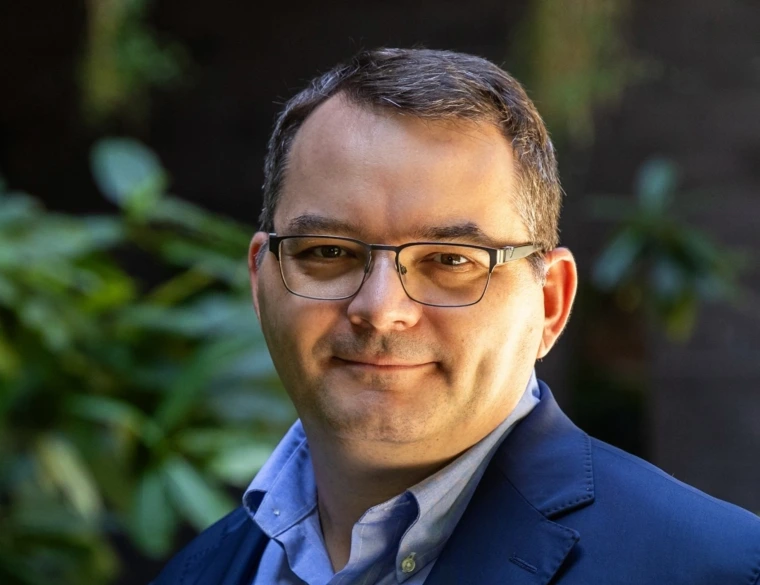
Professor Jonathan Keeling is Head of the School of Physics and Astronomy at the University of St Andrews, where he leads research in theoretical condensed matter physics with a focus on quantum phenomena. His work bridges fundamental quantum theory with potential applications in quantum technologies and materials science. His educational background includes a PhD from the University of Cambridge (2005) and a Master of Natural Science from Cambridge (2002). Prior academic positions include EPSRC Career Acceleration Fellow at Cambridge, Drapers' Junior Research Fellow at Pembroke College, and Lindemann Fellow at MIT. Keeling's research centers on open quantum systems and non-equilibrium phase transitions, with particular emphasis on light-matter interactions in systems like microcavity polaritons and cold atoms in optical cavities. His group explores how quantum coherence behaves out of equilibrium and how it can be dynamically controlled, with applications spanning quantum simulation, quantum information processing, and novel materials. Key research strands include cold atoms in optical cavities, exact numerical methods for phase transitions in open systems, and strong matter-light coupling with complex materials like organic molecules. His recent publications (2023-2025) reveal a strong focus on non-Markovian quantum dynamics, quantum spin glasses, polariton-mediated energy transfer, and computational methods for open quantum systems. The work shows increasing integration of theoretical frameworks with experimental implementations, particularly in cavity QED systems and quantum simulation platforms. Outstanding Referees Program, American Physical Society (2015) Keeling has supervised numerous PhD students and postdocs who have gone on to careers in academia and industry. His research is supported by multiple grants including an EPSRC-funded project on Multimode Cavity QED (2025-2027), previous EPSRC grants on understanding and engineering dissipation in quantum devices, and projects funded by The Royal Society and The Leverhulme Trust. He collaborates extensively with groups at Stanford, Cambridge, Aalto University, and other international institutions. The Keeling Group at St Andrews maintains active research programs in quantum simulation with cold atoms in cavities, theoretical modeling of organic polaritons, and development of numerical methods for non-Markovian quantum dynamics. The group contributes to the Centre for Designer Quantum Materials and maintains strong connections with experimental groups working on cavity QED implementations.