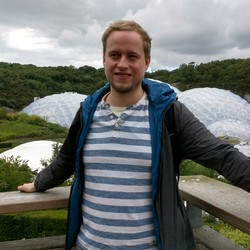
Janusz Konieczny is a Professor of Mathematics at the University of Mary Washington. He holds office hours in James Farmer Hall, Room 125, and can be contacted at jkoniecz@umw.edu. Educational Background M.S. in Computer Science, Jagiellonian University (1982) M.S. in Mathematics, Jagiellonian University (1978) Ph.D. in Mathematics, Pennsylvania State University (1992) Dr. Konieczny’s research focuses on algebraic semigroups, group theory, and transformation semigroups. His work often intersects with matrix theory and linear algebra. Scientific Awards UMW Alumni Association Outstanding Young Faculty Member Award Waple Professorship (2015–2017)
Elizabeth Dombi is a Teaching Fellow in the Department of Mathematics and Statistics at the University of Strathclyde, Faculty of Science. She holds dual leadership roles as Director of Teaching in her department and Associate Dean for Equality, Diversity and Inclusion (EDI) in the Faculty of Science. Her work integrates academic leadership, teaching innovation, and research in both pure mathematics and pedagogy. She earned her PhD in Pure Mathematics from the University of St Andrews (2001–2004), focusing on automatic semigroup acts and inverse semigroup presentations, and holds a Master of Mathematics from the University of Szeged. Since joining the University of Strathclyde in 2013 as a Teaching Associate, she has advanced into central roles shaping inclusive education and curriculum development. Her research spans two domains: Mathematical research in inverse semigroups, automata, formal language theory, combinatorial optimization, and word-representable graphs; and Scholarship of Teaching and Learning (SoTL) , with emphasis on fostering deep learning, feedback practices, student-as-partners models, curriculum contextualization, and Education for Sustainable Development. She actively uses LEAN for automated theorem proving in teaching contexts. Her recent publications reflect a growing trend toward educational innovation and collaborative pedagogy, particularly in enhancing student engagement through partnership models and inclusive assessment. Articles such as 'A time-capsule for Students as Partners 2034' and 'Are we really working with students?' demonstrate her leadership in reimagining feedback and student agency in higher education. Senior Fellow of the Higher Education Academy Representative for the London Mathematical Society Led departmental application for Bronze Award in Equality, Diversity and Inclusion (2024) She supervises fourth-year undergraduate projects in areas including cryptography, game theory, automata, epidemiology, and inverse semigroup theory. She is co-investigator on the Wellcome Trust-funded project 'Cultures of Collaborative Research in a Socially Progressive Technological University' and principal investigator on the internal project 'Breaking the Mould: Embracing dis/ability in Mathematics, Statistics and Life.' She is also active in university networks focused on teaching leadership and SoTL writing groups. Her work contributes to the UN Sustainable Development Goal of Quality Education, promoting inclusive and equitable learning environments. She teaches Mathematics 1M (MM117) and Applicable Analysis 2 (MM303) in the 2024/25 academic year and continues to mentor students and collaborate across disciplines to transform teaching and research cultures.
Matthias Langer is a Senior Lecturer in the Department of Mathematics and Statistics at the University of Strathclyde, part of the Faculty of Science. He received his PhD from the Vienna University of Technology and has held postdoctoral positions at the University of Leicester, the University of Bremen, and Vienna University of Technology before joining Strathclyde in 2004. He was a Visiting Professor at Vienna University of Technology in 2013 and 2014 and has been a Visiting Fellow at the Isaac Newton Institute three times. His research lies at the intersection of functional analysis, operator theory, and differential equations, with applications in mathematical physics and engineering. Key areas include spectral theory of block operator matrices, inverse problems, coagulation-fragmentation equations, and differential operators with singular coefficients. He applies these theories to problems in non-destructive testing, liquid crystals, quantum mechanics, and networks. The recent publications highlight a strong focus on canonical systems, Weyl coefficients, spectral analysis, and nonlinear PDEs arising in material science. His work combines deep theoretical analysis with practical modeling, particularly in systems governed by evolution equations and spectral problems with indefinite inner products. Scientific Awards and Recognitions: Three-time Visiting Fellow, Isaac Newton Institute for Mathematical Sciences Visiting Professor, Vienna University of Technology (2013, 2014) Advising and Grants: Dr. Langer has supervised several doctoral researchers including Grant Jamieson Ross, Sophie McLauchlan, and Michael Doherty. He has been Principal Investigator on multiple EPSRC-funded projects, including Doctoral Training Partnerships (DTP) and research on differential operators with singularities and indefinite inner product spaces. His projects span from 2007 to ongoing work extending to 2025. Professional Engagement: He serves on the editorial boards of Quaestiones Mathematicae and Complex Analysis and Operator Theory , and has been an invited speaker and organizer at international conferences such as IWOTA and the Nordic Congress of Mathematicians.
Christoph Haase is an Associate Professor at the Department of Computer Science, University of Oxford, and a Fellow of St Catherine’s College. His research focuses on developing rigorous mathematical methods for algorithmic verification, automated reasoning, automata theory, and logic in computer science. University of Oxford, UK (Current) University College London, UK (Former) ENS Paris-Saclay, France (Former) Microsoft Research Cambridge, UK (Former) His work includes fundamental contributions to decision procedures for arithmetic theories, particularly in Presburger and Büchi arithmetic, and applications to verification of software and hardware systems. He leads the ARiAT project, funded by an ERC Starting Grant (2020–2025), aiming to advance quantifier elimination and complexity bounds for arithmetic theories. Key publication trends include verification , automata theory , arithmetic logic , computational complexity , and automated reasoning . Collaborations span institutions like University of Paris, UCL, and Microsoft Research. Scientific Awards : ERC Starting Grant (2019) EPSRC Doctoral Prize (during DPhil studies) He has supervised PhD and MEng projects on topics such as SAT solving, linear arithmetic, and matrix semigroups, often co-supervising with researchers like Stefan Kiefer and James Worrell. Teaching includes Logic and Proof at Oxford and Operating Systems at ENS Paris-Saclay.
Dr. Josep Martinez Centelles is an Associate Professor at the Faculty of Mathematics , University of Valencia , specializing in Mathematical Analysis . His research spans operator theory, differential equations, and their applications to physics and engineering. PhD in Mathematics (1992) from University of Valencia Key research collaborations with experts in relativity, optimization, and harmonic analysis Research focuses on: Operator theory and semigroups in Banach spaces Harmonic analysis for time-frequency localization Relativistic thermodynamics and gravitational collapse modeling Computational methods in fluid dynamics and multi-objective optimization Recent work explores generalized ε-quasi solutions in set optimization (2022), enhanced LES discretization techniques (2015), and uncertainty principles in spherical mean transforms (2014). His publications appear in journals like zbMATH, Journal of Mathematical Analysis and Applications, and Computational Optimization and Applications.
Prof. Dr. Dorothee Frey is a Professor in the Department of Mathematics at Karlsruhe Institute of Technology (KIT), where she leads the Functional Analysis Working Group within the Institute for Analysis. Her position is situated in the Faculty of Mathematics, and she maintains an active research program focusing on harmonic analysis, partial differential equations, and functional analysis. With regular office hours on Tuesdays from 10am-11am in room 2.042 of the College Building for Mathematics, she actively supervises seminars and delivers lectures across multiple semesters through 2025. Prof. Frey's research interests center on harmonic analysis and its applications to partial differential equations, particularly wave phenomena, dispersive equations, and operator theory. Her work bridges theoretical mathematics with practical applications in fluid dynamics and mathematical physics. She has developed significant contributions in Strichartz estimates, wave equations with low regularity coefficients, and functional calculus approaches to paraproducts and pseudodifferential operators. Her research demonstrates strong connections between abstract functional analysis techniques and concrete problems in mathematical physics. Analyzing her publication record from 2013-2022 reveals consistent contributions to harmonic analysis, particularly in weighted norm inequalities, operator theory, and PDE applications. Her work shows increasing specialization in wave phenomena and dispersive equations, culminating in her current role as principal investigator in CRC 1173 projects on dispersive estimates for wave equations and nonlinear stability of periodic waves. The trend shows a clear progression from foundational work in functional analysis and harmonic analysis toward increasingly specialized applications in wave phenomena and mathematical physics. Prof. Frey actively contributes to the mathematical community through editorial work, serving on the editorial committees of Mémoires de la SMF and Bulletin de la SMF. Her organizational activities include co-organizing significant workshops and programs, such as the upcoming Frontiers in harmonic analysis program at the Isaac Newton Institute (2027) and the Workshop on Harmonic Analysis and Fluid Flows (2025), as well as past events like the Oberwolfach Seminar on Operator-Adapted Spaces in Harmonic Analysis and PDEs (2022). As a principal investigator in the Collaborative Research Center CRC 1173 'Wave phenomena: analysis and numerics,' Prof. Frey leads two major research projects: A13 on 'Dispersive estimates for wave equations with low regularity coefficients' (with R. Schnaubelt since July 2021) and A14 on 'Nonlinear stability of periodic waves in dissipative-dispersive systems' (with B. de Rijk since July 2023). These projects represent substantial research funding and collaborative efforts within the mathematical community. Prof. Frey is an active member of KIT's mathematical research infrastructure, participating in the Institute for Analysis and contributing to the Junior Research Groups ecosystem, particularly those focused on PDEs and wave phenomena. Her work intersects with multiple research groups within the Department of Mathematics, including those working on nonlinear partial differential equations and stability analysis, creating a robust collaborative environment for advancing mathematical analysis.
Vincenzo Recupero is an Associate Professor at the Department of Mathematical Sciences (DISMA) , Politecnico di Torino . His research focuses on mathematical analysis and its applications to complex systems. Scientific Branch : MATH-03/A - Mathematical Analysis ERC Sectors : Analysis, Application of mathematics in sciences, Mathematical physics, ODE and dynamical systems, Operator algebras SDG Goals : Quality education (Goal 4), Reduced inequalities (Goal 10) His research interests include partial differential equations for phase transitions (Penrose-Fife and Stefan models), quaternionic functional analysis in noncommutative frameworks, and rate independent processes like Moreau’s sweeping processes. These are applied to elastoplasticity, economic theory, crowd motion modeling, and electric circuits. The 9 recent articles highlight his expertise in Mathematical Analysis , Partial Differential Equations , and Operator Theory . Key trends include continuity methods for sweeping processes, BV solutions in variational inequalities, and advancements in quaternionic semigroups and Clifford algebras. Recupero teaches Mathematical Analysis II and Mathematical Methods for Engineering to undergraduate and graduate students. He has held research positions at Tongji University (2013). Conference Roles : Program committee, International Symposium on Hysteresis Modeling and Micromagnetics (HMM 2025) Chairman, Summer School on Multi-Rate Processes (2017, 2019) He contributes to the Nonlinear Analysis and Calculus of Variations research group and explores connections between hypercomplex analysis and quantum mechanics .
Alessandro De Luca is a Full Professor at Sapienza University of Rome, Department of Information Engineering, Electronics and Telecommunications (DIAG). He has held editorial leadership roles at IEEE Transactions on Robotics as Editor-in-Chief (2004–2008) and has been a key figure in robotics research, particularly in dynamic modeling, control systems, and physical human-robot interaction. His career spans over three decades, including leadership in the IEEE Robotics and Automation Society and contributions to international conferences. Education: PhD in Systems Engineering (1987) Academic roles: Full Professor since 2000, Associate Professor (1992–1993), Researcher (1988) Leadership: Vice-President of IEEE RAS (2012–2013), Chair of ERC Panels, and co-founder of I-RIM (Italian Robotics Institute). Research interests focus on robotics, with specific expertise in dynamic modeling, motion planning, soft robotics, kinematic redundancy, and nonlinear control. His work addresses challenges such as collision detection, feedback linearization, and haptic interfaces for augmented reality. Recent publications emphasize soft robot control under uncertainties, time-optimal trajectory planning, and mixed-reality human-robot collaboration. Scientific awards include IEEE Fellow (2007), IEEE Life Fellow (2023), the 2019 George Saridis Leadership Award, and multiple best paper recognitions. He has contributed to foundational texts like the Springer Handbook of Robotics and has coordinated national and EU projects such as SYMPLEXITY and SAPHARI.