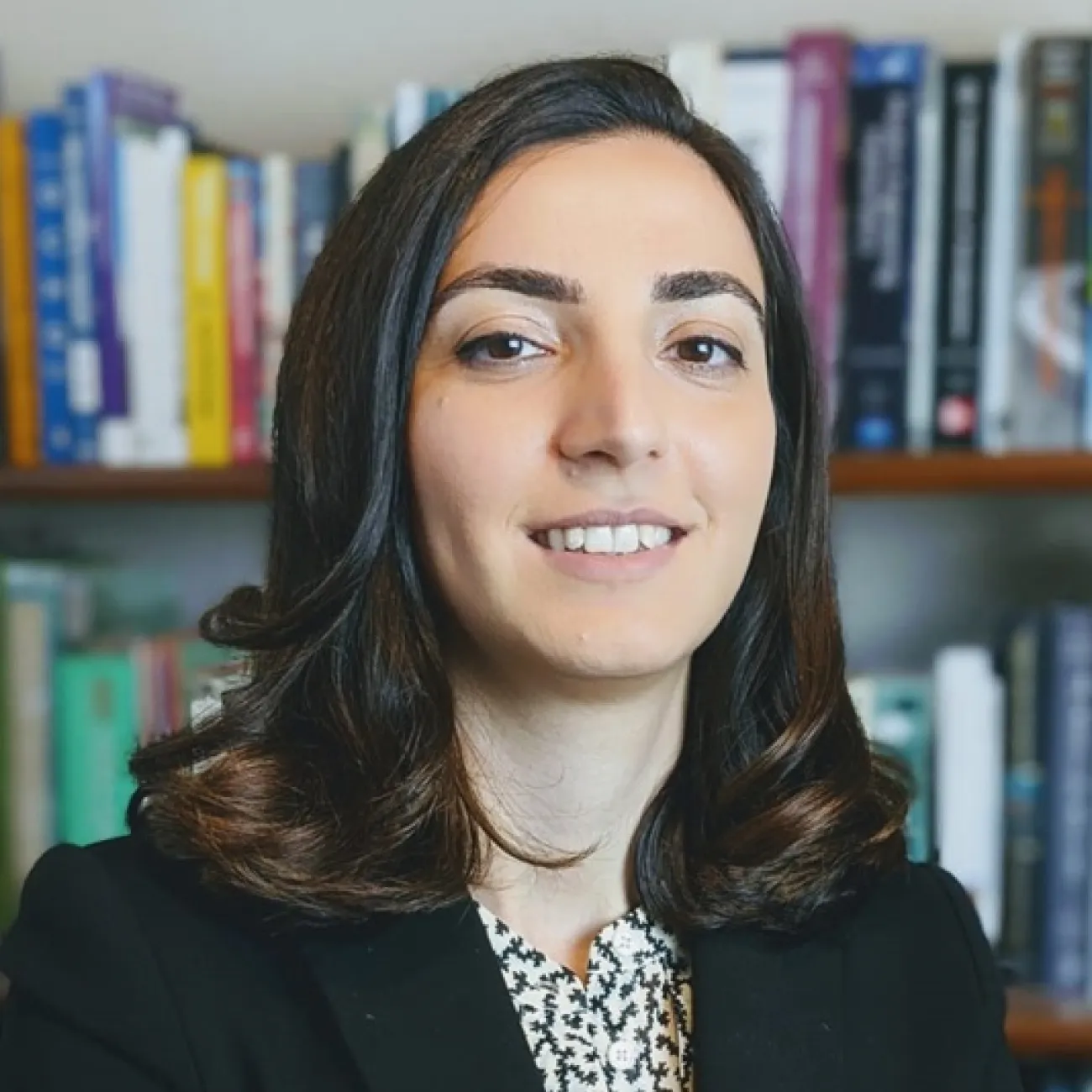
Dr Bahareh Zaghari (MSc, PhD, CEng, FHEA) is a Lecturer in the Electrical Power Engineering group at the University of Southampton's School of Electronics and Computer Science. Her research focuses on electrified aircraft systems, sensors with machine learning applications, electrical power systems, and nonlinear dynamics modeling. Current projects include acoustic sensing for temperature/flow measurement Co-design of electrical machines for aircraft electrification Research activities span hybrid-electric aircraft design (FutPrint50 Horizon project), fully electric aircraft development (EnabEl Innovate UK), and smart sensing systems for aerospace components. Industrial collaborations include KISTLER, iNetic, PALL Aerospace, Safran, ARUP, Embraer, and BAE Systems. Conference coordinator for IEEE Transportation Electrification Council's Electrified Aircraft committee Chair of IEEE/AIAA Electrified Aircraft Technology Symposium (2023) Panel moderator at AIAA Propulsion and Energy (2021) Her work demonstrates innovative applications of acoustic transducers in harsh environments, with contributions to temperature mapping, fault analysis, and energy harvesting systems. She currently supervises PhD student Shikhar Singh.
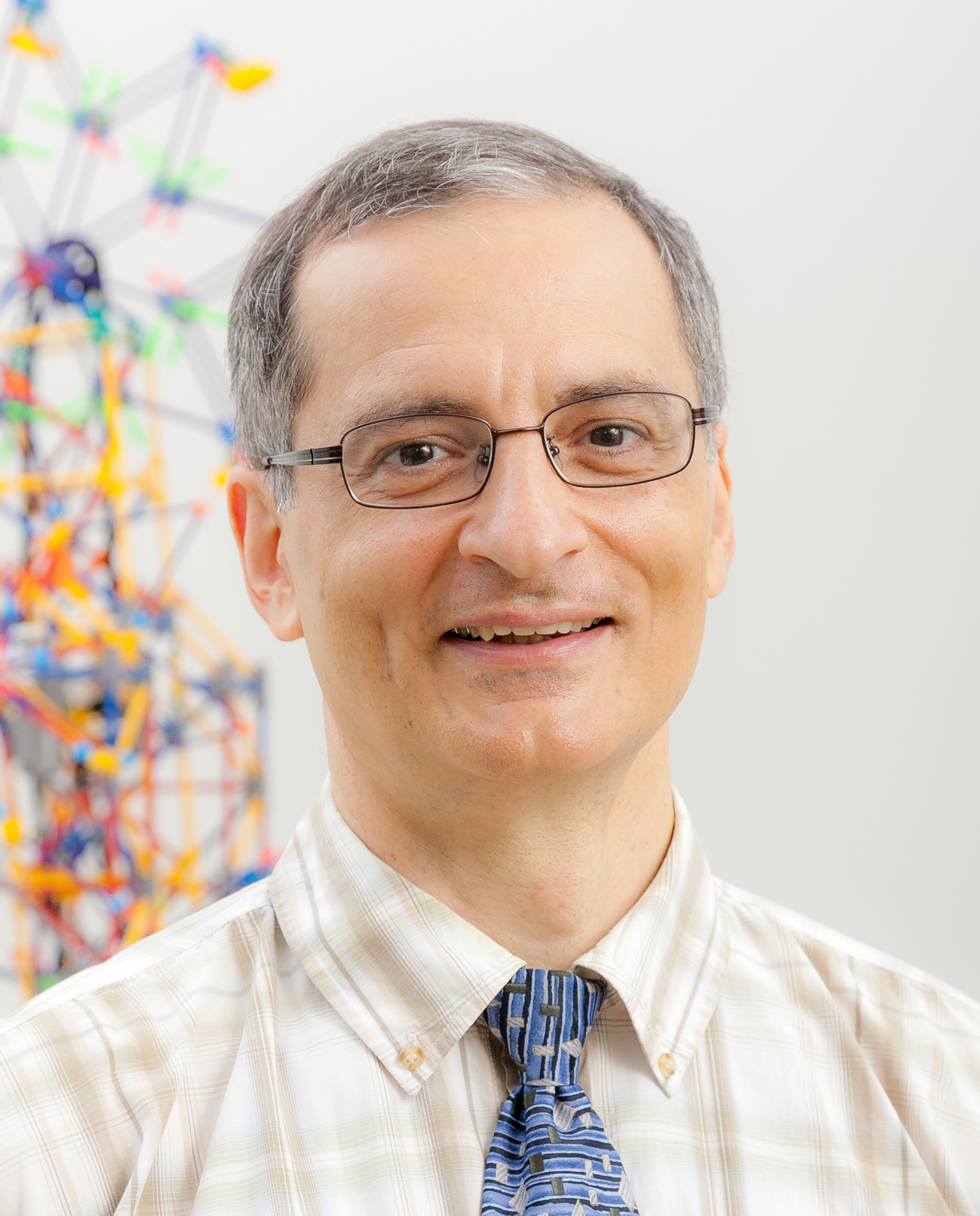
Nori Franco serves as Professor in the Department of Physics at the University of Michigan and Chief Scientist at RIKEN's Theoretical Quantum Physics Laboratory in Japan. His dual appointments reflect his significant contributions to both American and Japanese academic communities, with continuous service at Michigan since 1990 and at RIKEN since 2002. His research spans quantum information, condensed matter physics, and quantum optics, with particular focus on light-matter interactions, superconducting qubits, optomechanics, and quantum open systems. Franco's work bridges theoretical foundations with experimental implementations, especially in circuit quantum electrodynamics and quantum computing applications. Analysis of his recent publications reveals a strong emphasis on non-Hermitian quantum systems, quantum control techniques, and applications of quantum information science to fundamental physics problems. His research group consistently produces highly cited work, with publications appearing in top journals across quantum physics and condensed matter disciplines. Scientific Awards: Charles Hard Townes Medal (2024) - sole recipient for fundamental contributions to quantum optics and quantum information processing Research Doctorate Honoris Causa from University of Messina (2024) Highly Cited Researcher for eight consecutive years (2017-2024) Member of Academia Europaea (2023) Willis E. Lamb Medal (2023) for quantum electronics research Throughout his career, Franco has secured significant research funding and mentored numerous students and postdoctoral researchers. His work has received international recognition through invitations to deliver prestigious lectures including the Stanislav Ulam Lecture and Sir Nevill Mott Lecture in 2024. His research group maintains strong collaborations across multiple continents, reflecting his global impact on quantum physics. At RIKEN, Franco leads the Quantum Information Physics Theory Research Team within the Quantum Computing Center, directing cutting-edge theoretical work that complements experimental efforts in quantum computing hardware development.
Junfei Li is an Assistant Professor in the School of Mechanical Engineering at Purdue University. His research focuses on advanced acoustic technologies, including acoustic tweezers, acoustofluidics, metamaterials, and underwater communication systems. He specializes in multiphysics wave propagation, noise control, and energy harvesting. Li's work bridges fundamental science and engineering applications in biomedical devices, sustainable energy, and advanced materials. Research Interests: Acoustic tweezers for microscale manipulation Design of metamaterials for acoustic control Ultrasound and underwater communication systems Energy-efficient noise mitigation strategies His recent publications emphasize innovations in acoustic metasurfaces, nonreciprocal sound propagation, and biomedical acoustic applications. Li’s research has implications for improving medical imaging, energy sustainability, and next-generation acoustic devices. Awards & Recognition: None explicitly listed in the provided materials. Advising & Grants: No student advisees or grant information specified in the text.
Professor Steve G Burrow is a faculty member at the School of Civil, Aerospace and Design Engineering at the University of Bristol. His research focuses on energy harvesting, vibration control, and environmental sensing, particularly in aerospace and glaciological contexts. Professor of Aircraft Systems Member of the Cabot Institute for the Environment Active in Dynamics and Control research themes His work in energy harvesting emphasizes electromagnetic transducers and nonlinear resonant structures, while environmental sensing involves deploying sensors under ice sheets to study glacial hydrology. Recent articles highlight inerter-based suspension systems, vibration absorber optimization, and broadband energy harvesting techniques. Collaborations span nonlinear mathematics, glaciology, and structural dynamics. No scientific awards were explicitly mentioned, but his research outputs demonstrate extensive contributions to power electronics and sustainable technologies.
Tongcang Li is a Professor of Electrical and Computer Engineering and Physics at Purdue University, affiliated with the Elmore Family School of Electrical and Computer Engineering and the Department of Physics and Astronomy. He holds joint appointments at the Birck Nanotechnology Center and the Purdue Quantum Science and Engineering Institute. His research focuses on quantum photonics, optomechanics, and quantum sensing, with breakthroughs in levitated nanoscale systems and Casimir effects. Education: PhD, The University of Texas at Austin, 2011 BS, University of Science and Technology of China, 2004 Research Interests: Spin qubits in 2D materials (e.g., hexagonal boron nitride) Levitated optomechanics for quantum control and sensing Casimir interactions and vacuum friction Quantum transducers and optically trapped nanoparticles Notable Achievements: 2018: One of 10 APS Physics Highlights of the Year for GHz rotation of levitated nanoparticles 2022: Featured in Optics & Photonics News' 'Optics in 2022' for on-chip optical levitation with metalenses Grants & Funding: Supported by NSF, DOE, Gordon and Betty Moore Foundation, Toyota, ONR, DARPA, Sandia National Laboratories, and Los Alamos National Laboratory. Labs/Teams: Leads the Quantum Sensing and Optomechanics Laboratory at Purdue, advancing quantum sensing and quantum information processing technologies.
Gianmarco Pinton is an Associate Professor in the Department of Biomedical Engineering at the University of North Carolina at Chapel Hill. His research focuses on nonlinear ultrasound and mechanical wave propagation, with applications to medical imaging and therapy. He specializes in traumatic brain injury, shear shock waves, and ultrasound therapy. Ph.D., M.S., and B.S.E. in Biomedical Engineering/Physics from Duke University His lab develops physics and simulation tools for nonlinear wave propagation, aiming to create advanced diagnostic ultrasound methods. Key areas include traumatic brain injury, transcranial imaging, and therapeutic ultrasound. His recent work explores super-resolution imaging, brain motor circuits, and Alzheimer's disease vascular mapping using ultrasound. Article trends highlight innovations in transcranial ultrasound, super-resolution techniques, lung imaging, and neuromodulation. His publications address image degradation, contrast agents, and shear wave dynamics in neurological contexts.
Dr. Hamid Reza Hamedi is a Researcher at the Institute of Theoretical Physics and Astronomy (ITPA) within the Faculty of Physics at Vilnius University, Lithuania. His work focuses on quantum optics and atom-light interactions, with particular expertise in slow light phenomena, orbital angular momentum of light, and optical effects near plasmonic nanostructures. Dr. Hamedi's research interests span several cutting-edge areas of quantum optics and atomic physics. His work explores the intricate interactions between light and matter at the quantum level, with applications in quantum information processing, precision measurement, and novel optical technologies. He has made significant contributions to understanding how structured light, particularly light carrying orbital angular momentum, interacts with atomic systems and nanostructures. Analysis of Dr. Hamedi's recent publications reveals a strong focus on manipulating light-matter interactions using quantum coherence effects. His work frequently explores the photonic spin Hall effect, spontaneous emission control, and structured light propagation in various atomic configurations. A recurring theme is the use of optical vortices and structured light fields to achieve precise control over quantum systems, with applications ranging from quantum information to high-precision sensing. Dr. Hamedi has successfully led multiple research projects funded by prestigious organizations. Notably, he was the project leader for several European Social Fund and Lithuanian Research Council grants, including "Spatially inhomogeneous atom-light interaction" (2020-2022) and "Light-matter interaction next to plasmonic nanostructures" (2022-2024). He has also received COST action fellowships for research visits to leading institutions in Spain, Greece, and Latvia, demonstrating international recognition of his work. His research is conducted within the vibrant quantum optics community at Vilnius University's Institute of Theoretical Physics and Astronomy, which maintains strong collaborations with research groups across Europe. Dr. Hamedi's work contributes significantly to Lithuania's growing reputation in quantum technologies and advanced optical research.
Jim Crutchfield is a Distinguished Professor of Physics at the University of California, Davis, where he also serves as Director of the Complexity Sciences Center. He holds additional affiliations as President and Scientific Director of the Art & Science Laboratory in Santa Fe, External Faculty at the Santa Fe Institute, General Member of the Telluride Science Research Center, and Visiting Scholar at the Redwood Center for Theoretical Neuroscience. His work bridges physics, computation, and complex systems. Education: B.A. summa cum laude in Physics and Mathematics, University of California, Santa Cruz (1979) Ph.D. in Physics, University of California, Santa Cruz (1983) Crutchfield's research centers on computational mechanics , a framework he pioneered to quantify how natural systems store, process, and transmit information. His interests span nonlinear dynamics, evolutionary dynamics, information engines, quantum computation, and pattern discovery. He explores how structure emerges in complex systems, from cellular automata to biological evolution and neural networks. His recent work focuses on thermodynamic computing, causal inference, and the physics of intelligence. His publications reveal a consistent focus on the interplay between information, energy, and computation in physical systems. Themes include the thermodynamics of information engines, causal architecture in time series, emergent organization, and intrinsic computation in quantum and classical domains. These works span disciplines such as physics, computer science, biology, and cognitive science. Scientific Recognition: Postdoctoral Fellow, Miller Institute for Basic Research in Science IBM Postdoctoral Fellow, Condensed Matter Physics Distinguished Visiting Research Professor, Beckman Institute Bernard Osher Fellow, San Francisco Exploratorium NSF Graduate Fellow UCB Chancellor’s Fellow Crutchfield has advised over two dozen PhD students in physics, computer science, and mathematics, contributing significantly to the next generation of complexity scientists. He has led major interdisciplinary initiatives, including NSF-funded museum exhibits and workshops on network dynamics, collective cognition, and evolutionary dynamics. He has also been active in public discourse through talks, films, and publications on the philosophy of complexity. He leads research groups exploring the dynamics of learning, pattern discovery, and distributed intelligence, often in collaboration with institutions like the Santa Fe Institute and Caltech. His work continues to shape the theoretical foundations of complex systems science.
Henrik Myhre Jensen is a Professor at the College of Engineering , Aarhus University, specializing in Mechanics of Materials , Solid Mechanics , and Mechanical Engineering . His research focuses on fracture mechanics, composite materials, and computational modeling of structural behaviors. Research Focus Fracture mechanics in composites and layered materials Computational modeling of kink band propagation Surface wear and coating technologies Ultrasound imaging applications in mechanical systems Notable Contributions Henrik has contributed to understanding crack propagation in cantilever beams, developed numerical methods for simulating delamination in composites, and explored buckling instabilities in solids. His recent work connects machine learning (holomorphic neural networks) to traditional fracture mechanics problems. Key Projects MAGFLY (2017-2021): Magnets for Flywheel Energy Storage InnoVacc (2009): Pressure Testing of Vacuum Chambers Simulation of composite structures (2011-2020): Micro-mechanical modeling
Roozbeh Tabrizian is an Associate Professor in the Department of Electrical & Computer Engineering at the University of Florida, holding the Nelms Rising Star Endowed Professorship. His research focuses on RF micro- and nano-electro-mechanical systems (RF N/MEMS), nonlinear and nonreciprocal systems, and ferroelectric materials for sensing and information processing. He has received prestigious awards including the NSF CAREER Award (2018) and DARPA Young Faculty Award (2019). Education: PhD in Electrical Engineering from Georgia Tech (2013), BS from Sharif University of Technology (2007). Research interests include developing temperature-stable acoustic resonators, ferroelectric transducers, and novel materials for high-frequency applications. His work bridges nanotechnology, materials science, and MEMS to create innovative devices for communication and sensing. Key scientific awards include the HWCOE Innovation Award (2025), DARPA Director’s Fellowship (2021), and multiple best paper awards at international conferences. His grants include the NSF CAREER Award supporting nano-acoustic waveguide research. He advises on advanced MEMS fabrication techniques and collaborates on CMOS-compatible resonators. His lab develops nanoelectromechanical tags for anti-counterfeiting and high-precision frequency control systems.
David Horsley is a Professor in the Department of Electrical and Computer Engineering at Northeastern University, based at the Oakland, CA campus. He serves as Deputy Director of the Institute for NanoSystems Innovation, a bicoastal research institute focused on semiconductor and nanotechnology advancements. Horsley earned his PhD in Mechanical Engineering from the University of California, Berkeley in 1998. His research focuses on Micro-Electromechanical Systems (MEMS), including the design and manufacturing of microfabricated sensors/actuators, mechatronics, and control systems. Notable projects include DARPA-funded work on gyroscopes and ultrasonic transducers, as well as NSF and industry collaborations in deep tech innovation. He has received prestigious awards such as the IEEE Fellowship and NSF CAREER Award. His work spans academic-industry partnerships, with contributions to ultrasonic imaging, MEMS-based sensors, and inertial systems. Education: PhD, Mechanical Engineering (UC Berkeley, 1998) Research interests emphasize MEMS applications in biomedical imaging, navigation systems, and consumer electronics. Recent publications highlight advancements in piezoelectric micromachined ultrasonic transducers (PMUTs), including designs for long-range detection, fingerprint sensing, and array-based imaging systems. Horsley leads interdisciplinary teams in developing miniaturized sensors and resonators with enhanced performance metrics. His lab actively explores synchronization phenomena in micromechanical oscillators to improve stability in gyroscopes and other precision instruments. Key Awards: Global Network Accelerator Award (2024), NSF CAREER Award (2009) Grants: $2M DARPA FLASH project, NSF EAGER grant for international tech partnerships As Deputy Director, Horsley oversees the Institute for NanoSystems Innovation’s initiatives in nanoscale semiconductor design, fostering collaboration between Northeastern’s Boston and Oakland campuses. His lab develops MEMS technologies with applications in healthcare, robotics, and smart devices, emphasizing scalable manufacturing processes and cross-disciplinary innovation.
Muhammad R. Hajj is the George Meade Bond Professor, Chair of the Department of Civil, Environmental and Ocean Engineering, and Director of the Davidson Laboratory at Stevens Institute of Technology. With a distinguished career spanning over three decades, his expertise lies in nonlinear dynamics , fluid-structure interactions , and energy harvesting , applying these to ship hydrodynamics , biomimetic flight/underwater vehicles , and coastal resilience . He has mentored 32 PhD students and authored over 170 journal publications. Education PhD (1990), MS (1985), Civil Engineering , University of Texas at Austin BE (1983), Civil Engineering (with Distinction) , American University of Beirut Research Interests Dr. Hajj’s work bridges nonlinear dynamics and fluid mechanics to address challenges in structural/aeroelastic stability , bio-inspired design , and renewable energy systems . His fluid-structure interaction studies focus on ship hydrodynamics , transonic flutter , and storm surge prediction , while his energy harvesting research explores piezoelectric systems , self-powered sensors , and biomimetic energy conversion . Recent Trends in Publications His 2022-2021 publications emphasize coastal extreme weather resilience via AI-driven storm surge modeling , bio-inspired robotic fish for underwater energy harvesting , and nonlinear aeroelastic systems to enhance renewable energy extraction . Themes include high-efficiency piezoelectric designs , vortex-induced vibration control , and ultrasonic contactless power transfer , reflecting his commitment to integrating nonlinear dynamics with practical engineering applications . Scientific Honors Fellow, Engineering Mechanics Institute, ASCE Distinguished Civil Engineering Alumni (AUB, 2019) Dean’s Award for Excellence in Research (VT, 2016) Distinguished Leader in Research (VT, 2016) Excellence in Research Award (VT, 2015) Advising and Grants Dr. Hajj has supervised 32 PhD students , many of whom hold prestigious roles in academia and industry. He has secured major grants, including $1.8M from the Department of Energy for floating wave energy converters , $4.94M from the Port Authority for storm surge forecasting , and $200K from the NSF for bio-inspired telemetry energy harvesting .
Pasquale Scarlino is a Tenure Track Assistant Professor in the Institute of Physics at École Polytechnique Fédérale de Lausanne (EPFL), where he founded and leads the Hybrid Quantum Circuits (HQC) Laboratory. He holds a dual appointment with the School of Basic Sciences (SB) and the Physics Section (SB-SPH), conducting research at the intersection of semiconductor and superconducting quantum technologies. His laboratory develops hybrid quantum hardware for advanced quantum information processing. His educational background includes a Master's degree in Physics from the University of Salento (Italy, 2011), where he was a student of Scuola Superiore ISUFI, followed by a Ph.D. from TU Delft (2016) in the Spin Qubits group of Prof. L.M.K. Vandersypen at the Kavli Institute of Nanoscience-Qutech. His doctoral work focused on Si/SiGe spin qubits in collaboration with the M. Eriksson Group at Wisconsin University. Scarlino's research centers on experimental quantum physics using hybrid superconductor/semiconductor devices with electrostatically defined quantum dots coupled to high-impedance microwave resonators. He investigates light-matter interactions in unconventional regimes, quantum transport in low-dimensional systems, and spin/charge qubit implementations. His work aims to merge semiconductor and superconducting platforms to expand quantum information capabilities, with applications in quantum computing, quantum optics, and analog quantum simulation. Early career achievements include establishing the first coherent interface between superconducting and semiconducting quantum systems using high-impedance resonators. His publication record shows strong focus on microwave photon-mediated interactions between quantum systems, with recent work exploring quantum acoustics, topological band engineering, and criticality-enhanced sensing. The articles demonstrate increasing specialization in hybrid quantum hardware, with a shift toward germanium-based systems and advanced resonator designs in the latest publications. Scarlino has advised eleven Ph.D. students at EPFL and teaches courses including General Physics (Electromagnetism), Solid State Systems for Quantum Information, and Introduction to Quantum Science and Technology. His teaching emphasizes experimental quantum hardware approaches and critical assessment of quantum computing platforms. The Hybrid Quantum Circuits Laboratory operates within EPFL's Institute of Physics, utilizing state-of-the-art nanofabrication facilities and cryogenic measurement setups. The team collaborates extensively with leading quantum research groups worldwide, maintaining strong ties with previous institutions including ETH Zurich, TU Delft, and Microsoft Station Q Copenhagen.
Bernardo Tellini is a Full Professor of Electrical and Electronic Measurements at the Department of Energy, Systems, Land, and Construction Engineering (DESTEC) at the University of Pisa, where he also serves as Vice-Rector for Doctoral Research. He has held this institutional role since 2020, overseeing doctoral program planning, accreditation, and admission procedures. Previously, he chaired the doctoral program in Energy, Electrical, and Thermal Engineering from 2012 to 2016 and served on the Leonardo da Vinci Doctoral School in Engineering from 2008 to 2016. Education: PhD in Electrical Engineering, University of Pisa (1999) Degree in Electrical Engineering, University of Pisa (1993) Postdoctoral research at Karlsruhe Research Center for Technology and Environment Industry experience at ABB Tellini's research focuses on electrical and magnetic measurement methodologies for high-power pulsed applications, characterization of electrical and magnetic properties of materials, aging processes in battery cells, and electromagnetic emissions from power circuits. His work spans from fundamental measurement theory to practical industrial applications, particularly in railway technologies where he represents the University on the Steering Committee of the District for Railway Technologies, High-Speed, and Network Safety in Tuscany. He has served as president of the European Pulsed Power Laboratories agreement and chaired major IEEE conferences including I2MTC 2015 and MELECON 2020. His recent publications reveal a strong emphasis on RFID-based localization systems , nanoparticle-enhanced optical sensors , and advanced battery characterization techniques . The research trajectory shows increasing integration of measurement science with emerging technologies like plasmonic sensing, microwire-based transducers, and smart systems for industrial monitoring. His team has developed innovative approaches for battery health monitoring under vibration stress, temperature sensing using magnetic materials, and precise localization methods using phase-based RFID systems. Professional Service: President of Italian Section of IEEE (2019-2021) Scientific director of Pisa research unit in Association of Electrical and Electronic Measurements (GMEE) Member of Certification Committee of Italcertifer SpA (since 2019) Representative on District for Railway Technologies Steering Committee (since 2013) Tellini has authored approximately 200 publications in international journals and conference proceedings. His leadership extends to academic governance through roles on the DESTEC Department Human Resources Committee and various university committees overseeing scientific qualifications and doctoral programs. His research bridges theoretical measurement principles with practical engineering solutions for energy systems, transportation infrastructure, and industrial monitoring applications.
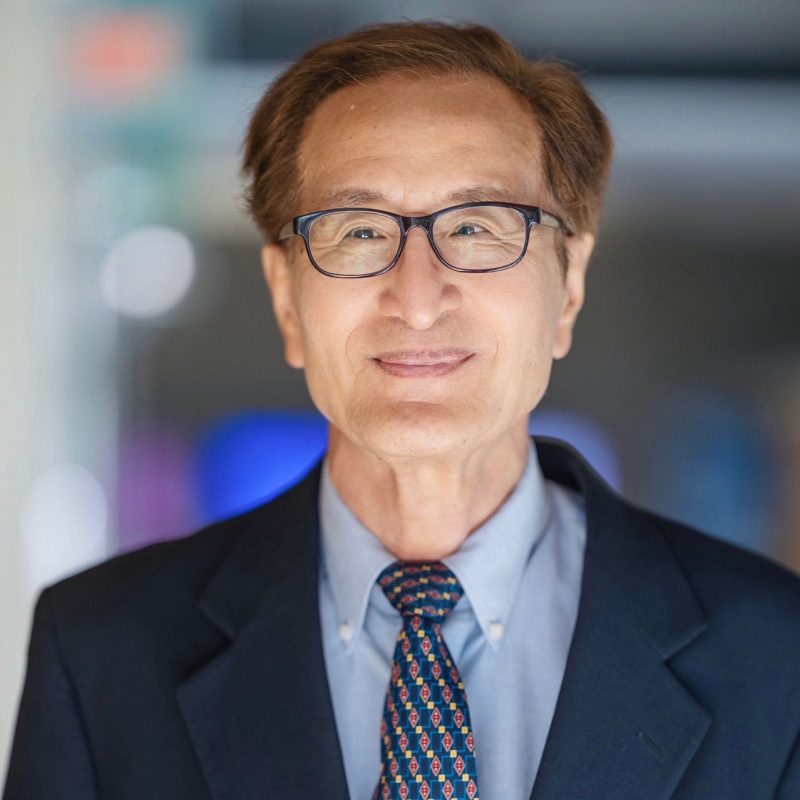
Dong S. Ha is a Professor in the Bradley Department of Electrical and Computer Engineering at Virginia Tech. As Founding Director of the Multifunctional Integrated Circuits & Systems (MICS) Lab, he focuses on advanced circuit design for energy harvesting, RF systems, and high-temperature electronics. His work spans analog/RF ICs, power management circuits, and wireless IoT solutions with machine learning integration. Education: PhD (1986) and MS (1984) in Electrical and Computer Engineering from the University of Iowa; B.S. (1974) in Electrical Engineering from Seoul National University. Research interests include energy harvesting (piezoelectric, thermal, RF), high-temperature RF circuits for oil/gas/spacecraft applications, and smart IoT systems. He actively seeks students for projects in RF design, energy harvesting, and embedded systems. His lab develops cutting-edge solutions for harsh environment communication, sustainable energy systems, and smart agriculture monitoring. Awarded IEEE Fellow (2008) for contributions to VLSI design/test. Key publications span energy harvesting circuits, GaN-based high-temperature systems, and low-power IoT architectures. Current projects include self-sustaining smart farm networks using federated learning and attack-resistant sensor systems. Labs/Teams: Leads MICS Lab focusing on integrated circuits and systems. Collaborates on cross-disciplinary projects involving machine learning, embedded systems, and sustainable energy. Active in industry partnerships for aerospace and automotive applications.