
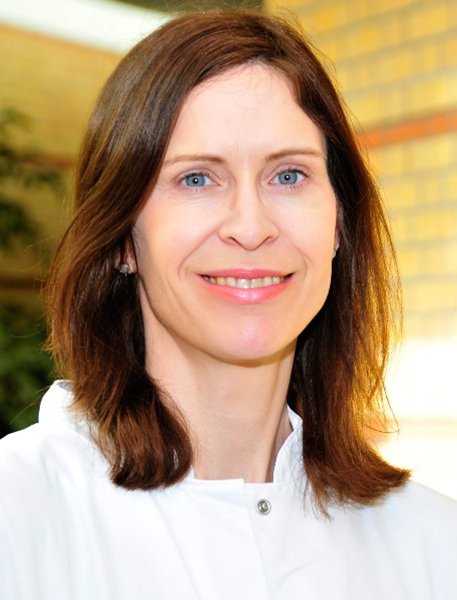
Prof Dr Agnes Flöel is a Professor at the University of Greifswald Medical School, where she leads research at the intersection of cognitive neuroscience, sleep physiology, and brain stimulation. Her work focuses on understanding neural mechanisms underlying memory formation and cognitive decline in aging, with particular emphasis on sleep-related processes and non-invasive brain stimulation techniques. Her research interests center on sleep physiology , cognitive neuroscience , and neurostimulation . Dr. Flöel investigates how slow oscillations, spindles, and delta waves interact during sleep to support memory consolidation, particularly in older adults and those with cognitive impairment. Her work extends to developing interventions combining cognitive training with transcranial direct current stimulation (tDCS) to enhance cognitive function in aging and early Alzheimer's disease. She also contributes to methodological advancements in sleep staging through deep learning approaches and addresses technical challenges in neuroimaging. Dr. Flöel's publication record demonstrates consistent productivity with multiple high-impact papers annually, primarily focused on sleep neuroscience, brain stimulation, and cognitive aging. Her work shows strong collaborative patterns with researchers across Germany, particularly within the SFB 1315 research consortium. Recent publications (2022-2024) increasingly incorporate computational approaches, deep learning, and multimodal neuroimaging to address fundamental questions about neural plasticity and memory. Her research has been supported through the Collaborative Research Center 1315 (SFB 1315) funded by the German Research Foundation, focusing on neuronal circuits in aging. Dr. Flöel serves as principal investigator for multiple clinical trials examining brain stimulation approaches for cognitive enhancement in older adults and those with mild cognitive impairment. Dr. Flöel leads a research group investigating sleep-brain interactions in aging, collaborating closely with computational neuroscientists, neurologists, and psychologists. Her team utilizes multimodal approaches including EEG, MRI, and behavioral assessments to understand neural mechanisms of cognitive decline and potential interventions.


