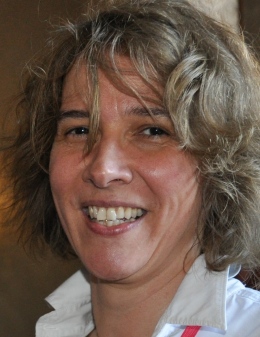
Edwin Langmann is a Professor of Physics at KTH Royal Institute of Technology in Stockholm, Sweden. He holds a PhD in Theoretical Physics from the University of Vienna (1990) and has held academic positions including Assistant Professor at KTH (1994–1998), Postdoc at the University of British Columbia (1991–1994), and various roles at Swedish institutions since 2000. His research focuses on mathematical physics, integrable systems, and superconductivity theory, with contributions to quantum many-body systems and exactly solvable models. Affiliations: Department of Condensed Matter Theory, KTH Royal Institute of Technology Educations: PhD (Theoretical Physics, University of Vienna, 1990), M.Sc. (Technical Physics, TU Graz, 1986) Langmann teaches courses in physics and mathematical methods, advising numerous master’s theses. His work bridges theoretical physics and mathematics, addressing topics like Calogero-Sutherland models, fractional quantum Hall effects, and Hubbard model phase diagrams. Recent research includes antiferromagnetic order in 3D systems and BCS superconductivity with finite-range potentials. He has supervised students including Frode Boman (2021), Max Oliveberg (2021), and Charles Gilljam (2020). His publications span journals such as Communications in Mathematical Physics and Physical Review B , emphasizing integrable systems and quantum field theory.
Ying Wang is an Associate Professor in English linguistics at Karlstad University since 2020, specializing in English for academic purposes, applied corpus linguistics, and second language writing. She holds a PhD from Uppsala University (2013) and has taught courses at both undergraduate and graduate levels focusing on academic writing, second language pedagogy, and corpus methodology. Her research explores rhetorical structures in disciplinary genres, evaluative language resources, and the impact of extramural English activities on L2 writing development. Notable projects include the Swedish Learner English Corpus (SLEC) initiative and analyses of predatory publishing practices in political science. She has also examined government communication strategies during the UK's COVID-19 pandemic response through corpus-assisted discourse studies. Key research contributions span formulaic language use in ELF contexts, methodological innovations in corpus linguistics, and linguistic comparisons between well-established and predatory journals. Her work bridges theoretical linguistics with practical applications in education and scholarly publishing ethics. Publications span prestigious journals like English for Specific Purposes , Text & Talk , and Journal of Second Language Writing , reflecting her interdisciplinary approach to language studies. Current projects emphasize corpus-driven research on academic communication practices and their pedagogical implications.
Henrik Nilsson is a Senior Lecturer at the Department of Education at Linnaeus University, Sweden. His work focuses on multicultural education contexts, school leadership, and organizational challenges in socially diverse educational settings. He holds a PhD in Education and actively collaborates with municipalities and the Swedish National Agency for Education on policy implementation. Research Groups: Center for Cultural Sociology, Center for Educational Leadership Key Projects: Seed project on addressing racism in teacher education programs His research investigates how schools navigate ethnic and social diversity, focusing on leadership practices, school improvement processes, and intercultural competence development in teacher training. He has published extensively on topics like immigrant incorporation,pedagogy in multicultural schools, and educational governance structures.
Niklas Wahlberg is a Professor in Biological Systematics at Lund University, Sweden. He holds roles including Museum Director of the Biological Museum and Principal Investigator in the BECC biodiversity initiative. His primary affiliation is with the Department of Biology, focusing on evolutionary biology and systematics of Lepidoptera. Education & Career: PhD in Evolutionary Biology from University of Helsinki (2000) Postdoc at Stockholm University (2000–2002) Academy Research Fellowship at University of Turku (2006–2011) Professor in Genetics at Turku (2014) before moving to Lund in 2015 Research Interests: His work centers on the evolutionary history of Lepidoptera, particularly diversification patterns linked to angiosperm evolution and mass extinction events. He employs molecular systematic methods, next-gen sequencing, and museum specimens to study clade origins and biogeography. Key topics include Cretaceous diversification, post-mass extinction radiation, and genomic discordance in butterflies. Awards & Recognition: Web of Science Highly Cited Researcher (2017, 2018) Elected to Kungliga Fysiografiska Sällskapet (2016) Grants & Projects: Swedish Research Council: Testing gene-trait associations in genome modifications (2025–2029) Infrastructure leader for museum collections and holistic specimen projects Labs & Collaborations: Head of the Systematic Biology Group at Lund, managing the Biological Museum’s collections. Active in global entomology networks and co-organizes major conferences like the International Congress of Entomology.
Jelena Zdravkovic is a Professor and Head of the Department of Computer and Systems Sciences (DSV) at Stockholm University. She leads the PRECIS research group which focuses on Process, Requirements, Enterprise, Capability, and Information Systems modelling. Her work spans theoretical and practical aspects of enterprise and IT solutions with a particular emphasis on digital transformation. Professor Zdravkovic's research interests center around Digital Business Ecosystems , Digital Twins , and Data-driven Requirements Engineering . Her work in Enterprise Modeling explores capability-oriented and consumer-oriented approaches to requirements engineering. She investigates how digital transformation and big data can be leveraged to improve requirements elicitation processes, and how organizations can model and manage complex digital business ecosystems. Her research has significant implications for how businesses can adapt to rapidly changing technological environments while maintaining resilience and competitiveness. Her recent publications reveal a clear trajectory toward integrating artificial intelligence with digital modeling techniques, particularly in the context of smart buildings and business ecosystems. There's a consistent focus on how data-driven approaches can transform traditional requirements engineering practices, making them more responsive to the velocity and variety of digital data sources. Her work bridges theoretical modeling with practical applications across various industries including healthcare, energy, and transportation. Professor Zdravkovic has been actively involved in mentoring PhD students, including supervising research on the Management Framework of Resilient Digital Business Ecosystems. She has participated in numerous national and international projects focused on interoperability and model-driven engineering, securing research funding for innovative work at the intersection of business and technology. She leads the PRECIS research group which deals with theories, methods and tools for analysis and design of organizational and IT solutions in congruence. The group's research covers three key topics – Enterprise Modelling, Business Process Management, and Conceptual Modelling. Their work brings together academic rigor with practical applications to solve real-world business challenges through innovative information systems approaches.
Zebo Peng is a Professor and Deputy Head of Department at Linköping University's Department of Computer and Information Science (IDA), leading the Software and Systems (SAS) division. His research focuses on embedded systems design, electronic design automation, SoC testing, and real-time systems with emphasis on fault tolerance and hardware/software co-design. He has contributed to projects like the ASTECC initiative, funded by the Swedish Foundation for Strategic Research, addressing adaptive software in edge-cloud continuum systems. Key research interests include cyber-physical systems security, time-sensitive networking (TSN), and optimization techniques using genetic algorithms. Recent work explores thermal-aware design for reliability, security-aware scheduling, and stability guarantees in control systems. His publications span journals like IEEE TPDS and ACM TECS, alongside conference contributions on topics like resource management and fault detection in distributed systems. Prof. Peng collaborates extensively within the SAS division, which bridges academic and industrial research in software engineering and computer systems. His team's projects address challenges in real-time systems, embedded security, and parallel computing architectures.
Sinisa Krajnovic is a Professor of Computational Fluid Dynamics and Head of the Department of Mechanics and Maritime Sciences at Chalmers University of Technology. His research focuses on vehicle aerodynamics, bluff-body flows, and time-dependent numerical simulations, particularly in ground vehicle flows (trains, cars, buses) and high-speed train dynamics. He leads studies on flow control mechanisms, bi-stable wake phenomena, and turbulence modeling using advanced CFD techniques like LES and PANS. Recent work emphasizes active flow control optimization, snow-resistance performance of bogies, and aerodynamic interactions in platoons. His 247+ publications span topics including high-speed train aerodynamics, ship airflow control, and bluff-body wake dynamics. Collaborations involve experimental validation and industrial applications in rail and marine transportation.
Vania Ceccato is a Professor at the Academy of Police Work, University of Borås, specializing in environmental criminology and situational crime prevention. She leads the international Nätverket Säkraplatser network, fostering collaboration between academia and practice for sustainable safety. Her research bridges urban design, rural criminology, and transit security, with a focus on inclusive safety measures. Her recent publications include studies on transit worker safety in Stockholm’s metro resilient urban design for climate and crime prevention LGBTQI+ safety in transportation rural-urban shooting patterns innovative survey methodologies Her work aligns with United Nations SDGs 9, 11, and 13, emphasizing how environmental criminology can drive sustainable, equitable urban development.
Dag Linnarsson is a Professor of Physiology at Karolinska Institutet, Department of Physiology and Pharmacology, where he has held the position since 1986 and transitioned to Senior Professor in 2009. His research primarily focuses on environmental physiology, with an emphasis on the human body's response to extreme conditions such as microgravity, hypergravity, and spaceflight. He leads the Environmental Physiology Research Group and the Lars Karlsson team, investigating topics like pulmonary function in astronauts, musculoskeletal countermeasures during space missions, and the effects of artificial gravity. His work spans studies on bed rest as a spaceflight analog, lung diffusing capacity, and nitric oxide dynamics under varying environmental pressures. Recent research includes assessing pulmonary nitric oxide levels in astronauts during long-term space missions and exploring the physiological impacts of lunar dust exposure. Linnarsson has also contributed to standardizing bed rest protocols for spaceflight research and evaluating centrifugation as a countermeasure for muscle and bone loss. He maintains affiliations with Karolinska Institutet’s C3 Fysiologi och farmakologi team and collaborates on interdisciplinary projects addressing space medicine challenges. While no formal student listings or awards are explicitly mentioned, his extensive publication record highlights contributions to respiratory physiology, cardiovascular adaptation, and musculoskeletal health in extreme environments.
Joacim Hansson is a Professor of Library and Information Science at Linnaeus University, Sweden. He teaches at doctoral and master's levels in Library and Information Science and the Digital Humanities program. His research focuses on Knowledge Organization (classification research), Document Studies (digital representation of cultural heritage), and Library Research (institutional identity of libraries). He is affiliated with the Centre for Digital Humanities and the Critical Knowledge Organization Research Group. He serves on editorial boards for journals like Journal of Librarianship and Information Science and is a Senior Associate Fellow at the International Institute of Hermeneutics. His work explores the intersection of classification systems, cultural heritage, and political influences on libraries. He has led projects such as 'Cultivating Information, Organizing Culture' and contributes to initiatives like EUniWell (European University for Well-Being). His publications analyze topics like bibliographic classification's societal role, public libraries in political turmoil, and Jewish library systems' philosophical foundations. He has authored books including Dewey och de svenska biblioteken and De ordnade böckernas folk . His research underscores libraries' democratic roles and the ethical dimensions of information organization. Education: Holds a PhD in Library and Information Science from Gothenburg University (1999) and a licentiate in library studies (1998). His doctoral work examined Swedish library classification systems' societal discourses. Grants and Projects: Leads the 'Cultivating Information' project and contributes to the ReSource graduate school on digital source criticism. Collaborates internationally on classification and cultural heritage digitization.
Tatiana Mikhaylova is a Lecturer at the University of Gävle. She holds a PhD from Uppsala University (2022) with a thesis exploring the historical and policy dimensions of private tutoring in Russia across Imperial, Soviet, and post-Soviet eras. Her research focuses on educational policy, shadow education systems, curriculum theory, and the role of quantification and visualization in shaping educational practices. She has conducted comparative studies between Sweden and Russia, examining how supplementary tutoring interacts with formal education systems. Her work analyzes the sociopolitical construction of educational policies, particularly how visual and numerical frameworks (e.g., Bloom’s Taxonomy, standardized testing metrics) influence educational governance and discourse. Key themes include historical pedagogical practices, the interplay between public and private educational sectors, and the ethical implications of AI integration in teacher training programs. Recent publications address topics like AI’s role in teacher professional development, the visualization of educational knowledge structures, and the quantification of reading comprehension benchmarks. She frequently collaborates with researchers such as David Pettersson and Emma Sundström Sjödin on projects examining Nordic educational policy and historical curriculum debates. Mikhaylova’s research has been presented at venues including the Nordic Education Research Association (NERA) conferences and the International Standing Conference for the History of Education (ISCHE). Her work bridges historical analysis with contemporary policy critique, emphasizing the need for critical perspectives on educational metrics and visual representation strategies.
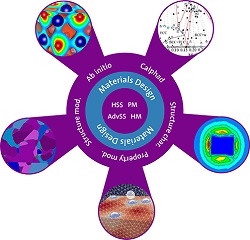
Peter Hedström is a Professor of Materials Science at the Department of Materials Science and Engineering, KTH Royal Institute of Technology. He leads the Hultgren Laboratory for Materials Characterization and directs the Center for X-rays in Swedish Materials Science (CeXS) and the Vinnova competence center NEXT. His research focuses on advanced materials characterization, structure-property relations, and materials design, particularly in metallic alloys, steels, ceramics, and composites. He co-founded companies Ferritico and Scatterin based on his research. Hedström’s work leverages large-scale infrastructure like synchrotron and neutron methods, with key projects including ENDUREIT for improving duplex stainless steels and Track-AM for additive manufacturing analysis. Education: PhD from Luleå University of Technology. Earlier roles at MEFOS/Swerim before joining KTH in 2008. Research Interests: Phase transformations, materials characterization (e.g., synchrotron/X-ray/neutron techniques), additive manufacturing, machine learning applications, and fatigue mechanics. His group explores topics like low-temperature embrittlement, microstructure-strength relationships, and cemented carbide sintering. Articles Trends: Recent work emphasizes in-situ observations of phase separation, precipitation kinetics, and microstructural stability under fatigue. Studies often integrate computational modeling with experimental methods, highlighting interdisciplinary approaches. Grants/Projects: Directs CeXS (hosting the Swedish beamline P21 at PETRA III) and NEXT. Active in EIT Raw Materials (ENDUREIT) and MMD initiatives. Supervises PhD/postdoc projects in neutron scattering, Mg-AM, and machine learning. Labs/Teams: Hultgren Laboratory, SwedNess graduate school, and collaborations with industrial partners like Ferritico.
Sarah Gillet is a Postdoctoral Researcher at the Division of Robotics, Perception, and Learning at KTH Royal Institute of Technology, where she focuses on developing social robot behaviors to foster collaboration and inclusion in human groups. Her research addresses challenges like in-group favoritism through computational approaches to shape group interactions. She holds a Doctoral Thesis (2024) titled Computational Approaches to Interaction-Shaping Robotics . Her work emphasizes group dynamics , robot-mediated inclusion , and pedagogical robotics , particularly in children and adolescent populations. Key areas include gaze behavior analysis, equitable participation promotion, and social robot roles such as mediators in educational settings. Dr. Gillet teaches the Social Robotics (DD2413) course and supervises master theses. Her recent publications explore robot gaze behaviors for participation balance, socially appropriate listening, and influence prediction models like RoSI. She actively participates in conferences like ACM/IEEE HRI and IEEE RO-MAN. Her research integrates computational methods with social science insights to design robots that actively improve human group interactions, with applications in education, collaboration, and bias mitigation.
Fredrik Sandin is a Professor in the Department of Computer Science, Electrical and Space Engineering at Luleå University of Technology, where he leads the Machine Learning research group with approximately thirty members. His work focuses on neuromorphic technologies and the intersection of machine learning with computational physics to solve challenging real-world interaction problems. He coordinates the 'Teknisk fysik och elektroteknik' program at LTU and has been instrumental in establishing neuromorphic research activities at the university. Luleå University of Technology, Department of Computer Science, Electrical and Space Engineering Member of WASP (Wallenberg AI, Autonomous Systems and Software Program) and ELLIS (European Laboratory for Learning and Intelligent Systems) Coordinator of Neuromorphic Innovation Platform Sweden with KTH, Lund University, Uppsala University, FOI, ABB, Ericsson, and SAAB Fredrik earned his PhD in Physics from Luleå University of Technology in 2007, with thesis work focusing on dense states of matter in neutron stars. His academic journey began with an MSc diploma work in ATLAS at CERN in 2001, followed by postdoctoral research in computational physics at IFPA in Belgium (2008-2009) and brain-like computing at EISLAB with Prof. Jerker Delsing (2010-2011). Professor Sandin's research interests center around neuromorphic technologies, particularly neuromorphic computing and spiking neural networks. He investigates sensor/detector and intelligent systems co-design where constraints like energy, power, latency, and dynamic range challenge conventional digital approaches. His work spans mixed-signal neuromorphic circuits, algorithms, and systems, as well as machine learning projects involving industrial data and collaboration. He has been a key figure in establishing neuromorphic research at LTU, supported by The Kempe Foundations, particularly through the 2014 Gunnar Öquist Fellowship. His recent publications demonstrate a strong interdisciplinary focus spanning quantum phase transitions, particle physics detector optimization, renewable energy materials, and the integration of large language models into control systems. This diverse portfolio reflects his approach connecting machine learning with fundamental physics and practical engineering applications, particularly in neuromorphic computing and intelligent systems design, with emphasis on solving real-world problems through co-design of hardware and algorithms. Gunnar Öquist Fellowship Award and 3 MSEK grant from The Kempe Foundations ISSP award for an Original Work in Theoretical Physics (signed by Prof. 't Hooft and Prof. Zichichi) New-Talents award for original work in theoretical physics at the International School of Subnuclear Physics in Erice Professor Sandin has supervised numerous PhD students working on topics ranging from neuromorphic TinyML to materials for neuromorphic computing, privacy-preserving machine learning at the edge, and intelligent fault diagnosis. He has secured substantial research funding from various sources including Vinnova, ÅForsk, Kempe Foundations, WASP-WISE, and EU programs like ECSEL JU Arrowhead Tools and ITEA3 AutoDC. His current major projects include the Neuromorphic Innovation Platform Sweden and several initiatives focused on neuromorphic condition monitoring and computing, with total funding exceeding 30 MSEK in the past five years. He leads the Machine Learning group at LTU, which collaborates extensively with industry partners including ABB, Ericsson, SAAB, SKF, and RISE. The group is active in developing neuromorphic technologies for wireless sensor networks, condition monitoring systems, and next-generation intelligent systems that address energy, power, and latency constraints that challenge conventional digital approaches.
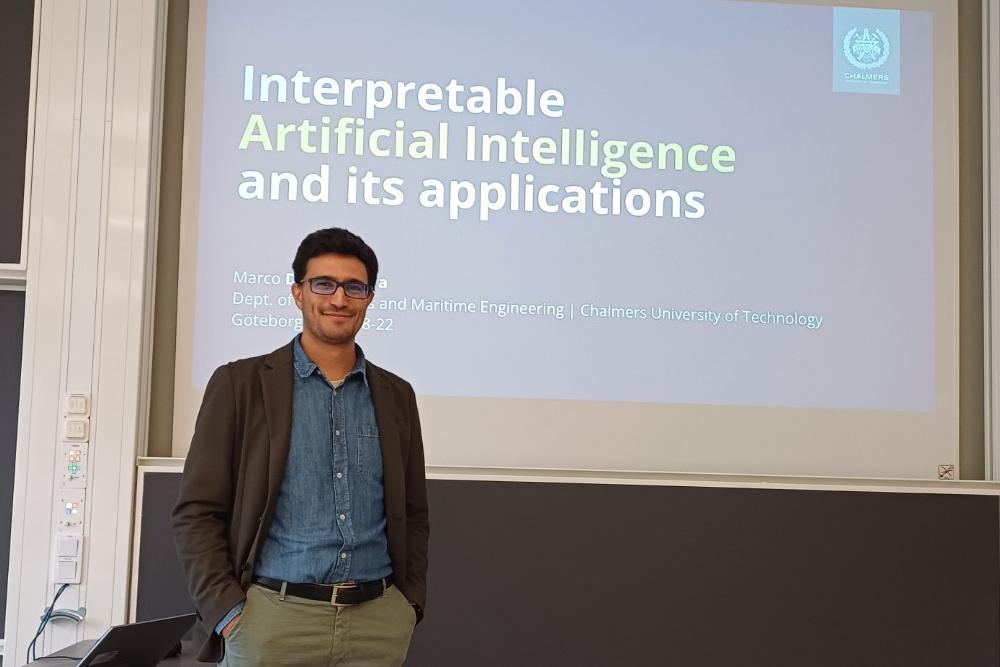
Marco L. Della Vedova is a Senior Lecturer in Applied Artificial Intelligence at Chalmers University of Technology, Sweden. He works in the Vehicle Engineering and Autonomous Systems division within the Department of Mechanics and Maritime Sciences, as part of Prof. Mattias Wahde's research group. Since 2025, he has served as Director of the Data Science and AI master's programme (MPDSC) at Chalmers, where he teaches courses including Introduction to Artificial Intelligence and Digitalization in Sports. Dr. Della Vedova earned his academic foundation at the University of Pavia, Italy, where he completed his BSc (2006), MSc (2009), and PhD (2013) in Computer Engineering. His doctoral research focused on "Real-Time Physical Systems and Electric Load Scheduling" under Prof. Tullio Facchinetti. During his PhD studies, he spent a year at U.C. Berkeley hosted by Prof. Francesco Borrelli at the Model Based Predictive and Distributed Control Lab. His research spans multiple AI domains with a strong emphasis on interpretability. Dr. Della Vedova develops interpretable methods for conversational AI, naturalness evaluation of forests using canopy height models, and geospatial applications. His work bridges theoretical AI with practical societal benefits, particularly in environmental monitoring, transportation systems, and orienteering. He has previously contributed to cloud computing, hate speech detection, and cyber-physical energy systems, demonstrating his interdisciplinary approach to AI research. Dr. Della Vedova's publication record reveals a consistent trajectory of impactful research across multiple domains of artificial intelligence. His recent work shows a strong focus on interpretability in AI systems, with significant contributions to natural language processing, geospatial analysis, and causal inference. The research demonstrates both theoretical depth and practical applications, particularly in environmental monitoring and social media analysis. His methodology often combines traditional machine learning approaches with novel interpretability techniques, creating bridges between complex AI systems and human understanding. Dr. Della Vedova has received several prestigious recognitions for his work: Best PhD thesis award from the Order of the Engineers of Bergamo (2013) Italian champion of Il Cervellone (2012) Top Italian performer in IEEEXtreme 6.0 programming competition (148th overall globally, 2012) Premio Arturo Schena award from Fondazione Credito Valtellinese (2010) With over 50 students supervised through bachelor's and master's theses, Dr. Della Vedova has established himself as a dedicated mentor in the AI community. His current PhD students include Minerva Suvanto working on interpretable NLP and Vivien Lacorre developing AI for railway infrastructure inspection. His supervision spans diverse topics from forest naturalness evaluation to hate speech detection and transportation optimization. Beyond formal supervision, he actively contributes to educational initiatives including serving as Director of Chalmers' Data Science and AI master's program and developing innovative teaching methods that connect theoretical concepts with real-world applications. Dr. Della Vedova is deeply embedded in both academic and professional communities. He leads the Applied Artificial Intelligence research group at Chalmers while maintaining strong connections with European research networks through projects like the ERASMUS+ EUrienteering initiative. His interdisciplinary approach is reflected in collaborations across computer science, environmental science, and social sciences. Notably, he applies his AI expertise to orienteering both as a researcher developing localization methods and as a licensed Event Advisor for the International Orienteering Federation, demonstrating how his professional and personal interests converge in innovative ways.