
Nitin J Sanketمشاهده پروفایل
استادیار
- Robotics
- Autonomous Systems
- Computer Vision
- +۸ مورد دیگر
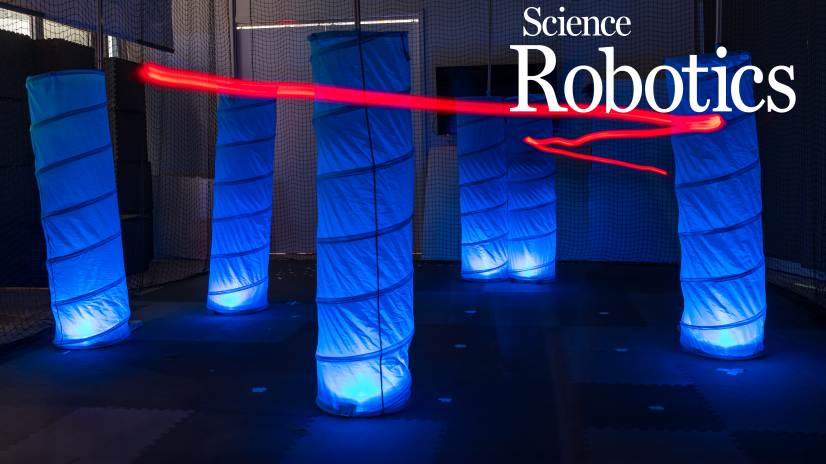
Nitin J Sanket is an Assistant Professor in the Robotics Engineering Department at Worcester Polytechnic Institute, where he leads the Perception and Autonomous Robotics Group (PeAR) founded in 2022. His research focuses on advancing autonomy for tiny mobile robots through bio-inspired approaches that enable on-board sensing and computation without external infrastructure. Ph.D. in Computer Science from University of Maryland, College Park (2021) M.S. in Robotics from University of Pennsylvania (2016) B.E. in Electronics and Communication from M. S. Ramaiah Institute of Technology, Bangalore, India (2013) Professor Sanket's research centers on four interconnected thrusts: Active perception (using movement to simplify perception problems), Interactive perception (selectively interacting with the environment), Novel perception (using data statistics like neural network uncertainty), and Novel sensing (employing sensors like event cameras). His work targets extreme resource-constrained robots, exemplified by the world's first RoboBeeHive prototype – hummingbird-sized nano-quadrotors capable of pollination with all sensing and computation performed on-board. His lab's 'Minimal-AI' philosophy emphasizes efficiency, using perception-action synergy to solve complex problems with minimal computational resources. His recent publications reveal a strong focus on efficient vision algorithms for tiny robots, with papers in Science Robotics (featured on the cover), IEEE ICRA, IROS, and CVPR. Key themes include uncertainty modeling for resource-constrained systems, event-based vision, and bio-inspired navigation. His work frequently bridges theoretical innovation with practical implementation on real hardware. Larry S. Davis Award for Best Computer Science PhD Thesis at University of Maryland (2021) MDPI Drones 2021 PhD Thesis Award Brin Family Prize (2018) Science Robotics cover feature (2023) Professor Sanket actively mentors 19 students (3 PhD, 6 Masters, 10 undergraduates) and recently secured a $705K NSF grant (September 2025) for bio-inspired sound navigation in tiny robots. His lab emphasizes hands-on experience with real hardware systems rather than pure simulation. His research on bat-inspired drones for search and rescue operations has received extensive media coverage from Associated Press, Washington Post, NPR, and other major outlets, demonstrating the real-world relevance of his work. The Perception and Autonomous Robotics Group (PeAR) provides students with opportunities to work on cutting-edge problems in nano-drone development, bio-inspired navigation, and minimal-AI approaches, preparing them for careers at the forefront of robotics innovation.