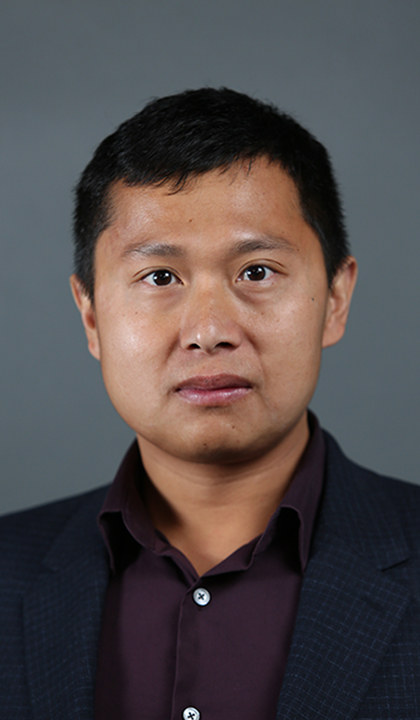
Mark R. Greenstreet is a Professor in the Department of Computer Science at the University of British Columbia (UBC). He holds a BSc from Caltech (1981), MA (1988), and PhD (1993) in Computer Science from Princeton University. His primary research focuses on formal verification of analog and mixed-signal (AMS) circuits, VLSI design, and hybrid systems. Notable contributions include the STARI signaling technique, tools like Coho for reachability analysis, and PReach for parallel model checking. He has advised numerous graduate students and collaborators, including Brad Bingham, Chao Yan, and Yan Peng. His work has been recognized with a Best Paper Award at the ASYNC Symposium. Supported by NSERC, Intel, and Oracle, his research bridges theoretical foundations and practical challenges in circuit design and verification. He teaches courses on formal methods, computer architecture, and automata theory at UBC.
Roderich Gross is a Senior Lecturer in the Department of Automatic Control and Systems Engineering at the University of Sheffield. He is also a Visiting Scientist at CSAIL, MIT, and leads the Enabling Technologies theme at Sheffield Robotics. His academic journey includes a Ph.D. in engineering science from Université libre de Bruxelles (2007), followed by postdoctoral fellowships as a JSPS Fellow (Tokyo Institute of Technology), Research Associate (University of Bristol), and Marie Curie Fellow (EPFL & Unilever). Research Interests : Swarm robotics, self-reconfigurable robots, multi-robot coordination, robotics software/tools (human-robot interaction interfaces, formal design tools), machine learning for behavior inference (Turing Learning, GANs), autonomous systems, natural computing (swarm intelligence, evolutionary algorithms). Scientific Contributions : Inventor of Turing Learning, a machine learning method for behavior inference. Key work includes swarm coordination, self-assembly, fault-tolerant quadcopters, energy-efficient drone delivery, and infrared-based swarm communication. Scientific Recognition : Held prestigious fellowships including JSPS and Marie Curie, and served as Associate Editor for leading robotics journals (IEEE Robotics and Automation Letters, Swarm Intelligence) and conference roles (General Chair DARS 2016, Program Co-Chair GECCO 2018). Grants : Principal Investigator on Horizon Europe OpenSwarm (£463,699), EPSRC Core Capital (£104,196), DSTL Multi Robot Systems (£98,781), and industry-funded modular robotics projects. Labs : Affiliated with the Natural Robotics Lab at the University of Sheffield.
Richard Futrell is an Associate Professor at the University of California, Irvine (UCI), affiliated with the Department of Language Science. He leads the Language Processing Group, focusing on computational models of human and machine language processing. His work bridges information theory, Bayesian cognitive modeling, and natural language processing (NLP) interpretability. University of California, Irvine Department of Language Science Language Processing Group leader His research examines how linguistic structures emerge from cognitive and communicative pressures. Key areas include dependency locality, surprisal theory in sentence processing, and efficiency-driven language evolution. He investigates how memory constraints, predictability, and information density shape syntactic and morphological patterns across languages. Recent publications analyze code-switching efficiency, syntactic priming, ERP component modeling, and agent-based language contact simulations. His work frequently employs Bayesian modeling, neural network analysis, and cross-linguistic corpora to uncover universal principles in language processing. ACL Best Paper Award (2024) Best Paper Award for Computational Modeling of Language (2023) Marr Prize for Best Student Paper (2017) He has developed datasets like SPACER for error repair analysis and contributed to phonotactic learning frameworks. His collaborations span cognitive scientists, computational linguists, and neuroscientists, advancing understanding of language production, comprehension, and structural optimization.
Mauro Maggioni is a Professor in the Departments of Mathematics and Applied Mathematics and Statistics at Johns Hopkins University. His research focuses on the mathematical foundations of Data Science, with applications in molecular dynamics, hyperspectral imaging, and reinforcement learning. He employs techniques from Harmonic Analysis, Approximation Theory, and Probability to develop scalable algorithms, particularly multiscale methods for analyzing high-dimensional data. Maggioni’s work bridges theoretical mathematics and practical applications, including cardiac electrophysiology modeling, unsupervised segmentation of hyperspectral images, and reduced-order modeling of complex systems. Education: B.S. in Mathematics from Università degli Studi in Milan, Italy; Ph.D. in Mathematics from Washington University in St. Louis. He held a Gibbs Assistant Professorship at Yale before moving to Duke University and later becoming a Bloomberg Distinguished Professor at JHU. Research Interests: Mathematical foundations of Data Science, Machine Learning, Partial Differential Equations, and their applications in physical and biological systems. Notable contributions include diffusion wavelets, interaction kernel learning, and multiscale geometric analysis of molecular dynamics data. Scientific Awards: Popov Prize in Approximation Theory (2007), NSF CAREER Award and Sloan Fellowship (2008), Fellow of the American Mathematical Society (2013), Simons Fellowship (2020). Advising & Grants: Maggioni mentors postdocs and students in areas like stochastic systems and signal processing. His group’s work is supported by Simons Foundation grants, NSF funding, and collaborations with institutions like MINDS and CIS at JHU. Labs/Teams: Leads a research group focused on data-driven discovery in mathematics and applied sciences, emphasizing interdisciplinary collaboration across computational methods, statistics, and domain-specific applications.
Philip Bille is a Professor and Head of the Algorithms, Logic and Graphs section at the Department of Applied Mathematics and Computer Science, Technical University of Denmark (DTU), College of Engineering. His research centers on the design and analysis of efficient algorithms, particularly for string processing, compressed data, and data structures. His research interests lie at the intersection of theoretical computer science and practical applications. He focuses on algorithms , data structures , string indexing , pattern matching , and compressed computation . His work enables efficient querying and processing of large-scale, repetitive data, with applications in bioinformatics, intrusion detection, and green computing. The recent publications reflect a strong trend in developing space-efficient and fast algorithms for modern computational challenges. Key themes include compressed data structures , sliding window indexing , finite automata compression , and energy-aware matrix operations . These works demonstrate expertise in balancing theoretical rigor with practical performance. Philip Bille actively supervises multiple PhD students and leads several research projects. He contributes to advancing sustainable computing aligned with UN SDGs. His work integrates algorithmic theory with real-world efficiency. Supervises PhD projects on hierarchical compression, adaptive computation, and vector processor algorithms. Involved in research on green computing, compressed formats, and efficient data models. He is affiliated with the Algorithms, Logic and Graphs group at DTU, a hub for theoretical and applied algorithmic research. The team explores fundamental problems in data representation and processing, pushing the boundaries of what is computationally feasible in terms of time and space.
Geoffrey Nelissen is an Assistant Professor in the Department of Mathematics and Computer Science at Eindhoven University of Technology. He holds additional roles as a Research Scientist and Investigador Auxiliar at INESC TEC (Portugal), contributing to interdisciplinary research in real-time systems. His work focuses on schedulability analysis, parallel task execution, and real-time communication protocols, with applications in embedded systems and multicore architectures. Research Interests: Real-Time Scheduling Response Time Analysis Multi-core and Parallel Systems Time-Sensitive Networking (TSN) Formal Verification Recent work emphasizes schedule abstraction frameworks, memory contention analysis, and deterministic communication protocols. His research has received recognition through multiple best paper awards including ICESS 2021 and RTAS 2022. He actively contributes to conferences like RTSS and ECRTS while teaching courses on Real-Time Systems and Operating Systems. Collaborations span European institutions with focus on embedded systems, autonomous driving, and safety-critical applications. Current projects explore holistic approaches to WCRT analysis and resilient real-time communication architectures.
José Luiz Fiadeiro is a Professor at Royal Holloway, University of London , affiliated with the Centre for Distributed and Global Computing. He previously held positions at the University of Leicester (including Head of Department), University of Lisbon, and Technical University of Lisbon. He has conducted visiting research at Imperial College London, King’s College London, PUC-Rio, University of Pisa, SRI International, UPC Barcelona, and NASA Ames. Research Interests: Formal aspects of software system modeling and analysis in global ubiquitous computing, with emphasis on distributed systems, formal verification methods, and service-oriented architectures. His work integrates theoretical computer science with practical software engineering challenges. Editorial & Leadership: Associate Editor: SN Computer Science Board Member: Information Processing Letters, EPTCS Steering Committee: CALCO (co-founder), ETAPS, FASE, WADT, WS-FM Scientific Board: INESC-TEC (Portugal) Awards & Honors: Elected Member, Academia Europaea Fellow, British Computer Society Grants & Projects: Leverhulme Trust Visiting Professorship (2018) Semantic Completions: Unifying Wave/Particle Information Views (AFOSR, 2016) Modeling and Analysis of Dynamic Interaction Networks (Royal Society, 2013–2015) Verification of Service-Oriented Systems (EPSRC, 2012) Professional Service: Extensive panel membership for research assessment in Portugal, Romania, Belgium (AEQES), France (AERES), and Lithuania (SKVC).
Dmitriy Traytel is an Associate Professor at the University of Copenhagen's Department of Computer Science since August 2020, where he currently heads the Software, Data, People & Society (SDPS) section. Prior to this position, he worked as a senior researcher (Oberassistent) in the Information Security Group led by David Basin at ETH Zürich. He completed his PhD at TU München under Tobias Nipkow's supervision in 2015. His research focuses on formal methods, particularly logic, automata theory, runtime verification and monitoring, decision procedures, (co)induction and (co)recursion, and interactive theorem proving. Traytel develops formally verified tools for runtime monitoring including VeriMon, TimelyMon, and WhyMon, emphasizing correctness and efficiency in monitoring complex temporal properties. His recent publications (2021-2025) demonstrate a strong focus on first-order temporal logic monitoring, with particular attention to explainable verdicts, scalable parallel implementations, and formal verification of monitoring algorithms. The work spans theoretical foundations in logic and category theory while maintaining practical applications in runtime verification systems. Distinguished Paper Award at POPL 2025 for 'Barendregt Convenes with Knaster and Tarski' Best Student Paper Award at FSCD 2016 Distinguished Paper Award at ATVA 2018 Traytel has supervised numerous PhD, Master's, and Bachelor's students in areas spanning formal verification, runtime monitoring, and theorem proving. His research has been supported through collaborations with major institutions including ETH Zürich and TU München. He actively contributes to the academic community by serving on program committees for major conferences including ITP 2025 and RV 2025. He leads the Software, Data, People & Society section at the University of Copenhagen, focusing on developing formally verified tools for runtime verification that bridge theoretical computer science with practical applications in security and system monitoring.
Professor Damien Woods is a faculty member at Maynooth University's Faculty of Science & Engineering, specifically affiliated with the Department of Computer Science and the Hamilton Institute. He leads groundbreaking research in DNA computing, molecular programming, and optical computing, focusing on self-assembly, algorithmic design, and computational complexity. ERC Consolidator Grant: 'Computationally Active DNA Nanostructures' SFI ERC Support Award EIC Pathfinder Challenge Grant: 'DISCO - DNA Infrastructure for Storage and Computation' His research projects explore programmable DNA storage, molecular robotics, and robust self-assembly systems. Recent publications span diverse topics like algorithmic DNA tile assembly, thermodynamic stability, and computational universality in nanosystems. Awards include ERC and SFI grants, with a focus on bridging theoretical computer science and experimental molecular biology. Scientific Contributions include: 2022: 'Turning Machines' - Molecular Robotics 2019: 'Diverse Molecular Algorithms' in Nature 2017: 'A Cargo-Sorting DNA Robot' in Science
Kenan Li, Ph.D., is an Associate Professor in the Department of Epidemiology and Biostatistics at Saint Louis University’s College for Public Health and Social Justice. He joined SLU in August 2022 and teaches courses such as Statistical Learning, R for Spatial Analysis, and Environmental Determinants of Health. His research bridges data science, GIS, and public health, focusing on spatial computation, environmental exposures, and community resilience. Ph.D. in Environmental Sciences, Louisiana State University M.S. in Environmental Sciences, Louisiana State University B.S. in Environmental Sciences and Applied Mathematics, Nankai University, China Dr. Li’s research interests lie at the intersection of spatial computation, environmental health, and community resilience . He develops geo-AI frameworks , integrated geo-cyber-infrastructures , and biostatistics algorithms using big data, deep learning, and sensor data. His work emphasizes understanding human-environment interactions, urban sustainability, and health disparities. His recent publications from 2023 to 2015 reveal a strong trend in spatial modeling of population dynamics , machine learning for environmental exposure analysis , and resilience assessment in vulnerable coastal regions. He has pioneered methods like Dynamic Time Warping Self-Organizing Maps and Wavelet-based Shapelet Discovery to extract meaningful patterns from high-frequency sensor data. His scientific awards include the Taylor Geospatial Institute Seed Grant (2023) , the Saint Louis University 2023 Health Research Grant , and selection for the Scholarly Undergraduate Research Grants and Experiences . He has secured funding from NSF, NIH, USC Keck School of Medicine, and the US Army Corps of Engineers. Dr. Li has advised and collaborated on numerous research projects, particularly in interdisciplinary teams studying the Mississippi River Delta and urban health interventions. He has been involved in NIH/NIBIB-funded projects and led research on emergency management of trail systems in Los Angeles County. He is actively involved in building research labs and teams focused on spatial data science and public health analytics , having previously worked at USC’s Spatial Sciences Institute and Population and Public Health Sciences Department.
Jim Crutchfield is a Distinguished Professor of Physics at the University of California, Davis, where he also serves as Director of the Complexity Sciences Center. He holds additional affiliations as President and Scientific Director of the Art & Science Laboratory in Santa Fe, External Faculty at the Santa Fe Institute, General Member of the Telluride Science Research Center, and Visiting Scholar at the Redwood Center for Theoretical Neuroscience. His work bridges physics, computation, and complex systems. Education: B.A. summa cum laude in Physics and Mathematics, University of California, Santa Cruz (1979) Ph.D. in Physics, University of California, Santa Cruz (1983) Crutchfield's research centers on computational mechanics , a framework he pioneered to quantify how natural systems store, process, and transmit information. His interests span nonlinear dynamics, evolutionary dynamics, information engines, quantum computation, and pattern discovery. He explores how structure emerges in complex systems, from cellular automata to biological evolution and neural networks. His recent work focuses on thermodynamic computing, causal inference, and the physics of intelligence. His publications reveal a consistent focus on the interplay between information, energy, and computation in physical systems. Themes include the thermodynamics of information engines, causal architecture in time series, emergent organization, and intrinsic computation in quantum and classical domains. These works span disciplines such as physics, computer science, biology, and cognitive science. Scientific Recognition: Postdoctoral Fellow, Miller Institute for Basic Research in Science IBM Postdoctoral Fellow, Condensed Matter Physics Distinguished Visiting Research Professor, Beckman Institute Bernard Osher Fellow, San Francisco Exploratorium NSF Graduate Fellow UCB Chancellor’s Fellow Crutchfield has advised over two dozen PhD students in physics, computer science, and mathematics, contributing significantly to the next generation of complexity scientists. He has led major interdisciplinary initiatives, including NSF-funded museum exhibits and workshops on network dynamics, collective cognition, and evolutionary dynamics. He has also been active in public discourse through talks, films, and publications on the philosophy of complexity. He leads research groups exploring the dynamics of learning, pattern discovery, and distributed intelligence, often in collaboration with institutions like the Santa Fe Institute and Caltech. His work continues to shape the theoretical foundations of complex systems science.
Xuan Zhang is an Associate Professor at the Department of Information and Communication Technology, University of Agder. His research focuses on Tsetlin Machines, learning automata, and their applications in machine learning, computer vision, and hyperspectral imaging. Research Trends: Zhang’s recent work includes developing interpretable machine learning models (e.g., Tsetlin Machines), optimizing convolutional architectures for image processing, and applying automata theory to solve multi-armed bandit problems and channel selection in cognitive networks. His field spans theoretical analysis and practical implementations in AI, remote sensing, and health informatics. Scientific Contributions Co-developed advanced Tsetlin Machine variants for XOR/NOT operator convergence, disease forecasting, and image restoration Published in journals like IEEE Transactions on Pattern Analysis and Machine Intelligence , Information Sciences , and Applied Intelligence Explored Bayesian pursuit algorithms, hierarchical learning automata, and particle swarm optimization techniques Contact: xuan.zhang@uia.no
Mohammed Y Niamat is a full-time Professor in the Department of Electrical Engineering and Computer Science at the University of Toledo's College of Engineering . His research focuses on hardware security, FPGA vulnerabilities, and blockchain applications in cybersecurity. Research Interests : Physical Unclonable Functions (PUFs), FPGA Security, Blockchain-based Security Frameworks, IoT Security, Smart Grid Authentication, Machine Learning Vulnerability Analysis Publications : Over 85 publications from 1986-2024, with recent works on integrations of blockchain and PUFs for secure supply chains, neural network modeling attacks on PUFs, and hardware Trojan detection techniques. Collaborations : Co-authored with Junghwan Kim (4), Weiqing Sun (2), Richard Molyet (1). Recent Article Trends : 2024 works on zero-trust architecture for FPGA supply chains using blockchain and ROPUFs; 2023 studies on IoT device authentication, hardware Trojan detection, and NFT-based IP protection; 2021-2019 research on machine learning attacks against PUFs, lightweight cryptographic designs for IoT, and BER optimization in wireless systems.
Bernhard Aichernig is an Associate Professor at the Institute of Software Engineering and Artificial Intelligence. His work bridges formal methods, model-based testing, and artificial intelligence, with a focus on automata learning, digital twins, and AI-assisted programming. Institution: Institute of Software Engineering and Artificial Intelligence Key Research Areas: Model-Based Testing, Automata Learning, AI-Driven Verification His research explores the integration of machine learning into formal verification, enabling scalable testing of complex systems like IoT devices and reinforcement learning agents. Recent projects include AI-Augmented DevOps frameworks (AIDOaRT) and digital twin validation (LearnTwins). Notable scientific awards include multiple best paper recognitions at SEFM (2020, 2021) and the TAYSIR Competition first place (2023). His publications emphasize hybrid approaches combining genetic programming, SMT solving, and neural networks for system modeling. 2025 : AI-assisted programming, timed automata via domain knowledge 2024 : Stochastic environment modeling, Git system learning 2023 : Reinforcement learning under partial observability, digital twins for VPN servers He actively contributes to testing frameworks like AALpy and investigates explainable AI for fault diagnosis in cyber-physical systems.
Maxime CORDY is a Research Scientist at the Interdisciplinary Centre for Security, Reliability and Trust (SnT) , University of Luxembourg, within the Security, Design and Validation group (SerVal) . He holds a PhD from the University of Namur (Belgium, 2014) and specializes in software engineering, applied artificial intelligence, and cybersecurity. His work focuses on adversarial machine learning, deep learning robustness, and model checking for critical systems. Research interests include adversarial attacks on tabular data , energy system optimization , code understanding models , and software quality assurance . Recent projects address challenges in secure AI deployment, automated test generation, and fault detection in large language models. Publications emphasize empirical studies on adversarial defenses, data augmentation for code models, and energy consumption forecasting. He contributes to tools like Daedalux (variability-aware model checking) and benchmarks like Tabularbench for adversarial robustness evaluation. Current affiliations include leadership within the SerVal group and collaborations on interdisciplinary projects such as MALETSQUE (Machine Learning Techniques for Software Quality Evaluation). His work bridges theoretical computer science with practical applications in energy systems, medical imaging, and space program design.