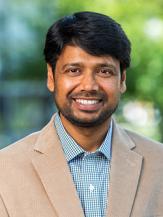
Kamesh Madduri is an Associate Professor in the Department of Computer Science and Engineering at Pennsylvania State University, with affiliations to the Huck Institutes of the Life Sciences. His research focuses on graph analytics, parallel algorithms, and high-performance computing for large-scale data analysis. NSF CAREER Award (2013) His work contributes to the development of scalable graph partitioning algorithms, extreme-scale sparse data analytics, and heterogeneous computing frameworks. Recent projects include multilayer network analysis (NetSplicer) and GPU-accelerated graph processing (Jet). Key research areas include network science, computational biology, and distributed-memory graph algorithms. His publications highlight applications in genomic workflows, advertising keyphrase recommendation (Graphite/BroadGen), and large-scale hydrology data management. Collaborative Research: CCRI (2021-2023) SHF: Medium: NetSplicer (2020-2024) PPoSS: Extreme-scale Sparse Data Analytics (2018-2022) XPS: Genomic Workflows Acceleration (2014-2020) EAGER: SME Manufacturing Integration (2024-2026)
Dr. Gillian Pink is a Senior Researcher at the Voltaire Foundation , University of Oxford, specializing in the digitization and analysis of Voltaire's marginalia , notebooks , and working manuscripts . Her research spans French Enlightenment literature , manuscript studies , and book history . Deputy General Editor of the Digital Voltaire project Member of Société des études voltairiennes Associated with Équipe Écritures et Lumières (ITEM, Paris) Her work integrates digital humanities with traditional textual criticism , focusing on the genesis of literary texts and authorial reading practices . Recent publications and conference papers analyze Voltaire's annotation systems , textual reuse , and collaborative manuscript production . She contributes to critical editions of Voltaire's posthumous works and marginalia .
Tiago Manuel Ribeiro Gomes is an Assistant Professor at the Department of Industrial Electronics within the School of Engineering at the University of Minho, Portugal. He is also a Senior Researcher at Centro ALGORITMI and a member of both the IE R&D Group and the ESRG R&D Lab. Holding a Ph.D. in Electronics and Computers Engineering, his research focuses on embedded real-time systems, computer architectures, and hardware/software co-design for IoT devices. Academic Degree: Ph.D. in Electronics and Computers Engineering Current Position: Assistant Professor, School of Engineering, University of Minho Gomes has led extensive research in IoT systems over 15 years, particularly in hardware acceleration for automotive LiDAR sensors, secure embedded systems, and efficient OS frameworks for low-end devices. His work includes the EU-funded CROSSCON project and spans hardware-assisted security, dynamic binary translation, and wireless sensor networks. Recent publications highlight his expertise in automotive sensor technology, with articles like FOG-Zip for LiDAR compression, SecureQNN for TinyML security, and Hardware-Assisted Range Image Generation for LiDAR processing. His work bridges IoT, embedded systems, and cybersecurity, focusing on real-time performance and hardware-software co-design. Projects include the development of reliable/secure automotive sensor solutions and EU project CROSSCON. He contributes to open-source frameworks like UTango for IoT security and investigates heterogeneous fault tolerance architectures using Arm/RISC-V processors. Labs: IE R&D Group, ESRG R&D Lab Education: Ph.D. in Electronics and Computers Engineering, Master’s in Telecommunications Engineering (both from University of Minho)
Professor Imogen Tyler is a leading sociologist at Lancaster University , renowned for her groundbreaking work on stigma, social abjection, and resistance . As a Fellow of the Academy of Social Sciences and recipient of the Stanford-Elsevier Top 2% Scientist ranking, Tyler's research spans social inequality, race, citizenship, and historical sociology , with a focus on neoliberalism's impact. Her influential books, Revolting Subjects (2013) and Stigma: The Machinery of Inequality (2020), have become essential texts in global sociology curricula. Key Research Themes : Stigma as structural power, anti-racist education, waste colonialism, welfare state critique, and community-aligned research methods. Recent Projects : Hard Times: Poverty and Protest in Britain and Elemental Inequalities: Struggles for Life Against State-Sanctioned Killing . Tyler's scholarly output reveals consistent engagement with neoliberal governance, racialised poverty, and creative resistance across two decades. Her scientific accolades include the Lancaster University Research Award (2014), Philip Leverhulme Prize (2015), and recognition for her Stigma Machine research (2020s). She actively collaborates with public institutions and community groups , exemplified by her work with Lancaster Black History Group and Lancaster Museums Service , which earned a Decolonizing Award (2023) runner-up distinction. Academic Leadership : Serves on the European Research Council Advisory Board (2024-), Academy of Social Sciences Council (2022-), and multiple UK research councils. Public Engagement : Developed KS2 Teaching Resources on 18th-century Black Lancastrians, produced Stigma Conversations Podcast , and created Connected Sociologies Video Lectures with 9k+ views.
Alex Coad is Professor at Waseda University’s Graduate School of Business and Finance, Faculty of Commerce, Tokyo. A 2007 PhD graduate of Université Paris 1 Panthéon-Sorbonne, he specialises in industrial dynamics, entrepreneurship and applied econometrics, with field-leading work on high-growth firms, innovation policy and firm survival. Education PhD student, Université Paris 1 Panthéon-Sorbonne, 2004-2007 Research Interests Coad’s research straddles three tightly linked domains: (i) the life-cycle of firms—how they start, grow, innovate and exit; (ii) the identification and support of high-growth enterprises (gazelles, scale-ups) and their role in job creation and productivity; and (iii) the econometric evaluation of innovation and entrepreneurship policies, including post-crisis resilience after COVID-19. He employs large micro-data panels, quasi-experimental designs and, more recently, machine-learning techniques to uncover robust empirical regularities. Publication Landscape Across 119 Scopus-indexed papers (h-index 44) and 17 000+ Google-Scholar citations (h-index 59), Coad’s recent output reveals three dominant streams: (1) policy-oriented studies on European high-growth firms and scale-ups; (2) COVID-related analyses of firm vulnerability, investment expectations and recovery paths; and (3) methodological contributions linking random-forest prediction to gazelle identification. His work consistently blends rigorous econometrics with actionable policy insight. Honours & Awards 2021 Waseda Research Award Teaching & Doctoral Supervision At Waseda he teaches graduate courses in Firm Growth & Innovation, Econometrics, Time-Series Analysis, Data-Science for Management and Japan Industry Studies, and supervises research seminars for the MSc in Finance. No individual student names are listed in the supplied material. Grants & Teams Coad leads or co-leads large EU-funded micro-data projects on productivity, innovation and COVID resilience, often involving cross-country research consortia; specific grant numbers or budgets are not disclosed in the text.
Professor Tomoji Kishi is a distinguished faculty member at Waseda University's School of Creative Science and Engineering, where he has been serving since 2009. Previously, he held academic positions at Japan Advanced Institute of Science and Technology (2003-2009) following a 21-year career at NEC Corporation (1982-2003). He earned his Ph.D. in Information Science from Japan Advanced Institute of Science and Technology in 2002, building upon his earlier engineering graduate studies at Kyoto University. Professor Kishi's research focuses on software engineering, particularly in software product line development, model checking, formal verification, and aspect-oriented modeling. His work bridges theoretical formal methods with practical applications in embedded systems, automotive software, and IoT technologies. He has made significant contributions to scalability challenges in model checking for configurable systems and has pioneered approaches to variability management and approximate modeling techniques. His publication record demonstrates remarkable consistency and evolution, with 42 papers and 153 citations according to Scopus data (h-index: 7), spanning from foundational work in software architecture in the 1990s to cutting-edge research on AI-enhanced verification methods in 2025. His recent work shows increasing application of machine learning techniques to traditional formal methods problems, particularly in the context of highly configurable systems and IoT applications. ITS Standardization Activity Merit Prize (2022) from Society of Automotive Engineers of Japan IPSJ/ITSCJ Standardization Contribution Award (2017) IPSJ/ITSCJ Project Editor Award (2016 and 2013) Information Processing Society of Japan Society Activity Contribution Award (2010) IPA/SEC Journal Best Paper Award (2007) Information Processing Society of Japan Yamashita Memorial Research Award (1998) Professor Kishi has led multiple JSPS-funded research projects, including recent work on 'variability management methods prioritizing usability through variability mining' (2020-2023) and 'utility-first modeling method' (2017-2020). His industry collaborations, particularly with automotive systems developers, demonstrate the practical impact of his research. He maintains active membership in major professional societies including IEEE Computer Society, ACM, and the Information Processing Society of Japan.
Satoru Hayamizu is a Professor at Waseda University 's Green Computing Systems Research Organization , with a career spanning over four decades. His research focuses on Audio-Visual Speech Recognition , Machine Learning , and Medical Informatics , as evidenced by 126 publications and an h-index of 18. Education: The University of Tokyo (PhD in Mechanical Engineering) Prior affiliations: Gifu University (2002-), National Institute of Advanced Industrial Science and Technology (1981-2001) Research Interests include: Audio-visual speech recognition with sparse representation and DNN techniques Development of low-cost CNN-based road condition detection systems Swallowing function evaluation using acoustic and image processing Human behavior analysis for service operation estimation Research Trends reveal consistent work in multimodal signal processing (2006-2024), deep learning applications (2012-2024), and medical diagnostic systems (2006-2017). His publications show integration of sparsity modeling (2012-2021), industrial equipment diagnostics (2018-2021), and social impact technologies (2013-2024). Research Projects funded by Japan Society for the Promotion of Science include: Swallowing timing estimation (2018-2021) Multimodal silent speech recognition (2016-2020) ICT-based piano learning systems (2013-2016) Keyword display mechanisms (2010-2012) Labs & Collaborations include partnerships with Satoshi Tamura (co-author on 12+ papers), Hidekazu Fukai , and Chiyomi Miyajima . His work bridges academic research and industrial applications , particularly in manufacturing AI (2024 book) and Timor-Leste infrastructure monitoring.
Federico D'Asaro is a researcher and PhD student at Politecnico di Torino, affiliated with the Department of Control and Computer Science (DAUIN) and the Computer Graphics & Vision Group (CGVG). He works as an external lecturer and teaching assistant for the Applied Data Science Project course in the Data Science and Engineering program. His research focuses on Vision-Language Models (VLMs), particularly addressing the Modality Gap in multimodal feature spaces and their applications in downstream tasks like semantic segmentation and speech emotion recognition. Education: Master's degree in Data Science and Engineering (2021), currently pursuing PhD in Computer and Systems Engineering (39th cycle, 2023-2026). His research at the intersection of Natural Language Processing and Computer Vision investigates how reducing the Modality Gap improves crossmodal performance. Recent work applies Large Speech Models (LSMs) to cross-lingual emotion recognition and non-verbal vocalization tasks. He collaborates with researchers like Andrea Bottino, Giuseppe Rizzo, and Juan José Márquez Villacis on projects involving multimodal deep learning and feature extraction. The trends in his publications highlight expertise in multimodal learning (Vision-Language Models, speech-text alignment), deep learning for segmentation and emotion recognition, and crossmodal adaptation in speech processing. His 2025 work focuses on contrastive alignment and non-verbal vocalization, while 2024 studies explore transfer learning of speech models across languages. Teaching Contributions External lecturer for Applied Data Science Project (2025/26) Course collaborator for Applied Data Science Project (2024/25) Federico is part of the Computer Graphics & Vision Group (CGVG) , contributing to interdisciplinary projects that bridge Computer Vision , Natural Language Processing , and Speech Emotion Recognition . His work emphasizes practical applications of multimodal models in real-world scenarios.
Daniele Toninelli is an Associate Professor of Economic Statistics (SECS-S/03) at the University of Bergamo's Department of Economics, where he also serves as Director of the 'Data Analyst for Strategic Decisions' program, Internship Manager for the department, and member of the School of Economics and Management's Joint Teacher-Student Commission. His educational background includes a PhD in Marketing for Business Strategies (University of Bergamo, 2009), Master's in Statistics for Market Research (University of Milan-Bicocca, 2004), and Degree in Statistical and Economic Sciences (University of Milan-Bicocca, 2003). Toninelli's research focuses on: Survey and web survey methodology design and optimization Integration of big data for economic and social indicators Development of price indexes and composite indicators Social media analytics for economic measurement His work bridges statistical theory with applications in labor markets, sustainability metrics, and environmental data analysis. Teaching activities encompass undergraduate and graduate courses including Economic Statistics, Quantitative Methods for Business Data Analysis, Advanced Business Statistics, and specialized 'Data Skills' modules covering visualization, survey methods, and SAS certification preparation. International research collaborations include visiting positions at Statistics Canada (2008-2013), University of Ottawa (2012-2013), VŠB-Technical University of Ostrava (2012-2013), RECSM at Universitat Pompeu Fabra (2014), and guest lectures at University of Ljubljana (2018). He previously served on the management committee of the WEBDATANET network (COST Action IS1004). Professional experience includes roles at PiTre Milan, IBM Semea/Celestica, and Multiplex Arcadia, applying statistical expertise in industrial settings.
David Sasseville is a Post-Doc researcher in Comparative Linguistics (Hittitology) at Philipps University Marburg, specializing in Anatolian languages with particular focus on Luwian, Lycian, and Lydian. A French-Canadian from the Gaspésie peninsula of Québec, he completed his undergraduate studies in Ancient Greek, Latin, and Historical Linguistics at Concordia University in Montreal before pursuing two Master's degrees at Marburg University: one in Indo-European Linguistics focused on the Anatolian branch, and another in Ancient Greek Philology. His research centers on the linguistic structure and historical development of Anatolian languages, with special emphasis on verbal morphology, phonology, and syntax. Through meticulous philological analysis combined with comparative linguistic methods, Sasseville bridges traditional philology with modern linguistic theory to reconstruct earlier stages of these languages and their relationship to Proto-Indo-European. Sasseville's scholarly output demonstrates consistent advancement in understanding Anatolian languages through careful examination of fragmentary texts. His 2021 monograph Anatolian Verbal Stem Formation: Luwian, Lycian and Lydian provides a comprehensive classification of verbal stem classes across these languages. His more recent work includes studies on Luwian dative-locative endings, Lydian o-vocalism, Palaic texts from Hattusa, and the identification of new languages in Hittite archives. He actively collaborates with international scholars including Susanne Görke (with whom he's preparing a new edition of Palaic texts from Hattusa), Elisabeth Rieken, Ilya Yakubovich, and Annick Payne across multiple institutions. His work on the eDiAna digital dictionary project has involved supervising academic internships for doctoral student Oscar Billing from Uppsala University and MA student Jonas Döll from Philipps University Marburg. Sasseville teaches a diverse range of courses including Hieroglyphic Luwian, Cuneiform Luwian, Palaic, Historical Grammar of Sanskrit, Hittite Reading for Beginners, Latin Linguistics, Lycian Varieties, and Introduction to Historical Linguistics, reflecting his broad expertise across ancient languages and linguistic theory.
Christopher M. Hammerly is an Assistant Professor in the Department of Linguistics at the University of British Columbia and Director of the Experimental Linguistics and Fieldwork Lab (ELF-Lab). As a descendant of the White Earth Nation in Minnesota, much of his work focuses on documenting, analyzing, and revitalizing Anishinaabemowin (Ojibwe) through formal theories, computational models, and experimental methods. His research explores the cognitive foundations of morphosyntax, particularly person, number, and noun classification systems, and their role in linguistic phenomena like movement and agreement. Education: PhD in Linguistics (2020), UMass Amherst BA in Linguistics (2014), University of Minnesota BS in Psychology (2014), University of Minnesota Hammerly’s recent work includes developing speech synthesis systems, machine translation tools, and educational platforms for Ojibwe and other Indigenous languages. He advocates for community-driven language technologies and critical reflection on academic representation and ethics. Contact: chris.hammerly@ubc.ca
Julia Heideklang is a Scientific Researcher at the Philologisches Seminar of Eberhard-Karls-Universität Tübingen since 2022, specializing in early modern translation cultures and paratextual strategies in scientific literature. Her work bridges Neo-Latin studies with the history of botany, examining how marginal textual elements shaped scientific knowledge formation. PhD in Classics at Humboldt-Universität zu Berlin (2017-2024) Doctoral candidate at DFG Graduate School 2190 (2017-2021) LBI Fellow at Ludwig Boltzmann Institute for Neo-Latin Studies (2022) Her research focuses on paratexts in early modern prints and their role in constructing botanical knowledge. She investigates how title pages, dedicatory letters, and marginal annotations in works like the Herbarius Latinus (1484) functioned as epistemic catalysts during science's institutionalization. Current publications analyze translation functions in Machiavelli's Il Principe adaptations, Campanella's spatial concepts in Latin translations, and database methodologies for tracking early modern translation processes. Her work reveals critical insights into knowledge transmission through textual framing devices. 2025: Paul-Oskar-Kristeller Fellowship, Renaissance Society of America 2022: LBI Fellow, Ludwig Boltzmann Institute for Neo-Latin Studies Active in academic events, she presented on topics ranging from gender diversity in translation cultures to Machiavellian thought recreation in Latin. As blog contributor to Übersetzungsgeschichte(n) , she promotes public engagement with translation research.
Shafaeat Hossain is a Professor in the Department of Computer Science at Southern Connecticut State University (SCSU) . He holds a Ph.D. in Computational Analysis and Modeling from Louisiana Tech University (2014) and advanced degrees from the University of Dhaka. His research focuses on machine learning , user authentication in smart devices , behavioral biometrics , and multi-biometric verification . B.S. in Computer Science and Engineering, University of Dhaka (2006) M.S. in Computer Science, Louisiana Tech University (2012) Ph.D. in Computational Analysis and Modeling, Louisiana Tech University (2014) His work bridges machine learning with security applications , particularly in touchscreen gesture analysis , continuous authentication , and behavioral biometrics for smartphones. He explores multi-biometric fusion strategies to enhance security and user convenience, while also investigating game theory in social networks and NLP for deep authorship attribution . Recent publications highlight advances in capacitive swipe authentication , zoom gesture analysis , and Wi-Fi indoor positioning . Collaborative studies address sleep apnea diagnosis and smartwatch dynamics in verification systems. SCSU Faculty Scholar Award (2023) SCSU Mid-Level Faculty Research Fellowship (2019) Senior Member, IEEE He has secured grants totaling over $25,000 from SCSU, CSU-AAUP, and UConn for projects on child safety in digital authentication and multi-biometric security enhancement . His scholarship spans IEEE Access , Computers & Security , and top-tier conferences like IEEE IJCNN and SMARTCOMP .
Patricia Anthony serves as Associate Professor at Lincoln University's School of Landscape Architecture in New Zealand, where she holds an ORCID identifier 0000-0002-4991-3340. Her academic appointments include Faculty Postgraduate Chair for the Faculty of Environment, Society and Design (2021-2024) and current affiliation with the Centre for Geospatial and Computing Technologies (2025-present). Previously, she served as Head of Department (2016-2017), Department Postgraduate Coordinator (2014-2016), and SHIFT Coordinator (2017-2020). Her educational background comprises a Ph.D. from the University of Southampton, United Kingdom; an M.Sc. from Birkbeck, University of London, United Kingdom; and a BSc (High Honors) from the State University of New York, United States. She is proficient in Malay language, with reading, writing, and speaking capabilities. Dr. Anthony's research centers on agent and multi-agent systems, utilizing artificial intelligence techniques including machine learning, evolutionary computation, and text processing as decision-making strategies for agents. She is recognized as a leading researcher applying intelligent agents across diverse domains such as online auctions, agriculture, education, and social media analysis. Her specialized work in sentiment analysis and emotion identification enables agents to detect emotional states in textual communications, with recent applications in earthquake tweet analysis. Her publication record demonstrates consistent scholarly output with over 130 publications, showing particular strength in applying multi-agent systems to practical challenges. Recent work reveals three major research streams: trust and reputation management in IoT environments (accounting for approximately 30% of recent publications), agricultural technology applications including mastitis detection and water resource management (approximately 40%), and social media analysis focusing on elderly technology adoption and cyber aggression classification (approximately 30%). Adjunct Professor, Hubei University of Technology, Wuhan, China Program Committee/Senior Program Committee member for Pacific Rim International Conferences on Artificial Intelligence (PRICAI) 2016, 2018, 2019 Co-chair for International Carnahan Conference on Security Technology (ICCST) 2014, 2016, 2018, 2020 Member of Institute of Electrical and Electronics Engineers (IEEE) Reviewer for Engineering Applications of Artificial Intelligence, Malaysian Journal of Computer Science, and Adaptive Behaviour Dr. Anthony has supervised numerous postgraduate students across multiple research areas related to multi-agent systems, with completed projects spanning cyber aggression classification, agricultural technology, IoT security, and elderly technology adoption. She serves as an examiner for advanced computing courses including Advanced Database (COMP643), Advanced Programming (COMP642), and Studio Project (COMP639), demonstrating her integration within the university's computing curriculum despite her Landscape Architecture appointment. Her research aligns with Sustainable Development Goal 11 (Sustainable Cities and Communities), reflecting her commitment to applying computational techniques to address real-world challenges in urban and community contexts. She actively collaborates across disciplines through the Centre for Geospatial and Computing Technologies, bridging computational methods with landscape architecture applications.
Chief Assistant Professor Gloria Hristova, PhD candidate in Data Science, holds a dual academic role at Sofia University's Department of Statistics and Econometrics within the Faculty of Economics and Business Administration. Her research focuses on applying machine learning and NLP techniques to business analytics, digital transformation assessment, and public sentiment analysis. She teaches courses on text analytics, machine learning for finance, and quantitative management methods. Active in open-source contributions, her GitHub repositories showcase projects in data science competitions and Python-based analytical tools development. Education: PhD Studies in Data Science (2019–present), Department of Statistics and Econometrics, Sofia University. Professional memberships include the Data Science Society. Research Interests: Business Applications of Machine Learning Sentiment Analysis in Public Services Automated Analytics Tools Development Text Mining for Customer Insights Published works analyze digital transformation in SMEs, public opinion on e-government services, and banking chat data analytics. Her recent projects employ transformer-based language models and BERTopic for topic modeling in crisis contexts like pandemic education shifts. Professional Affiliations: Representative of FEBA in the Assistant's Club at Sofia University. Collaborates with academic and industry partners on data-driven solutions for enterprise digitalization challenges.