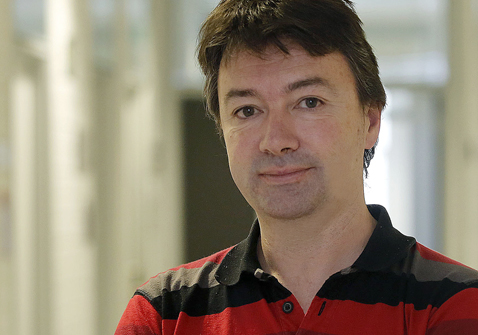
Michalis Vazirgiannis is a Professor at LIX, École Polytechnique (France) leading the Data Science and Mining (DaSciM) group. With academic backgrounds in Physics (Athens University), AI (Heriot-Watt University), and Informatics (Athens University), he has conducted research at Fraunhofer, Max Planck MPI, and INRIA/FUTURS while teaching at institutions across Greece, France, China, and Spain. His research spans Machine/Deep Learning for Graphs (GNNs, graph kernels, embeddings) Text Mining & NLP (Graph-of-Words, biomedical text analysis) Combinatorial Optimization for pandemic forecasting and energy systems Event/Anomaly Detection in time series and sensory data Industrial collaborations with Airbus, Google, Tencent, and BNP . He has supervised 29 completed PhD theses, published over 250 papers, and received prestigious awards including Marie Curie and Tencent Rhino-Bird Fellowships. His team leads the ANR-HELAS Chair (2020-2025) focusing on heterogeneous data deep learning.
Horacio Saggion is the Chair in Computer Science and Artificial Intelligence at the Department of Information and Communication Technologies, Universitat Pompeu Fabra. He leads the TALN Group and the Large Scale Text Understanding Systems Lab. His research focuses on Computational Linguistics, with specialties in Text Summarization, Information Extraction, and Semantic Analysis. He coordinates the Horizon Europe iDEM project on inclusive democratic spaces and previously led the SignON project for Sign Language Translation. Key technologies include the SUMMA Summarization system and the Dr Inventor Text Mining Library. Education: PhD, MSc, and Licenciatura in Computer Science. Research Interests: Text simplification for accessibility, sign language translation, misinformation detection, and ethical AI applications. His work bridges natural language processing with societal needs such as clear communication in public administration. Grants & Projects: Coordinator of iDEM (Horizon Europe), PI of SignON, Simplext, and Able to Include. Involved in BEA shared tasks and CLEF labs. Active in organizing workshops like TSAR at EMNLP. Labs & Teams: Head of TALN Group and Text Understanding Lab. Collaborations include Universitat Pompeu Fabra's interdisciplinary initiatives and industry partnerships for technology commercialization.
Pablo Calleja is a Research Fellow at the Faculty of Computer Science, Polytechnic University of Madrid (UPM), where he has been a member of the Ontology Engineering Group (OEG) since March 2014. His research focuses on Natural Language Processing (NLP), medical terminology mapping, and legal domain applications. He holds a degree in Computer Engineering from San Pablo CEU University (2013) and has prior industry experience as a software developer at IECISA (2008–2011) and a collaboration grant at the Open Access Classroom, San Pablo CEU University (2011–2013). Key contributions include projects like Drugs4covid for pandemic drug discovery, TermitUp for terminological enrichment, and esT5s , a Spanish text summarization model. His work spans legal knowledge graphs, multilingual compliance systems, and NER techniques for academic content analysis. He has also explored accessibility multimedia services and semantic graph applications in tourism ( DBtravel ). Professional roles include collaboration grants at UPM and active participation in interdisciplinary projects such as SNOMED-CT annotation for medical technical sheets. Research trends emphasize cross-domain adaptation (e.g., K-Flares), data augmentation (Widaug), and multilingual NLP solutions. Advising and grants: His current position is supported by a collaboration grant at OEG. Earlier grants include work at San Pablo CEU University. No formal advisees are listed, but he contributes to collaborative research teams. Labs and teams: Core member of the Ontology Engineering Group (OEG), focusing on knowledge representation, NLP, and applied informatics in healthcare and law domains.
Ahmed AbuRa'ed is a Researcher at the Department of Information and Communication Technologies (DTIC) at Universitat Pompeu Fabra (UPF), Barcelona. He is affiliated with the TALN research group and the Large-Scale Text Understanding Systems Lab. His work focuses on advancing knowledge in scientific text summarization, information extraction, and machine learning. Education: PhD in Computer Science (2020), UPF, Barcelona, Spain M.Sc. in Computer Science (2015), University of Trento, Italy B.Sc. in Computer Information Systems (2007), An-Najah University, Nablus, Palestine Research Interests: Natural Language Processing (NLP), Machine Learning/Deep Learning, Semantic Web, Information Extraction, Data Mining, and Scientific Document Summarization. His projects include developing systems for automatic generation of state-of-the-art reports, scientific text summarization, and cross-document relation discovery. Publications Focus: His 15 most recent articles (2016–2021) emphasize advancements in scientific literature analysis, including citation detection, text simplification, and cross-document summarization. Notable works involve systems like LaSTUS/TALN for scientific text processing and OlloBot for Arabic health dialogue agents. Labs & Teams: Active member of the TALN research group and the Large-Scale Text Understanding Systems Lab at UPF's DTIC department. Open to collaborations in NLP, Machine Learning, and related fields via email or Skype.
Mariano Rico is an Associate Professor at the Polytechnic University of Madrid (UPM), affiliated with the OEG research group in the Artificial Intelligence Department. Previously, he served as a Senior Researcher at OEG (2016-2020) and held teaching roles at the Autonomous University of Madrid (UAM). His primary affiliations include the UPM's Faculty of Computer Science and the UAM's Computer Engineering Department. Education: PhD in Computer Science (UAM, 2009), MSc in Physics (UAM, 1992), and postgraduate studies in Telecommunications Engineering. He conducted research stays at DERI (Ireland) and Freie Universität Berlin, focusing on Semantic Web and Linked Data. Research interests center on Linked Open Data, Natural Language Processing (NLP), and Semantic Web technologies, with contributions to DBpedia's Spanish branch and projects like Wf4Ever and LIDER. He actively collaborates with institutions in Leipzig, Bielefeld, and Berlin on Linked Data and linguistic applications. Teaching: Coordinates courses in NLP, Linguistic Engineering, and Big Data Visualization at UPM and online programs. Has instructed over 300 UAM faculty through teacher training programs on LaTeX, bibliographic management, and digital scholarly practices. Projects: Lead roles in European and national initiatives including SlideWiki, UpGrid, and Neptune. Current work focuses on NLP applications like text summarization (esT5s) and terminology tools (TermInteract). Labs/Teams: Core member of the OEG group, contributing to semantic web infrastructure and NLP tool development. Maintains international collaborations through AKSW and CITEC groups.
Bernardino Casas Fernández is an Adjunct Professor at the Departament de Llenguatges i Sistemes Informàtics (LSI) of Universitat Politècnica de Catalunya (UPC). He holds offices at both the Vilanova i la Geltrú campus (EPSEVG-VG1, Room 120) and the Barcelona campus (Campus Nord-Edifici Omega, Room 224). His research focuses on quantitative linguistics, natural language processing, polysemy analysis, and computational linguistics. He has contributed to open-source tools like FreeLing and projects such as CARPANTA for email summarization. Recent work explores semanticity in Catalan using large language models and ethical implications of generative AI in education. He maintains active involvement in computational linguistics and child language development studies. Education details are not explicitly listed, but his academic career spans from 2003 (earliest article) to 2024. He collaborates with initiatives like LAPPS (Language Acquisition and Processing Systems) and has participated in projects involving churn prediction systems and entropy estimation techniques.
Eneko Agirre is a Full Professor at the Faculty of Computer Science of the University of the Basque Country UPV/EHU, where he serves as the director of the HiTZ Centre on Language Technology. He is an active member of the Ixa Research Group and has established himself as a leading figure in Natural Language Processing, particularly in multilingual and low-resource language settings. His work bridges theoretical advances with practical applications for language technology. Agirre received his PhD from the University of the Basque Country in 1999 with a thesis on conceptual relationships and ontologies, supervised by Dr. Kepa Sarasola Gabiola and Dr. Arantza Díaz de Ilarraza Sánchez. His academic journey has been marked by significant contributions to computational linguistics and language technology. His research primarily focuses on Natural Language Processing challenges, with special emphasis on Word Sense Disambiguation, cross-lingual transfer learning, dialogue systems, and Large Language Models for low-resource languages. He has pioneered work on Basque language technology and has consistently addressed the challenges of multilingual AI systems, particularly examining how language models perform across different linguistic contexts and cultural settings. Analysis of his recent publications reveals a strong trajectory toward advancing Large Language Models for low-resource languages, with particular attention to Basque. His work spans vision-language models, information extraction techniques, and rigorous evaluation methodologies for NLP systems. A recurring theme is the exploration of how language models handle low-resource languages compared to high-resource ones, with groundbreaking findings about cultural knowledge transfer between languages. Fellow of the ACL (2021), one of only 74 research leaders worldwide National Research Prize on Informatics (2021) Best resource paper award at ACL 2024 Honourable mention paper award (top 1%) at EMNLP (2020) Outstanding Paper award (top 2%) at COLING (2020) Recipient of three Google Faculty Research Awards (2017, 2018, 2019) Agirre has supervised over 25 PhD students, many of whom have received prestigious awards including the EurAI Artificial Intelligence PhD Dissertation Award. His research has been supported by numerous European projects including LIHLITH (2018-2020) on lifelong learning for dialogue systems, and he has served as principal investigator for multiple CHIST-ERA and FP7 projects. His work with Google includes collaborative projects on entity dictionaries and conversational question answering systems. As director of the HiTZ Centre on Language Technology and member of the Ixa Research Group, Agirre leads a vibrant team focused on advancing language technology for Basque and other under-resourced languages. The center has developed significant resources including Latxa, an open language model for Basque, and has established itself as a hub for multilingual NLP research. His group actively collaborates with international institutions including Stanford, NYU, and various European universities, fostering a global network for language technology research.
Andreas Kaltenbrunner is a Part-Time Lecturer at the Universitat Pompeu Fabra (UPF) in Barcelona, specializing in Data Driven Social Analytics and Information Retrieval. He serves as Director of Research on AI and Data Science at IN3 - UOC R&I and is an Affiliate Researcher at ISI Turin, Italy. His research focuses on computational social science, user behavior analysis, and applications of AI/ML in social media and network dynamics. Key interests include large language models (LLMs), personality assessment simulations, and digital epidemiology. His work bridges theoretical frameworks with practical applications, such as predicting urban mobility patterns and evaluating AI systems’ performance in political contexts. He collaborates with institutions like UNICEF and the ISI Foundation, contributing to projects on data-driven decision-making and social impact. His interdisciplinary approach integrates network science, computational methods, and socio-cultural analysis. Recent publications highlight innovations in LLM validation, cross-lingual Wikipedia reliability modeling, and climate-related forecasting. While no explicit awards are listed, his prolific output reflects sustained contributions to computational social science and AI ethics.
Álvaro Jesús López López is a researcher at the Instituto de Investigación Tecnológica (IIT) and a professor at the Higher Technical School of Engineering (ICAI), both part of Comillas Pontifical University. He holds the position of Associate Research Fellow and serves as a principal investigator at the Chair of Smart Industry, where he leads applied research on digital technologies such as generative AI, computer vision, and synthetic data generation. He also directs executive programs in generative artificial intelligence for professionals at Comillas Onexed. His research interests include Artificial Intelligence, Reinforcement Learning, Generative AI, Smart Industry, and Railway Systems . His work focuses on applying advanced AI techniques to industrial and transportation challenges, particularly in energy efficiency and automation. He has published extensively in high-impact journals such as Engineering Applications of Artificial Intelligence , Applied Intelligence , and Transportation Research Part C . The recent articles highlight a strong trend toward applied AI in industrial and robotic systems , with a focus on sim-to-real transfer, keyphrase extraction, and reinforcement learning enhanced with semantic knowledge. His work bridges the gap between theoretical AI and real-world industrial applications. Scientific Awards: Honorable Mention from the Industry 4.0 Observatory (2021) Honorable Mention at the 6th Connected Industry Promotion Award Erasmus Teaching/Research Staff Training Grant (2014) He has advised multiple PhD students and leads several industry-funded research projects with organizations such as Ferrovial, Endesa, Metro de Madrid, and the European Commission. He has also organized scientific events and delivered numerous invited talks on AI and digitalization. His research has led to practical applications, including a patent on utilizing regenerative braking energy in railways. He completed a research stay at the Royal Institute of Technology (KTH) in Stockholm and has contributed to books and policy reports on digitalization in industry.
Juan Pablo Pascual is an Adjunct Professor at Universidad Carlos III de Madrid (UC3M), where he contributes to the academic mission through teaching and scholarly activities. His primary affiliation is with the university, though the specific school or department is not mentioned in the available information. No research interests or publications are listed in the provided text, so no discernible trends in scholarly output can be summarized at this time. No scientific awards or honors are mentioned in the available data. There is no information regarding student advising, research grants, or leadership in research teams or laboratories.
Marcos Fernández Pichel is an Assistant Professor at the Department of Electronics and Computing, affiliated with the Higher Technical School of Engineering at the University of Santiago de Compostela. He holds a Doctorate from the same institution (2023) with a thesis focused on technologies for analyzing health-related online content credibility. His research focuses on health information credibility assessment, natural language processing (NLP), and misinformation detection. He collaborates with the Singular Center for Research in Intelligent Technologies (CiTIUS) and has developed systems like Depressmind for mental health surveillance on social media, and Social Minder for detecting pandemic-related misinformation. His work has been recognized by the Royal Galician Academy of Sciences' award for best young researcher article (2022). Key projects include analysis of search engine performance for health queries, LLM-based depression symptom assessment, and risk communication strategies for radon gas. He has contributed to TREC Health Misinformation Track competitions (2021-2022), demonstrating expertise in retrieval systems and misinformation detection methodologies. Pichel's research often bridges computational linguistics with public health applications, emphasizing real-time monitoring of dynamic web sources (e.g., eXtream system). His work frequently involves semi-supervised learning techniques and ethical considerations in AI-driven health communication systems.
Laura Fernández Robles is a Professor at the Department of Mechanical, Informatics and Aerospace Engineering within the University of León, Spain. She leads research in computer vision, intelligent systems, and machine learning applications in engineering projects. Education: PhD in Engineering (2016), Universidad de León Thesis: "Técnicas de reconocimiento de objetos en aplicaciones reales" Supervised by Dr. Manuel Castejón Limas, Dr. Nicolai Petkov, and Dr. Enrique Alegre Gutiérrez Research Focus: Her work bridges computer vision, biometric identification, and engineering optimization, with recent emphasis on explainable AI, smishing detection, and sustainability integration in engineering projects. Publication Trends: Over the last decade, her research has spanned object recognition systems, audio embeddings for speech tasks, cybersecurity frameworks, and interdisciplinary applications in agriculture and education. Her methodologies often combine deep learning, feature engineering, and robust pattern analysis.
Patricia Robledo Ramón is an Associate Professor at the Faculty of Education, University of León, affiliated with the Department of Psychology, Sociology and Philosophy. Her research specialization lies in Developmental and Educational Psychology, with a focus on writing development, metacognitive strategies, family-school collaboration, and academic interventions. She obtained her PhD from the University of León in 2012 under the supervision of Dr. Jesús Nicasio García Sánchez. Her work investigates cognitive and motivational aspects of writing competence across educational stages, emphasizing home-school partnerships and evidence-based instructional methods. Recent studies explore digital tools for academic writing, socioeconomic influences on literacy development, and innovative pedagogies like flipped classrooms. Robledo Ramón's publications (2021–2024) demonstrate consistent themes: optimizing writing strategies, assessing family educational practices, and enhancing academic performance through metacognitive training. No awards or supervised students are documented in available sources.
Manuel Lama Penín is a Full Professor at the Research Center on Intelligent Technologies (CiTIUS) with the University of Santiago de Compostela. His research bridges machine learning, process mining, and semantic modeling to address challenges in healthcare, industry, and e-learning. He has led 29 of 51 R&D projects and authored over 150 scientific works, including 52 journal articles. Research Areas: Process Mining & Conformance Checking Predictive Monitoring & Drift Detection Semantic Modeling & Service Computing Social Workflow Analysis & Data-to-Text AI in Healthcare & Educational Technologies Notable Projects: TRANSFIRESAUDE (2023, EU Health R&I Ecosystems) AQUATECHInn 4.0 (2023, Aquaculture Education) INCEPTION (2021, Concept Drift in Process Mining) Scientific Recognition: Recipient of the Transfer Technology award from the Galician Royal Academy of Sciences for co-founding InVerbis Analytics, a spin-off commercializing process mining research. Article Trends: His recent publications focus on explainable AI integration in EU regulations, drift detection methodologies, and natural language generation for process documentation. Collaborative efforts emphasize cloud-based solutions, healthcare process formalization, and predictive modeling across sectors.
Carlos Badenes-Olmedo is an Associate Professor in the Computer Systems Department at Universidad Politécnica de Madrid (UPM) . He is a member of the Ontology Engineering Group (OEG) , AI.nnovation Space , and co-founder of the spin-off company LibrAIry S.L. , which offers AI services for NLP and knowledge management. He also co-chairs the Knowledge Graph Summarization Workshop at ISWC. His research focuses on Natural Language Processing , Semantic Web Technologies , and Knowledge Graphs with applications in multilingual document similarity, topic modeling, and biomedical informatics. He has published extensively on cross-lingual search, scalable hashing algorithms, and AI in public health and procurement. Notable scientific awards include: DAAD Postdoc Funding (2021) Margarita Salas Mobility Grant (2021) ActuaUPM 3rd Prize for Best Startups (2020) Finalist for Margarita Salas Research Awards (2022) Finalist for Innovation Talent Recruitment Award (2021) He contributes to software engineering with tools like librAIry for distributed text mining, Corpus Viewer for NLP pipelines, and r4r for RESTful APIs over RDF data. His work bridges academia and industry through projects like TheyBuyForYou and TBFY Harvester for EU public procurement.