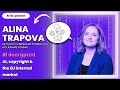
Dr Alina Trapova is a Lecturer in Law at the Faculty of Laws, University College London (UCL), with expertise in intellectual property law and artificial intelligence. She holds a PhD in Legal Studies (cum laude) from Bocconi University, an LLM in Intellectual Property Law from Queen Mary University of London, and an LLB from the University of Sheffield. Her research focuses on AI’s intersection with copyright law, digital entertainment, and legal education reforms. Alina previously served as an Assistant Professor at the University of Nottingham (2021–2022) and worked at the EUIPO and European Audiovisual Observatory on procedural harmonization and piracy mitigation projects. She advises governmental bodies like the Ukrainian government on specialized IP court frameworks and collaborates with institutions like the Milano Fashion Institute. Her research interests include AI-generated content rights, copyright exceptions in education, and contractual frameworks for emerging technologies. Notable projects include studies on AI in video games, EU copyright reforms, and the role of collective management organizations in digital markets. Alina is trilingual (Italian/Spanish/German) and contributes to policy discussions on global IP harmonization. Awards include her cum laude PhD thesis on EU copyright and machine learning. Her work bridges legal theory with practical applications in tech-driven industries, emphasizing inclusive enforcement mechanisms and dynamic contractual models.
Michael Barlow is an Associate Professor in the Department of Applied Language Studies and Linguistics at the University of Auckland. His research focuses on corpus linguistics, cognitive linguistics, and computational tools for language analysis. He develops software like Collocate, MonoConc Pro, and ParaConc for linguistic research and teaching. His work spans areas including phrasal verbs, academic writing conventions, and individual language variation. Barlow regularly presents at international conferences such as AAAL and AILA and collaborates on projects like the Asia Pacific Corpus Linguistics Association (APCLA). Research Interests: Corpus Linguistics Language Variation & Usage-Based Models Translation and Contrastive Analysis Computational Linguistics Tools Recent Articles: His 2022 study on research article macrostructures and 2021 paper on L2 speech performance via gestures highlight his corpus-driven methods. Earlier work includes foundational studies on idiolects and parallel corpora. Advising: Supervises PhD students in areas like academic discourse analysis and metaphor in economic language. Notable advisees include Vaclav Brezina (now at Lancaster University) and Thi Ngoc Phuong Le (author of The Academic Discourse of Mechanical Engineering ). Labs/Projects: Leads CorpusLAB for discipline-specific writing guides and WordSkew software linking corpus data with discourse structure. Active in software development for language teaching and research.
Umer Farooq is a Professor at Dhofar University's College of Engineering, specializing in Electrical and Computer Engineering. His research spans interdisciplinary areas including artificial intelligence, nanotechnology, educational technology, and cybersecurity. He has contributed to over 90 publications since 2002, focusing on topics such as neural networks, federated learning, IoT security, and biomedical applications. His work bridges theoretical advancements with practical implementations in fields like medical imaging, renewable energy systems, and smart education platforms. Research interests emphasize innovative solutions at the intersection of engineering and computing. Notable contributions include federated learning frameworks for education, neural network-based medical diagnostics, and secure IoT systems. Recent trends in his publications highlight advancements in machine learning for healthcare, nonlinear dynamics in electronic systems, and sustainable energy solutions. No scientific awards or grants are explicitly listed in the provided texts. Collaborations span global institutions, reflecting his active role in international academic networks.
Els Lefever is an Associate Professor at Ghent University, where she works with the LT3 (Language and Translation Technology) research team. Her position focuses on computational linguistics and natural language processing research, with strong ties to both theoretical and applied aspects of language technology. Dr. Lefever earned her PhD in Computer Science from Ghent University in 2012 with her dissertation titled "ParaSense: Parallel Corpora for Word Sense Disambiguation." Her academic journey began as a computational linguist at the R&D department of Lernout & Hauspie Speech Products before transitioning to academia. Els Lefever's research spans multiple areas within computational linguistics with particular expertise in multilingual natural language processing. Her work focuses on computational semantics, cross-lingual word sense disambiguation, and multilingual terminology extraction. Recent research directions include automatic detection of irony in online text, argumentation mining in social media, sentiment analysis of financial news, language modeling for low-resourced languages, and computational approaches to Byzantine Greek epigrams. Her research demonstrates a consistent pattern of bridging theoretical computational linguistics with practical applications across diverse language domains and historical periods. Professor Lefever actively supervises PhD research on several cutting-edge topics including terminology extraction from comparable corpora, event extraction and sentiment mining of financial news, language modeling for low-resourced languages, argumentation mining in social media, and the automatic detection of links between Byzantine Greek epigrams. Her supervision portfolio demonstrates her commitment to advancing multiple frontiers of computational linguistics simultaneously. As an educator, Professor Lefever teaches courses in Terminology and Translation Technology, Language Technology, Localisation, Digital Text Analysis, and Digital Humanities. Her teaching reflects her research interests, providing students with both theoretical foundations and practical skills in language technology applications. The LT3 research group, where Professor Lefever is a key member, maintains strong connections with both academic and industry partners. The group has participated in numerous international conferences and shared tasks including SemEval competitions across multiple years, demonstrating consistent contributions to benchmark datasets and evaluation methodologies in natural language processing.
Dr. Helen Groves is a Clinical Lecturer in Paediatric Infectious Diseases at Queen’s University Belfast’s School of Medicine, Dentistry and Biomedical Sciences, based at the Wellcome Wolfson Institute for Experimental Medicine. She completed postgraduate training in the UK Clinical Academic Training Program, including an Academic Clinical Lectureship at Queen’s University Belfast and a Wellcome Trust-funded PhD on early immune responses to respiratory syncytial virus (RSV). Her clinical training included a subspecialty program in the UK and a Clinical Fellowship at the Hospital for Sick Children in Toronto (2019–2021). Education: Helen Groves earned a Doctor of Philosophy (PhD) in 2018 from Queen’s University Belfast, supervised by Dr. U. F. Power and Dr. M. Shields. Her thesis, titled Elucidation of the roles of PTN and ISG15 in RSV cytopathogenesis: possible biomarkers of severe disease , explored RSV-driven immune mechanisms. She holds qualifications from the UK’s postgraduate Clinical Academic Training Program and subspecialty Paediatric Infectious Diseases training. Research Interests: Her work focuses on early-life respiratory viral infections, particularly RSV, aiming to understand immune responses and develop treatments. Key projects include leading the INHALER study (examining pandemic impacts on asthma/viral-wheeze development) and co-leading the PRECISE study (evaluating point-of-care testing for corticosteroid guidance in preschool wheeze). She is also a co-investigator in the pan-European CAR-CF trial, analyzing antibody responses in cystic fibrosis patients. Scientific Awards: Notable recognitions include: Clinical Academics in Training Annual Conference 2024 runner-up for post-doctoral plenary presentation Colonel Davis Research Scholarship (2017) First prize for oral presentations at the Annual Postgraduate Research Symposium (2017 and 2016) First prize at the BPAIIG Winter Meeting 2018 Advising & Grants: Helen has secured Wellcome Trust PhD funding and currently oversees major collaborative studies. Her work involves peer-review roles, including for the Pediatric Infectious Disease Journal , and editorial activities with the European Society for Paediatric Infectious Diseases. She actively participates in conferences and workshops, such as the Clinical Academics in Training Annual Conference 2024 and Health Data Research UK events. Labs & Teams: Based at Queen’s University Belfast’s Wellcome Wolfson Institute, she collaborates internationally in studies like the CAR-CF trial and INHALER/PRECISE cohort projects. Her network includes institutions in Canada, the US, and Europe, emphasizing global pediatric health research.
Antonina Puchkovskaia is a Lecturer in Digital Humanities at King's College London's Department of Digital Humanities, within the Faculty of Arts & Humanities. Previously, she was an Associate Professor at ITMO University (Russia), where she founded and led the Digital Humanities Center. She holds a PhD in Cultural History from Saint-Petersburg State University (2016) and was a Willard McCarty Fellow at King’s College (2018-2019). Recognized as a promising academic by the British Academy in 2022, her work bridges cultural history, spatial humanities, and digital heritage. Research interests include technical processes shaping humanities data, spatial humanities, and digital public humanities critique. She explores cultural data visibility and representation, particularly in GLAM sectors. Teaching focuses on undergraduate and postgraduate digital humanities courses globally. Notable projects include the Pages of Early Soviet Performance (PESP) and analyzing national anthems' characteristics. Key publications address Gulag literature digitization, race in Slavic scholarship, and NLP applications for historical texts. She organizes conferences, including Lev Manovich talks, and participates in Princeton's DH Slavic Group.
Dr. Ahmed Taiye Mohammed holds a Postdoctoral research fellowship at Linnaeus University's Department of Cultural Sciences, Faculty of Arts and Humanities in Växjö, Sweden. He earned his Master's and PhD from Northern University of Malaysia (UUM) with a thesis on text anomaly detection. His research focuses on Digital Humanities (DH), AI applications in education, and computational thinking for non-engineers. He teaches courses like Digital Humanities Research Methods, Programming for DH, and AI in Healthcare. Key research projects include InKuiS (innovative cultural entrepreneurship) and AI for ISP (supporting academic writing via ChatGPT). He collaborates with Linnaeus University Centre for Data Intensive Sciences (DISA) on e-health initiatives. Recent publications explore AI in K-12 education, automated library classification, and text mining for archaeology. His work spans AI ethics, DH methodologies, and interdisciplinary applications of computational tools. Teaching responsibilities include over 10 courses at undergraduate/master's levels, emphasizing practical skills in DH technologies. Active in developing AI-based educational tools like CHAT4ISP-AI and exploring generative AI for academic writing support. Research also involves social media ecosystems, data mining practices, and satellite image classification using SVM techniques.
Zhiyong (Johnny) Zhang is a Professor of Quantitative Psychology at the University of Notre Dame and serves as the Quantitative Area Director. He is the director of the Lab for Big Data Methodology and a Fellow at the Institute for Educational Initiatives. His primary research areas include Bayesian methods, network analysis, structural equation modeling, and statistical computing. Dr. Zhang holds a Ph.D. in Quantitative Psychology from the University of Virginia. His work focuses on developing advanced statistical methodologies and software for education, health, management, and psychology. He is the Editor of the Journal of Behavioral Data Science and an Associate Editor of Multivariate Behavioral Research. His research trends span Bayesian inference, neural network applications, mediation analysis, and methodological innovations in factor analysis and latent growth models. He has contributed to software tools like WebPower for statistical power analysis and RAMpath for structural equation modeling. Zhang has received prestigious awards, including Fellow status in the American Psychological Association and election to the Society of Multivariate Experimental Psychology. His advising and grants include mentoring students in quantitative methodologies and leading research on text mining, emotion recognition, and big data applications. The Lab for Big Data Methodology under his direction advances interdisciplinary statistical approaches.
Yun Fu is a tenured Professor in the Department of Electrical and Computer Engineering at Northeastern University, with a joint appointment in the Khoury College of Computer Science. He has established himself as a leading researcher in Artificial Intelligence, with over 500 publications in top-tier venues including IEEE/ACM transactions and major AI conferences. His work spans both theoretical foundations and practical applications, with significant impact in computer vision and machine learning. Professor Fu earned his Ph.D. in Electrical and Computer Engineering from the University of Illinois at Urbana-Champaign. His academic career progressed from Assistant Professor at SUNY Buffalo to his current position as tenured Professor at Northeastern University, where he has held appointments since 2012. His educational background includes a Beckman Graduate Fellowship at UIUC (2007-2008). His research focuses on advancing Artificial Intelligence with particular emphasis on Computer Vision, Pattern Recognition, and Machine Learning. His seminal work includes the "Residual Dense Network for Image Super-Resolution" presented at CVPR 2018, which was ranked among the Top 10 Most Influential CVPR papers. His research interests span image processing, anomaly detection, multimodal learning, and trajectory prediction, with applications ranging from healthcare to consumer technology. Analysis of his recent publications reveals a strong trend toward developing efficient and robust AI systems that bridge computer vision with language understanding. His work increasingly focuses on multimodal learning, trajectory prediction for multi-agent systems, anomaly detection in complex environments, and model validation techniques for black-box systems, while maintaining practical applications in real-world scenarios. Professor Fu's extensive recognition includes: Fellow of IEEE (2018), OSA (2019), SPIE (2018), IAPR (2016), AAIA (2021), and AAAI (2025) Member of Academia Europaea (2022) and European Academy of Sciences and Arts (2023) Fellow of National Academy of Inventors (2023) Multiple Young Investigator Awards from NAE, ONR, ARO, IEEE, ACM, and INNS 12 Best Paper Awards from major conferences Industrial Research Awards from Google, Amazon, Samsung, JPMorgan, and others Professor Fu has successfully mentored numerous Ph.D. students who now hold prominent positions in academia and industry at institutions including Amazon, Microsoft, Meta, Adobe, and major universities. His entrepreneurial ventures include founding Giaran (acquired by Shiseido in 2017) and co-founding TVision Insights, demonstrating his commitment to translating research into real-world impact. He has secured significant research funding from both government agencies and industry partners. As the PI and Founding Director of the SmiLe Lab at Northeastern University, Professor Fu leads a dynamic research group focused on advancing the state-of-the-art in AI and Computer Vision. The lab fosters interdisciplinary collaboration across computer science, electrical engineering, and applied mathematics, with ongoing projects in efficient deep learning, multimodal understanding, and practical AI applications.
Hans Moen is a Research Fellow in the Department of Computer Science at Aalto University, affiliated with the Professorships of Marttinen P. and Kaski Samuel. His research focuses on natural language processing (NLP) applications in healthcare, including clinical documentation analysis, stigmatizing language detection in medical records, and transformer-based deep learning for health trajectory modeling. Moen has contributed to interdisciplinary projects involving nursing informatics, healthcare disparities, and predictive modeling in clinical settings. Research Interests: His work bridges computer science and healthcare, emphasizing: NLP techniques for clinical text analysis Health equity through language bias detection Machine learning for longitudinal health data Automated clinical documentation systems Prominent contributions include identifying racial/ethnic disparities in birth clinical notes (2025) and developing self-supervised summarization methods for nursing records (2024). His 2023 Aalto SCI award recognized excellence in teaching assistantship. Collaborations span healthcare institutions and interdisciplinary teams, addressing challenges in electronic health records, patient risk prediction, and clinical decision support systems.
Rosemary Pang is a Lecturer in the Data Analytics and Computational Social Science (DACSS) program at the University of Massachusetts Amherst , housed within the School of Public Policy. She teaches R programming, survey analysis, and text analysis courses. Her research focuses on autocratic regimes' political dynamics, particularly in China, with expertise in computational methods including NLP and quantitative text analysis. Education: Ph.D. in Political Science and Social Data Analytics (Dual Degree), Pennsylvania State University M.A., Purdue University B.A., University of Nottingham, Ningbo, China Her work bridges comparative politics and computational methods, examining topics like party institutionalization, corruption, and legitimacy in non-democratic systems. Recent research explores protest dynamics in autocracies and the societal impacts of social movements. While no formal student advisees are listed, her teaching and research emphasize applied data science in political contexts. No grants or awards are explicitly mentioned in the provided materials. Her methodological strengths include text mining, survey analysis, and computational social science frameworks, which she applies to understand authoritarian governance structures and their societal implications.
Fabio Crestani is a Full Professor of Informatics at the Università della Svizzera italiana (USI) since 2007, serving as Pro-rector for Internationalisation since March 2024. He previously held roles at the University of Strathclyde (UK) and conducted sabbaticals at institutions like UC Berkeley and Xerox PARC. His expertise spans Information Retrieval, Text Mining, and Digital Libraries, with over 250 publications and editorial leadership roles, including Editor-in-Chief of Information Processing and Management (2008–2015). Education: PhD and MSc in Computing Science, University of Glasgow (UK) Degree in Statistics, University of Padova (Italy) Research Interests: Advanced information access systems Conversational search and user interaction models Machine learning for text analysis Early risk prediction (e.g., mental health via social media) Grants & Collaborations: Funded by Swiss National Science Foundation, Hasler Stiftung, and EU projects. Collaborations with institutions in UK, Italy, Spain, USA, and Malaysia. Labs & Teams: Lead the Information Retrieval Group at USI, which focuses on distributed IR, personalization, and mobile information access. The group includes 10+ researchers and has produced influential work in top-tier venues like SIGIR and ACL.
Hady W. LAUW is an Associate Professor in the School of Computing and Information Systems (SCIS) at Singapore Management University (SMU), serving as Director of the BSc (Computer Science) Programme and a Lee Kong Chian Fellow. He holds a PhD from Nanyang Technological University (2008). His research focuses on artificial intelligence, data science, machine learning, and recommender systems, with notable contributions to multimodal recommendation frameworks like Cornac and collaborative filtering techniques. He teaches advanced courses including IS712 Machine Learning for postgraduate students and CS608 Recommender Systems for MITB programme participants. His work emphasizes practical applications, such as designing explainable recommendation systems and integrating A/B testing into frameworks. Key research interests include web mining, preference learning, representation learning, and decision support systems. He has advised multiple students on topics like neural networks, collaborative filtering, and comparative analysis of reviews. Scientific achievements include the Lee Kong Chian Fellowship and over 100 publications in top venues like ACM WWW and IEEE TKDE. He actively contributes to conferences as a PC member and chairs events like PAKDD. His Cornac framework supports reproducible research in multimodal recommendations. He leads the Preferred.AI research group, fostering undergraduate and postgraduate research in computing. His work bridges theoretical advancements with industry applications, particularly in data-driven decision making and automated evaluation metrics.
Fred Popowich is a Professor in the School of Computing Science at Simon Fraser University (SFU), Canada. He holds adjunct positions at Dalhousie University's Faculty of Graduate Studies and is an Associate Member of SFU's Department of Linguistics and Cognitive Science Program. His academic career began post-PhD (Cognitive Science/Artificial Intelligence, University of Edinburgh, 1989) and has spanned over three decades at SFU. Education: PhD in Cognitive Science/Artificial Intelligence (University of Edinburgh, 1989); M.Sc. and B.Sc. in Computing Science (Simon Fraser University and University of Alberta, 1985/1982). Research focuses on natural language processing (NLP), machine translation, intelligent systems, and big data applications. He directs SFU’s Big Data Initiative and leads the Natural Language Laboratory, supervising MSc/PhD students in computing science. His work includes developing systems for smart homes, toxic language detection in social media, and energy grid analysis. Industry roles include co-founding Axonwave Software (as CTO/President) and contributing to technology commercialization. Current projects address EV charging impacts, personalized learning systems, and real-time load monitoring. Publications span machine translation, sentiment analysis, and NLP applications in education and energy systems. His work bridges theoretical computer science with practical applications in healthcare, smart cities, and education.
Rhema Linder is a Teaching Assistant Professor in the Department of Electrical Engineering and Computer Science at the University of Tennessee, Knoxville. His academic journey includes a BS in Computer Science and Mathematics from LeTourneau University (2009) and a PhD in Computer Science from Texas A&M University (2019). Prior to his current role, he served as a postdoctoral researcher at the PAIRS lab at UT Knoxville. His research focuses on Human-Computer Interaction (HCI), AI Art, Information Visualization, and Creative Cognition. He explores how AI and software systems can enhance creative productivity, particularly in collaborative online environments. His work integrates theories from creative cognition, social science, and HCI to design tools for engineering, design, and scholarship. Rhema has held internships at Adobe Research and Microsoft Research, contributing to projects in data science and human-computer interaction. His GitHub repositories include open-source projects like kivy-games, demonstrating his engagement with software development and educational tools. His research interests emphasize multidisciplinary approaches, blending art, technology, and social science to innovate in creative online spaces. He is actively involved in the PAIRS lab, focusing on advancing understanding of human-AI collaboration and information management systems.