Hilda Tellioglu is an Associate Professor and Dean of Academic Affairs for Informatics at TU Wien, leading the Artifact-based Computing and User Research department. She holds a dual role as Head of Research Unit and oversees the Office of the Dean. Her work focuses on Human-Computer Interaction (HCI), Design Thinking, and Digital Transformation, with a strong emphasis on socio-technical systems and participatory design methodologies. Research interests span software engineering, CSCW, ambient assisted living (AAL), and digital co-creation practices in urban planning. She has spearheaded projects like aspern.mobil LAB, EnviSense, and StreetForum, exploring smart mobility, environmental sensing, and citizen participation in urban development. Her work frequently integrates tangible interfaces and model-based design approaches. Key contributions include frameworks for digital transformation evaluation (EEFCET 2020), user-centered design for informal caregivers (TOPIC platform), and crisis management systems using crowdsourcing (RE-ACTA). She has led over 20+ research projects funded by FFG, EU, and national agencies, focusing on mobility innovation, healthcare technology, and sustainable urban systems. Teaching responsibilities include courses on Design Thinking, Digital Transformation, and Research Methods across bachelor's, master's, and PhD programs. She actively promotes interdisciplinary collaboration through initiatives like the Center for Technology & Society (CTS) and Living Lab methodologies.
Verena Fuchsberger-Staufer is an Associate Professor at the University of Salzburg's Department of Artificial Intelligence and Human Interfaces. Her work focuses on Human-Computer Interaction (HCI), exploring interdisciplinary design, collaborative technologies, and digital craftsmanship. She has led multiple research projects, including FEM*mad (2021-2025) and retangent (2019-2022), examining maker culture and remote tangible engagements.
Christopher Frauenberger is a Professor of Human-Computer Interaction at the IT University of Linz . His research bridges philosophy and design to explore relationships between humans and digital technologies, focusing on Entanglement HCI and PANDORA philosophy circle . He actively engages with neurodiverse groups , particularly autistic children, and examines ethics in design through roles like ACM SIGCHI Ethics Board and Interdisciplinary Transformation University affiliations. Education : PhD in Human-Computer Interaction Research Areas : Participatory Design, Assistive Technologies, Social Play, Ethics in HCI His recent work explores diversity computing and inclusive design spaces , emphasizing relational agency and performative perspectives . Publications address smart technologies for children , critical design methodologies , and value-driven innovation . Supervisions include doctoral work on post-project toolkits and value-driven meeting rooms . He advocates for posthumanist design and critical reflections on technology's societal impact.
Tekaya Nidham serves as a Junior Researcher at the University of Applied Sciences St. Pölten within the Media Computing Research Group, Institute of Creative Media Technologies, Department of Media and Digital Technologies. Currently pursuing a PhD jointly at FHSTP and TU WIEN, they contribute to interdisciplinary research bridging technology and cultural applications. Education: MScRes in AI for Decision Making (2020-2022) BSc in Business Intelligence (2017-2020) Research focuses on foundational computer vision with applications spanning medical imaging, cultural heritage preservation, and social sciences. Their work integrates GPU computing and multi-modal learning to develop innovative solutions for data representation and AI-driven analysis in marketing contexts. Special emphasis is placed on making complex data tangible through visual analytics. Publication trends demonstrate strong alignment with cultural heritage technology applications, particularly through the 2025 Science Festival contribution on data tangibility systems. This reflects their commitment to translating technical research into public-facing interactive experiences. Scientific Awards: Actively engaged in collaborative research projects including "Visual Analytics and Computer Vision Meet Cultural Heritage," they work within the Media Computing Research Group to advance computational methods for heritage preservation. No formal advising responsibilities or grant management details are currently documented in available sources. Operates within the Media Computing Research Group infrastructure at Campus-Platz 1, St. Pölten, focusing on practical implementation of computer vision systems for real-world cultural and social applications.
Florian Grassinger is a Junior Researcher at the Institute of Creative Media/Technologies, Department of Media and Digital Technologies at Fachhochschule St. Pölten (University of Applied Sciences St. Pölten). He has been working in the Media Computing Research Group since July 2016, focusing on data visualization, visual analytics, and interactive systems. His educational background includes: Bachelor's degree in Industrial Simulation (2010-2014) from FH St. Pölten Master's degree in Digital Healthcare (2014-2016) from FH St. Pölten Grassinger's research focuses on making data more accessible and understandable through innovative visualization techniques. His work spans data visualization, visual analytics, and visualization onboarding, with particular emphasis on multimodal data representation (making data visible, audible, and tangible). He explores how to effectively guide users in understanding complex visualizations through educational theories and interactive systems design. His research has applications in diverse domains including healthcare (particularly dementia care), facility management, and data journalism. His publication record shows a strong focus on visualization onboarding techniques, data physicalization, and multimodal data representation. Over the past several years, his work has increasingly addressed practical applications of visualization in real-world contexts such as dementia care counseling and facility management systems. He frequently collaborates with researchers like Wolfgang Aigner and Christina Stoiber on advancing visualization literacy and developing more intuitive visualization interfaces. Grassinger is actively involved in numerous research projects including the Josef Ressel Center Industrial Data Lab, IoT4LAC, Dataskop, and SEVA (Self-Explanatory Visual Analytics). These projects focus on applying visualization techniques to solve practical problems in domains ranging from community IoT applications to data-driven journalism.
Janis Lena Meißner is a post-doctoral researcher in the HCI research group at TU Wien, focusing on inclusion in digital transformation processes. She teaches courses including "Computational Aspects of Digital Fabrication" and "Free and Open Technologies," while conducting research that critically examines technology use among non-expert users and marginalized communities. Her educational background includes a doctoral degree in Digital Civics from Open Lab at Newcastle University, an MSc in Media Informatics, and a Bachelor's degree in Media Informatics. Prior to her academic career, she worked in the IT department of an Austrian governmental institution and as a consultant for a software company. Meißner's research centers on productive creative practices of non-expert technology users and their meaning-making processes with digital tools. She has explored sociomaterial practices of "makers-in-the-making," including people with disabilities using 3D printers for empowering hacks, charity workers creating interactive e-textile blankets, and Men Shed organizers combining traditional crafts with digital technologies. Her work challenges the "non-technical" framing of non-expert users and highlights social justice issues in digital transformation. She has particular expertise in participatory and creative research methods, examining how co-design can establish healthy researcher-participant relationships. Her recent publications reveal strong trends in inclusive maker spaces, accessibility for Deaf communities, hidden technological labor in female-dominated professions, and feminist approaches to human-computer interaction. As a co-founding member of fempower.tech, she actively promotes feminist perspectives in HCI. Her work bridges academic research with practical applications in digital inclusion, particularly through projects exploring hidden technological labor of service workers and telemonitoring in healthcare contexts.
Elisabeth André is a Full Professor of Computer Science and Chair of Multimedia Concepts and Applications at University of Augsburg, where she has been faculty since 2001. She previously served as Managing Director of the Institute for Computer Science at Augsburg University from 2004 to 2006. Professor André has received multiple prestigious professorship offers, including W3-Professorships in Human-Computer Interaction and Cognitive Systems from University of Stuttgart and Human-Machine Interaction from Otto-Friedrich-Universität Bamberg in 2009. Her academic journey began with a Diploma in Computer Science (1988) and Dr. rer. Nat. (1995) from Saarland University. Before joining Augsburg, she spent over a decade as a Scientific Researcher at DFKI GmbH (German Research Center for Artificial Intelligence), where she rose to Principal Researcher and was appointed a DFKI Research Fellow. Professor André's research focuses on designing and evaluating interactive multimodal user interfaces, experimental learning environments with animated characters, and affective computing. She is internationally recognized as a pioneer in embodied conversational agents, having organized one of the first international workshops on the topic in 1997. Her work stands out for its empirical foundation, including extensive corpus studies of human behaviors to inform virtual agent behavior modeling. Notably, she has conducted significant cross-cultural research with Japanese partners to develop culture-specific behaviors in virtual agents. Her publication record shows a consistent trajectory of innovation in human-computer interaction, with particular emphasis on multimodal analysis, gaze behavior simulation, and emotion recognition systems. The research trends in her recent work demonstrate increasing sophistication in input recognition methods and the development of practical toolboxes (AuBT, EmoVoice, SSI) that have been adopted by research institutions worldwide. 2007 Alcatel-Lucent Fellowship at Universität Stuttgart Best Paper Finalist at International Conference on Intelligent Virtual Agents (2007-2009) 2005 Convivio Best Demo Award 2000 Best Paper Award at International Conference on Intelligent User Interfaces 1998 RoboCup Scientific Award Multiple student projects winning international awards including GALA Awards and TEI conference awards Professor André has supervised 2 completed dissertations and is currently guiding 11 PhD students and 1 Habilitation candidate. Her leadership extends to major research projects including EU-funded initiatives (METABO, E-Circus, IRIS, DynaLearn, CALLAS) and DFG projects (CUBE-G, OC-Trust). She serves on numerous editorial boards and has held significant organizational roles in major conferences including IUI, IVA, and CASA. Her laboratory has developed multiple software toolkits that are used internationally in large-scale research projects, demonstrating the practical impact of her work. Current research directions include advanced emotion recognition systems, culture-adaptive virtual agents, and applications of her technology to educational and healthcare domains.
Manuela Waldner is an Assistant Professor (tenure track) at TU Wien's Department of Computer Graphics and Visualization. She leads research in visual interfaces for exploring large-scale data, focusing on human-computer interaction and attention guidance in complex visualizations. Her work spans academic roles including Visualization Group membership and PhD Program Visual Heritage involvement. Research interests include: Interactive data exploration Guided visual attention mechanisms Emerging display environments (VR, multi-display systems) Publications emphasize practical applications of visualization techniques in domains like geographic data, medical imaging, and collaborative analytics. Notable projects include weBIGeo (geographic visualization) and Deskollage (visual information foraging). Awards include the Best Paper Award at EuroVA 2024 . Teaching roles include courses on Information Visualization , Computer Graphics , and Visual Computing . Active in academic service through program committees and editorial roles.
Paweł W. Woźniak is a Professor and Head of Research Unit at TU Wien, with prior roles including Associate Professor at Chalmers University of Technology, Assistant Professor at Utrecht University, and Postdoctoral Fellow at the University of Stuttgart. Current: Professor & Head of Research Unit, TU Wien Former: Associate Professor, Chalmers University of Technology Former: Assistant Professor, Utrecht University Former: Postdoctoral Fellow, University of Stuttgart Education PhD in Human-Computer Interaction, Chalmers University of Technology (2016) Research Interests focus on the intersection of technologies, sport, and wellbeing. He investigates everyday experiences of physical activity to design technologies that enhance wellbeing, with expertise in personal informatics, multi-surface interactions, sensory augmentation, and the ethical implications of interactive systems. His work includes building devices for sports, exploring VR for emotional regulation, and understanding user apprehensions about AI and mixed reality. Scientific Awards include paper recognitions at CHI, MobileHCI, and EICS, alongside leadership roles in academic conferences. Leadership involves heading a research unit at TU Wien and organizing workshops in HCI.
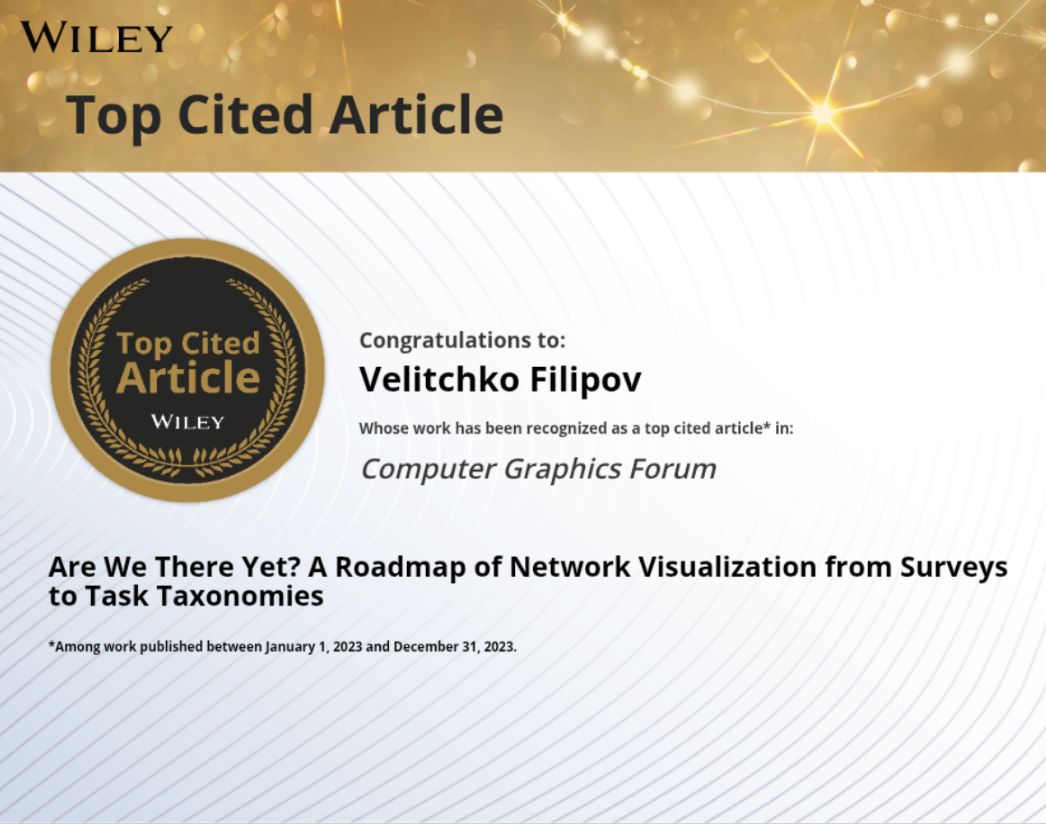
Velitchko Filipov is a PostDoc Researcher at the Institute of Visual Computing & Human-Centered Technology within the Faculty of Informatics at Vienna University of Technology (TU Wien). His work focuses on advancing Information Visualization and Visual Analytics, with a strong specialization in Dynamic Network Analysis. He is currently involved in multiple research projects including ArtVis (2022-2027), SANE (2024-2027), VaCoViCu2 (2023-2027), and SMGV-Esprit (2024-2027), with ArtVis funded by the Austrian Science Fund (FWF). Dr. Filipov completed his doctoral dissertation titled "Networks in time and space: visual analytics of dynamic network representations" at TU Wien in 2024. Prior to that, he completed his Diploma Thesis "Visual exploration and comparison of multiple resume: focus on time and space" at the same institution in 2017. His research centers on creating innovative visual representations and interactive techniques for exploring complex, time-varying networks. These approaches have significant applications in Art History, where understanding the evolution of artistic movements is crucial, and Information Diffusion. His work also benefits computational social sciences and digital humanities by providing tools to uncover patterns within evolving relational data. He has made notable contributions to uncertainty visualization, network physicalization, and the visualization of historical networks. Dr. Filipov's publication record shows a clear progression from foundational work on CV visualization and biographical trajectory mapping toward increasingly sophisticated techniques for dynamic network analysis. His recent work demonstrates a strong focus on making network data tangible through physicalization techniques and on addressing uncertainty in network representations, reflecting the evolving challenges in the visualization field. His scientific achievements have been recognized with several prestigious awards: Best Paper Award at EuroVis 2025 for "NODKANT: Exploring Constructive Network Physicalization" Top Cited Article 2025 in Computer Graphics Forum for "Are We There Yet? A Roadmap of Network Visualization from Surveys to Task Taxonomies" Nominee for Best Dissertation Award 2024 at TU Wien Informatics Best Paper at VIS4DH 2019 Graph Drawing Contest winner in 2019 and 2018 Dr. Filipov actively supervises students, with recent theses including "Dynamic network analysis with centrality measures" (2024) and "Utilizing visual analytics for network exploration in the domain of art history research" (2023). His research is supported by multiple grants, most notably the FWF project ArtVis. He collaborates extensively with researchers across Europe, particularly with Silvia Miksch, Wolfgang Aigner, and Renata Raidou. He is a key member of the Visual Analytics research group at TU Wien, participating in interdisciplinary collaborations that bridge computer science with art history and digital humanities. His work on the ArtVis project exemplifies this approach, developing visualization techniques specifically tailored to address the research challenges faced by art historians studying artistic networks and influence.
FH-Prof. Dr. Markus Seidl is a Professor in the Department of Media and Digital Technologies at the University of Applied Sciences St. Pölten. He leads the Creative Computing (BA) program and serves as interim head of the Media Computing Research Group within the Institute of Creative Media/Technologies. His roles include academic director and former Managing Director (2015–2020). Seidl holds a PhD in Computer Vision from TU Wien (2016) and has extensive experience in interdisciplinary projects, particularly in digital cultural heritage. His research focuses on computer vision techniques for analyzing rock art (petroglyphs) and enhancing museum experiences through multi-touch interfaces and BYOD integration. Key projects include the Europa Nostra-award-winning rock art analysis work and multi-touch table applications exhibited globally. He has supervised over 20 theses on topics like medieval manuscript analysis and AI-driven cultural artifact understanding. Notable contributions span 120+ publications, including work on 3D surface segmentation, flood level estimation from social media, and interactive museum technologies. His work bridges computer science with archaeology, design, and education, emphasizing experiential learning and technology-driven cultural preservation.
Anke Brock is an Assistant Professor at the National School of Civil Aviation (ENAC) in Toulouse, France, specializing in Human-Computer Interaction (HCI) and inclusive design. She holds dual affiliations as an Inria Research Scientist (CR1) and contributes to academic leadership as co-responsible for ENAC’s Master in Human-Computer Interaction (M2IHM). With over 550 hours of teaching experience, she instructs courses on accessibility, interactive programming, and climate education. Her research focuses on technologies for users with sensory, cognitive, or motor impairments, as well as situational impairments like stress or fatigue. She explores how these systems can enhance experiences for all users, leveraging user-centered design principles. Scientific Awards: Best Paper Award at ISS'21 Honorable Mention at MUM'17 Ifrath PhD Award (2015) Thesis Innovation Award (2014) Novela Award (2013) Anita Borg EMEA Scholarship (2012) Her mentored students span postdoctoral and PhD research on topics such as mixed reality systems for the visually impaired, drone navigation for users with disabilities, and 3D-printed accessible maps. Publications and projects reflect expertise in augmented reality, adaptive interfaces, and inclusive design.
Johannes Pflegerl is a Professor at the University of Applied Sciences St. Pölten, serving as Director of the Ilse Arlt Institute for Social Inclusion Research and Deputy Head of the Department of Social Affairs. He holds a doctorate in sociology from the University of Vienna and has dedicated his career to social work with older adults, interdisciplinary collaboration, and digital inclusion in aging populations. His roles span lecturing since 2007, leading the Master’s program in Social Work (2012–2022), and pioneering research in family caregiving, dementia care, and Ambient Assisted Living. Doctorate in Sociology (University of Vienna) Research Associate at Austrian Institute for Family Research (1995–2005) Lecturer and Researcher at Department of Social Affairs (2005–2007) His research focuses on Social Work with Older Adults , Family Caregiving , and Digital Solutions for Aging Populations . He explores interdisciplinary approaches in palliative care, community nursing, and social prescribing, integrating technology like mixed reality and multiscreen platforms to combat loneliness. Projects include Smart Companion , UmBrello , and XR2Resilience , emphasizing resource-oriented interventions and inclusion of refugees. The 15 most recent articles highlight trends in family group conferencing , data-driven caregiving tools , and digital communication for elderly . These works bridge social work methodologies with technological innovation, addressing challenges in dementia care, interprofessional healthcare, and community-based aging support.
Lucas Schöffer serves as a Lecturer in the Department of Media and Digital Technologies at the University of Applied Sciences St. Pölten, Austria. He is affiliated with the Institute of Creative Media Technologies and contributes to multiple study programs including Creative Computing (BA), Media Technology (BA), Interactive Technologies (MA), and Smart Engineering (BA). His academic work spans both teaching and research in emerging digital technologies. Dr. Schöffer's research interests focus on the practical applications of extended reality technologies, particularly in healthcare, education, and industrial settings. His work explores how virtual and augmented reality can enhance user experiences in rehabilitation, training, and collaborative work environments. He has made significant contributions to understanding biomechanics in virtual environments and developing inclusive technologies for diverse user groups including elderly populations and young adults. His publication record demonstrates a clear evolution from early work on ambient assisted living and mobile technologies toward increasingly sophisticated XR applications. Recent publications highlight his expertise in quantitative gaze tracking, adaptive XR training systems, and biomechanical analysis in virtual environments. His collaborative research spans multiple disciplines including computer science, healthcare, industrial engineering, and human-computer interaction. Dr. Schöffer actively participates in numerous research projects including EyeQTrack, GreenTouch, IMPACT-sXR, MIRACLE, VeRgonomiX, and BRELOMATE. These projects demonstrate his commitment to applying media technologies to solve real-world problems in healthcare, ergonomics, industrial manufacturing, and social inclusion. He works within the Immersive Media Lab and ReMoCap Lab environments at the university, contributing to both theoretical research and practical implementations of emerging technologies.
Henry Ehlers is a PreDoc Researcher and PhD Candidate at the Vienna University of Technology (TU Wien), working within the Faculty of Informatics, Institute of Visual Computing & Human-Centered Technology, specifically in the Computer Graphics Group (E193-02). He holds the position of University Assistant (Univ.Ass.) and is actively pursuing his doctoral studies under the supervision of Renata Raidou since 2021, with expected completion in 2024. His research focuses on advanced visualization techniques, particularly in the areas of network and graph visualization. Ehlers specializes in biological network visualization, compound graphs, uncertainty visualization, and data physicalization. His work bridges theoretical computer science with practical applications in visual analytics, creating innovative methods for representing complex network structures and making them accessible to domain experts. Analysis of his publication record reveals a strong emphasis on improving network visualization techniques, with particular focus on biological applications, uncertainty representation, and physical data representations. His research trajectory shows increasing sophistication in addressing visualization challenges across multiple domains including biology, environmental science, and social networks. Recent publications demonstrate his leadership in developing novel interaction techniques and visualization metaphors for complex data structures. Ehlers is actively involved in multiple research projects including ArtVis (2022-2027), SANE (2024-2027), and SMGV-Esprit (2024-2027), which support his research in visualization techniques. His collaborative approach is evident in his extensive co-authorship network across international institutions and research groups at TU Wien. As a member of the Visualization Group led by Renata Raidou, Ehlers contributes to the team's mission of developing innovative visualization solutions for complex data challenges. His work particularly focuses on creating more intuitive and effective ways to represent network structures through both digital and physical means, pushing the boundaries of how we interact with complex relational data.