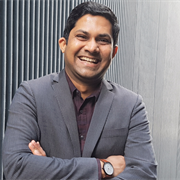
Dr. Rohit Ashok Khot is a Senior Lecturer in the School of Design at RMIT University, Australia, and directs the HAFP Research Lab. He specializes in Human-Computer Interaction (HCI), particularly Human-Food Interaction (HFI), digital health, and multisensory experiences. With 89 scholarly publications and an h-index of 26, his work challenges traditional design paradigms and integrates play, technology, and food. Recognized with awards like the DECRA and AI 2000 Most Influential Scholar, he leads conferences like ACM DIS 2022 and collaborates globally. His research extends to sustainable food systems and UN SDGs, with the HAFP Lab producing 25 outputs since 2020. Media features in IEEE Spectrum, Mashable, and ABC highlight his innovative projects. Dr. Khot teaches courses on HCI, design thinking, and digital health while mentoring students who have secured prestigious fellowships. He remains open to collaboration and supervision in Masters/PhD research.
Associate Professor Stewart Von Itzstein is affiliated with the University of South Australia’s UniSA STEM, specializing in Computer Science. His research focuses on augmented reality (AR), human-computer interaction, and educational technology. He has contributed to studies on spatial AR, haptic interfaces, deceptive digital patterns, and player motivation in games. Notable projects include analyzing IDE vs. traditional methods in programming assessments and evaluating cognitive impacts of AR predictive cues. His work bridges technical innovation with ethical considerations, such as consumer data rights and dark pattern mitigation. Research Areas: Spatial Augmented Reality (SAR) applications and performance optimization Haptic feedback systems and retargeting algorithms Educational technology and programming pedagogy Deceptive digital patterns and consumer protection Player motivation in digital games Key Collaborations: Wearable Computer Lab, Australian Research Centre for Interactive and Virtual Environments, and cross-disciplinary teams in STEM and creative fields.
Dr. Euan Freeman is a Lecturer in the Glasgow Interactive Systems Section at the School of Computing Science, University of Glasgow. His research focuses on creating new digital experiences that leverage our sense of touch and physical capabilities through haptic interaction techniques. His primary research interests include ultrasound haptic feedback, mid-air gesture interaction, vibrotactile feedback, and acoustic levitation. Freeman's work addresses the gap in current computing devices which have high-definition audio and visual output but fail to fully utilize our sense of touch. He has developed a vision for computing devices that take advantage of our haptic perceptual capabilities, allowing us to experience the digital world with the same richness as the physical world. His recent publications demonstrate a strong focus on touchless interaction techniques, particularly ultrasound haptics and mid-air gestures, with applications ranging from medical imaging to autonomous vehicle interfaces. The research spans both theoretical exploration of haptic perception and practical implementation of novel interaction techniques. Freeman has secured significant research funding, including €60,000 from Huawei for mid-air interaction with mobile devices and €35,500 from Nokia for haptic feedback in virtual environments. He currently supervises PhD students Ross, James (working on Technology-Enhanced Skateboarding) and Waugh, Kieran (improving usability of contactless interfaces for public kiosks). Within the University of Glasgow, Freeman serves as Deputy Programme Director for MSc CS+ and MSc IT+ programs, and teaches courses on Mobile Human-Computer Interaction, Research Methods & Techniques, and Human-Computer Interaction: Design & Evaluation. His industry collaborations include work with Huawei, Nokia, and Ultraleap, demonstrating strong connections between his academic research and practical industry applications.
Stephen Lindsay is a Lecturer in Healthcare Technologies at the University of Glasgow's School of Computing Science. His research in Human-Computer Interaction focuses on digital health, assistive technologies, and participatory design with marginalized groups, especially people with cognitive impairments. Current projects explore collaborative health management, maker spaces for cognitive rehabilitation, and cross-cultural digital health solutions. Lindsay employs participatory action research to co-design technologies with communities in Bangladesh and neurodivergent populations. His publications demonstrate consistent focus on accessibility innovation, with recurring themes in mental health infrastructure, inclusive maker cultures, speech interface accessibility, and community-centered design. Recent work increasingly addresses global health equity through partnerships in South Asia. Lindsay supervises PhD students working on conversational agents for peer support (Wanshu Yu), assistive technologies for neurodivergent adults (Benjamin Phua), and machine learning for e-assessment (Andy Grey).
Shaun Lawson is a Professor of Social Computing and Head of the Department of Computer & Information Sciences at Northumbria University. He leads the £9.5M UKRI AI Centre for Doctoral Training in Citizen Centred AI and directs the University’s Peak of Research Excellence in Computerised Society and Digital Citizens. Previously, he founded the Northumbria Social Computing (NorSC) Research Group (2015) and the Lincoln Social Computing (LiSC) Research Centre (2005–2015). His work bridges computing, design, and social sciences, focusing on social media, collaborative digital services, and their societal impacts. Notable areas include mental health, activism, animal behavior, and sustainability. He has secured over £12M in grants from EPSRC, ESRC, EU, and industry, with Education: PhD in Mechanical Engineering (University of Surrey, 1996), BEng in Electrical and Electronic Engineering (Newcastle University, 1990). Research interests emphasize interdisciplinary approaches to digital civics, ethical design, and participatory technologies. He is founding chair of the UK SIGCHI chapter and a member of EPSRC/ESRC Peer Review Colleges. Recent work explores AI ethics, interspecies interaction (e.g., Dog Internet projects), and digital tools for marginalized communities. His grants fund initiatives like AI for citizen empowerment and sustainable tech solutions. Grants & Awards: Over £12M in research funding; inaugural UK Professor of Social Computing (2011). Active in policy through contributions to ethical frameworks in AI and digital services. Labs/Teams: Leads NorSC, previously LiSC. Collaborates globally on animal-computer interaction (ACI) and digital civics. Supervises 5 doctoral students, focusing on citizen-centric AI and participatory design methodologies.
Joseph McKay is an Associate Professor of New Media at Purchase College (SUNY), specializing in interactive art-games and digital media. He holds a BFA from Nova Scotia College of Art & Design (1993) and an MFA from UC Berkeley (2007), with additional studies at the Whitney Independent Study Program (2000-2001). His work bridges fine art and playful interactivity, focusing on video games as modern storytelling mediums. He teaches courses like Experimental Game Lab, Programming for Visual Artists, and Physical Computing. Key research areas include VR/AR development, computational art, and the intersection of technology with everyday life. Notable projects include Awwful Tree Farmer (2024), Peckish (2023), and Zamboni Simulator . He has exhibited widely, including at MoMA, Berkeley Art Museum, and The Wrong Biennale. Awards include the Juanita & Joseph Leff Distinguished Professorship (2016–17) and the Eisner Award (2006). As an educator, he emphasizes hands-on technical skills and conceptual innovation. His exhibitions often explore themes like environmental interaction, surveillance, and playful critique of technology. He previously taught at UC Berkeley, Stanford, and Diablo Valley College, and directed the Woodstock Digital Media Festival (2011–2012).
Argenis Ramirez Gomez is a Senior Lecturer in Creative Technologies at the University of Portsmouth, Faculty of Creative & Cultural Industries, School of Film, Media and Creative Technologies. He is actively involved in research, teaching, and PhD supervision in the field of Human-Computer Interaction (HCI), with a focus on emerging technologies, game interaction, and digital heritage applications. Education: Ph.D. in Computer Science (Human-Computer Interaction), Lancaster University (2016–2020) MSc in Computer Science, Lancaster University (2015–2016) MSc in Cognitive Systems and Interactive Media, Pompeu Fabra University (2014–2015) Bachelor’s in Audiovisual Systems Engineering, Pompeu Fabra University His research centers on innovative interaction techniques, particularly gaze-based and earable interfaces, often applied in playful and museum contexts. He integrates creative coding, human-centered design, and speculative methods to explore how technology can create meaningful, engaging experiences. His work spans interaction design, games, infovis, and cultural innovation, emphasizing both utility and playfulness. The trends in his recent publications reflect a strong interdisciplinary focus on blending technology with cultural heritage, especially through holography, digital avatars, and interactive museum installations. His research combines technical innovation with artistic expression, often resulting in public exhibitions and creative artifacts. Key themes include gaze interaction, embodied control, low-cost holography, and playful engagement in natural history museums. Scientific Awards and Recognition: Invited keynote speaker at Larian Studios (2024) Hosted multiple non-academic visitors and participated in industry collaborations Active contributor to conferences and workshops in HCI and digital heritage He supervises PhD, MSc, and BSc students and leads several active research projects, including 'Playing with Secret Powers' and 'Daddy the Pufferfish', often in collaboration with Dr. Chris Bailey-Ross. He has secured research funding for projects such as HoloRoom and Designing Interactions with Museums' Collections. His external roles include former Research Associate at Cardiff University and Associate Lecturer at Lancaster University. He is a core member of the Centre of Excellence for Heritage Innovation and frequently collaborates with cultural institutions like the Cumberland House Natural History Museum. His lab work involves prototyping interactive systems, developing digital exhibits, and exploring the future of museum engagement through emerging technologies.
April Yi Wang is a tenure-track Assistant Professor at the Department of Computer Science, ETH Zürich, leading the PEACH Lab. She holds core faculty roles at the Institute for Intelligent Interactive Systems and the ETH AI Center. Her research focuses on human-centered approaches in programming, education technology, and data science collaboration. She earned her PhD from the University of Michigan (2023) and MSc from Simon Fraser University (2018), advised by Steve Oney and Christopher Brooks. Education: PhD in Information Science, University of Michigan (2018–2023) MSc in Computer Science, Simon Fraser University (2016–2018) B.Eng in Computer Science, Zhejiang University (2013–2016) Research Interests: Human-Computer Interaction (HCI) Programming Support Systems Collaborative Data Science AI-Enhanced Education Literate Programming Accessibility in Technology Recent Work Trends: Her 2025 publications emphasize AI-driven educational tools (e.g., Math2Visual for math pedagogy, datAR for data literacy), emotion-aware moderation systems, and studies on workplace multitasking. Her work bridges HCI with computational education, focusing on intuitive programming interfaces and inclusive design. Awards: Gary M. Olson Award (2023), ACM CHI Honorable Mentions (2023/2020/2018), Rising Stars in EECS (2022). Grants: Innovedum funding for Coducate project (2025). Lab Focus: Designing expressive systems for programming and data literacy through visual/tangible interfaces, AI co-decomposition tools, and interdisciplinary metaphors. Teaching: Courses on Human-Computer Interaction, Educational Technology, and Mixed Reality at ETH Zürich.
Marianella Chamorro-Koc is a Professor in the Department of Industrial Design at Queensland University of Technology's School of Design. With over 100 publications spanning more than two decades, she leads the QUT Design Lab's healthcare innovation initiatives, focusing on human-centered design approaches that bridge design theory and practical healthcare applications. Her work integrates academic research with real-world problem solving across multiple healthcare contexts. Chamorro-Koc's research interests center on healthcare design innovation, with particular expertise in accessibility design, user experience for vulnerable populations, and product usability. Her work demonstrates a consistent focus on designing for people with disabilities, pediatric healthcare experiences, and digital health technologies. She has developed innovative approaches to understanding how design can improve healthcare outcomes, particularly through empathetic and inclusive design methodologies that prioritize user needs and experiences. Her recent publications reveal a strong emphasis on healthcare design innovation, with significant contributions in pediatric medical equipment design, accessibility technologies for people with disabilities, and digital health solutions. The research trends show an evolution from foundational work in product usability to more complex healthcare system design, with increasing focus on inclusive design methodologies and co-creation approaches that involve end users as active participants in the design process. Chamorro-Koc has secured substantial research funding and leads multiple interdisciplinary projects connecting design with healthcare delivery. She has collaborated extensively with healthcare providers including Metro North Hospital and Health Services, Clinical Excellence Queensland Healthcare Accelerator Lab Program, and various international healthcare institutions. Her work bridges the gap between academic design research and practical healthcare implementation, resulting in tangible design solutions that improve patient experiences and healthcare outcomes. She leads the QUT Design Lab's initiatives in healthcare design, with particular focus on pediatric care environments, accessibility technologies, and digital health innovation. Her team employs co-design methodologies that actively involve patients, healthcare providers, and designers in the innovation process, creating solutions that are both technically sound and deeply empathetic to user needs.
Niall McGuire is a Researcher in the Department of Computer and Information Sciences at the University of Strathclyde. He holds a Doctor of Philosophy (PhD) in Computer and Information Sciences. His work contributes to UN Sustainable Development Goals related to innovation and infrastructure. McGuire is involved in a major EPSRC-funded project (Industrial CASE Account - University of Strathclyde 2021) as a Research Co-investigator, focusing on brain-machine interfaces and information retrieval systems for individuals with physical impairments. His research interests center on the intersection of neurotechnology and information retrieval, including EEG-based systems, brain-computer interfaces, and adaptive human-computer interaction. Key topics include error classification in physiological signals, prediction of cognitive states, and EEG applications in music and aviation contexts. McGuire's recent publications explore challenges in brain-machine interface integration, EEG query representations, and ethical considerations in neurotechnology. His work emphasizes practical applications for accessibility and safety-critical systems. He is affiliated with the Human Centric AI Research Group at the University of Strathclyde, focusing on translating neuroscientific insights into tangible technological solutions.
Karl Bittner MSc. is a researcher at the Institute of Landscape Development, Recreation and Conservation Planning within the Department of Landscape, Water and Infrastructure at the University of Natural Resources and Life Sciences, Vienna (BOKU). His work focuses on the intersection of computer science, landscape visualization, and renewable energy planning, with particular expertise in virtual reality, GIS, and serious game applications for participatory planning processes. Bittner's research interests center around computer graphics, virtual reality visualization, geoinformatics, and their application to landscape planning challenges. His work demonstrates a strong focus on developing innovative visualization tools to address complex environmental planning issues, particularly related to renewable energy integration in landscapes. His research bridges technical computing approaches with practical landscape planning applications, creating tools that help stakeholders visualize and understand potential landscape changes. His recent publications reveal a consistent research trajectory focused on applying advanced visualization techniques to renewable energy planning challenges, with particular emphasis on wind farms, agrivoltaics, and climate adaptation strategies. Bittner's work shows a strong trend toward developing interactive, user-centered visualization tools that facilitate public engagement in planning processes. Bittner has presented his research at numerous conferences including the Digital Landscape Architecture Conference, AgriVoltaics Conference, and various planning forums across Europe. His presentations often focus on practical applications of visualization technologies in real-world planning contexts, demonstrating the tangible impact of his research. His educational background includes a Master's degree in Game Engineering and Simulation (2020-2022) and a Bachelor's degree in Computer Science (2017-2020), both from UAS Technikum Vienna, providing him with a strong technical foundation for his current research in landscape visualization technologies.
Michael L. Rivera is an Assistant Professor at the ATLAS Institute and the Department of Computer Science at the University of Colorado Boulder. He leads the Utility Research Lab, a highly interdisciplinary group that invents and investigates digital fabrication technology, tools, and techniques with the goal of advancing science and engineering while positively impacting people, society, and the environment. Dr. Rivera completed his Ph.D. and M.S. in Human-Computer Interaction at the Human-Computer Interaction Institute of Carnegie Mellon University, where he was advised by Scott Hudson as part of the DevLab. Before Carnegie Mellon, he earned a M.S.E in Computer Graphics and Game Technology and a B.S.E in Digital Media Design from the University of Pennsylvania. He also previously worked as a software engineer at Facebook. His research spans the intersection of digital fabrication, human-computer interaction, and material science. Dr. Rivera's work focuses on developing novel fabrication techniques such as desktop biofibers spinning, electrospinning, and sustainable material processing with everyday waste products like coffee grounds. His research has significant implications for sustainable manufacturing, tangible interfaces, and accessible technology design. Analysis of his recent publications reveals a consistent focus on making digital fabrication more accessible, sustainable, and interdisciplinary. His work bridges computer science, material engineering, and design, with particular emphasis on open-source hardware development, computational design tools, and applications for social good. The research demonstrates a progression from fundamental fabrication techniques toward more applied, socially conscious applications. CRA/CCC Computing Innovation Fellowship Google - CMD-IT Dissertation Fellowship Carnegie Mellon University Sansom Endowed Presidential Fellowship Adobe Research Fellowship Honorable Mention Xerox Technical Minority Scholarship Dr. Rivera is currently recruiting PhD students to join the Utility Research Lab. His research has been supported by various fellowships and grants throughout his career, including industry partnerships with Google and Adobe. His work demonstrates strong potential for future funding in sustainable manufacturing and accessible technology. The Utility Research Lab, directed by Dr. Rivera, is a highly interdisciplinary research group focused on inventing and investigating digital fabrication technology. The lab has developed several notable projects including the Desktop Biofibers Spinning Machine (presented at CHI 2024), desktop electrospinning technology (CHI 2019), and systems for 3D printing with spent coffee grounds. The lab maintains an active GitHub presence with numerous open-source repositories related to their research.
Dr. Philipp Mock serves as a Research Fellow at the Leibniz Institute for Knowledge Media (IWM) in Tübingen, Germany, where he has been a core member of the Media Development Group since 2014. His technical expertise centers on developing machine learning algorithms and AI systems for human-machine interaction, with current responsibilities including software development and methodological consulting for ML applications. Education: PhD in Computer Science, University of Tübingen (2017) Diploma in Computer Science, University of Tübingen (2004-2011) Mock's research integrates Human-Computer Interaction with machine learning to analyze behavioral patterns through interaction data. His work spans multimodal interfaces, educational technology, and cognitive assessment systems, with particular focus on translating touch interaction metrics into predictors of cognitive states (ADHD risk, workload) and developing novel collaborative interfaces for tabletop displays. This interdisciplinary approach bridges computer science, cognitive psychology, and educational design to create adaptive systems that respond to user behavior in real-time. His publication trajectory reveals a clear evolution from foundational work on interactive surface technologies (2012-2015) toward sophisticated ML applications for behavioral analysis (2016-2018). Current projects like the longitudinal human-AI interaction study (2024-2026) demonstrate continued innovation in understanding long-term dynamics between users and intelligent systems, with strong emphasis on real-world educational and clinical applications. Mock actively contributes to multiple IWM research labs including Multimodal Interaction, Everyday Media, Perception and Action, and Knowledge Construction. His collaborative projects such as the human-AI interaction study span these labs, reflecting an integrated approach to studying how people interact with increasingly sophisticated AI systems across diverse contexts from museums to educational settings.
Ricarose Roque serves as an Associate Professor in the Information Science department at the University of Colorado Boulder with courtesy appointments in Computer Science and Learning Sciences and Human Development at the School of Education. She directs the Creative Communities research group and leads the Family Creative Learning project, focusing on equitable computational learning environments for marginalized youth. Her educational foundation includes: SB and MEng in Computer Science and Engineering from MIT SM and PhD in Media Arts and Sciences from MIT Roque's research centers on designing learning environments where young people—particularly those marginalized by race, ethnicity, immigration status, or socioeconomic status—become computational creators. Through community-engaged and ethnographic methods, she examines how social context shapes children's computing participation. Her work bridges constructionist learning theory with practical interventions like family workshops using Scratch, emphasizing identity development and equity in computing education. Analysis of her 15 most recent publications (2015-2024) reveals consistent focus on family and community-based computational learning, with strong emphasis on marginalized groups. Key trends include identity resource development in creative computing, culturally responsive construction kits, facilitator roles in out-of-school settings, and material/social contexts of learning. Her scholarship frequently leverages the Scratch ecosystem while addressing systemic barriers in computing access. Her notable recognition includes: Jan Hawkins Award for Early Career Contributions to Humanistic Research and Scholarship in Learning Technologies (2023) As director of the Creative Communities group, Roque mentors students through research projects and course instruction. Her teaching portfolio includes Community-Based Design, Designing for Creativity and Learning, and Computational Reasoning courses. While specific grant details aren't provided, her sustained Family Creative Learning project and computational tinkering initiatives indicate significant external funding for community-centered research. The Creative Communities research group operates through two primary initiatives: Family Creative Learning workshops that engage families from non-dominant groups in community centers using Scratch, and computational tinkering research exploring social, physical, and cross-disciplinary engagement models. This work occurs at the intersection of learning sciences, human-computer interaction, and social justice.
Geoff Hinchcliffe is an Associate Professor and Associate Dean (Education) in the School of Art & Design at the Australian National University (ANU). He holds a Doctor of Philosophy in Communications and a Bachelor of Visual Arts from ANU. His research focuses on data visualization, computational design, and interaction design with an emphasis on cultural collections and climate science communication. He collaborates with institutions like the State Library of NSW, National Gallery of Australia, and Make Designed Objects to develop innovative interfaces for digital collections and public engagement. Key projects include "ANU Climate Coaster" – a physical-digital installation translating climate data "The Corley Explorer" – an interactive platform for Queensland's cultural heritage "My Climate 2050" – a web-based climate scenario visualization tool His work bridges theory and practice, exploring speculative design methodologies and the poetics of data representation. As an educator, he champions interdisciplinary approaches in design education and has contributed to curriculum development including the Bachelor of Design program at ANU. Recent research interests include dynamic design processes for computational contexts, materiality of digital data, and the role of playfulness in interactive systems. He has secured multiple research grants totaling over $100,000 for projects like "Compelling Collections" and "Tangible Data Representation".