Professor Maja Pantic is a Professor of Affective & Behavioural Computing at the Department of Computing, Faculty of Engineering, Imperial College London. Her research focuses on artificial intelligence, image processing, and audio-visual speech recognition. She leads projects in multimodal systems, including facial analysis, emotion recognition, and speech-driven animation. Affiliations include the AI for Healthcare initiative, the Artificial Intelligence Network, and the Machine Learning Network. Her work addresses challenges in real-time speech enhancement, cross-modal learning, and synthetic data generation. Recent publications emphasize advancements in audiovisual speech synthesis, lip-reading, and emotion-aware systems. She has contributed to datasets like KAN-AV and SEWA DB, advancing research in face analysis and affective computing.
Lars Hanson is a Professor of Product Design Engineering at the University of Skövde's School of Engineering Science. His research focuses on ergonomics, digital human modeling, and optimizing manufacturing systems with a strong emphasis on human well-being and sustainable production. He leads projects like LITMUS (Industry 4.0 to 5.0 transition) and has contributed to developing tools such as IPS IMMA for ergonomic simulations. Active in virtual verification of human-robot collaboration and smart textile systems for workplace safety Published extensively in journals like International Journal of Human Factors Modelling and Simulation and IEEE Access Editor of conference proceedings and contributor to industry standards in automotive and healthcare sectors Research interests include multi-objective optimization of factory layouts, musculoskeletal risk assessment, and integrating ergonomic evaluations into product design processes. Current projects address Industry 5.0 sustainability challenges through digital twin technologies and smart manufacturing solutions.
Professor Hans Gellersen is a faculty member at the Department of Computer Science, Aarhus University. His research focuses on human-computer interaction, virtual/augmented reality, eye tracking, and multimodal interaction. He leads projects exploring gaze-based interfaces, natural input techniques, and XR applications. Key interests include improving interaction efficiency in 3D environments and addressing accessibility challenges in extended reality systems. Recent work emphasizes dynamic eye dominance analysis for foveated rendering, multimodal input cascades (hand-head-eye), and gaze-assisted 3D object manipulation. He investigates user performance in VR/AR systems, calibration methods for eye tracking, and collaborative mixed reality tools. Notable contributions include frameworks for spatial interfaces, gesture fusion, and accessibility adaptations for users with movement disorders. His publications span top venues like CHI, IEEE VR, and ACM Transactions on Computer-Human Interaction. Research themes include gaze-hand coordination, implicit calibration systems, and reconfigurable collaboration spaces. Current projects explore seamless interaction techniques that combine gaze with physical movements and environmental cues.
Dr Jeff Chamberlain is a Senior Lecturer at Deakin Business School, Faculty of Business and Law, Deakin University, where he also serves as Deputy Director of the MBA program. With over two decades of industry experience at the Australian Taxation Office (ATO), he transitioned into academia, bringing a pragmatic, industry-informed approach to teaching and research. His work centers on the 'triple helix' model linking strategy, business processes, and technology. Doctor of Philosophy, Deakin University Master of Electronic Commerce, Deakin University Graduate Diploma of Electronic Commerce, Deakin University Graduate Certificate of Electronic Commerce, Deakin University Graduate Certificate of Higher Education, Deakin University Bachelor of Business, Deakin University CPA (Certified Practising Accountant), CPA Australia His research focuses on business process management, digital transformation in SMEs, enterprise systems (especially ERP), and organizational learning. He explores how SMEs strategize for technological change and the role of awareness and learning in enterprise transformation. Recent work includes a study on a Global Advisory Program (GAP) for innovative SMEs. The recent articles reflect a strong trajectory in e-government, digital services, and cross-cultural project management, with a pivot toward educational innovation and flexible learning models. His work bridges public sector digital transformation and academic pedagogy, emphasizing practical application. Vice Chancellor's Award for Teaching Excellence, 2017 Fellow, CPA Australia (FCPA), 2016 Fellow, Institute of Managers and Leaders (FIML), 2016 Dean's Lecturing Legend Award, 2012 Australia Day Achievement Award, 2002 Jeff has supervised numerous student capstone projects, led industry-university partnerships, and secured internal grants such as the BPM Deakin project. He has been involved in executive education with DeakinCo, delivering transformation leadership programs to Tata Aerospace. He also serves on the board of Eastern Innovation Business Centre, supporting sustainable startups. He leads the 'BPMDeakin' virtual community and has developed innovative teaching models like 'Start Anytime' and 'Cloud First'. His teaching units include MBA705 Enterprise Optimisation and Transformation, emphasizing real-world applicability and digital agility.
Chris Bryan is an Assistant Professor in the School of Computing and Augmented Intelligence (SCAI) at Arizona State University (ASU), part of the Ira A. Fulton Schools of Engineering. He leads the Sonoran Visualization Laboratory (SVL @ ASU), focusing on data visualization, human-computer interaction, and advanced interfaces for data science. His research includes explainable AI, augmented/virtual reality, and privacy-preserving visualization techniques. Educations: Ph.D. Computer Science, University of California, Davis (2018) B.S. Computer Science, University of Arkansas (2008) Research Interests: Bryan’s work spans data visualization, human-computer interaction, explainable AI, and immersive visualization. He develops tools for collaborative analysis, privacy-aware systems, and visual analytics for complex data. Current projects involve VR/AR interfaces, bias reduction in NLP tasks, and educational visualization tools. Recent Achievements: Recipient of the 2024 and 2023 Top Five Percent Faculty Award at ASU’s Ira A. Fulton Schools of Engineering. NSF grants for privacy-preserving visualization (SaTC #2224066) and visualization education (IUSE #2216452). Multiple publications in top venues like IEEE VIS, CHI, and EuroVis, including work on differential privacy, mind wandering in visualization, and LLM prompt exploration. Advising & Grants: Advises Ph.D., MS, and undergraduate students on visualization and HCI research. Collaborates with institutions like Los Alamos National Laboratory, Phoenix Children’s Hospital, and Nankai University. Lab focuses on mentoring and preparing students for academic and industry roles in visualization and AI. Labs & Teams: Leads the SVL @ ASU, which uses advanced hardware (HTC Vive, HoloLens 2) and tools like D3.js, React, and LaTeX. The lab emphasizes interdisciplinary projects with domain experts in medicine, engineering, and security.
Aneta Podkalicka is a Senior Lecturer in Communications and Media Studies at the School of Media, Film and Journalism (MFJ), Monash University, Melbourne. She is actively engaged in research, teaching, and supervision, with a strong focus on media's role in social innovation, environmental sustainability, and everyday life. Her work bridges academic research with real-world applications across non-profit, government, and commercial sectors. Her research interests include: Media and everyday life Environmental communication Media for social innovation Digital and automated technologies and work futures Thrift, secondhand, and circular economies Media analytics and research training Aneta’s recent publications reflect a consistent trajectory in examining how media shapes sustainable practices, digital economies, and social inclusion. Her work spans cultural studies, sociology of consumption, and media policy, often employing qualitative and interdisciplinary methods. She has contributed to journals such as International Journal of Cultural Studies , Media International Australia , and Convergence , as well as book publications with Intellect and Palgrave. She is currently a Chief Investigator on the international project 'Workers in transition through automation, digitalisation and robotisation of work' (2020–2025), and previously led a project on virtual housing policy modeling. She has served as guest editor for Media International Australia and Linkoping University Electronic Press, demonstrating her active role in academic publishing. Aneta supervises postgraduate students in media, communication, sociology of consumption, and design. She is part of the 'Media and Environment' research group at MFJ and contributes to advancing the UN Sustainable Development Goals, particularly those related to sustainable consumption and environmental sustainability.
Ricardo Valerdi is a Professor and Department Head in the Department of Systems and Industrial Engineering at the University of Arizona's College of Engineering. He is a Distinguished Outreach Professor, Faculty Athletics Representative for the Big 12 Conference and NCAA, and a member of the Graduate Faculty. His academic journey includes positions at MIT (2005–2011) and continuous service at the University of Arizona since 2011, with current roles beginning in 2018 and ongoing leadership since 2020. His educational background includes a PhD in Industrial and Systems Engineering from the University of Southern California, an MS in System Architecture and Engineering from the same institution, and a BS in Electrical Engineering from the University of San Diego. Valerdi's research spans systems engineering, cost estimation, model-based systems engineering (MBSE), digital engineering, sports analytics, and test and evaluation of complex systems. He is renowned for his work on the Constructive Systems Engineering Cost Model (COSYSMO) and has pioneered the integration of virtual reality with MBSE. His recent publications reflect a strong focus on executable modeling, systems thinking education, cost modeling convergence, and applications in space and defense systems. His body of work from 2020 to 2025 shows a consistent trajectory in advancing digital engineering tools, integrating immersive technologies into systems design, refining parametric cost models, and assessing systems thinking competencies in education. The publications emphasize interdisciplinary applications, including space missions, ERP systems, and cyber resiliency, demonstrating a blend of theoretical and applied systems engineering. Best paper award, Journal of Systems Engineering International Council of Systems Engineering, Summer I 2016 Foreign Member, Mexican Academy of Engineering, Summer I 2016 Frank Freiman Award for Lifetime Achievement in Cost Estimation and Parametric Modeling, International Cost Estimating & Analysis Association, Fall 2015 Dr. Valerdi has advised numerous graduate students and led educational initiatives integrating industry-focused projects. He founded and co-edited the Journal of Enterprise Transformation and served as editor-in-chief of the Journal of Cost Analysis and Parametrics. He has received significant recognition and grants supporting research in systems engineering cost modeling, human systems integration, and digital transformation. His leadership extends to service as a Fulbright Scholar, visiting professor at West Point, and visiting fellow of the UK Royal Academy of Engineering. He leads research teams focused on cost estimation, digital engineering, and systems integration, often collaborating with defense and aerospace stakeholders. His labs and initiatives emphasize virtual reality integration, executable modeling, and systems thinking assessment. Future work is expected to further explore AI-driven cost models, digital twins for complex systems, and scalable frameworks for MBSE adoption across domains.
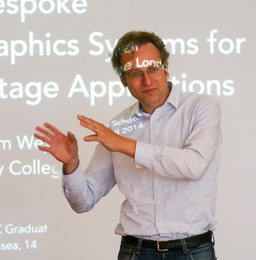
Tim Weyrich is Professor of Visual Computing (part-time) at University College London and Professor of Digital Reality at Friedrich-Alexander University Erlangen-Nürnberg. He leads the Digital Reality Lab and has affiliations with the Virtual Environments and Computer Graphics group at UCL, Eurographics, and the EPSRC Doctoral Training Centre (SEAHA). Previously, he held a Postdoctoral Teaching Fellowship at Princeton University. Research Interests: Content creation and computational photography Appearance modeling and fabrication Point-based graphics and cultural heritage analysis Digital humanities and 3D printing Article Trends: Recent work focuses on neural radiance fields (FruitNeRF++), 3D Gaussian splatting, mmWave radar inverse rendering, and texture anomaly detection. Applications span autonomous systems, cultural heritage, and medical imaging. Scientific Awards: Best Paper Honourable Mention (BMVC 2022) Best Student Paper Award (EG Workshop on GCH 2014) Honorable Mention (Eurographics 2011) Best Student Paper Honourable Mention (BMVC 2018) ACM SIGCHI Best Paper Honourable Mention (CHI 2013)
Nikos Hardavellas is a Professor of Computer Science and Electrical and Computer Engineering at Northwestern University, affiliated with the McCormick School of Engineering. He leads the Parallel Architecture Group at Northwestern (PARAG@N), focusing on energy-efficient parallel computing and quantum systems. His research spans quantum computing systems, fault-tolerant quantum error management, memory-centric architectures, and photonics-based interconnects. Education: Ph.D. Computer Science, Carnegie Mellon University (2009) M.S. Computer Science, Carnegie Mellon University (2006) M.S. Computer Science, University of Rochester (1997) B.S. Computer Science, University of Crete (1995) Research Interests: Quantum system software stack and error mitigation Memory-centric computing and programmable memory systems Energy-efficient architectures and dark silicon Photonics and optical interconnects Parallel systems and compiler-hardware co-design Key Contributions: Developed SupermarQ, a scalable quantum benchmark suite Pioneered optical cache hierarchies (Pho$) and energy-proportional photonic networks Advanced compiler-driven virtual memory systems (CARAT) and MPI autotuning (ACCLAiM) Awards & Honors: NSF CAREER Award (2015) Future CRA Leader (2024) Best Paper Awards at HPCA (2022) and ISLPED (2021 nomination) Test-of-Time Award at EDBT (2019) Grants & Service: Secured $4.8M in research funding from NSF, industry partners, and university initiatives Executive Committee member of Northwestern’s INQUIRE Institute for Quantum Research General Co-chair of IEEE/ACM MICRO 2022 Extensive service on departmental committees and thesis advisory boards Labs & Teams: Directs PARAG@N, collaborating on quantum computing, photonics, and energy-efficient architectures. Engages with industry partners like AMD, Intel, and Synopsys.
Prof Ghassan Beydoun is a Professor and Head of Discipline (Information Systems) at the School of Computer Science, University of Technology Sydney (UTS). He leads the Information Systems discipline and is affiliated with the Centre for Advanced Modelling and Geospatial Information Systems (CAMGIS). His research focuses on AI-driven systems, agent-based modelling, ontologies, and disaster management, with notable contributions to knowledge graphs, enterprise architecture, and IoT applications. Beydoun actively supervises Masters and PhD students in these domains. His research interests span metamodelling, agent systems, and AI applications in disaster management (e.g., flood, landslide, and earthquake risk assessment), health systems, and smart infrastructure. He has pioneered frameworks for reproducible machine learning solutions, digital identity systems, and cloud migration strategies. Beydoun’s work integrates interdisciplinary methods, such as bibliometric analysis for journal evolution and XAI for spatial hazard prediction. Recent publications highlight his expertise in AI for climate-induced hazard modelling, agent-based knowledge transfer mechanisms, and metaverse applications in education. His funded projects include AI-powered circular economy initiatives, smart beach safety systems, and health data querying frameworks. Beydoun collaborates with industry partners like CSIRO, Capsicum Business Architects, and Data Zoo, translating research into practical solutions for enterprise architecture, cybersecurity, and public health.
Mizuki Mazzotta is an Assistant Teaching Professor in the Department of Russian and East Asian Languages and Cultures at Emory University, where she also serves as Japanese Language Coordinator. Her academic journey includes a Ph.D. in Applied Linguistics from Georgia State University (2018) and M.A. degrees in Linguistics (McGill University) and Applied Linguistics (University of South Florida). Her research focuses on instructed second language acquisition, particularly the role of affect and sociocultural theory in L2 learning. She has extensive experience teaching Japanese language courses and mentoring students at Emory and previous institutions like Georgia State University. Education: Ph.D., Applied Linguistics, Georgia State University (2018) M.A., Linguistics, McGill University (2005) M.A., Applied Linguistics, University of South Florida (1997) B.A., English Literature, Soka University (1995) Research Interests: Instructed Second Language Acquisition Corrective Feedback in L2 Writing Sociocultural Theory in Language Education Learner Affect and Motivation Technology-Enhanced Language Learning Cultural Awareness in Language Instruction Awards & Grants: Recipient of multiple grants including the KAKENHI Grant (Japan), Mellon Humanities Pathways Grant, and Emory College Pedagogy Mini-Grant. Member of honor societies: Phi Beta Delta and Golden Key International. Service & Leadership: Executive Committee Member, Emory College Language Center Organizer of Japanese Program Guest Speaker Talks and Cultural Events Reviewer for Language Teaching Research and other academic journals Interviewer for the Japan Exchange Teaching Program Teaching & Mentorship: Instructor of Japanese language courses at Emory and Georgia State University Developer of study abroad programs in Japan and internship collaborations Mentor for Japanese interns and temporary faculty
Hesham ElSawy is an Assistant Professor in the Department of Systems and Networks at the School of Computing, Faculty of Arts and Science, Queen's University. His work focuses on advancing next-generation wireless systems, with particular emphasis on federated learning, IoT networks, and edge computing. He is affiliated with Ingenuity Labs Research Institute, Queen's University, and contributes to interdisciplinary research at the intersection of communication theory and network optimization. His research interests span stochastic geometry modeling, energy-efficient protocols for massive IoT deployments, and resilient federated learning frameworks. ElSawy explores novel paradigms in aerial wireless networks, UAV-assisted communication, and network security through percolation theory applications. Recent publications highlight his contributions to system-level analysis of parallel computing at extreme edges, UAV-enabled federated learning architectures, and energy-as-a-service models for RF-powered networks. His work emphasizes practical implementations and large-scale network validation. ElSawy holds no listed awards or grants in the provided text but maintains active collaborations through Ingenuity Labs. His research addresses critical challenges in 5G/6G networks, including latency optimization, resource allocation, and heterogeneous network integration.
Waldemar Karwowski is a Pegasus Professor and Chairman of the Department of Industrial Engineering and Management Systems at the University of Central Florida, USA. He also serves as Executive Director of the Institute for Advanced Systems Engineering. His affiliations include the College of Engineering and Computer Science and multiple international academic roles. He holds a Doctor of Science (dr hab.) in Management Science from Poland, a Ph.D. in Industrial Engineering from Texas Tech University, and three honorary doctorates from universities in Ukraine, Slovakia, and Russia. His research focuses on neuroergonomics, human systems integration, safety engineering, nonlinear dynamics in human-machine systems, and applications of soft computing. He co-edits leading journals including Human Factors and Ergonomics in Manufacturing and Theoretical Issues in Ergonomics Science . Key achievements include Fellowships from HFES, IEA, and the UK's Institute of Ergonomics, and past presidencies of HFES (2007) and the International Ergonomics Association (2000-2003). His work addresses grand challenges in human factors, AI ethics, and healthcare safety culture. Recent research explores EEG-based neuroergonomic metrics, graph neural networks for brain connectivity analysis, and pandemic modeling with nonlinear dynamics. Awards include the Handbook of Human Factors and Ergonomics (5th ed., 2022) co-edited with Gavriel Salvendy. His advisory roles span industry and government, emphasizing systems engineering and human-centered AI integration.
Dr. Cheryl Collier is a Professor and Dean of the Faculty of Arts, Humanities and Social Sciences at the University of Windsor, appointed since July 2021. She holds a position in the Department of Political Science with research expertise in gender-based violence in political contexts, Canadian social policy, and feminist institutionalism. Her research examines: Violence against women in politics (VAWIP) #MeToo movement impacts on political institutions Comparative legislative harassment policies Media representations of gender-based violence Intersectional approaches to policy analysis Recent publications form a comprehensive analysis of gender-based violence in Canadian politics, including social media harassment, mainstream media coverage, institutional responses, and policy solutions. Her work employs comparative frameworks analyzing Canada alongside the UK and other democracies.
Dr. Tao Shu is an Associate Professor in the Department of Computer Science and Software Engineering at Auburn University. His research focuses on cybersecurity, wireless communication systems, federated learning, and IoT applications. He holds a Ph.D. in Electrical and Computer Engineering from the University of Arizona, and M.S. and B.S. degrees in Electronic Engineering from South China University of Technology. Dr. Shu's work emphasizes secure communication and distributed learning systems, including projects funded by the NSF such as a novel method to prevent cyberattacks on Low Earth Orbit (LEO) satellites. He has been recognized for academic excellence, including being named to Auburn University’s 2020 promotion and tenure list. His research interests span cybersecurity mechanisms for autonomous vehicles, privacy-preserving federated learning, and resource allocation in metaverse environments. He explores innovative solutions for sensor spoofing detection, adversarial machine learning, and energy-efficient IoT systems. Dr. Shu is affiliated with Auburn’s Center for Artificial Intelligence and Cybersecurity Engineering and actively contributes to interdisciplinary projects. His publications reflect a strong focus on practical applications of theoretical advancements in wireless systems and secure data transmission.