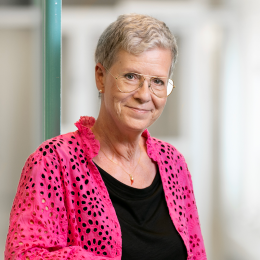
Andreas Thor is a Senior Lecturer in Linguistics at the Department of Nordic Languages, Uppsala University, based at Campus Gotland in Visby. His scholarly work centers on historical linguistics and philology, with particular attention to early Christian Latin epic poetry. Education: FD (Filosofie Doktor, PhD) – Uppsala University, exact field not specified in text. Research Interests: Thor's research is rooted in the linguistic and stylistic analysis of late-antique and early-medieval Latin texts, especially the Euangeliorum libri of Juvencus. His monographic study explores vocabulary choice, syntactic patterns, and literary technique within the framework of early Christian Latin literature. Publications & Academic Contributions: His principal publication, the 2013 doctoral monograph Studies on Juvencus' Language and Style , constitutes the main scholarly output available. The work provides a comprehensive linguistic commentary on Juvencus’ fourth-century hexameter paraphrase of the Gospels, situating its language within the broader context of late Latin and early Christian literary culture.
Marlene Johansson Falck is Deputy Dean of the Faculty of Arts and Professor of English Linguistics at Umeå University. She holds a PhD in English Linguistics from Luleå University of Technology (2005) and was a postdoctoral fellow at the University of California, Santa Cruz (2008–2010). Her academic roles include serving as Associate Editor for Metaphor and Symbol , co-chair of MetNet Scandinvania, and leadership in the Scandinavian Association for Language and Cognition (SALC). She is also a Recognised University Teacher (2020). Her research focuses on Cognitive Linguistics, particularly metaphor, spatial language, and embodied cognition. Key areas include the influence of artifacts on language structure, preposition usage in English/Swedish, and applying cognitive principles to language teaching. Notable projects include the 2010–2014 study on prepositions funded by the Swedish Academy. Recent publications (2020–2025) explore embodied scenes in language learning, metaphor identification methodologies, and spatial-temporal metaphors. She has supervised six PhD candidates, emphasizing collaborative and creative pedagogical approaches. Her work bridges theory and practice, influencing second language education through cognitive frameworks. Awards include recognition for teaching excellence. She contributes to interdisciplinary networks like CogLing UmU and collaborates internationally, including visits to Georgetown University and repeated collaborations with UCSC researchers.
Emily Hofstetter is an Associate Professor and Docent at Linköping University's Department of Culture and Society, within the Division of Language, Culture and Interaction. Her research focuses on the intricate processes of human interaction, particularly through the lens of conversation analysis and embodied coordination. She investigates how voice, body, and non-lexical vocalizations facilitate real-time social coordination, with applications to climate change communication via megagames and workplace interactions in opera rehearsals. Her research projects include "Switching the Current," using megagames to explore energy system transformations, and studies on non-lexical vocalizations' role in embodied coordination. Hofstetter applies the CARM methodology for communication training and has produced YouTube videos explaining conversation analysis techniques. She collaborates with researchers like Leelo Keevallik and Saul Albert, contributing to interdisciplinary fields spanning linguistics, sociology, and game design. Publications emphasize multimodal interaction analysis, including healthcare communication, human-robot interaction, and board game studies. Her work bridges theoretical insights with practical applications in education, policy, and technology design, advocating for systems thinking in serious game development. Hofstetter's academic affiliations include the Language and Culture research environment and the Division of Language, Culture and Interaction at Linköping University. Her research environment fosters collaborations across cultural and social science disciplines, emphasizing interactional studies' societal relevance.
Solveig Granath is a Professor of English at Karlstad University, where she has been affiliated since 1994 following the completion of her Ph.D. in English linguistics. Her research focuses on English syntax, particularly the interplay between syntactic structures and semantic/pragmatic factors, often employing corpus-linguistic methods. She has collaborated with Michael Wherrity on studies involving the progressive aspect and stative verbs using Columbia School Theory. Professor Granath holds a B.A. in English, German, and French from Karlstad University, and a teaching certificate from Mölndal Teacher Training College. She pursued doctoral studies at Brown University (USA), Umeå University, and the University of Gothenburg. Her teaching includes undergraduate courses in English linguistics, grammar, and language history, as well as graduate courses on Old/Middle English, corpus linguistics, and syntactic theory. Her research interests span corpus linguistics, syntactic theory, and the analysis of adverb placement, clause-initial 'thus', and prepositions like 'besides' and 'beyond'. Her work frequently addresses gaps between prescriptive grammar and descriptive linguistic practice, emphasizing empirical data from large corpora. Publications highlight her contributions to understanding linguistic patterns in political discourse (e.g., 'Political Correctness' in Time Magazine), syntactic structures in news media, and the application of ICT in language education. Her articles often bridge theoretical linguistics and applied corpus methods, contributing to both academic and pedagogical domains. No scientific awards are explicitly mentioned, though her extensive publication record reflects sustained scholarly impact. Teaching and advising form a core part of her role, though specific student advisees are not listed. Her work occasionally explores educational technology, such as the integration of IT in language instruction, as seen in collaborative publications on digital tools for teaching. While no dedicated lab is explicitly noted, her research often centers on collaborative projects and corpus-driven methodologies.
Graham Leigh is a Professor at the University of Gothenburg's Department of Philosophy and Logic. His primary research focuses on mathematical logic, proof theory, and modal logic, with significant contributions to cyclic proofs, theories of truth, and realisability semantics. He has collaborated extensively with researchers like Bahareh Afshari and Daichi Hayashi on foundational topics in logic and formal systems. Recent work emphasizes advancing proof systems for modal µ-calculus, exploring non-wellfounded proof structures, and analyzing truth theories within intuitionistic frameworks. His publications often bridge theoretical logic with applications in computer science, particularly in automated reasoning and program verification. Leigh's research also investigates the interplay between syntax and semantics in paradoxical contexts, contributing to the understanding of self-referential systems and their foundational limitations. He maintains an active publication record in top-tier journals and conferences such as the Journal of Symbolic Logic and Advances in Modal Logic .
Ida van der Woude is a faculty member and Programme Director at the Faculty of Arts and Sciences, Linköping University. Her work focuses on discursive and linguistic analysis, particularly examining cultural and historical shifts in language use. Her research explores: Discourse analysis of cultural concepts like "family" Linguistic evolution in German and Swedish public contexts Semiotic interpretation of compound words Historical changes in language patterns Intersections of culture and communication Recent publications analyze comparative linguistic trends in European media since the 1960s, showing her expertise in: Language change Sociolinguistics Textual analysis Cultural semiotics Comparative literature Discourse theory Contact: ida.van.der.woude@liu.se
Petter Ericson is a Researcher at the Department of Computer Science , Umeå University , specializing in Responsible AI . His work bridges graph theory , formal grammars , and ethics , with interdisciplinary interests in music and sociotechnical systems . Affiliated with the Responsible AI Research Group , he explores the alignment of AI with human values. Ericson’s research spans formal computational models , including hyperedge replacement grammars and order-preserving DAGs , alongside AI ethics and fairness frameworks . His publications address sociotechnical limits in AI safety, artistic shifts through AI, and graph language learnability. He has contributed to interdisciplinary projects like Concordia , a musical XR instrument for planetary data sonification, and Musereduce , a hierarchical music analysis framework. Ericson applies computational methods to Bayesian music theory and jazz harmony datasets.
Fredrik Heinat is an Associate Professor at Lund University's Centre for Languages and Literature, Faculty of Humanities and Theology. His academic work focuses on English linguistics with particular expertise in syntax, semantics, and psycholinguistics. He maintains an active research profile with numerous publications and ongoing projects in linguistic theory and language processing. Dr. Heinat's research interests span multiple areas of theoretical and experimental linguistics. His primary focus includes syntax, semantics, morphology, theoretical linguistics, psycholinguistics, language processing, argument structure, predicate formation, reference, quantifiers, and Scandinavian languages. His work often bridges theoretical linguistic frameworks with empirical psycholinguistic methods to investigate how language is processed and represented in the mind. His recent publications demonstrate a consistent focus on quantification, negation, discourse structure, and agreement phenomena, with particular emphasis on Scandinavian languages (especially Swedish). Through a combination of experimental methods including ERP studies, EEG, and production experiments, he has made significant contributions to our understanding of how linguistic constraints interact with cognitive processing during language comprehension and production. Dr. Heinat has received research funding from prestigious organizations including the Swedish Research Council and Olle Engkvists stiftelse. His current projects include "Mood and sentence processing," "V2 in main and embedded clauses in English and Danish over the last thousand years," "Memory representations and language processing," "Quantification in Swedish," and "Development and validation of a conceptual span task in Swedish." These projects reflect his interdisciplinary approach spanning historical linguistics, cognitive science, and theoretical syntax. As a dedicated educator, Dr. Heinat teaches courses in English linguistics including "English: Level 2," "English: Linguistic Analysis," "English: English Grammar," and advanced courses for higher-level students. His teaching reflects his research expertise, providing students with both theoretical foundations and exposure to current research methodologies in linguistics. Dr. Heinat is actively involved in the academic community through conference presentations, workshop organization, and collaborative research. His ORCID profile (0000-0002-2537-2965) documents his extensive publication record and research contributions across multiple subfields of linguistics.
Eva Klingvall is an Associate Professor at the Department of English Studies, Centre for Languages and Literature, Lund University. Her research bridges theoretical linguistics and neurolinguistics, focusing on syntax, semantics, and language processing mechanisms. Current Research: Investigates memory's role in pronoun processing using EEG, examining distance and information density effects. Key Projects: Explores memory representations in language processing, quantification in Swedish, and conceptual span tasks. Her work reveals intersections between linguistic theory, cognitive processing, and neurolinguistic methodologies, with applications in anaphora resolution and negation studies. Scientific Awards: Elected to AcademiaNet (2022) and Academia Europaea (2022). She supervises PhD students Elena Kopaeva and Fredrik Lauridsen and coordinates Lund University's Grammar Seminar since 2024. Her research is supported by the Swedish Research Council and Olle Engkvist Foundation.
Satu Manninen is a Professor in English Linguistics and Manager of Research and Research Education at the Centre for Languages and Literature , Lund University. She has coordinated the international MA programme in Languages and Linguistics and serves as an editor for the Lund Journal of English Studies and the Lund Studies in English book series. Education : Ph.D. in Theoretical Linguistics (University of Edinburgh, 1999), MA/BA in English Philology (University of Tampere) with second-subject studies in Nordic Philology, Journalism, Social Psychology, and Psychology. Research Focus : Her work spans theoretical syntax (Finnish and Finnic languages), academic writing in non-native contexts, and ideophones/expressive vocabulary in Finnish, English, and Swedish. She examines dictionary definitions, translation strategies, and multimodal narratives (comics, cartoons) with Dr. Maria Wiktorsson. Key Article Trends : Recent publications address ideophones in multimodal texts, pedagogical mentorship models for doctoral students, academic writing frameworks, and reduplicative compounds in English. Collaborative projects emphasize cross-linguistic translation and corpus-based analysis. Scientific Awards : Qualified Teaching Practitioner, The Joint Faculties of Humanities and Theology (2025). Teaching & Administrative Roles : She has taught courses in generative syntax , lexical semantics , language and gender , and academic writing at all levels (BA, MA, PhD). Administrative duties include membership in the Academic Appointments Board and leadership of research education. Labs & Collaborations : Collaborated with Malmö University (Dr. Maria Wiktorsson) on ideophones and translation studies, and with the German Unit at Lund on literary translation projects. Involved in pedagogical development work at University of Alicante (2024).
Elzbieta Strzelecka serves as a Senior Lecturer in the Department of Humanities and Social Sciences at Mid Sweden University in Sundsvall, specializing in Swedish language didactics and linguistic research. Her academic career spans decades with significant contributions to cognitive linguistics and grammar pedagogy, particularly for Swedish as a second language. Her research centers on cognitive linguistics frameworks applied to Swedish grammar instruction, with emphasis on particle verb semantics, container metaphors, and cross-linguistic comparisons between Swedish and Polish. She pioneered phenomenographic analyses of students' grammar histories, revealing emotional and cognitive dimensions of language learning. Her work bridges theoretical linguistics with practical classroom applications, focusing on spatial language concepts and teacher strategy development. Analysis of her publication trajectory shows consistent evolution from foundational cognitive linguistic studies of particle verbs toward contemporary grammar pedagogy innovation. Recent work emphasizes teacher training methodologies and student-centered approaches, with strong collaboration patterns particularly with Lena Boström. Her publications demonstrate interdisciplinary reach spanning cognitive science, educational psychology, and contrastive linguistics while maintaining focus on practical Swedish language instruction.
Ludmila Pöppel is a Professor at Stockholm University , affiliated with the Department of Slavic and Baltic Languages, Finnish, Dutch and German . Her research focuses on discourse analysis , lexical semantics , phraseology , and corpus linguistics , often intersecting with political discourse and construction grammar . Research Themes: Analyzing near-synonyms in Russian (e.g., беспорядки vs. волнения), combinatorial properties of words, and semantic shifts in political terminology like революция (revolution) vs. переворот (coup). Key Projects: Leadership in the TELICORE collaboration between Stockholm University, Higher School of Economics (Russia), and Ilia State University (Georgia), and contributions to the Russian-Swedish dictionary database for discursive units. Publications: Her work spans corpus-driven studies of Russian constructions (e.g., дело в том, что, то-то и N), their cross-linguistic parallels, and the pragmatic functions of focus particles. She emphasizes empirical data from Sketch Engine and the Russian National Corpus to identify language-specific features. Advising: Supervises doctoral students and numerous undergraduate and master's theses, integrating her research on political discourse into teaching at all levels, including courses on corpus linguistics and lexical semantics . Labs/Networks: Member of the Language and Power Network , analyzing how language shapes political narratives in polarized climates.
Petur Helgason serves as a Senior Lecturer in the Department of Linguistics at Stockholm University, with his office located in Room C 280 at Universitetsvägen 10 C (2nd-3rd floor). His professional address is Institutionen för lingvistik, 106 91 Stockholm. Dr. Helgason's academic work centers on linguistic theory and language structure. As a member of Stockholm University's linguistics department, his research spans multiple dimensions of language analysis including phonetic systems, syntactic structures, semantic interpretation, and morphological patterns. His position as Senior Lecturer indicates substantial expertise and experience in linguistic scholarship and pedagogy. With no publications or specific research projects detailed in the available information, Dr. Helgason maintains professional accessibility through his university email address for academic inquiries and potential collaborations within the linguistic community.
Camilla Bardel is a full Professor at the Department of Teaching and Learning , Stockholm University. Her research focuses on third language acquisition , cross-linguistic influence, and language education with a specialization in Romance languages. She leads research groups on Multilingualism and Third Language Acquisition and RomSLA (Romance Languages and Second Language Acquisition), while collaborating with projects like TAL (Teaching, Assessment and Learning of second foreign languages) and FRAM (Foreign Language Education Research School). PhD in Italian from Lund University (2000) Full Professor at Stockholm University since 2010 Former Professor of Italian at Department of French, Italian and Classics (2013–2014) Her research examines how multilingual learners acquire third languages, particularly focusing on grammatical aspect, lexical profiling, and syntactic transfer. Key projects include studies on the role of explicit metalinguistic knowledge in L3 acquisition, the development of lexical sophistication tools for L2/L3 oral production, and alignment between teaching, learning, and assessment in Swedish language education. She has contributed extensively to understanding transfer from L1/L2 to L3, with a particular focus on Germanic syntax and Romance language structures. Recent publications analyze intercomprehension in L3 judgment tasks, oral proficiency trends in Swedish lower secondary schools, and academic vocabulary assessment tools. She co-organized the 2025 postgraduate course on Third Language Research with Ylva Falk, emphasizing empirical methodologies and multilingual education theories.
Ute Bohnacker is Professor of Linguistics at Uppsala University's Department of Linguistics and Philology and also holds the position of Reader in Scandinavian Languages. She has made significant contributions to the field of linguistics through her research on language acquisition, bilingualism, and narrative analysis, with particular focus on Germanic languages and multilingual child development in the Swedish context. Her research expertise spans first and second language acquisition, bilingualism, narrative structures, grammar, and discourse, with special interest in Germanic languages. Bohnacker's recent work has expanded into language assessment and impaired populations, examining both typical and atypical multilingual child language development. She has conducted morphosyntactic studies of Icelandic and Swedish child language, investigated word order and discourse pragmatics in adult second and third language learners, and contributed to theory-building in second language research regarding the influence of first and second languages on third language acquisition. Bohnacker's publication record from 2021-2025 reveals a consistent focus on bilingual language development across multiple language pairs (Turkish-Swedish, Arabic-Swedish, German-Swedish), with particular attention to narrative macrostructure, vocabulary development, and language assessment. Her work demonstrates a clear progression from theoretical linguistics to practical applications in educational and clinical settings, with increasing emphasis on developmental language disorders in bilingual contexts. She has been actively involved in the European network COST Action IS0804 on multilingualism and language impairment and has led the development of the Multilingual Assessment Instrument for Narratives (MAIN), now used worldwide. Currently, she leads the interdisciplinary BiLI-TAS project (funded by Vetenskapsrådet 2014-2019 and Riksbankens jubileumsfond 2020-) that maps language development in bilingual Turkish-, Arabic-, and German-speaking preschool children and early school-age children in Sweden. Bohnacker's research group examines language development in both heritage languages and Swedish, identifying typical developmental stages and warning signs for atypical development (language disorder). Her empirical results have direct relevance for theory-building in language acquisition research, language disorders, and speech therapy practice.