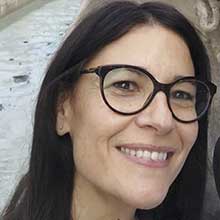
Elisabetta Magni is a Full Professor at the University of Bologna's Department of Modern Languages, Literatures, and Cultures, specializing in Historical and General Linguistics. Her research focuses on language change, morphological systems, and Indo-European languages, particularly Latin and Greek. She has contributed to studies on syntactic structures, grammaticalization processes, and the diachronic evolution of linguistic forms. Recent work includes analyses of the optative mood in New Testament Greek, Latin apposition constructions, and the development of general extenders from Latin to Italian. Her teaching activities include courses on general linguistics and language history, supported by resources such as etymological maps and videos on writing systems. She oversees projects like the E-LOCAL app for language and culture learning, emphasizing innovative pedagogy. Office hours are held via Teams and in-person at the LILEC Department. Her publications span over three decades, addressing topics ranging from Latin syntax and Greek morphology to sociolinguistic aspects of language change. Collaborative works include co-editing Universals of Language Today (2009) and contributing to international journals like Journal of Latin Linguistics . She actively participates in academic networks, promoting interdisciplinary approaches to linguistic studies.
Dr. Maria Vender is an Associate Professor in the Department of Foreign Languages and Literatures at the University of Verona, affiliated with the School of Cultures and Civilizations. Her academic roles include membership in the Faculty Board of the Linguistics PhD Program, the Teaching Committee for Foreign Languages and Literatures, and the Department's Communication and Web Commission. She actively contributes to research centers such as the Laboratorio di Linguistica Applicata (La.LiA) and leads projects like the PRIN PNRR 2022 REAding CompreHension for inclusion (REACH). Her teaching spans undergraduate and graduate courses in Language Learning, Semiotics, and Bilingualism across programs like the Master's in Linguistics and the Professional Master’s in Bibliotherapy. Her research focuses on language acquisition, developmental disorders, and applied linguistics, with recent work addressing literacy interventions for vulnerable populations, bilingualism in neurodiverse children, and cognitive aspects of language processing. She has published extensively in journals and conferences, emphasizing methodologies like eye-tracking and experimental linguistics. Maria Vender is also involved in third mission initiatives, including public engagement programs and professional training courses on literacy and educational inclusion.
Andrea Facchin is an Associate Professor of Arabic Language and Literature at Ca' Foscari University of Venice. His expertise spans TAFL (Teaching Arabic as a Foreign Language), language policy, and cross-cultural communication. He leads the DAR Laboratory for Arabic language teaching innovations and co-developed the CALI certification for Italian learners. He chairs Italy’s team in Qatar Foundation International’s Arabic Language Programs Survey. His research emphasizes historical and contemporary Arabic pedagogy, non-verbal communication, and sociopolitical influences on language education. Education & Leadership: Holds a PhD from Ca' Foscari, where he also teaches. Active in editorial roles for Quaderni di Studi Arabi. Fluent in Arabic (advanced written/spoken) and English (advanced). Research Focus: Explores TAFL’s evolution since the 1960s, CEFR integration, pronunciation pedagogy, and Sudan’s 1950s Arabization efforts. His 2019 monograph Teaching Arabic as a Foreign Language earned Ca’ Foscari’s Research Award. Recent work includes a translation of Ibrahim Darghuthi’s novel Le palme muoiono in piedi . Awards & Impact: 2020 Starting Research Award for his groundbreaking TAFL scholarship. Engages students in cultural projects like writing human rights texts in Arabic, bridging language learning with societal values. Collaborations: Works internationally with institutions in Finland, Netherlands, and Tunisia. Part of the American Councils for International Education for CALI development. Editor for Études sémitiques and Lettera a una professoressa editions.
Giuliana Giusti is a Full Professor at Ca' Foscari University of Venice, affiliated with the Department of Comparative Linguistic and Cultural Studies. She holds roles such as Substitute member of the GEP Team, Delegate for Quality Assurance, and Effective representative of the University's Single Guarantee Committee (CUG). Her research focuses on syntax, formal linguistics, and Romance languages, with particular emphasis on determiners, clitics, and grammatical variation across Italo-Romance dialects. Giusti has contributed extensively to studies on linguistic metacognition, gender-inclusive language, and historical linguistics, including analyses of Latin syntax and its evolution into modern Romance languages. She teaches courses on formal syntax, English linguistics, and language and gender at undergraduate and graduate levels. Her academic work spans over 150 publications, including monographs, edited volumes, and peer-reviewed articles in journals like Linguistics , Revista Română de Lingvistică , and Isogloss . Giusti's research integrates theoretical syntax with empirical studies, often employing comparative methods to explore phenomena such as indefinite determiners, quantifiers, and clitic placement. She has also led initiatives promoting linguistic awareness and inclusive language practices, reflecting her commitment to societal impact through academia. Giusti’s teaching portfolio includes advanced courses on comparative syntax, formal syntax, and language policy, alongside contributions to curriculum development for students with learning disabilities. Her academic leadership roles underscore her institutional engagement, balancing research, education, and administrative responsibilities at Ca' Foscari.
Cristiana De Santis is a Full Professor of Italian Linguistics at the University of Bologna's Department of Education Studies 'Giovanni Maria Bertin'. She holds a PhD in Italian Linguistics (2003) and has held academic positions since 2007, including roles at the Department of Interpretation and Translation and the Collegio Superiore. Her research focuses on Italian grammar, political language, educational linguistics, and gender studies. She is affiliated with research centers CSGE and CRESPI and maintains a blog on Italian grammar. Education: PhD in Italian Linguistics (2003), University of Bologna Master's in Modern Literature (1997), University of Bologna Research Interests: Her work explores authoritative language, Italian grammar, political discourse analysis, and the role of linguistics in education. She emphasizes valency grammar, discourse analysis, and the sociocultural dimensions of language use. Publications: Over 30 peer-reviewed articles and books, including works on gender and language, political rhetoric, and valency grammar applications. Recent topics include inclusive language debates and the linguistic legacy of Gianni Rodari. Awards: None explicitly stated in the provided texts. Teaching & Grants: Leads courses on Italian syntax and grammar, and has coordinated national and international research projects on language education and political discourse. Active in teacher training programs. Labs/Teams: Collaborates with CSGE (Gender and Education) and CRESPI (Teacher Professional Development) at the University of Bologna.
Giulia Bencini is an Adjunct Professor at Ca' Foscari University of Venice, affiliated with the Interdepartmental School of Economics, Languages and Entrepreneurship. She serves on the Board of Directors for the Bembolab Laboratory. Her research focuses on language sciences, particularly psycholinguistics and neurolinguistics, with emphasis on language disorders and cognitive mechanisms underlying linguistic processing. She actively participates in projects like ADAPT (2013-2015) and a cognitive stimulation initiative for elderly individuals with cognitive decline (2016). Her publications address universal design principles in communication rights and neurocognitive aspects of language rehabilitation. Teaching responsibilities include courses such as Early Language Development and Psycholinguistics at the master's level, alongside English language instruction across undergraduate programs. She maintains office hours Tuesdays 2:15–4:15 PM CET via预约. Key research areas include the intersection of language structure and cognitive processes, applied linguistics for clinical contexts, and inclusive design methodologies. She collaborates with interdisciplinary teams and contributes to both theoretical and applied linguistic research.
Roberto Zamparelli is an Associate Professor at the University of Trento in both the Department of Psychology and Cognitive Science and the Center for Mind/Brain Sciences (CIMeC) . His research spans theoretical and computational linguistics with a focus on syntax-semantics interface phenomena. His research interests include formal semantics , distributional semantics , computational models of language , and linguistic education . He has supervised multiple PhD theses and contributed to interdisciplinary projects combining linguistics with cognitive science. The 15 most recent articles (2013-2024) demonstrate consistent focus on partitive structures , multimodal language models , semantic knowledge evaluation , and multilingualism effects . Key subfields include ellipsis mechanisms, cross-linguistic analysis, and neural network linguistic testing. Marie Curie Post-Doctoral Fellowship (1997-1999) British Academy 'Joint Activity Grant' (2000) Patent: Dispositivo didattico per l’apprendimento o l’esercizio nell’uso di strutture linguistiche (2016) Students supervised include Eva Vecchi , Rossella Varvara , and Sara Zanellini . His work integrates computational methods with theoretical linguistics , supported by grants like the PRIN REPLAI project (2023-25) and EU Atheme collaboration (2014-19).
Martina Irsara is a researcher at the University of Bolzano , affiliated with the Faculty of Education . Her work focuses on multilingualism, English language teaching, and comparative linguistics, particularly in the South Tyrol region of northern Italy.
Serena Perrone is an Associate Professor at the University of Genoa , affiliated with the School of Humanities and the Department of Antiquities, Philosophy, and History . She serves as a Course Coordinator for the Master's Degree Course in Philology and Ancient Sciences and holds additional roles as a Member of the School Council and the research commission. Teaching: Classical Philology, Papyrology, Theatre and Dramaturgy of Antiquity Research Focus: Homeric texts, Greek and Latin philology, papyrology, and ancient theatre studies
Olga Tribulato is a Full Professor in the Department of Humanities at Ca' Foscari University of Venice, where she serves as a Member of the Ca' Foscari ERC Board. Her academic specialization is in Greek Language and Literature (SSD HELL-01/B). Professor Tribulato's research focuses on Ancient Greek linguistics, with particular emphasis on Atticism (linguistic purism in Ancient Greek), Greek dialects, Greek lexicography, and the linguistic landscape of Ancient Sicily. Her work bridges philological analysis with historical and sociolinguistic approaches to understanding the development and variation of Ancient Greek. Recent publications demonstrate a strong focus on Atticist lexica, particularly examining Phrynichus' Praeparatio sophistica and the Antiatticist lexicon. She has co-edited the significant volume "Ancient Greek Purism 1: The Roots of Atticism" (2024) and has contributed numerous entries to the Digital Encyclopedia of Atticism. Her research also explores the linguistic aspects of Greek comedy, the language of Herodotus, and the sociolinguistic context of ancient Sicily. Professor Tribulato has received recognition for her scholarly contributions through invitations to contribute to major reference works including The Cambridge Companion to Sappho (2021) and Brill's Companion to Theocritus (2021), as well as The Oxford Handbook of Ancient Sicily (forthcoming). She maintains an active research profile with numerous publications spanning journal articles, book chapters, encyclopedia entries, and scholarly monographs. Her work appears in prestigious journals such as The Classical Quarterly, Harvard Studies in Classical Philology, and Zeitschrift für Papyrologie und Epigraphik.
Davide Mastrantonio is an Associate Professor of Italian Linguistics at Ca' Foscari University of Venice, Department of Humanities, where he has served since August 1, 2023. He holds the qualification to full professorship effective March 2025. His institutional roles include being the contact person for written Italian in the Humanities Area and responsible for linguistic training at the School for International Education (SIE). His research spans multiple dimensions of Italian linguistics, with particular focus on historical linguistics, textuality, and academic Italian. Mastrantonio investigates linguistic contact between Latin and vernacular Italian, syntax and textuality of ancient Italian, medieval Sienese documents, the language of Galileo Galilei, and the history of words. A significant portion of his work concerns academic Italian as a denotative written variety of medium-high formality that transcends disciplinary boundaries. His recent publications reveal a strong emphasis on textual analysis, discourse phenomena, and the development of academic language resources. The trend shows increasing focus on practical applications of linguistic research, particularly in language teaching and the creation of specialized dictionaries and language resources for academic contexts. His work bridges historical linguistics with contemporary language teaching methodologies. As Principal Investigator, Mastrantonio leads the PRIN 2022 PNRR project "Dictionary of Academic Italian: Textual Forms and Functions" (DIA), which involves Ca' Foscari University, the University of Milan, and the University for Foreigners of Siena. He serves on the scientific committees of the journal "La lingua italiana" (Serra Editore) and the series "Variae Voces" (Cesati Editore), and is a member of the editorial board of "Italiano a scuola". Mastrantonio teaches courses including Italian Philology, Linguistics and Literature, Professional Italian, Italian Linguistics II, and History of the Italian Language II across various degree programs. His teaching approach integrates historical linguistic knowledge with practical language skills development, particularly for academic contexts. He has also conducted teacher training for the IPRASE research institute and the "I Lincei per la Scuola" Foundation.
Agnese Macchiarelli is a Contract Lecturer at Ca' Foscari University of Venice's Department of Humanities. Her academic work bridges medieval studies and digital humanities, with a focus on textual criticism, manuscript studies, and the digital preservation of historical texts. She maintains office hours during lecture periods and coordinates via email. Education: PhD in Italian Studies, Ca' Foscari University of Venice (2017-2021) Master's in Italian Studies and Linguistic Sciences, University of Bologna (2013-2015) Bachelor's in Italian Studies, Sapienza University of Rome (2009-2013) Classical High School Diploma, Santa Teresa di Gesù, Rome (2003-2008) Research Focus: Macchiarelli specializes in medieval Italian literature, Dominican theological texts, and digital scholarly editing. Her work frequently examines 14th-century authors like Iacopo Passavanti and Dante, employing both traditional philological methods and digital tools like treebanking and text encoding. She maintains particular expertise in the digital representation of sacred historical texts. Professional Activities: Scientific Fellow at Bergische Universität Wuppertal and VeDPH (2023-2026) for the DFG/FWF project History as a Visual Concept: Peter of Poitiers' Compendium Historiae Research Grant: Legacy of Thomas Aquinas Treebank Project (2021-2022) Teaching Assistant in Medieval/Romance Philology (since 2021) Affiliated with Venice Centre for Digital and Public Humanities (VeDPH) since 2021 Research stay at École des Hautes Études en Sciences Sociales, Paris (2019-2020)
Serenella Baggio is a Full Professor of Italian Language History at the Department of Literature and Philosophy of the University of Trento. She has been at the University of Trento since 2002, initially as Associate Professor and since 2021 as Full Professor. She coordinates the Italian Writing courses and has been a member of the doctoral school 'Le forme del testo' since 2002, while also supervising numerous master's and doctoral theses through double-degree programs with institutions like Technische Universität Dresden and University of Augsburg. Baggio earned her Bachelor's Degree from the University of Padua with a thesis on 'Color and Word between the Middle Ages and the Renaissance' (1978). She obtained her Postgraduate Diploma in Modern Philology (1987) and Doctorate in Romance and Italian Philology (1987), both from the University of Padua. Her academic journey included teaching Italian at the University of Würzburg (1979-1983) and in Italian high schools (1984-2001) before joining the University of Trento. Professor Baggio's research focuses on the language of non-literary texts and the comparison between literary and non-literary language from the origins to the 20th century. Her work spans multiple areas including: color terminology (cromonimia), artistic lexicon between Middle Ages and Renaissance, popular literature, popular writings (letters, diaries, memories from migration and WWI), medical vernacularizations, medieval lapidaries, Boccaccio's Decameron, medieval syntax, regional languages, linguistic atlases, language contact, and Trentino dialects. She has made significant contributions to the study of popular writing through archives like the Cinquetti Archive and psychiatric hospital archives in Trentino. Her research bridges historical linguistics with sociolinguistic perspectives, often focusing on marginalized voices and non-standard language varieties. Her recent publications (2019-2021) demonstrate continued engagement with historical linguistics, particularly focusing on WWI language documentation, Trentino's linguistic heritage, and the analysis of spoken language in historical texts. She has worked extensively with sound archives like the Phonogrammarchiv in Vienna, examining historical recordings of Italian dialects. Her publications show a consistent pattern of interdisciplinary work connecting linguistic analysis with historical, anthropological, and sociological perspectives. Baggio has coordinated significant research projects including an Erasmus program with UBO-Brest, France, and a DFG project with TU Dresden on Italian manuscript collections. Her work with IPRASE on monitoring linguistic competencies and with the Trentino Popular Writing Archive demonstrates her commitment to applied linguistics and community engagement. She has been actively involved in creating linguistic laboratories across Trentino through the 'Formare formatori' project and has contributed to the establishment of the Trentino Giscel group. Her collaboration with museums and cultural institutions, particularly on popular writings and historical archives, shows her dedication to making linguistic research accessible beyond academia. She has organized numerous conferences including 'Lingue naturali, lingue inventate' (2019) and 'Lingua franca, lingue franche' (2021), and has participated in academic radio programs like 'La lingua batte' (Radio3, 2017) and 'Zazà' (Radio3, 2020), demonstrating her commitment to public scholarship.
Judit Papp is a Researcher in Finno-Ugric Philology at the Department of Literary, Linguistic and Comparative Studies, Università degli Studi di Napoli "L'Orientale". She specializes in Hungarian language, literature, and culture, with particular expertise in Finno-Ugric philology, translation studies, and Hungarian folklore. Dr. Papp's research interests span multiple domains: Hungarian language structure and evolution, particularly focusing on pandemic-related neologisms and linguistic changes Hungarian literature, especially 20th century and contemporary works Translation studies, with emphasis on Hungarian-Italian literary translations Holocaust representation in children's literature Toponymy and urban nomenclature in Budapest Finno-Ugric linguistic heritage and cultural connections Her recent publications demonstrate a strong focus on interdisciplinary research connecting linguistics, literature, and cultural studies. She has produced significant work on Hungarian translations of Dante's Divine Comedy, Holocaust representation in picturebooks, and the linguistic impact of the COVID-19 pandemic on Hungarian terminology. Her research often bridges Hungarian studies with broader European cultural contexts, particularly Italian-Hungarian connections. Dr. Papp has received several scientific awards and recognitions: Burch University Award (2015) from International Burch University, Sarajevo Research grant from Università degli Studi di Napoli "L'Orientale" (2008) Research grant from Università degli Studi di Napoli "L'Orientale" (2007) Doctoral scholarship from Scuola Europea di Studi Avanzati (2002) She serves on multiple editorial boards including "ITALIANISTICA DEBRECENIENSIS" (since 2021), "ANNALI DELL'ISTITUTO UNIVERSITARIO ORIENTALE DI NAPOLI. STUDI FINNO-UGRICI" (since 2020), and previously on "JOURNAL OF STUDIES IN LANGUAGE, CULTURE AND SOCIETY" (2018-2020) and "JOURNAL OF LANGUAGES FOR SPECIFIC PURPOSES" (2016-2023). Dr. Papp leads the digital mapping project "Ricordi ungheresi medievali a Napoli: da Maria d'Ungheria a Ladislao I di Napoli" which explores Hungarian historical connections to Naples through the life of Queen Maria of Hungary. She also coordinates the Hungarian/Italian/English dictionary project for pandemic-related terminology.
Valentina Crestani is Associate Professor of Language and Translation at the University of Milan, specializing in German-Italian linguistic mediation. She coordinates the 4EU+ European Pluralities program and leads Human Hall's Linguistic Inclusiveness project. Her research examines accessible communication systems like Leichte Sprache (German) and linguaggio facile (Italian), with focus areas including: gender-sensitive terminology development, audiovisual accessibility strategies, and institutional translation frameworks. She has edited volumes on disability-language intersections including Gender, Disability, Language: Projects and Perspectives in Milan . Dr. Crestani's publications analyze comparative translation methodologies, particularly regarding legal and educational materials for diverse audiences. Recent work explores energy terminology complexity and museum communication adaptations.