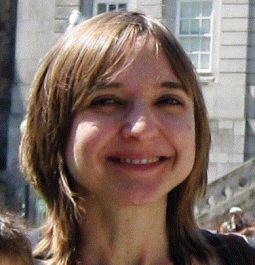
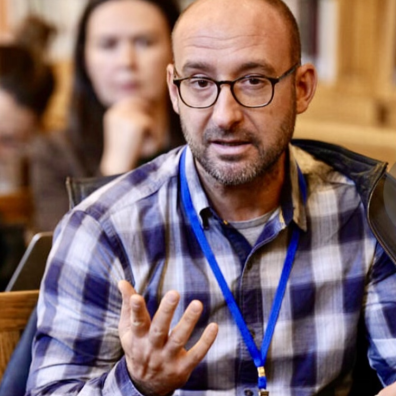
Caroline Heycock is a Professor of Syntax at the University of Edinburgh , affiliated with the School of Philosophy, Psychology and Language Sciences and the Department of Linguistics and English Language . She is currently on research leave until January 2025. Her teaching includes courses on syntax at both undergraduate and postgraduate levels. She actively supervises PhD students and has advised numerous scholars in syntactic theory and related fields. Her research focuses on syntactic theory , variation , and change , with particular attention to copular clauses, Faroese syntax, and Scots dialectal features. Key projects include investigations into nominal predication structures, verb movement in Faroese, and sociolinguistic aspects of Scots syntax. She has secured funding from major bodies like the Arts and Humanities Research Council (AHRC) and the European Union. Recent work explores the theoretical and empirical dimensions of copular clauses, including appositional boundaries and cross-linguistic agreement patterns. Her research integrates formal syntax with sociolinguistic methodologies, as seen in studies on Scots dialectal variation and experimental analyses of Icelandic agreement phenomena. Caroline Heycock has supervised over 25 PhD students and has led or co-led 15 research projects, including major initiatives like the Scots Syntactic Atlas and the EU-funded AThEME project. Her contributions span theoretical syntax, language acquisition, and historical change, with a focus on under-researched languages like Faroese and Scots.
Ana Madeira is an Associate Professor at the Language Sciences Department of the Faculty of Social Sciences and Humanities, Universidade Nova de Lisboa. She is affiliated with the Linguistics Research Centre of the same university (CLUNL), where she contributes to research in second language acquisition, syntax, and foreign language teaching. Her work spans theoretical and applied linguistics, with a focus on Portuguese as a second language and bilingualism. Doctorate: University College London, in Linguistics. Her research explores microvariation in anaphora resolution, control and restructuring phenomena, and the impact of input on language acquisition. She has contributed to projects assessing language proficiency, developing placement tests, and creating digital teaching platforms like Saberportuguês.pt. Ana has coordinated postgraduate programs and served as a principal investigator in projects funded by institutions such as the Calouste Gulbenkian Foundation and the British Academy. Notable awards include the British Academy Postdoctoral Research Fellowship. She has reviewed for journals like Probus and Linguistic Approaches to Bilingualism and collaborated with publishers to develop educational materials. Her professional experience includes organizing summer courses, teacher training, and advising on bilingualism and academic success in Portuguese education.
Professor Björn Hansen is Chair of Slavic Linguistics at the Institute of Slavic Studies, University of Regensburg, where he has held a professorship since 2002. Previously, he served as Lecturer in Slavonic Linguistics at the University of Cambridge (2000-2002) and as a research assistant at the University of Hamburg. He is also Partnerschaftsbeauftragter for university cooperation with the University of Novi Sad (Serbia) and University of Łódź (Poland), and chairs the doctoral committee for the Faculty of Philosophy IV at Regensburg. Born: 1964 in Flensburg 1984-1991: Studies in East Slavic Studies and German Language and Literature at University of Hamburg 1995: PhD in Slavic Linguistics (University of Hamburg) 2001: Habilitation in Slavic Philology - Linguistics (University of Hamburg) Hansen's research spans multiple areas of Slavic linguistics, with particular focus on the structures of Polish, Russian, Serbian and Croatian languages. His work investigates language contact phenomena, areal typology, language change in Slavia, heritage linguistics, and corpus linguistics. He specializes in syntax and semantics, particularly examining modality, grammaticalization processes, contact-induced change, clitics (including clitic climbing), indefiniteness, subject encoding, frame semantics of public discourse, and the language of religion. His methodological approach often combines corpus-based analysis with theoretical linguistic frameworks. Analysis of Hansen's recent publications reveals consistent focus on microvariation in South Slavic languages, particularly Bosnian, Croatian, and Serbian. His work demonstrates expertise in clitic phenomena, modal constructions, and subject case marking. He frequently employs corpus-based methodologies to investigate rare linguistic phenomena, especially in underresourced languages. His research increasingly connects historical linguistics with contemporary language use, examining how grammaticalization processes evolve over time and across language contact situations. Member of DFG-Fachkollegium 104-02 (2009-2024) Official expert for Alexander von Humboldt Foundation (since 2011) Reviewer for multiple national research foundations including DFG, Swiss National Science Foundation, and Austrian Science Fund Member of editorial boards for several international linguistics journals Hansen has supervised numerous doctoral and master's students, with research spanning heritage language syntax, Slavic modality, language contact phenomena, and corpus-based linguistic analysis. He leads multiple externally funded research projects including 'seeFfield' (VolkswagenStiftung, 2022-2029), 'LangGener' (DFG-NCN, 2018-2022), and several DFG projects examining microvariation in Bosnian/Croatian/Serbian, Polish-German bilingualism, and historical semantics of corruption. As Principal Investigator of the Graduate School for East and Southeast European Studies (2012-2019), he has significantly contributed to interdisciplinary research in the region. Hansen directs the Binational Study Program 'German-Polish Studies' (funded by DAAD) and has organized numerous international conferences and workshops on Slavic linguistics, including the 'Clitic Climbing' workshop (2017) and 'Perspectives of German-Slavic Multilingualism' conference (2016).
Dr Julio Villa-García is an Honorary Senior Lecturer at the University of Manchester and an Associate Professor of English Linguistics at the University of Oviedo (Spain). He specializes in theoretical syntax, syntactic variation, and bilingualism. His research focuses on the syntax of English and Spanish, with contributions to the study of complementisers, clitics, and the syntax-phonology interface. He has held roles at institutions including Villanova University and has been a visiting researcher funded by the EU's 'María Zambrano' grant. Education: BA (Hons) in English Studies (University of Oviedo, 2005); MA in Linguistics (University of Kent, 2005; University of Essex, 2007; University of Connecticut, 2010); PhD in Linguistics (University of Connecticut, 2012). Research Interests: Syntax variation, microvariation, clitic systems, left periphery structures, bilingualism, and applications of linguistic theory to language pedagogy. His work bridges theoretical and descriptive approaches, often comparing Romance languages. Recognition: Recipient of the Arthur Abramson Award for Teaching (2010). He coordinates the Bilingualism Series at the Instituto Cervantes and has engaged in public talks on multilingualism and language learning.
Cecilia Poletto is a Professor of Linguistics at Goethe University Frankfurt (since 2011) and holds a part-time professorship at the University of Padua (since 2016). Her research focuses on Germanic and Romance syntax, microvariation, and historical morphosyntax. She has held a permanent research position at the Consiglio Nazionale delle Ricerche (CNR) in Padua from 1995 to 2005 and served as an Associate Professor at the University of Venice (2005–2011). Her work bridges formal syntax with diachronic and dialectological perspectives, particularly examining quantifier placement, complementizer phrase structure, and null subject phenomena in Old Italian. She has contributed influential studies on remnant movement, smuggling operations in interrogatives, and multilingual competence effects in Italian-German bilinguals. Awarded Fellow of the CNR since 2017, she also served on Italy’s national professor evaluation committee (2016–2018). Her research has been published in top journals like Glossa and Frontiers in Psychology , alongside monographs on Old Italian word order and Northern Italian dialect syntax.
Astrid van Alem is a Lecturer in Dutch linguistics at Leiden University and Utrecht University. She holds a PhD from Leiden University (2023) and previously conducted postdoctoral research in syntax and morphology at the University of Potsdam. Her research focuses on syntactic and morphosyntactic variation in Dutch dialects and related West Germanic languages, particularly addressing phi-features, complementiser agreement, clitic doubling, and imperative word order. She has published a doctoral thesis analyzing phi-feature variation and multiple empirical studies on syntactic phenomena. Current projects include investigations into quantitative 'er' morphology and Frisian Right Node Raising. Her academic affiliations include the Centre for Linguistics at Leiden University and teaching roles at both institutions. Recent presentations cover topics such as complementiser agreement in Limburgish dialects and the headedness of quantitative 'er' constructions. She actively participates in linguistic conferences and the Leiden Summer School program, demonstrating commitment to both research and pedagogy.
Mardale Alexandru is a University Professor at Inalco , affiliated with the Europe Department and the SeDyL research center. His work focuses on the syntax–semantics–discourse interface, particularly in heritage Romanian contexts, differential object marking, and the grammaticalization of prepositions in Romance languages. Research Interests: His expertise spans heritage language acquisition, linguistic expression of displacement, and modality in Romanian. He examines how language contact and reduced input affect syntactic structures, with a strong emphasis on grammaticalization processes and case-preposition interactions. 2024-2023 publications highlight his work on heritage Romanian in France, differential object marking, and clitic doubling. 2022-2003 contributions explore complex prepositions, animacy effects, and diachronic changes in Romanian syntax. Administrative Roles: He serves as Head of Romanian Studies and Educational Manager of the cross-disciplinary Linguistics course (LGE) at Inalco. He holds key positions in institutional governance, including membership in the Scientific Council and Research Commission.
Dr. Marc-Olivier Hinzelin is a Privatdozent (equivalent to Professor) in Romance Linguistics at the University of Hamburg's Faculty of Humanities, where he has served as a Scientific Assistant since 2010. His research focuses on Romance languages with particular expertise in French, Spanish, Catalan, and Portuguese linguistics. University of Hamburg, Faculty of Humanities, Department of Language, Literature, Media II Institute of Romance Studies Office: Room B11012, Von-Melle-Park 6, PO Box #11, 20146 Hamburg Dr. Hinzelin's research spans multiple areas of linguistics with a focus on Romance languages. His work examines syntactic structures, morphological patterns, and phonological systems across Romance languages, with special attention to verbal morphology and pronoun systems. He investigates both synchronic and diachronic aspects of language, including language change and historical development across Romance varieties including French, Spanish, Catalan, Portuguese, Occitan, and other minority Romance languages. His scholarly activities include participation in multiple research projects examining Romance clitics, syntactic microvariation in Romance languages of France, and the linguistic characteristics of Gallo-Romance areas. Dr. Hinzelin serves on editorial boards and reviews for numerous linguistics journals, demonstrating his active engagement with the international academic community. Dr. Hinzelin actively contributes to academic administration at the University of Hamburg, serving on the Faculty Council of the Faculty of Humanities since 2021, the Academic Senate since 2016, and various examination committees. His office hours are regularly scheduled throughout the academic year, reflecting his commitment to student mentorship and teaching responsibilities.
Dr. Thomas Rankin is an Associate Professor in the Department of English and American Studies at Masaryk University's Faculty of Arts in Brno, Czech Republic. His academic work focuses on the intersection of linguistics and language teaching methodology, with particular expertise in second language acquisition and English syntax. He maintains an active research profile while teaching courses related to English language didactics and supervising Master's theses in language education. Dr. Rankin's primary research interests include second language acquisition, English syntax, and language teacher education. His work particularly examines how learners acquire complex syntactic structures in English as a second language, with a focus on negative inversion, negative polarity items, and word order variation. His research often investigates the interplay between input frequency, first language transfer, and the development of explicit and implicit knowledge in language learners, contributing valuable insights to both theoretical linguistics and practical language teaching. His recent publications reveal a clear research trajectory focused on understanding the acquisition of specific syntactic phenomena in L2 English, particularly negative constructions. His work bridges theoretical linguistics and practical language teaching, with increasing attention to teacher cognition and metalinguistic awareness in language educators. The consistency in his research topics demonstrates a sustained scholarly commitment to understanding how syntactic knowledge develops in second language learners and how this knowledge can inform language teacher education. Dr. Rankin actively supervises Master's students in the Teaching English Language and Literature for Secondary Schools program, guiding them through thesis projects focused on language teaching methodology. His grant activity includes participation in several university-funded research projects related to language teaching innovation, including "Implementing Innovative Teaching Methods in Language Teacher Training" where he serves as a researcher. His work contributes significantly to the development of language education practices at Masaryk University.