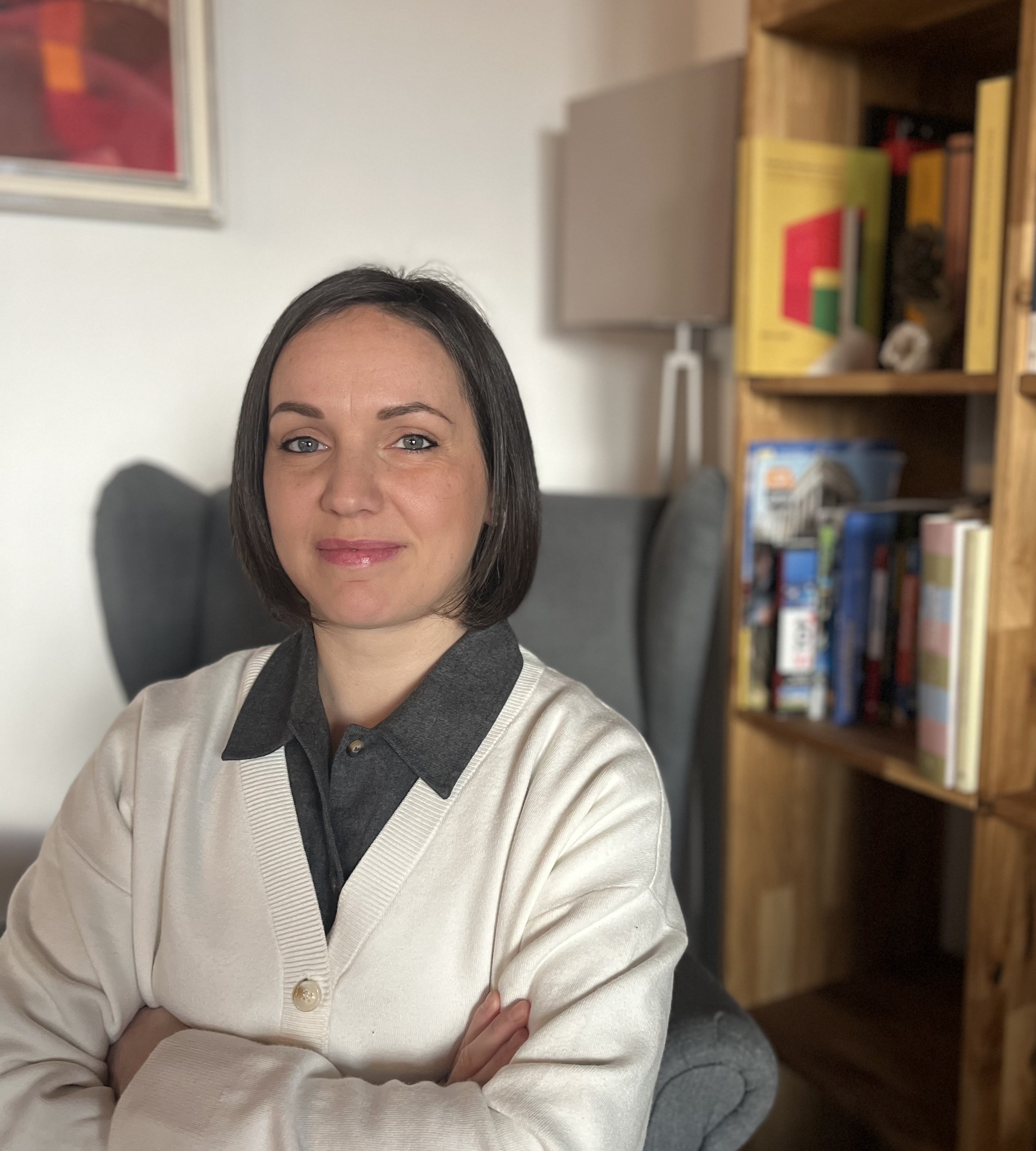
Lucie Broc is a Lecturer in the Department of Psychology at the University of Poitiers, affiliated with CeRCA (Center for Research on Cognition and Learning) and MSHS (Maison des Sciences de l'Homme et de la Société). Her research focuses on the typical and atypical development of oral and written language in children and adolescents, particularly those with Developmental Language Disorder (DLD) and High Functioning Autism (HFA). University of Poitiers CeRCA/MSHS Research Center Her work investigates the impact of transcription modes (typing vs. handwriting) on spelling performance, orthographic error patterns in neurodevelopmental disorders, and the role of narrative writing in mobilizing syntactic knowledge. She collaborates with Prof. Julie Dockrell (UCL), Prof. Marie Anne Schelstraete (UCLouvain), and CNRS Research Director Thierry Olive. Recent publications analyze keyboard typing interventions, working memory assessments, and cross-linguistic spelling differences. Her research employs both experimental studies and meta-analyses across European languages, with a focus on special education applications. Contact: lucie.broc@univ-poitiers.fr
Barend Beekhuizen serves as Assistant Professor in the Department of Language Studies at the University of Toronto Mississauga (UTM), holding dual graduate appointments in Linguistics and Computer Science. His interdisciplinary work bridges computational modeling with linguistic theory to investigate word meaning representation across languages and discourse contexts. His academic credentials include: PhD in Linguistics (cum laude), Leiden University MA in Linguistics (Research), Leiden University BA in Dutch Language and Literature, Leiden University Beekhuizen's research centers on computational models of lexical semantics, examining how languages categorize reality through words and how these categories function in communication. He employs methodologies spanning cross-linguistic corpus analysis, spontaneous conversational data, and social media corpora to address questions in semantic typology, discourse pragmatics, and interactional linguistics. His publication trajectory reveals an evolution from foundational studies on color term acquisition and lexical ambiguity toward contemporary investigations of gender bias in language models and syntactic structures in discourse. This progression demonstrates consistent application of computational approaches to increasingly socially relevant linguistic phenomena while maintaining rigorous theoretical grounding. Key recognition includes: Connaught New Researcher Award (2019-2021) for "Word Meaning in Action" Research funding highlights: NSERC Discovery Grant (2019-2025) as Principal Investigator for "Computational models of word meaning in use" DSI Catalyst Grant (2022-2023) as Co-investigator for "A computational sociolinguistic approach for studying gender inequities in social media interactions" He teaches advanced courses including LIN341 (Linguistics and Computation), LIN353 (Discourse Analysis), and JFL1207 (Advanced Computational Methods for Linguists) for the 2025-26 academic year, training students in computational linguistic methodologies.
Melissa L.-H. Võ is a Professor at the Faculty of Psychology and Sport Sciences , Goethe University Frankfurt. Her research focuses on scene perception , visual search , and cognitive neuroscience , particularly how scene grammar and spatial priors guide attention and locomotion in naturalistic environments. Her recent work, including the 2021 Psychological Science study on auxiliary anchor-object information, demonstrates the critical role of environmental regularities in behavioral efficiency. She has secured significant funding from the German Research Foundation and the Hessian Ministry of Science and Art , and her 2022 Nature Reviews Psychology paper on remote VR highlights methodological innovations. Key Research Areas: Scene grammar and contextual prediction Attentional guidance in immersive environments Interplay of semantic and syntactic scene processing Major Awards: German Research Foundation (DFG) Grant No. SFB/TRR 135 Hessian Ministry project 'The Adaptive Mind' She supervises researchers like Jason Helbing and Dejan Draschkow , and her work bridges cognitive psychology , neuroscience , and virtual reality applications.
Chiara Branchini is an Associate Professor at the Department of Comparative Linguistic and Cultural Studies at Ca' Foscari University of Venice. She is actively involved in teaching Italian Sign Language (LIS) and its linguistics to undergraduate and graduate students, and serves as coordinator of the 1st level Master's degree and Advanced Training Course in 'Theory and Techniques of Translation and Interpretation Italian-LIS'. Her research focuses on the syntax of Italian Sign Language , including linear order, interrogative and imperative sentences, complex sentences, sociolinguistic analysis, and bimodal bilingual production . Education: PhD in European Intercultural Studies (2007) from the University of Urbino with thesis 'On relativization and clefting in Italian Sign Language (LIS)'; Master's in Foreign Languages and Literatures (2001) from the University of Urbino with thesis 'The Body at the Service of Language. Analysis of Non-Manual Components in American Sign Language (ASL)' Research: Currently collaborating on the drafting of a grammar blueprint for Italian Sign Language within European research project COST ACTION IS 1006; previously participated in national research project PRIN 2007 'Dimensions of variation in Italian Sign Language' by collecting and analyzing the CORPUS LIS Projects: Scientific director of FSE 2012 research grant 'Development of a video-glossary of specialist terms in Italian Sign Language (LIS)'; collaborator on European project 'Spread the sign: dissemination in Europe of vocational sign language' Publications: Authored numerous articles on LIS syntax, grammar, and bilingualism in outlets like Bilingualism , Sign Language & Linguistics , and Glossa , as well as book chapters in A Grammar of Italian Sign Language (LIS) and SignGram Blueprint Editorial Roles: Member of the editorial board for LiLiS (Languages, Language and Deafness) Edizioni Ca' Foscari Reviewing: Regular abstract reviewer for international conferences
Francesca Volpato is an Associate Professor in the Department of Comparative Linguistic and Cultural Studies at Ca' Foscari University of Venice. She specializes in linguistics with a focus on language disorders, particularly in the areas of deafness, language learning disorders, and clinical linguistics. Her work bridges theoretical linguistics with clinical applications, examining how syntactic structures are acquired and processed by various populations. Dr. Volpato's research primarily focuses on the acquisition and processing of complex syntactic structures, particularly relative clauses and clitic pronouns, in both typical and atypical language development. Her work examines these phenomena in diverse populations including children with developmental dyslexia, hearing-impaired individuals with cochlear implants, and bilingual speakers. She employs experimental methodologies such as production tasks, comprehension tests, and sentence repetition to investigate syntactic competence across different language varieties and populations. Her research demonstrates how theoretical linguistic frameworks can inform clinical practice and educational interventions for individuals with language disorders. Dr. Volpato teaches courses on linguistics for deafness, language and learning disorders, and clinical linguistics at both undergraduate and graduate levels across multiple degree programs. Her consistent teaching in these specialized areas reflects her expertise and commitment to training future linguists and speech-language pathologists. As a member of the Joint Teacher-Student Commission for the SLCC Department, she also contributes to academic governance and student affairs within her department.
Zeynep Bilki serves as Associate Professor and Department Head within the Department of Foreign Language Education, Department of English Language Education at TED University in Ankara, Turkey. With uninterrupted teaching engagement documented from 2016 through the 2025 Spring Semester, she instructs core courses in English Language Teaching methodologies, Second Language Acquisition, Technology-Enhanced Language Learning, and teacher practicum experiences across undergraduate and graduate programs. Her research program demonstrates concentrated expertise in virtual exchange implementation for language teacher development, AI applications in L2 writing assessment (including pioneering analysis of ChatGPT-4 capabilities), automated writing evaluation systems, and critical digital literacy frameworks. This scholarly trajectory reveals consistent international collaboration, exemplified by the Turkish-Polish virtual exchange project examining teacher wellbeing, and increasingly sophisticated integration of emerging technologies into language pedagogy. Analysis of her 15 most recent publications (2021-2025) identifies three dominant research thrusts: (1) technology-mediated writing instruction with emphasis on automated feedback mechanisms and AI assessment tools, (2) virtual exchange programs designed to develop pre-service teachers' intercultural and digital competencies, and (3) critical pedagogy applications in language teacher education. Her work consistently bridges theoretical frameworks with practical classroom applications, particularly in teacher training contexts. Through ongoing supervision of Master's and PhD candidates—evidenced by continuous instruction in thesis courses including Master’s Thesis I/II and PhD Qualifying Exam since 2016—Dr. Bilki maintains active mentorship of graduate researchers. Her institutional leadership as Department Head further underscores her significant role in shaping English language education programs at TED University, though specific grant funding details remain unreported in available materials.
Charles Yang is a Professor at the University of Pennsylvania's Department of Linguistics, with joint appointments in Computer and Information Science and Psychology. As Chair of Linguistics and Director of the Program in Cognitive Science since 2011, he co-directs the Integrated Language Science and Technology group with John Trueswell. PhD in Computer Science, MIT AI Lab Faculty at Yale (2000-2008) Current roles: Chair of Linguistics, Director of Cognitive Science Program His research bridges linguistics, cognitive science, and computational modeling, focusing on human and machine language acquisition, phonological and morphological learning, and computational modeling of historical language change. He develops the Tolerance Principle for quantifying language acquisition thresholds and investigates neural language models as cognitive theories. Recent publications analyze language acquisition through computational models (2021-2024), with the 2025 work evaluating LLMs for low-resource languages. His 2016 book The Price of Linguistic Productivity won the Leonard Bloomfield Award and explores productivity in language systems. Guggenheim Fellowship (2018) Bloomfield Book Award (2018) NSF GRFP Fellowship Leonard Bloomfield Book Award (2016) Yang advises students in language acquisition, computational linguistics, and cognitive modeling. His lab collaborates with researchers like Bob Berwick, Johan Bolhuis, and Noam Chomsky on integrated approaches to language science.
Dr. Rianne van Lieburg is an Assistant Professor of Dutch Linguistics at Utrecht University, Faculty of Humanities, within the Department of Languages, Literature and Communication. She is affiliated with the Institute for Language Sciences and specializes in language acquisition, processing and disorders. Her work focuses on multilingualism and second language acquisition, particularly examining how knowledge of one language affects the processing of another language and how adults acquire the sounds and grammar of a second language. Her research expertise spans several key areas: Multilingualism and cross-linguistic influence Dutch as a Second Language acquisition Psycholinguistic methods in language research Second Language Acquisition processes Language processing in bilingual speakers Dr. van Lieburg's publication record shows a strong focus on structural priming, syntactic representations, and language processing in bilingual contexts. Her recent work examines lexical boost effects, production preferences in heritage speakers, abstract syntactic representations in beginning L2 learners, and the relationship between production and comprehension in language processing. Her research employs psycholinguistic methods such as structural priming and cue-distractor tasks to investigate these phenomena. She is actively involved in teaching across multiple programs: Bachelor's program in Dutch Language and Literature Master's programs in Multilingualism & Language Acquisition and Intercultural Communication Dr. van Lieburg coordinates the NVT-internship (Dutch as a Foreign Language), which allows students to complete internships at Dutch departments at universities abroad as part of their Erasmus exchange program. Her teaching portfolio includes courses such as: The Dutch Language in Cognition and Society The Dutch Language: System and Variation Didactics of Dutch as a Second Language Multilingual Education in the Netherlands Language Diagnostics
Serena Talento is an Assistant Professor at the Chair of Literatures in African Languages at the University of Bayreuth . She also holds a Research Associate position at the Department of Linguistics and Language Practice at the University of the Free State and is affiliated with the Tsikinya-Chaka Centre at the University of the Witwatersrand . Her editorial work includes co-editing the Swahili Forum journal. Education Doctorate : African Studies, University of Bayreuth (2018) M.A. : Languages and Cultures of Africa, University of Naples “L’Orientale” (2011) B.A. : Languages and Cultures of Africa, University of Naples “L’Orientale” (2008) Research Interests center on literary translation into and from Swahili, with a focus on sociology of translation , translation history , Shakespearean adaptations in East Africa , and the intersection of translation with nationalism and manuscript cultures . Her work employs historical and sociological frameworks to analyze the social relevance of translated texts. Publications Trends reveal a consistent focus on Swahili literary exchanges , postcolonial translation , and sociological dimensions of cross-cultural communication . She explores comparative literature , manuscript traditions , and historical reception studies , often linking these to broader African literary theory and translation policy . Affiliated Projects include the Recalibrating Afrikanistik initiative and collaborations with institutions such as the University of Leipzig and University of the Witwatersrand .
Professor Katrien Beuls is a leading researcher at the Namur Digital Institute within the Faculty of Computer Science at the University of Namur. With over 69 research outputs and an h-index of 30, her work bridges artificial intelligence, computational linguistics, and cognitive science. She actively contributes to the United Nations Sustainable Development Goals through her research in human-inspired AI systems. Her research focuses on developing human-like language processing systems through computational construction grammar, neuro-symbolic approaches, and grounded language learning. Professor Beuls investigates how machines can learn language through situated interactions similar to human language acquisition, with particular emphasis on explainable AI systems that combine neural and symbolic approaches for better interpretability. Her work spans theoretical linguistics, cognitive modeling, and practical AI applications. Analysis of her recent publications reveals a strong trend toward integrating symbolic and neural approaches in language processing, with increasing focus on explainability, grounded language understanding, and construction grammar formalisms. Her research demonstrates consistent progression from theoretical computational linguistics toward practical applications in visual dialogue systems, recipe understanding, and language acquisition modeling. Professor Beuls leads significant research projects including CxG-LEARN (Syntactic-Semantic Operators for Machine Learning of Usage-Based Construction Grammars, 2024-2027), ARIAC by DigitalWallonia4.AI (Applications and Research for Trusted Artificial Intelligence, 2021-2027), and Meaning and Understanding in Human-Centric AI (2020-2024). These projects demonstrate her leadership in advancing construction grammar implementations and neuro-symbolic AI approaches. She has been actively involved in academic dissemination with 12 recorded activities including invited talks, conference organization (10th European Starting AI Researchers' Symposium), and workshop participation. Her media presence includes 11 contributions where she discusses topics like human-inspired language models, kindergarten-inspired AI, and the future of intelligent systems.
Dr. Emma Gregory is a Senior Lecturer at the School of Allied Health Professions, Nursing and Midwifery , University of Sheffield. She serves as the Professional Lead for Speech and Language Therapy and works with adults with aphasia in the Aphasia Centre . Qualifications: BA, MMedSci, PhD Clinical Experience: NHS clinician (2004-2007) focusing on neurological communication and swallowing disorders Her research emphasizes: Interventions for word-finding difficulties in aphasia Accessible information design for individuals with aphasia Scholarship of teaching and learning Technology-enhanced learning in clinical education Recent publications highlight collaborative approaches to aphasia therapy, accessible communication design, and pedagogical strategies for student support. She is a member of the Royal College of Speech and Language Therapists and holds a Senior Fellowship at the Higher Education Academy.
Mrs Dee Webster is a Lecturer at the University of Sheffield , affiliated with the School of Allied Health Professions, Nursing and Midwifery and the Department of Human Communication Sciences . With a clinical background as a Highly Specialist Speech and Language Therapist in Nottinghamshire, she specializes in stroke-related communication and dysphagia management. Education: BA, MMedSci, CertMRCSLT, RegHCPC Current roles: University Teacher, clinical team leader Key teaching areas: Aphasia, Motor Speech Disorders, Dysphagia, Dementia, Clinical Methods Dee's research focuses on acquired aphasia , technological approaches to aphasia therapy , and evidence-based practice . She advocates for co-creation of services with aphasia patients and integrates research into clinical workflows. Her publications demonstrate expertise in neurological communication disorders and therapeutic interventions , particularly using syntactic cueing methods. Two key articles (2012 and 2019) highlight her work in aphasia rehabilitation and speech recovery. Scientific Awards : Fellow of the Higher Education Academy (FHEA) Professional Memberships: Trent Dysphagia CEN, North-West Aphasia CEN Dee combines academic teaching with clinical practice, emphasizing research translation into healthcare settings. She served on the British Aphasiology Society committee for six years and contributes to postgraduate clinical education programs.
Dr. Debra Aarons is a Senior Lecturer in Linguistics within the School of Humanities & Languages at the University of New South Wales (UNSW), specializing in the linguistic analysis of humor and signed language linguistics. With a distinguished academic career spanning decades, she has established herself as a leading researcher at the intersection of language structure, cultural expression, and comedic performance. Her educational background includes: BA (Majors English and Philosophy) from Witwatersrand University (1976) BA Honours (English Literature) from Witwatersrand University (1977) Higher Dip. Ed PG from Witwatersrand University (1979) BA Honours (Applied Linguistics) from Witwatersrand University (1986) PhD (Applied Linguistics) from Boston University (1994) Dr. Aarons' research centers on the linguistic structures of humor , examining both formal grammatical properties and pragmatic dimensions of jokes and comedic performance. She investigates how linguistic play reveals tacit knowledge of language systems and how cultural contexts shape humorous expression. Her work spans multiple domains including standup comedy analysis, Jewish comedy traditions, and language play in both spoken and signed modalities. Earlier in her career, she made significant contributions to South African Sign Language linguistics , examining syntactic structures, sociolinguistic variation, and educational inclusion for deaf communities. Analysis of her publication record reveals a clear evolution from foundational work in sign language linguistics to her current specialization in humor studies, while maintaining connections between these fields through her interest in language structure. Recent publications demonstrate particular focus on socially critical standup comedy, with detailed analyses of performers like Sarah Silverman and examinations of Jewish comedy traditions across historical contexts. Her work consistently bridges theoretical linguistics with cultural analysis, revealing how language structures underpin comedic expression across diverse media and social settings. Her scholarly recognition includes: British Council Scholarship (Lancaster UK, 1986) Fulbright Scholarship (Boston University, 1987) University of Bologna, Senior Visiting Fellowship (2017) Dr. Aarons maintains an active research program with ongoing collaborative projects, particularly with Marc Mierowsky. She is currently co-authoring a monograph titled 'Playing with Food and Language: Eating, Joking and Disgust' with Delia Chiaro for Taylor and Francis. Her research methodology combines rigorous linguistic analysis with cultural context, examining how language structures facilitate humor across different communicative settings. Though specific laboratory structures aren't detailed, her collaborative publication pattern suggests active research partnerships across disciplines. Her work bridges linguistics with cultural studies, performance studies, and cognitive science, creating a multidisciplinary approach to understanding the complex relationship between language structure and humorous expression.
Joseph Collentine serves as Professor in the Department of Global Languages and Cultures at Northern Arizona University, where his research centers on second language acquisition with specialized focus on Spanish linguistics. His scholarly contributions span corpus-based methodologies, pragmatic competence development, and comparative analysis of language learning contexts including study-abroad versus traditional classroom environments. Collentine's research portfolio demonstrates deep engagement with structural and functional aspects of Spanish as a second language, particularly examining subjunctive mood acquisition, syntactic complexity, and discourse functions. His work integrates corpus linguistics with pedagogical applications, investigating how technological tools like virtual environments and corpus resources enhance language instruction. Recent publications highlight evolving trends toward technology-mediated language learning and teacher training in corpus utilization. His publication record shows consistent scholarly output from 2004 through 2024, with significant contributions to major reference works including The Handbook of Spanish Second Language Acquisition and The Routledge Encyclopedia of Second Language Acquisition. While no scientific awards are documented in the source material, his h-index of 4 and 502 Scopus citations reflect substantial academic impact within applied linguistics. No information regarding student advising, research grants, or laboratory affiliations appears in the provided texts.
Markéta Lopatková , Associate Professor at the Institute of Formal and Applied Linguistics (Faculty of Mathematics and Physics, Charles University), is a leading Czech computational linguist specializing in dependency syntax, valency theory, and formal language modeling. Her work focuses on the Prague Dependency Treebank and VALLEX valency lexicon, incorporating tectogrammatical representations and dependency analysis by reduction. She has coordinated major EU projects like LCT and CLARA, and served on editorial/review boards for journals and conferences. Ph.D. in Computational Linguistics (2001), Charles University M.Sc. in Mathematics (1992), Charles University Research spans Czech sentence ambiguity, non-projectivity, light verb constructions, and reflexive/reciprocal modeling using restarting automata. Her 15 most recent articles address topics like Uniform Meaning Representation conversion, cross-lingual dependency analysis, and reflexive construction detection in Czech. As principal investigator for projects such as VALLEX (2018-2020) and Delving Deeper (2012-2015), she advanced valency lexicon methodologies and linguistic theory feedback loops for NLP systems. Awards include Charles University's Silver Medal (2021), Monographs of Distinction (2016), and Slovník roku 3rd Place (2009). She has supervised 5 PhD students and 6 Master’s students, contributing to European Masters programs (LCT) and international conference committees (ACL, COLING, EURALEX). Scientific Leadership : Deputy Head of Institute (2021), Former Head (2012-2020) Teaching : Courses in Dependency Grammars, Mathematical Methods in Linguistics, and Mathematical Analysis (Czech)